"Do we need a GRC platform or an identity risk tool?" is the wrong question, asked constantly, because it assumes the two are bidding for the same job. They aren't. One is built to be the enterprise's system of record for risk across the whole business. The other is built to discover and act on identity and SaaS access risk continuously, at a pace no register was ever designed to match. Here's where each one genuinely wins, without the usual vendor instinct to pretend one side has no real strengths.
Every comparison between a GRC platform and an identity-focused tool like Zluri eventually collapses into a feature checklist, dashboards, integrations, pricing tiers, as if the two are competing for the same budget line and the same job. They're not. A GRC platform and Zluri solve different problems well, and pretending either one dominates across the board does a disservice to whoever's actually trying to decide where to invest.
This is an honest accounting of both, not a case for one replacing the other.
Where GRC Wins
Breadth across the entire risk landscape. A GRC platform's register isn't limited to IT or identity. It covers financial risk, operational risk, strategic risk, vendor risk, legal risk, all in one place, with a shared taxonomy and a shared reporting structure. No identity-focused tool, Zluri included, is trying to be that system, and nothing about identity risk discovery gives you enterprise risk breadth for free.
Formal audit workflow, built for exactly that purpose. Control testing, evidence collection tied to specific frameworks, mapped requirements across SOC 2, ISO 27001, SOX, and dozens of others, this is a GRC platform's core competency, refined over years of serving exactly this need. An identity tool can generate evidence relevant to access controls specifically. It isn't built to run the audit workflow itself.
Board and examiner-level reporting. GRC platforms are built to translate risk data into the language a board, a regulator, or an external examiner actually reads: risk appetite, control maturity, remediation timelines against commitments. This is a genuinely different skill than surfacing a risk finding, and it's one GRC platforms have had a long time to get right.
A single source of truth across every risk category an organization tracks. When legal, finance, security, and operations all need to see risk in one place, with consistent scoring and consistent ownership assignment, a GRC platform's centralization is the actual point, not a side benefit.
Where Zluri Wins
Discovering risk nobody logged yet. A GRC register is only as complete as what a person entered into it. Zluri's discovery layer finds the application nobody approved, the contractor's access that should have expired, the AI agent with more OAuth scope than its task requires, before anyone has to notice and type it in. This is the gap most GRC platforms openly acknowledge sits outside their core design.
Matching the actual speed identity risk moves at. Identity and SaaS access risk changes by the day, sometimes by the hour. A quarterly or even monthly review cycle, which is standard for most GRC-driven processes, leaves a wide window where risk accumulates unnoticed. Zluri's scoring updates continuously, closing that window rather than managing it on a schedule built for slower-moving risk categories.
Turning a finding into a fix, not just a task. GRC's standard remediation model logs a finding and assigns it to a person. Zluri's policy engine, SoD enforcement, and review remediation playbooks can act directly, revoking access or downgrading a permission the moment a violation fires. For identity risk specifically, the time between "logged" and "fixed" is where the actual exposure lives, and Zluri closes that gap automatically rather than depending on someone working through a ticket queue.
Treating non-human identities as a real category, not an edge case. Service accounts, API keys, and AI agents don't map cleanly onto a risk model built around human actors and business processes. Zluri discovers, scores, and reviews them the same way it does human identities. Most GRC platforms have no native concept for this population at all.
Generating the underlying access evidence itself, not just tracking that a control exists. Run logs, review reports, policy traceability chains, SoD violation records, this is the raw evidence an audit ultimately needs, produced as a byproduct of Zluri's actual operations rather than a separate evidence-gathering exercise someone has to run before the audit starts.
The Comparison, Side by Side
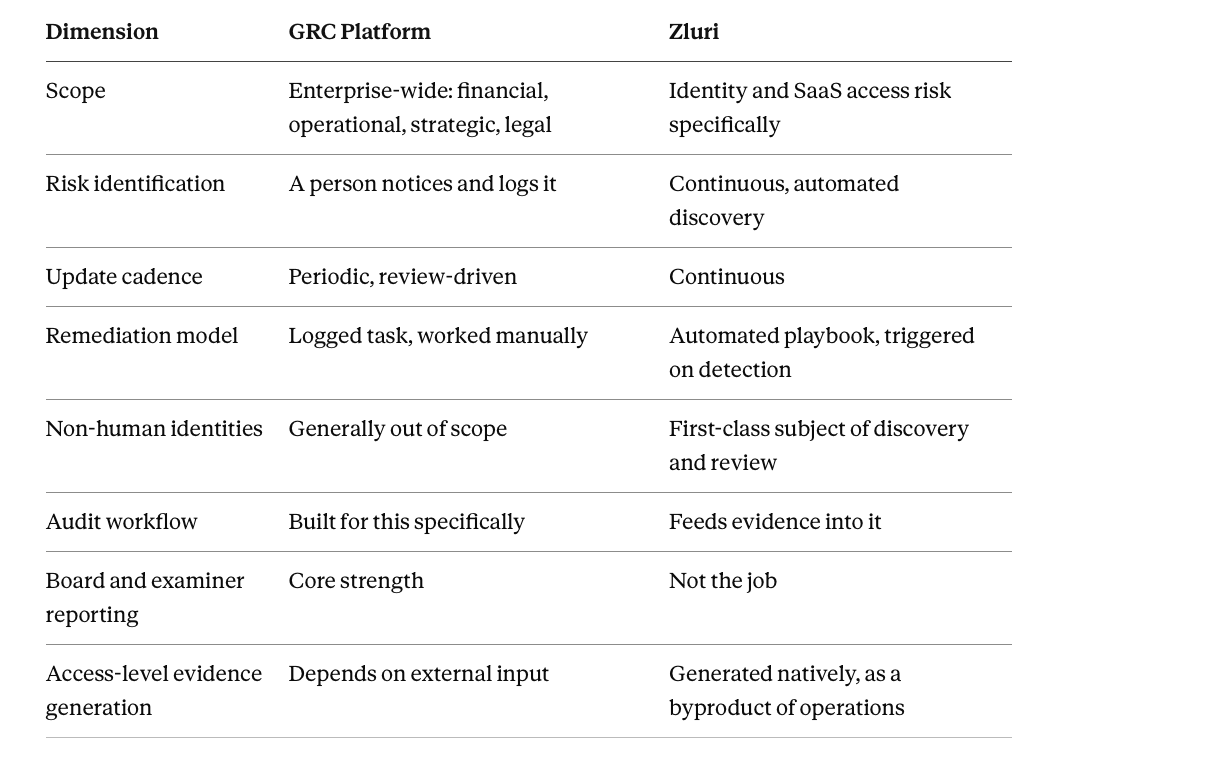
Read the table honestly and the pattern is clear: neither column is longer because one tool is better. They're different lengths because the two are answering different questions, and each one's list of strengths is exactly what you'd expect from a tool built for that specific question.
Where the Overlap Looks Like Competition and Isn't
The confusion mostly comes from one place: both tools eventually touch "risk" and "compliance," so it's easy to assume they're solving the same problem at different levels of polish. They're not. A GRC platform asks "what risks exist across our entire business, and can we prove we're managing them." Zluri asks "what can every identity, human or not, actually do right now across our SaaS and AI stack, and is that still appropriate." The second question is a genuine input to the first one. It isn't a smaller version of it.
This is also why "just use the GRC platform's access module" rarely holds up in practice. Most GRC platforms bolt on some access-related tracking, but it inherits the same identification model as the rest of the register: a person has to notice and enter it. That's a real capability gap, not a matter of GRC vendors under-investing in a feature.
Choosing Where to Invest First
If the organization can't currently produce a defensible answer to "what risks exist across our whole business, and are we managing them on schedule," that's a GRC gap, and it needs GRC-shaped infrastructure to close: a register, a formal audit workflow, board-level reporting.
If the organization can answer that question reasonably well but keeps failing audits specifically on access review evidence, or keeps discovering shadow IT and orphaned access after the fact rather than before, that's an identity risk gap, and no amount of GRC maturity closes it on its own, because the gap isn't in the register's structure. It's in what reaches the register in the first place.
Most organizations past a certain size eventually need both, run together rather than in competition: the GRC platform as the enterprise system of record, Zluri as the continuous discovery and remediation layer feeding the identity and access portion of that record with evidence a person was never going to type in fast enough to matter.
Two Tools, Two Real Jobs
The instinct to rank GRC against Zluri, or any identity risk tool, comes from treating "risk management" as one job with one best tool. It's several jobs wearing one name. GRC wins at breadth, formal audit process, and reporting to people who need risk translated into language a board or examiner reads. Zluri wins at finding risk before anyone has to notice it, keeping pace with how fast identity and SaaS access actually change, and turning a finding into a fix without a ticket queue in between. Neither list makes the other tool weaker. It makes the case for running both, each doing the job it was actually built for.
Frequently Asked Questions
Should a growing organization start with a GRC platform or with Zluri?
It depends on which gap is costing more risk right now. An organization with no formal risk register or audit workflow at all usually needs GRC infrastructure first, since board and examiner reporting and cross-functional risk tracking are foundational requirements most compliance frameworks assume exist. An organization that already has a GRC platform but keeps failing audits on access evidence, or keeps discovering shadow IT after the fact, has an identity risk gap that GRC maturity alone won't close.
Can a GRC platform's access management module do what Zluri does?
Generally not to the same depth, because most GRC access modules inherit the same identification model as the rest of the register, a person has to notice and enter the finding. Zluri's discovery and scoring run continuously and automatically, which is a different capability than a module that tracks access-related tasks once someone has already logged them.
Does using Zluri mean an organization doesn't need a GRC platform?
Only if identity and SaaS access risk is the organization's entire risk surface, which is rare. Most organizations track financial, operational, legal, and strategic risk well beyond IT, and that's squarely GRC's job. Zluri is built to be excellent at one specific, fast-moving category within that broader picture, not to replace the system that tracks everything else.
What's the clearest sign an organization has an identity risk gap rather than a GRC gap?
Recurring audit findings specifically about access review evidence, discovering applications or accounts that were never in any inventory, or a pattern of contractor and service account access lingering well past when it should have been revoked. These are symptoms of a discovery and remediation-speed problem, not a symptom of an incomplete or poorly organized risk register.
Is it wasteful to run both a GRC platform and Zluri at the same time?
No, because they're not duplicating the same function. A GRC platform run without an identity-specific discovery layer is working from whatever a person manually feeds it on the identity side, which is the exact gap that produces the audit findings and after-the-fact discoveries this comparison describes. Running both means the GRC platform's register actually reflects current identity and access risk instead of a periodic, human-limited approximation of it.
.webp)


.svg)