Data access governance solutions solve a real problem, but it's the narrowest and last of three tiers, not the first. The biggest risk reduction still comes from removing unnecessary access to the application itself. The second biggest comes from governing the access that legitimately remains. Data access governance is what's left over once both of those are actually handled.
Application-level access governance answers a specific, important question well: does this identity have an account in this application, and should they. That question, answered correctly across an entire SaaS estate, is genuinely difficult work and a real security improvement over not knowing at all. It's also, on its own, a much narrower answer than it sounds like, because it says nothing about the layer underneath it: once someone's inside an application you've already discovered, reviewed, and approved, what specific data can they actually reach.
Worth being explicit about what this piece is and isn't arguing: none of this is a case against data access governance solutions being genuinely useful, including for SaaS environments. It's a case about sequencing, about which risk-reduction move actually pays off first, and about not skipping the coarser, cheaper cuts on the way to the more sophisticated one.
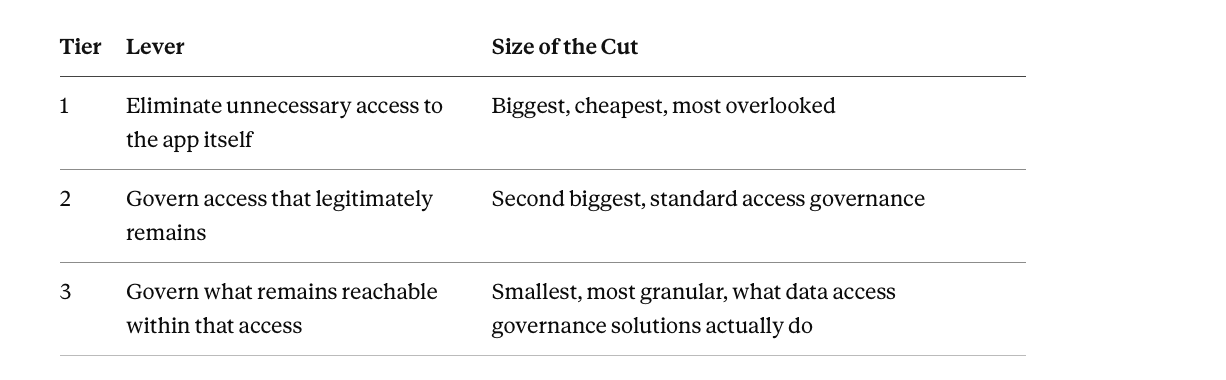
At a glance, before the detail:
The Biggest Risk Reduction Happens Before Data Access Governance Even Applies
It's worth being direct about sequencing before going any further, because getting this wrong is how organizations end up buying the narrowest tool first. Risk reduction in this space happens in three tiers, and they aren't equally sized. Each one only matters once the tier before it has actually been addressed.
Tier one: eliminate unnecessary access to the application itself. This is the biggest, coarsest cut available, and it's also the one most often skipped in favor of something more sophisticated-sounding.
An account that shouldn't exist at all, an orphaned login, a former contractor's credential, a duplicate identity from a merge that was never cleaned up, carries zero legitimate need for any data inside that application, no matter how tightly the data-level permissions are configured. Removing that account removes 100% of the risk it represented, instantly, with no need for content classification or permission mapping of any kind.
Tier two: govern the access that legitimately remains. Once unnecessary accounts are gone, the accounts that stay need to be scoped correctly, role-appropriate access, reviewed on a real cadence, revoked when a role changes.
This is standard application access governance, and it closes a meaningful share of remaining risk on its own, since a right-sized account with role-appropriate permissions already limits exposure considerably before any data-layer question even gets asked.
Tier three: govern what remains reachable within legitimately-scoped access. Only after the first two tiers are handled does the narrower question this piece has been describing actually become the highest-leverage lever left: given that this account should exist and should have some access to this application, does the specific data it can reach match what the role actually requires.
This is real, and it catches genuine risk the first two tiers can't, but it's also the smallest of the three cuts, addressing exposure that survives after the coarser reductions have already happened.
Buying a data access governance solution before tier one and tier two are under control means paying for the most granular, most expensive layer of visibility while the biggest, cheapest risk reductions are still sitting there unaddressed. The sequencing matters as much as the capability itself.
Two Different Questions That Get Treated as One
"Does this person have access to Salesforce" and "which Salesforce records can this person actually see" are not the same question, even though most access governance conversations treat them as if answering the first one settles the second.
The first is an account-level question: identity, application, yes or no. The second is a data-level question: object permissions, field-level security, record-sharing rules, row-level filters, and every other mechanism inside the application itself that determines what a logged-in, fully authorized user can actually pull up on screen.
An organization can answer the first question with complete confidence, a clean access review, every Salesforce user accounted for, every account justified, and still have almost no idea whether a sales rep in one region can query customer records belonging to every other region, or whether a support agent's role grants visibility into fields containing data their job never requires.
The account-level governance was done correctly. The data-level exposure was never actually examined, because the two questions live at different layers, and most governance programs stop at the first one.
What Data Access Governance Solutions Actually Do
Scoped narrowly and accurately, a data access governance solution does three specific things, none of which an application access governance platform is built to do:
- Discovers and classifies sensitive content inside a given data store, file shares, drives, databases, so the organization knows what's actually sensitive rather than assuming
- Maps permissions at the object, field, or file level rather than the account level, showing exactly what a given identity can see once they're logged in
- Monitors for exposure drift, permissions that quietly broadened over time through inherited sharing, role changes, or misconfiguration, independent of whether the underlying account access was ever reviewed
That's a narrower, more specific capability set than "governs who can access our data" makes it sound like. It's not a broader or more thorough version of access review. It's a different technical layer, aimed specifically at the content and permissions sitting inside applications an organization has typically already brought under account-level control, and it's genuinely only the highest-leverage purchase once tiers one and two are no longer where the easy risk is sitting.
Does This Cover On-Premises Data, SaaS Data, or Both?
Both, though the category's roots are worth knowing since they explain why some vendors are stronger in one environment than the other. Data access governance originated as an on-premises discipline: file servers and network shares with permissions controlled through access control lists maintained in a directory service, Active Directory being the standard, long before most organizations ran meaningful workloads in the cloud.
Cloud and SaaS adoption expanded the same underlying problem into a genuinely broader environment. Collaboration platforms, Microsoft 365 and SharePoint, Google Drive, Box, Dropbox, all became additional places unstructured data lives and gets shared, frequently in ways link-sharing and permission inheritance make even harder to track than a traditional on-prem file share.
Most current data access governance solutions are built to cover both, connecting to on-prem file systems and directory services alongside cloud storage and SaaS collaboration platforms, but the balance varies genuinely by vendor. Some retain stronger on-prem, AD-native roots. Others were built cloud-first and treat on-prem connectivity as a secondary integration. Worth confirming directly against your actual environment, on-prem file servers, cloud drives, or a real mix of both, rather than assuming full coverage by default.
SaaS specifically introduces a gap this category generally doesn't address at all: data sitting inside shadow applications nobody's connected. On-prem data governance historically had a built-in advantage that's easy to overlook, IT provisioned the file servers, so the universe of data stores was at least centrally known even if permissions inside them weren't well governed.
SaaS breaks that assumption entirely. Purchasing is decentralized, anyone can sign up for a new tool with a work email and a credit card, which means a meaningful share of an organization's real data footprint lives inside applications that were never connected to any governance tool in the first place, data access governance included.
A data access governance solution can only classify and map permissions inside data stores it's actually connected to. It has no visibility into a shadow SaaS application nobody's told it about, which means the exposure sitting inside that application isn't a permission-mapping problem the category is built to solve. It's a discovery problem sitting one layer earlier, and it requires the application to be found before any data-level governance, on-prem or SaaS, can even begin to apply to it.
One More Category Worth Separating: Data Governance vs Data Access Governance
There's a fourth term that gets folded into this conversation and shouldn't be: data governance broadly, the Collibra, Informatica, and Alation category of tools built around cataloging, metadata management, lineage tracking, and data quality.
These platforms answer valuable questions of their own: what data exists, where it came from, whether it's accurate and consistent. They generally don't answer, in any depth, which specific identity can reach which specific piece of that data right now.
That's a real, separate gap, not a smaller version of what a data catalog already covers. A well-maintained catalog can tell you a customer database exists, what fields it contains, and how it's transformed downstream, while saying almost nothing about whether the wrong fifty people in the company can currently query it.
Data access governance, in the sense this piece has been using the term, is the narrower discipline that actually answers that second question, permission mapping at the identity-to-data level. It's worth not assuming a data catalog or metadata platform already covers it just because both terms contain the word "data."
Where This Shows Up in Practice
A CRM with clean account-level governance can still let every logged-in user query records well outside their actual territory, because the object and field-level permission model inside the application was never separately reviewed once account access was approved.
A cloud storage or file-sharing platform can show a perfectly governed list of who has an account, while inherited sharing links quietly grant far broader file-level visibility than anyone provisioning the account intended.
Both cases would report a clean result under account-level governance, because that process was only ever built to check the first question, not the narrower one a data access governance solution exists to answer.
Why These Are Genuinely Different Disciplines, Not One Extended
It's worth being precise about this rather than blurring it, because conflating the two is exactly how tier three gets purchased before tiers one and two are actually finished.
Application access governance, identity and access management, provisioning, deprovisioning, account-level review, operates on the relationship between an identity and an application as a whole. Data access governance, in the narrower, more accurate sense of the term, operates one layer deeper: the relationship between an identity and specific data, files, records, or fields inside that application, often unstructured or semi-structured data sitting in file shares, drives, and repositories that don't map cleanly onto a simple account permission at all.
These require different mechanisms to actually govern:
- Account-level governance depends on identity data, role definitions, and provisioning workflows
- Data-level governance depends on content discovery, classification of what's actually sensitive within a given data store, and permission mapping at the object or file level
That's a meaningfully different technical problem, closer to understanding what a repository contains than to understanding who's allowed to log into it.
Where Zluri Fits, and Where It Deliberately Doesn't
Zluri's strength sits specifically at tiers one and two: discovering every application, including the ones that never went through an official channel, eliminating access nobody's using or that no longer has a legitimate owner, and governing the identity-to-application relationship across the full inventory, provisioning, deprovisioning, access reviews, and risk scoring applied to who has an account and whether they should.
What Zluri doesn't do is tier three, the deeper layer inside a given application's own data: classifying sensitive content inside a file repository, mapping object or field-level permissions inside a CRM, or evaluating row-level access rules inside a data warehouse. That's genuinely specialized work, closer to data security posture management and dedicated data access governance tooling built specifically around content discovery and classification within a data store.
An organization pursuing all three tiers is better served treating tier three as a deliberate, later addition, once the coarser, higher-leverage reductions in tiers one and two are already producing results.
Frequently Asked Questions
If an application's access is fully governed, doesn't that mean the data inside it is protected too?
Not necessarily. Account-level governance confirms who has a legitimate account and whether that account is still justified. It doesn't examine what specific records, fields, or files that account can actually see once logged in, which is governed by a separate permission layer inside the application itself.
Why do organizations sometimes skip straight to a data access governance solution?
Because it sounds like the more sophisticated, complete answer, and it's genuinely a real capability gap once the coarser tiers are handled. The risk is buying it before eliminating unnecessary access and governing what remains, which means paying for the most granular layer of visibility while the biggest, cheapest risk reductions are still sitting there unaddressed.
Is data access governance the same as general data governance tools like Collibra or Informatica?
No, and the overlap in naming causes real confusion. Data catalog and metadata management platforms answer what data exists, where it came from, and whether it's accurate. Data access governance answers a different question specifically: which identity can currently reach which specific piece of that data. A strong data catalog doesn't automatically mean access to what it catalogs is actually governed.
Is data access governance the same discipline as application access governance, just applied more thoroughly?
No, they depend on different underlying mechanisms. Application access governance operates on identity and account data. Data access governance operates on content discovery and permission mapping inside a specific data store, which is a different technical problem requiring different tooling, not a deeper setting inside the same governance process.
Should an organization prioritize application-level or data-level access governance first?
Application-level comes first, and unnecessary access removal comes before that. The full sequence is: eliminate accounts that shouldn't exist at all, govern the access that legitimately remains, then address data-level exposure within that remaining access. Data access governance becomes the priority specifically once the first two, coarser tiers are already under control, not before.
Do data access governance solutions cover on-premises data, SaaS data, or both?
Most modern solutions cover both, but coverage depth varies by vendor. The category originated on-premises, governing file servers and network shares through Active Directory permissions, and expanded to cover cloud storage and SaaS collaboration platforms as data moved there. Vendors with on-prem roots and vendors built cloud-first don't always have equal depth in the other environment, so it's worth confirming against your actual mix of on-prem and cloud data rather than assuming full coverage.
Do data access governance solutions cover data sitting inside shadow SaaS apps?
Generally not, and this is a real, separate gap from the on-prem versus SaaS question. These solutions map permissions inside data stores they're actually connected to. A shadow SaaS application nobody's reported isn't in that connected set, which means any data inside it sits outside the tool's visibility entirely, regardless of how strong its permission-mapping capability is for the applications it does know about. That's a discovery gap, not a data-governance gap, and it needs to be closed separately before data-level governance can apply to that application at all.
.webp)


.svg)