

Reading 25 feature lists back to back doesn't produce a shortlist, it produces fatigue. What actually narrows the field is knowing which category you're shopping in and what each platform is genuinely best at, then comparing three or four real candidates in depth instead of skimming twenty-five.
SaaS management platforms have converged on a similar surface-level feature set, discovery, license tracking, renewal alerts, so the real differentiation lives one layer down: what each platform was actually built to be best at, and who it was built for.
This guide is organized to get you to a real shortlist fast: five categories, a best-for line on every entry, and enough specific detail to know which three or four deserve an actual demo.
Key Features to Evaluate Before Comparing Platforms
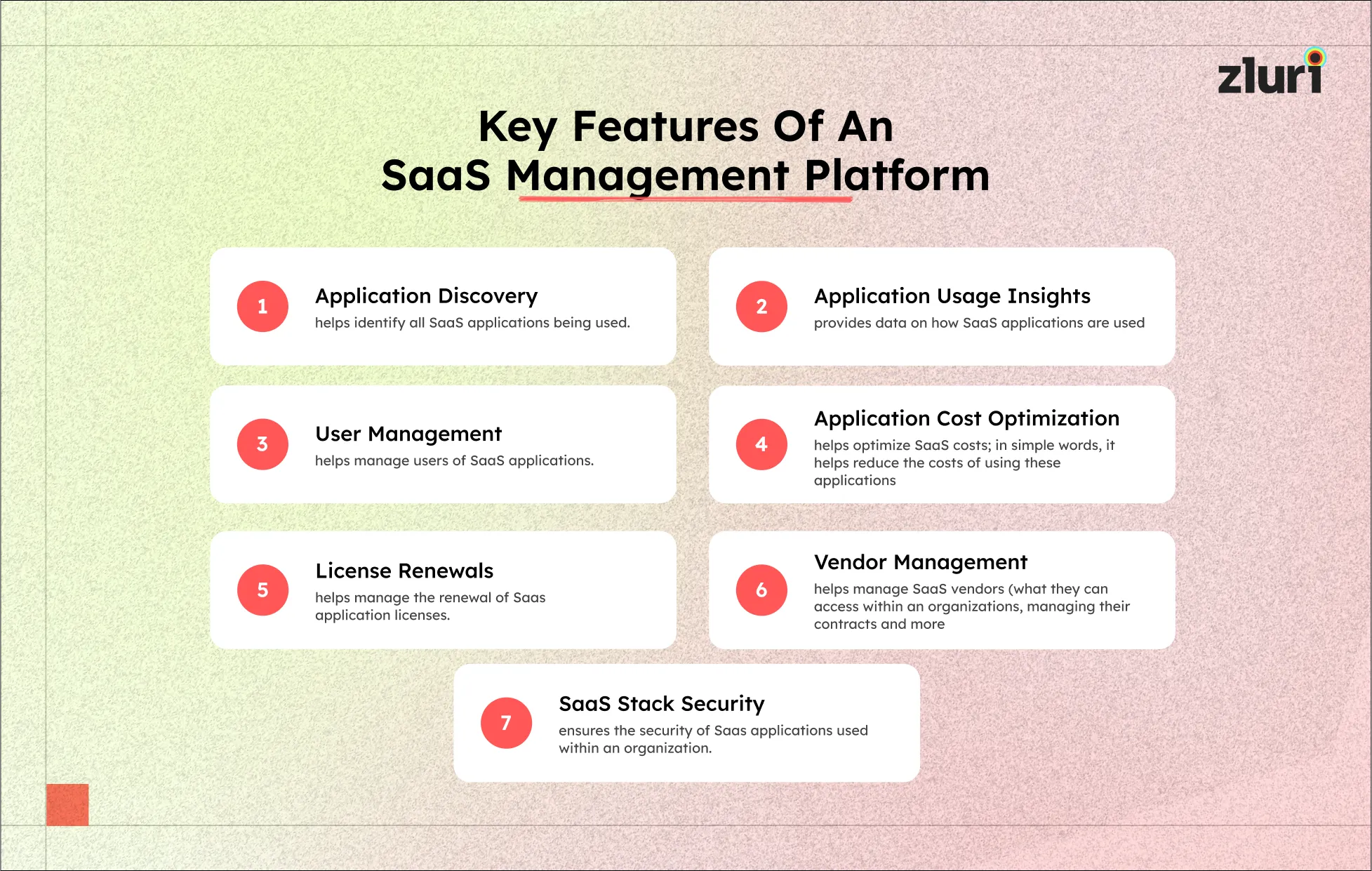
Before sorting by category, know what separates a genuinely capable platform from a thin one:
- discovery breadth (multiple methods, not just SSO, since SSO-only discovery misses everything outside its own integrations),
- usage and cost visibility that updates continuously rather than on a scheduled report,
- license optimization that recommends specific action, not just flags a number,
- renewal management with real lead time and routed alerts, and
- access governance tied to actual identity data rather than a static, unmaintained app list.
How to Actually Use This List to Shortlist
Pick your category first based on your primary pain point, spend, security, adoption, identity governance, then compare only within it. A platform excelling in one category rarely competes meaningfully with the top options in another, so cross-category comparison usually wastes evaluation time rather than sharpening the decision.
Also Read: To choose a suitable solution, consider reading How to choose an SMP solution
Category 1: Identity-Integrated Full Suite
Platforms that treat SaaS management and identity governance as one connected problem rather than two separate tools bolted together.
1. Zluri
Zluri combines full SaaS visibility with identity governance built in, discovering apps, licenses, and the identities (human and non-human) that access them, then acting on what it finds through automated provisioning, deprovisioning, and license optimization. Beyond SaaS management specifically, Zluri also runs a dedicated identity security posture management capability, continuously monitoring identity risk and remediating it through 1,500+ automated actions, which puts it in genuine competition with the security-and-governance-first platforms in Category 3 as well, not just the full-suite category it's listed under here.
Key features:
- Eight-method discovery (SSO/IDPs, direct integrations, finance systems, CASBs, MDMs, HRMS, directories, browser extensions) covering a 240,000+ app catalog
- Automated onboarding/offboarding tied to HRMS events, with access scoped by role, department, and seniority
- Four-category license optimization (unassigned, undeprovisioned, unused, underused) with consent-first reclamation
- Continuous identity risk detection and remediation (over-privileged accounts, toxic access combinations, dormant identities) via automated posture management
- Access reviews scoped at the app, group, or user level, with role and privilege context surfaced inline
Best for: organizations that want SaaS spend control, identity/access governance, and ongoing identity risk monitoring handled by one platform rather than stitched together from two or three.
Book a demo to see it against your actual stack.
Ratings: G2 4.8/5, Capterra 4.9/5
2. BetterCloud
BetterCloud pairs no-code workflow automation with SaaS operations specifically, covering onboarding, offboarding, mid-lifecycle access changes, and security policy enforcement, and has recently extended into AI governance for tracking AI copilots and agents across the stack.
Key features:
- No-code workflow builder for onboarding, offboarding, and mid-lifecycle access changes
- Automated remediation of security policy violations (file sharing, permission sprawl)
- An "IT Agent" for natural-language administration across connected apps
- Muting/whitelisting controls to keep automated cleanup from disrupting legitimate external collaboration
Best for: IT teams already leaning on heavy workflow automation for Google Workspace or Microsoft 365-centric environments who want that same automation extended across the broader SaaS stack.
Ratings: G2 4.4/5, Capterra 4.0/5
Category 2: Enterprise-Scale Visibility and Governance
Built for large, complex organizations with hundreds of applications and mature procurement, ITAM, or FinOps functions already in place.
3. Zylo
Zylo focuses on enterprise-grade discovery (financial-first, pulling from expense reports and AP data), renewal management with automated workflow triggers, and license optimization backed by benchmark data across a large customer base.
Key features:
- Financial-first discovery via expense reports, invoices, and accounts payable data
- Renewal management with automated alerts and workflow triggers
- AI-powered savings recommendations benchmarked against comparable organizations
- Enterprise governance tooling built for hundreds of applications and renewal cycles at once
Best for: large organizations with mature procurement and FinOps functions that need operational rigor at real scale, not lightweight setup.
Ratings: G2 4.8/5, Capterra 4.5/5
4. Productiv
Productiv centers on feature-level usage analytics, not just "is this app active," but which specific features within it actually get used, combined with contract and security data into what it calls SaaS Intelligence.
Key features:
- Feature-level engagement analytics across 50+ usage dimensions
- A unified system of record combining SSO, expense, contract, and security signals
- AI and shadow-AI visibility layered into the same usage view
- Workflows for renewals, license management, and access requests built on top of the usage data
Best for: teams that need to understand not just whether an app is used, but which features justify the license tier being paid for.
Ratings: G2 3.8/5
5. Torii
Torii uses AI-driven discovery to surface significantly more applications than typical SSO-only scans catch, paired with an open API and plugin marketplace for extending into the rest of the tech stack.
Key features:
- AI discovery claiming up to 4x more application coverage than standard scans
- Cost-saving recommendations targeting 30%+ potential spend reduction
- Open API and plugin marketplace for custom workflow extension
- Workflow automation for IT operations beyond just discovery
Best for: organizations with significant shadow IT concerns that want the broadest possible discovery net, plus room to build custom integrations on top.
Ratings: G2 4.5/5, Capterra 4.9/5
6. Corma
Corma manages the full IT asset lifecycle for SaaS specifically, from initial setup through retirement, with automated access provisioning tied to onboarding events.
Key features:
- Full lifecycle management from app setup through retirement
- Automated access provisioning for new hires with faster approval routing
- Real-time visibility dashboards across cost and usage
- IT operations automation layered on top of standard asset tracking
Best for: IT teams that want SaaS treated explicitly as an IT asset management problem, with lifecycle discipline from acquisition to decommission.
7. InvGate Asset Management
InvGate brings SaaS application management under a broader IT asset management umbrella, useful for organizations that want one system covering both SaaS and traditional IT assets rather than a SaaS-only point solution.
Key features:
- Combined hardware and SaaS asset tracking in one platform
- Software compliance audit support
- ITAM-grade reporting and lifecycle tracking
- Integration with broader ITSM workflows
Best for: organizations that don't want a SaaS-only tool and would rather manage SaaS applications inside their existing, broader ITAM platform.
8. Trelica
Trelica covers the standard set, discovery, spend tracking, license and renewal management, usage insights, and compliance monitoring, with detailed spend reporting aimed at surfacing reallocation opportunities.
Key features:
- Discovery and inventory across the full SaaS stack
- License and renewal management with detailed spend reporting
- Usage insights tied to reallocation and rightsizing decisions
- Compliance monitoring across connected applications
Best for: teams that want solid, well-rounded coverage across all the standard SMP capabilities without a specific niche focus. (See Zluri vs. Trelica.)
Ratings: G2 4.8/5
9. CloudEagle
CloudEagle auto-categorizes apps and users with one-click deprovisioning, backed by 300+ integrations, and proactively flags duplicate spend and unauthorized app use.
Key features:
- Auto-categorization of apps and users with one-click deprovisioning
- 300+ integrations for usage data accuracy
- Duplicate spend and unauthorized app detection
- Renewal date consolidation with reminders starting 90 days out
Best for: teams that want fast deprovisioning workflows and long renewal lead time (90 days) built in by default.
Ratings: G2 4.7/5
Category 3: Security, Risk, and Access Governance-First
Platforms where the primary lens is security posture and access governance, with SaaS spend as a secondary benefit rather than the main pitch.
Worth noting before this list: Zluri, covered above in the Identity-Integrated Full Suite category, also runs a dedicated identity security posture management capability, continuous identity risk monitoring and remediation through 1,500+ automated actions, and belongs in this comparison set as well, not just the full-suite one.
10. Lumos
Lumos leads with security and compliance, discovering and cataloging SaaS apps while layering in application security posture assessments checked against industry standards.
Key features:
- App discovery and cataloging with a security-first lens
- Application security posture assessment and compliance reporting
- Subscription optimization tied to security review, not just cost
- Standards-based compliance checks built into the discovery layer
Best for: security-conscious organizations that want SaaS discovery to double as an ongoing compliance and posture assessment tool.
Ratings: G2 4.8/5
11. Ampliphae SaaSGuard
SaaSGuard shows exactly who's using which apps and what risk they carry, with usage rules configurable by department and built-in data privacy compliance checks.
Key features:
- Per-department usage rules and risk visibility
- Built-in data privacy compliance checks
- Shadow IT-focused discovery and risk scoring
- Departmental-level policy configuration
Best for: organizations specifically targeting shadow IT risk with department-level policy granularity.
Ratings: G2 4.7/5
12. Check Point Harmony SaaS
Harmony SaaS, now part of Check Point, is threat-prevention-first: API and gateway log-based discovery combined with machine learning threat detection, aimed at stopping data theft and unauthorized access rather than optimizing spend.
Key features:
- API and gateway log-based discovery
- Machine learning-based threat detection
- Focus on data theft and unauthorized access prevention
- Backed by Check Point's broader security platform
Best for: security teams where threat prevention is the primary requirement and spend optimization is a secondary or non-existent concern.
Ratings: G2 4.5/5, Capterra 4.5/5
Category 4: Spend, Procurement, and Financial Operations
Platforms where the core value proposition is financial control, cost visibility, and procurement leverage, with app discovery as the supporting layer.
13. Cledara
Cledara pairs real-time spend tracking (payments, budgeting, invoice matching) with security evaluation of both approved and unapproved tools, plus one-click cancellation for non-compliant apps.
Key features:
- Real-time payment tracking, budgeting, and invoice matching
- Security evaluation extended to unapproved (shadow IT) tools, not just sanctioned ones
- One-click cancellation for non-compliant applications
- Built-in onboarding/offboarding workflows
Best for: finance-led teams that want spend control and lightweight security review combined in one accessible platform. (See BetterCloud vs. Cledara for a direct feature comparison.)
Ratings: G2 4.6/5, Capterra 4.5/5
14. Tropic
Tropic attaches usage data directly to supplier and contract profiles, so overspend and underutilization show up against actual contract terms rather than as a separate report, with an Assisted Purchasing team available for negotiation support.
Key features:
- Usage data tied directly to supplier and contract profiles
- Assisted Purchasing team for contract negotiation
- Overspend and underutilization surfaced against actual contract terms
- Procurement workflow support beyond pure tracking
Best for: procurement-led teams that want negotiation support bundled with the software, not just visibility.
Ratings: G2 4.6/5
15. Vendr (formerly Blissfully)
Vendr, which acquired Blissfully, focuses on supplier management and automated discovery to eliminate unauthorized spend, with usage reports tailored to company stage to inform renewal decisions.
Key features:
- Supplier management with automated discovery
- Usage reports tailored to company growth stage
- Unauthorized spend elimination focus
- Renewal decision support tied to company-stage benchmarks
Best for: growth-stage companies that want renewal guidance benchmarked against where they actually are, not generic enterprise advice.
Ratings: Capterra 4.2/5
16. SpendHound
SpendHound focuses on financial and procurement-led SaaS management specifically, positioning itself as a lightweight, transparent-pricing alternative to heavier enterprise governance platforms.
Key features:
- Financial-first discovery and renewal workflow triggers
- Transparent pricing model (a differentiator from custom-quote-only competitors)
- Benchmarking against market pricing data for negotiation support
- Positioned explicitly for lean finance and procurement teams
Best for: lean finance/procurement teams that want straightforward, transparent pricing rather than an enterprise governance platform with a long implementation cycle.
17. IBM Cloudability (formerly Apptio Cloudability SaaS)
IBM Cloudability tracks both SaaS and on-premises software consumption in one view, rightsizing the portfolio by eliminating duplicate or inactive apps and forecasting spend alongside active contract management.
Key features:
- Combined SaaS and on-premises consumption tracking
- Portfolio rightsizing through duplicate/inactive app elimination
- Spend forecasting tied to contract management
- Backed by IBM's broader FinOps tooling
Best for: organizations with a genuine hybrid stack (SaaS plus on-prem) that want one consumption view rather than two separate tools.
Ratings: G2 4.2/5, Capterra 4.5/5
18. Sastrify
Sastrify covers discovery, cost optimization, renewal alerts, vendor management, and security in one platform, with a dedicated vendor management function that handles the buying process and tracks vendor performance directly.
Key features:
- Discovery, cost optimization, and renewal alerts in one platform
- Dedicated vendor management function handling the buying process directly
- Vendor performance tracking over time
- Security review layered into procurement decisions
Best for: teams that want the vendor negotiation and buying process itself handled or supported directly, not just informed by data.
Ratings: G2 4.5/5, Capterra 5/5
Category 5: Specialized and Narrower-Focus Point Solutions
Platforms built for a specific need rather than broad, all-purpose coverage, worth considering when your primary pain point is narrow and well-defined.
19. Substly
Substly targets small and midsize teams specifically, with automated discovery, unapproved-app detection, and spend breakdowns by category, team, or role.
Key features:
- Lightweight automated discovery built for smaller teams
- Unapproved-app detection
- Spend breakdowns by category, team, or role
- Simple setup without enterprise-scale complexity
Best for: small and midsize teams that want core SMP functionality without enterprise-grade setup overhead.
Ratings: G2 4.9/5, Capterra 5/5
20. LicenseOne
LicenseOne centers on app discovery and usage tracking specifically to inform renewal and consolidation decisions, aimed at simplifying license optimization and cost negotiation.
Key features:
- Discovery and usage tracking focused on renewal decisions
- License optimization and consolidation recommendations
- Cost negotiation support tied to usage data
- Streamlined feature set focused narrowly on renewal outcomes
Best for: teams whose primary need is renewal and consolidation decision support, without needing a broader feature set.
Ratings: G2 5/5, Capterra 5/5
21. Megazone PoPs
Megazone PoPs offers a personalized app launcher alongside admin controls for real-time user and access management across groups and business units, aimed at consolidating SaaS costs.
Key features:
- Personalized employee-facing app launcher
- Real-time user and access management across groups and business units
- SaaS cost consolidation tooling
- Admin controls scoped to business unit structure
Best for: organizations wanting a strong employee-facing app launcher experience alongside admin-side cost control.
Ratings: G2 5/5
22. ActivTrak
ActivTrak focuses on sprawl control and adoption data, surfacing inactive accounts, unallocated licenses, and overlapping tools, with customizable alerts to reduce manual oversight.
Key features:
- Inactive account and unallocated license surfacing
- Overlapping tool detection
- Customizable alerting to reduce manual review
- Adoption data alongside pure sprawl metrics
Best for: teams whose primary pain point is sprawl and adoption visibility specifically, rather than full lifecycle or governance features.
Ratings: G2 4.4/5, Capterra 4.6/5
23. Josys
Josys centralizes software, hardware, and user profile management in one dashboard, with HR data integration for instant employee data import and role-based permission automation.
Key features:
- Combined software, hardware, and user profile management
- HR data integration (Google Workspace, Azure AD, SmartHR) for instant employee import
- Role-based permission automation
- Underused license reallocation
Best for: organizations that want SaaS and hardware asset management unified with HR data in a single dashboard.
Ratings: G2 4.7/5
24. Beamy
Beamy uses a browser extension for SaaS detection and usage tracking over time, centralizing that data into a consolidated portfolio with automatic alerts on new detections.
Key features:
- Browser extension-based detection and usage tracking
- Automatic alerts on newly detected applications
- Usage-guideline documentation for employees
- Portfolio consolidation from browser-level data specifically
Best for: organizations that want browser-level shadow IT detection as the primary discovery mechanism, complementing or replacing SSO-only visibility.
Ratings: G2 5/5
25. Flexera Snow
Snow, now under Flexera, tracks usage for 25,000+ paid and free applications via API connectors, SSO, and a browser extension, identifying which app features actually get used so licenses aren't paid for on unused functionality.
Key features:
- Feature-level usage tracking across 25,000+ applications
- Multi-method discovery (API connectors, SSO, browser extension)
- License rightsizing based on actual feature usage, not just app-level activity
- Backed by Flexera's broader IT asset management suite
Best for: organizations that specifically want feature-level (not just app-level) usage data to justify license tier decisions.
Ratings: G2 4/5, Capterra 4.3/5
Narrowing Your Shortlist
Once you've picked a category, narrow to 3-4 candidates using three questions: does the platform's primary strength match your actual biggest pain point (spend, security, adoption, or governance), does its scale match your organization's (an enterprise-built tool can be genuinely painful to implement at a 50-person company, and vice versa), and does its review base give you enough real signal to trust the rating (a 4.8/5 from 13 reviews carries different weight than a 4.8/5 from 400).
Frequently Asked Questions
What factors should businesses consider while choosing a SaaS management platform?
Category fit first (spend vs. security vs. adoption vs. governance), then scalability, ease of integration, UI/UX, pricing structure, customer support, and how well the feature set maps to your specific industry and compliance requirements.
What are the challenges organizations face without a SaaS management platform?
Shadow IT, overspending on unused licenses, compliance gaps, security vulnerabilities, and no centralized visibility into software usage or cost, the same problems that show up as budget surprises and audit failures months later.
Can a SaaS management platform help optimize software licenses?
Yes. SMPs analyze usage patterns to identify over-licensed or underutilized software and recommend reallocation or downsizing based on that data rather than guesswork.
What's the difference between a SaaS management platform and IT asset management (ITAM) software?
ITAM covers all IT assets, hardware and software both. SMPs are purpose-built for SaaS specifically, with deeper usage-pattern insight, license optimization, and compliance tracking than a general-purpose ITAM tool typically offers, though platforms like Corma and InvGate blur this line deliberately by covering both.
Is it worth evaluating more than one platform per category, or should you just pick the highest-rated one?
Worth evaluating at least two per category. Rating alone doesn't capture fit, a platform with a thinner review base (like ConductorOne) can still be the right choice for a specific need, and a highly-rated enterprise platform can be genuinely painful to implement at the wrong scale. A short demo of two real candidates beats trusting a star rating alone.


.svg)