


Identity sprawl isn't about any one identity having too much access, that's a related but separate problem. It's about the number and fragmentation of identity records themselves growing out of control: the same person represented three different ways across three systems, service accounts created ad hoc with nobody tracking how many exist, shadow accounts nobody discovered because they never went through a formal process. The question isn't "does this identity have too much." It's "how many identities are there, really, and do we actually know."
Identity sprawl describes the uncontrolled growth in the number and fragmentation of identity records an organization actually has. This is distinct from access sprawl, which is about how much any single identity can do.
An organization can have relatively well-scoped access per identity and still be drowning in identity sprawl. Duplicate accounts for the same person, service accounts nobody remembers creating, contractor identities that were never formally tracked, all of this can pile up simply because nobody has an accurate count of how many identities genuinely exist. This piece covers how Zluri contains this specific problem.
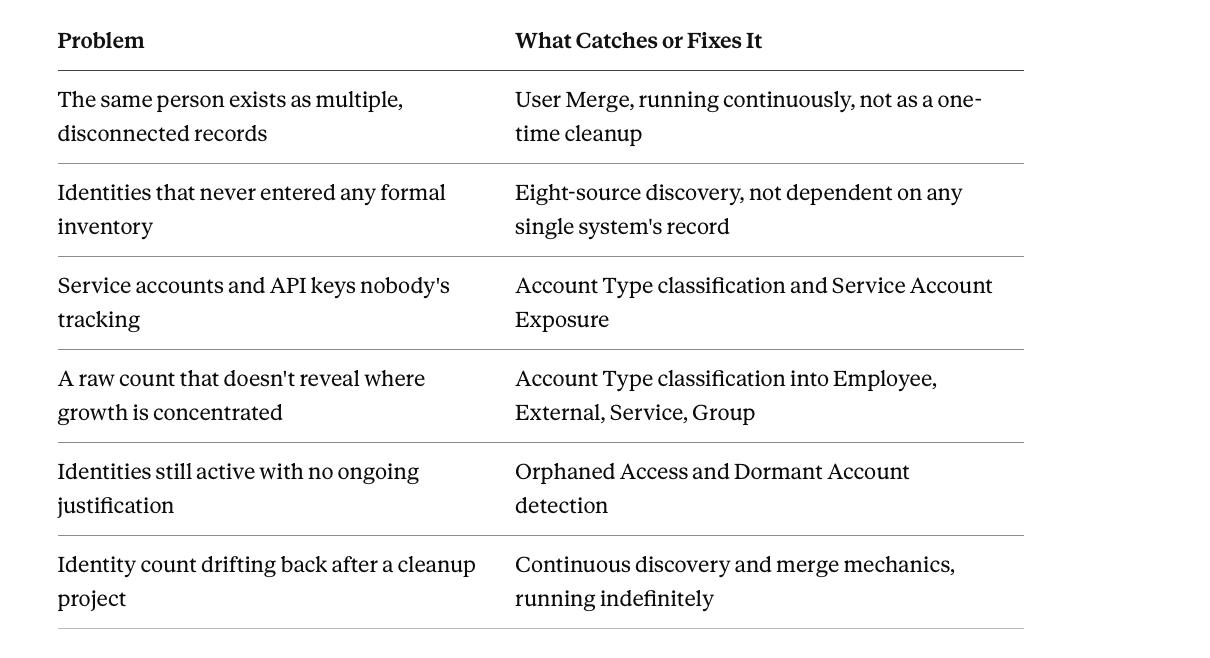
At a glance, before the detail:
Where Identity Sprawl Actually Comes From
Sprawl accumulates through a handful of specific, predictable patterns:
- The same person gets represented as multiple records because a manual account was created before their SSO sync caught up, or because they show up under a slightly different email in a second connected system.
- Service accounts and API keys get created quickly to solve an immediate integration need, with nobody tracking the total count or revisiting whether each one is still needed.
- Contractors and external users get added informally, sometimes through a system that was never brought under the same discovery model as the rest of the organization.
None of these individually looks alarming in the moment. They accumulate quietly, which is exactly what makes sprawl a genuine problem rather than a single, obvious mistake.
Fixing Fragmentation Where the Same Person Exists Twice
The most direct form of identity sprawl is the same real person represented as multiple, disconnected records.
Merge duplicate records the moment they're detected, continuously. Zluri's User Merge mechanic addresses this largely automatically: whenever one account's primary email appears as an alternate email of another account in any connected source, the two are merged, with activity, attributes, and ownership consolidating into one surviving record rather than staying fragmented across two.
This isn't a one-time cleanup exercise. It's a continuously operating mechanic that catches new fragmentation as it naturally occurs, which matters because sprawl doesn't stop accumulating just because a cleanup project happened once.
Discovering the Identities That Were Never Officially Tracked
Surface identities regardless of which channel first reveals them. A significant share of identity sprawl is invisible by definition, accounts that exist but were never brought into any formal inventory in the first place. Zluri's eight-source discovery model, rather than depending on any single system's official record, catches an account discovered through a transaction record, an agent detecting activity, or a direct integration reporting a user nobody manually added.
This matters because the honest first step in containing sprawl is admitting how much of it currently exists outside any official count. That requires looking in the places an unofficial identity is actually likely to show up, not just the systems that were already being watched.
The Fastest-Growing, Least-Tracked Source: Non-Human Identities
Service accounts, API keys, and integrations are disproportionately responsible for modern identity sprawl. They're created quickly, for a specific technical need, by whoever happens to be solving that need at the time, with no equivalent to an HR record ever generated to track them.
Track service identities as their own category, with clear ownership. Account Type classification treats Service identities as a distinct, trackable category rather than letting them blend invisibly into general user counts. Service Account Exposure specifically flags accounts with no clear individual owner, exactly the population where sprawl tends to concentrate hardest, since nobody's job includes periodically asking how many of these actually still exist.
Knowing What Kind of Identity Each Record Actually Is
Containing sprawl requires more than a raw count. It requires knowing what each identity actually represents.
Categorize every identity, don't leave it in an undifferentiated pile. Account Type classification, Employee, External, Service, or Group, gives every identity a real categorization. This is what makes it possible to actually ask meaningful sprawl-reduction questions separately for each population: how many service accounts do we genuinely have, versus how many contractor accounts, versus how many duplicate employee records, rather than one unstructured number that doesn't reveal where the actual growth is concentrated.
Catching Identities That Persist Past Their Justification
Sprawl isn't only about too many records existing. It's also about records that should have stopped existing but didn't.
Flag identities that outlived their justification. Orphaned Access and Dormant Account detection catch identities still technically active with no ongoing reason to be. Every departed employee's lingering account, every abandoned service integration's still-active credential, adds to the count without adding any legitimate value.
Why Sprawl Reduction Has to Be Continuous
A one-time identity audit produces an accurate count on the day it's run and starts drifting immediately afterward. New accounts get created, new integrations get connected, new fragmentation happens as systems get added or changed.
Zluri's continuous discovery and merge mechanics are what keep the identity count from silently growing back after a cleanup project ends, treating sprawl containment as an ongoing operational state rather than a periodic project with a defined end date.
Frequently Asked Questions
Is identity sprawl the same problem as access sprawl?
No, they're related but distinct. Identity sprawl is about the number and fragmentation of identity records themselves: duplicate accounts, untracked service accounts, unofficial identities. Access sprawl is about how much any single identity can do, privilege accumulating over time. An organization can have well-controlled access per identity and still have severe identity sprawl if it has no accurate count of how many identities actually exist.
Why are non-human identities considered a bigger identity sprawl risk than human accounts?
Because they're typically created quickly to solve an immediate technical need, with no equivalent to an HR record generated to track them, and no individual whose job includes periodically checking how many still exist or whether each one is still needed. This makes them the population where sprawl accumulates fastest and gets noticed slowest.
How does merging two user records actually reduce identity sprawl?
By consolidating what would otherwise be two disconnected, fragmented representations of the same real person into one accurate record. This both reduces the total identity count and ensures that a person's full access picture is evaluated correctly, rather than split across records that were never recognized as belonging to the same individual.
Can identity sprawl be fully solved with a one-time cleanup project?
Not durably. New fragmentation and new untracked accounts accumulate continuously as an organization operates: new integrations, new hires processed slightly differently, new ad hoc service accounts. Continuous discovery and merge mechanics are what keep the identity count accurate on an ongoing basis, rather than accurate only on the day a cleanup project happens to finish.


.svg)