.webp)

Every organization running identity governance has a framework. Very few designed it. Most inherited one, silently, from whichever platform they bought, and discovered its constraints years later, when changing them meant rearchitecting everything. This guide is about making that choice consciously instead.
Ask ten teams what an identity governance framework is and you'll get ten answers, most of them describing either a compliance standard or a product. It's neither. Getting the definition right is the first step to designing one deliberately, so let's start there.
What an Identity Governance Framework Is (and Isn't)
An identity governance framework is the set of architectural decisions that determine what your governance program can and cannot do: how applications and identities get discovered, how access gets modeled, how systems connect, how policies get enforced, how much runs automatically, and how everything gets proven to an auditor.
It sits underneath your platform and above your daily processes, which is the distinction most teams collapse:
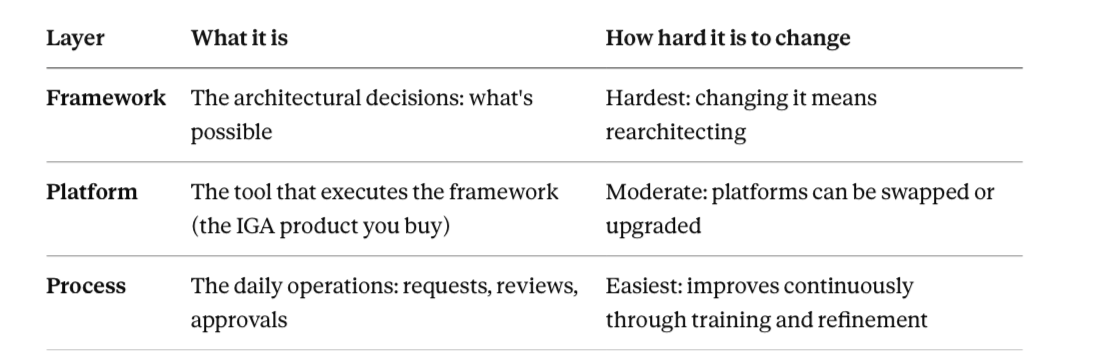
Think of it as a building. The framework is the foundation: load-bearing, invisible, and brutally expensive to change. The platform is the house built on it. Process is the furniture, rearranged whenever you like.
What it isn't: a compliance standard. NIST, ISO 27001, and SOX define what outcomes governance must achieve. Your identity governance framework defines how your architecture achieves them, which is why the same compliance requirement gets met well by one framework and badly by another. (More on that mapping below.)
The critical mistake is jumping straight to platform selection. When you skip framework design, you don't end up without a framework. You end up with the vendor's, chosen for you during a demo, inherited without anyone realizing a choice was made.
The Six Components of an Identity Governance Framework
Every framework, designed or inherited, answers six architectural questions. These are its components.
1. Discovery: how do applications and identities become visible?
The foundation of everything else, because you cannot govern what you cannot see. The design choice runs from narrow to comprehensive:
- IdP-inherited: the framework governs whatever is federated to your SSO, typically 40 to 60 percent of a real environment
- Multi-method: SSO data combined with finance and expense records, browser and desktop agents, and API integrations, surfacing the unfederated tools and shadow IT the IdP never sees
This single decision sets the ceiling on governance completeness. Every other component operates only on what discovery makes visible.
2. Access model: how is "who should have what" expressed?
- Role-based (RBAC): simple and auditable, until role explosion (200 roles nobody maintains)
- Attribute-based (ABAC): flexible, higher design burden
- Hybrid: roles for the common case, attributes for the exceptions, which is where most real environments land
The access model determines both your maintenance burden and how precisely least privilege can actually be expressed.
3. Integration: how do systems connect?
Pre-built integrations for standard SaaS, API and schema-driven approaches that generalize across similar applications, and a defined path for on-prem or custom-built apps. The integration component decides how fast a newly adopted application can come under governance, and whether the answer involves weeks or a development project.
4. Policy and enforcement: where do rules live, and when do they act?
The framework decides whether policies like segregation of duties are enforced at request time (violations blocked before access exists) or detected after the fact (violations flagged for later cleanup). Pre-provisioning enforcement and post-provisioning detection are different architectures, not different settings, and the choice shapes your real risk posture more than the policy text does.
5. Automation depth: how much runs without a human?
From ticket-driven manual work, through semi-automated approvals, to full lifecycle automation where joiner, mover, and leaver events trigger provisioning and revocation directly from the HR system. Automation depth determines whether governance scales with headcount or with hiring.
6. Audit and evidence: how does the framework prove itself?
Whether evidence is generated continuously (reports reflect current state, on demand) or assembled manually before each audit. This component decides whether audit season is a query or a quarter-long project.
The Five Design Questions to Answer Before Any Demo
The six components translate into five questions, and the discipline that makes them work: answer all five in writing, before the first demo. Every vendor demo embodies a vendor's answers to these same questions, presented persuasively. Walk in with your own answers written down, and the demo becomes an evaluation. Walk in without them, and it becomes an inheritance.
Question 1: How will we discover what needs governing?
The most consequential question, because every other answer operates only on what this one makes visible.
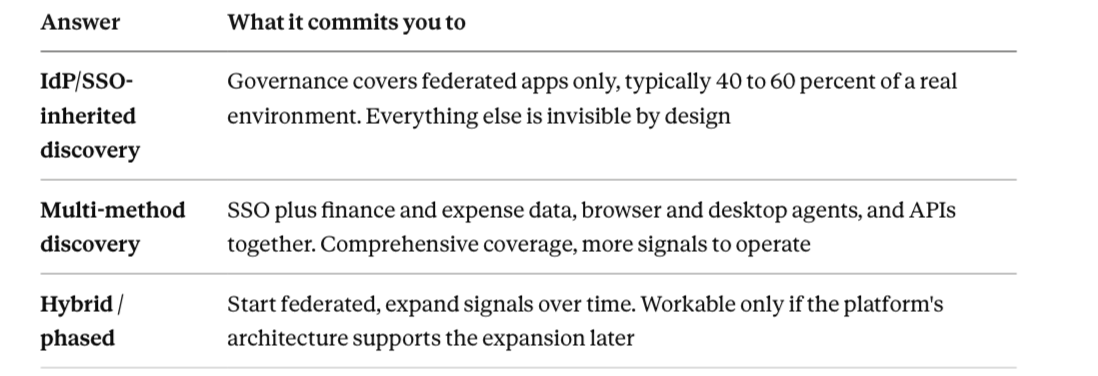
How to answer it for your environment: pull your IdP's app list, then pull twelve months of software spend from finance. The gap between the two lists is your shadow surface, and it's the number that decides this question. A 15 percent gap makes IdP-inherited discovery defensible. A 50 percent gap makes it a plan to govern half your company.
The vendor question that tests it: "Walk me through exactly how you would discover an application that isn't connected to our IdP and SSO." A vague answer, or one involving professional services, is itself an answer.
Question 2: How will we model who gets what?
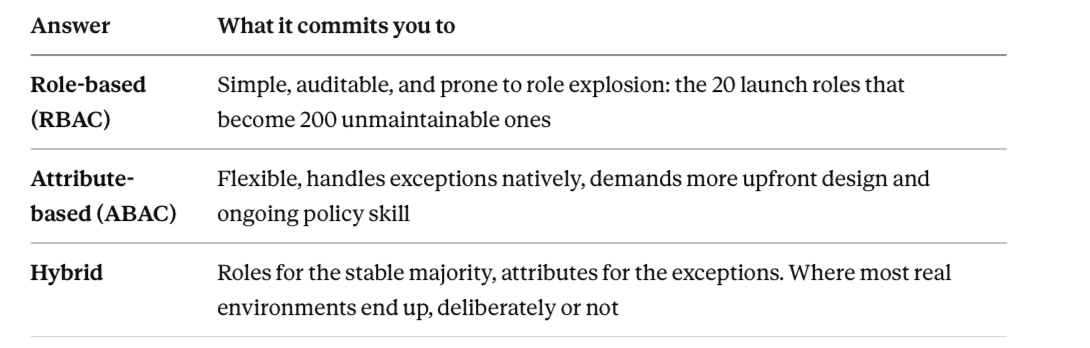
How to answer it: count your genuine exception patterns. Location-based data rules, seniority tiers, team-specific tooling, contractor variants. Fewer than a handful, RBAC holds. More than that, design the hybrid now rather than discovering the role explosion in eighteen months.
Question 3: How will applications actually connect?
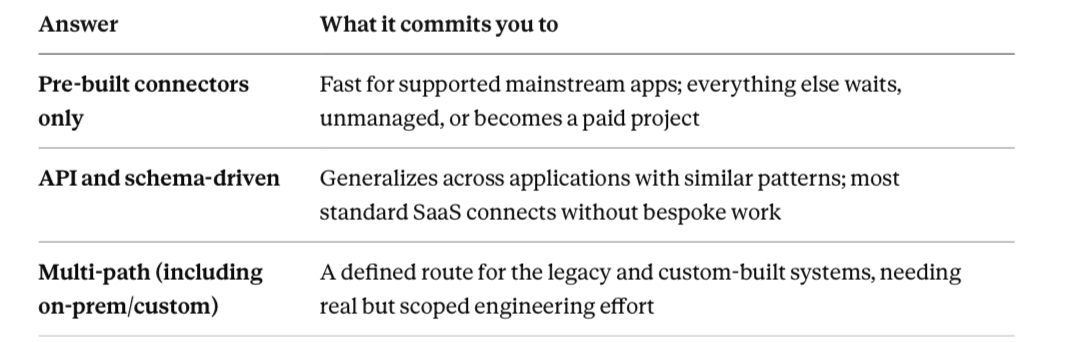
How to answer it: list your ten most critical applications and your five strangest ones (the custom internal tool, the on-prem system, the deeply customized instance). Your integration answer has to cover both lists, because governance gaps concentrate in exactly the apps that don't connect easily. During evaluation, ask for a live demonstration of integration depth on your critical apps, not connector counts: can it provision, deprovision, and read entitlement-level detail, or just see a user list?
Question 4: How will this scale as we grow?
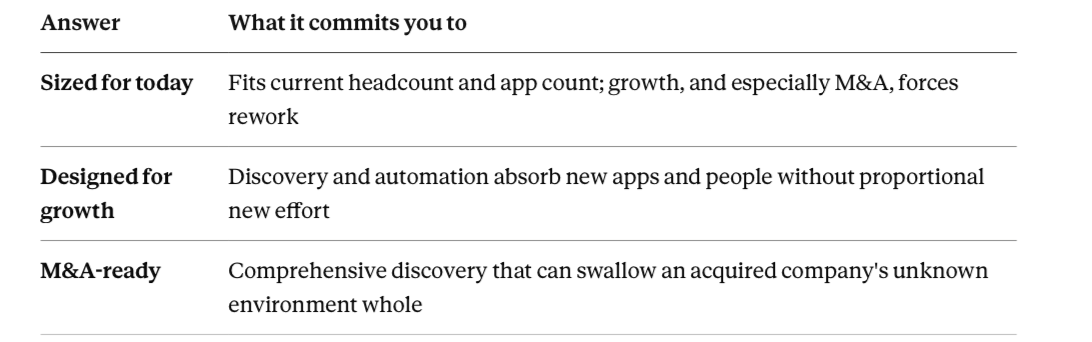
How to answer it: two honest inputs. Your realistic headcount and application trajectory over three years, and whether acquisition is even a possibility. M&A is the stress test most frameworks fail: an acquired company arrives overnight with its own portfolio, its own identity data, and often no governance at all, and only a discovery-first framework absorbs that cleanly.
Question 5: How deep will automation go?
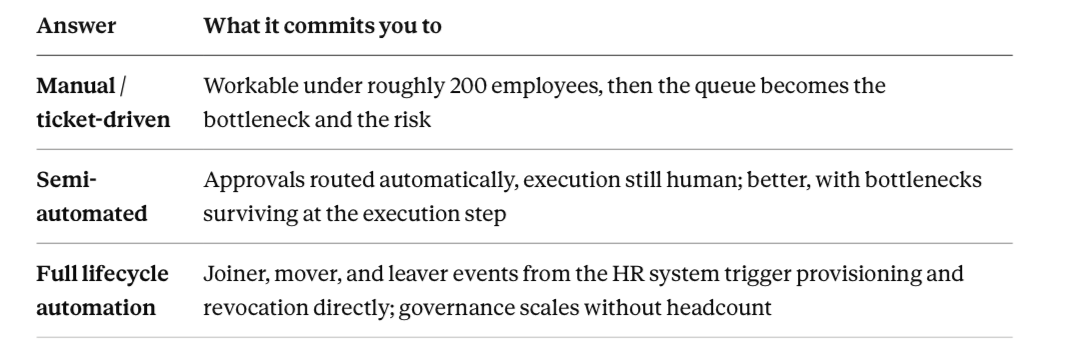
How to answer it: take your monthly departure count and multiply by the average systems-per-person. That's your monthly revocation workload. If the number makes manual execution obviously fail, and past modest size it always does, then automation depth isn't a preference, it's the load-bearing answer.
The five answers interlock. Full automation on top of IdP-only discovery automates half your environment perfectly and ignores the rest. Comprehensive discovery feeding manual processes finds everything and fixes nothing. The framework is the set, not any single answer.
The one-page version
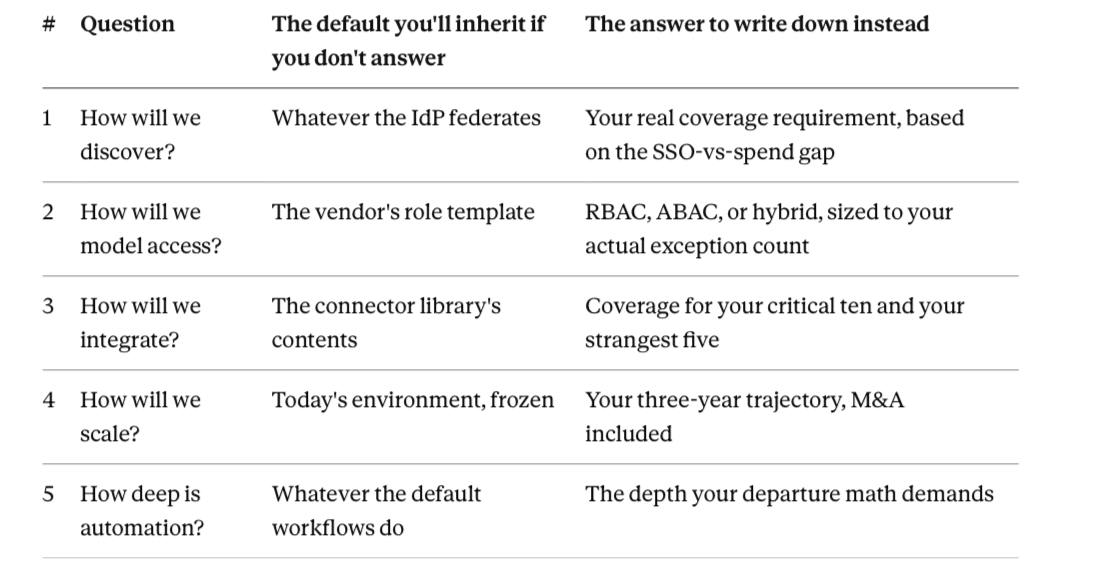
Answer the five in writing, bring the page to every demo, and score what you see against it. The short version that matters: answer them before the demos, or the demos will answer them for you.
Framework Debt: Why These Decisions Compound
Framework decisions behave like interest. Each choice creates constraints that grow over time, and the growth is invisible until something forces the bill.
A worked example. In year one, a team chooses IdP-inherited discovery, because the vendor demo showed SSO integration and it looked clean. What they actually chose: governance limited to federated applications. In year two, teams adopt dozens of unfederated tools; each stays invisible. In year three, an audit finds a departed contractor with live access to a tool the platform never knew existed. The finding isn't a process failure or a platform bug. It's the year-one framework decision, matured.
The same compounding applies to every component:
- RBAC-only access models mature into role explosion, then into a rearchitecture project
- Connector-only integration matures into a backlog of ungoverned apps growing faster than it clears
- Detection-only policy matures into violation queues nobody works through
- Manual-heavy automation matures into a governance team that must scale linearly with the company
Framework debt is the gap between the framework your environment needs and the one you inherited. It accrues silently, and it's always cheapest to pay down at design time.
How the Framework Maps to Compliance Standards
Half the people searching for "identity governance framework" mean regulatory frameworks. The relationship is simple: standards define the outcomes; your framework determines how well your architecture produces them.
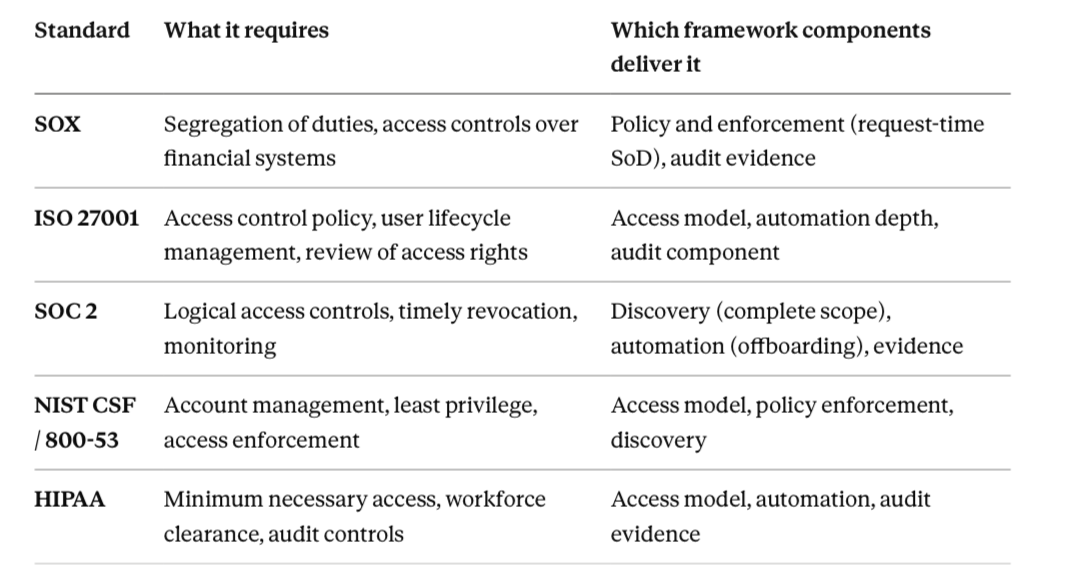
Notice what recurs in the right column: discovery and automation appear underneath nearly everything, because a control applied to an incomplete inventory, or executed manually at scale, fails its standard in practice while passing it on paper.
How to Build Yours Deliberately: A Five-Step Sequence
Step 1: Map your actual environment first. Application count versus federated count, unfederated and legacy inventory, identity sources, non-human identities. Your framework must fit this reality, not the vendor's demo tenant.
Step 2: Answer the five design questions in writing. Before any vendor conversation. The written answers become your evaluation criteria instead of the vendor's feature list.
Step 3: Validate framework assumptions against reality. If a platform's framework assumes SSO-based discovery, test what percentage of your apps that actually covers. An assumption that fails your environment fails it permanently, regardless of every other feature.
Step 4: Select the platform that implements your framework, not the one whose framework you'd be inheriting. The evaluation question shifts from "what features does it have" to "does its architecture match the answers we wrote down."
Step 5: Plan for evolution. New app types, new compliance requirements, acquisitions, AI tools. A framework that can extend, new discovery signals, new access models, new integration paths, ages into an asset. One that can't ages into debt.
Frequently Asked Questions
What is an identity governance framework in simple terms?
It's the set of architectural decisions underneath your identity governance program: how applications get discovered, how access gets modeled and granted, how systems connect, how policies get enforced, how much runs automatically, and how it all gets proven to auditors. The platform you buy executes these decisions; the framework is the decisions themselves.
Is an identity governance framework the same as an IGA platform?
No, and conflating them is the most common mistake in this space. The platform is a product you purchase; the framework is the architecture that determines what any platform can do in your environment. Two companies running the identical platform with different frameworks get completely different outcomes, most visibly in what percentage of their environment is actually governed.
How is this different from compliance frameworks like NIST or ISO 27001?
Compliance frameworks define required outcomes: access must be reviewed, revocation must be timely, duties must be segregated. Your identity governance framework is the architecture that produces those outcomes. A weak framework can pass audits on paper, reviews run on an incomplete inventory still complete "successfully", while failing the standard's intent in practice.
Can we change our framework after the platform is deployed?
Partially, and expensively. Process-level changes are easy and platform swaps are moderate, but true framework changes, moving from IdP-inherited to multi-method discovery, or from RBAC-only to a hybrid access model, typically mean rearchitecting workflows, policies, and integrations built on the old assumptions. This asymmetry is exactly why the framework deserves deliberate design before purchase rather than discovery after it.
Who in the organization should own the identity governance framework?
The team that owns identity, usually IT or security, should hold the pen, but the design decisions need input from compliance (evidence requirements), HR (lifecycle events), finance (application and spend data as a discovery source), and app owners (integration realities). A framework designed by one team encodes one team's assumptions, and the gaps surface later as everyone else's problems.
.webp)


.svg)