

Access sprawl rarely happens through one bad decision. It happens through years of individually reasonable ones: a project here, a temporary need there, a role change that added new access without anyone revisiting the old. Each addition small and defensible on its own, the sum considerably harder to justify. The question access sprawl asks isn't "was any single grant wrong." It's "does this identity's total accumulated access still make sense, all at once."
Access sprawl describes the gradual, usually unintentional growth in how much a given identity can do. This is distinct from identity sprawl, which is about the count and fragmentation of identity records themselves.
An organization can have a clean, well-tracked set of identities and still suffer serious access sprawl if those identities have spent years accumulating permissions from old projects, past roles, and temporary needs that were never revisited once the original justification expired. This piece covers exactly how that accumulation happens and how Zluri's mechanics catch and reverse it. For the pattern behind why static employees accumulate just as much access as people who change roles constantly, see the Jessica vs Sarah breakdown.
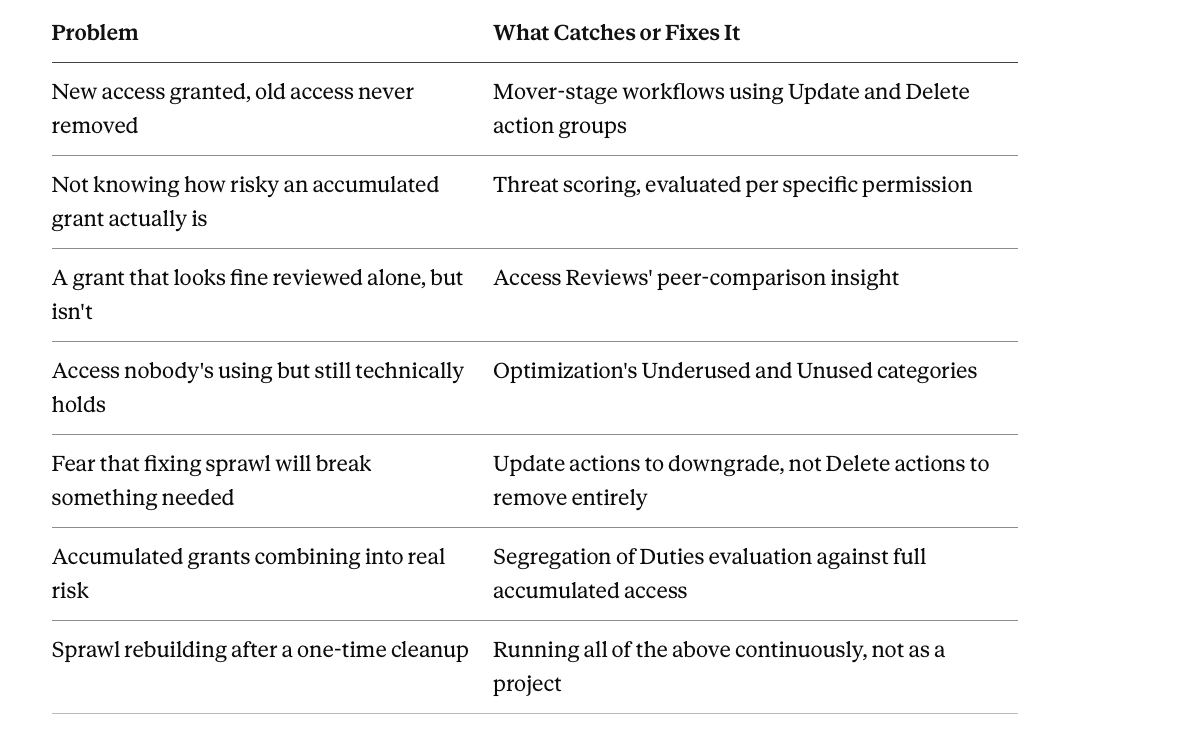
At a glance, before the detail:
The Actual Mechanism Behind Most Access Sprawl
It's worth naming the specific pattern responsible for the bulk of real-world access sprawl, since understanding it is what makes reversing it tractable.
Addition is reliable. Removal isn't. When someone's role changes, a promotion, a department transfer, a new project assignment, granting the new access that role requires happens reliably. It's obvious and gets acted on. Removing the access their previous role no longer justifies happens far less reliably, since nothing about the new role change inherently signals that old access should go away, and there's rarely an equally obvious trigger prompting anyone to check.
This asymmetry, add reliably, remove inconsistently, repeated across a person's entire tenure, is what actually produces access sprawl. Not one bad grant, but years of role changes that only ever added.
Making the Removal Half as Deliberate as the Addition Half
The fix: build removal into the same workflow as the grant. Mover-specific workflows that explicitly handle both sides of a role change, not just the addition, close this gap directly. Using the Update and Delete action groups to revoke or downgrade access tied to a person's previous role at the same time new access gets granted for their current one closes exactly the gap that produces sprawl in the first place.
This has to be built deliberately. An onboarding-style workflow that only ever adds access will never trigger this removal on its own, since nothing about a role change inherently signals "and also take away the old stuff" unless that removal is explicitly configured as part of the same event.
Measuring What a Sprawling Grant Actually Permits
Once access has already accumulated, the first step in addressing it is knowing precisely what each accumulated grant actually allows, not just that it exists.
Score each grant individually, not the identity as a whole. Threat scoring, evaluated per specific permission, distinguishes a low-risk, narrow grant left over from an old project from a high-threat, broad one that represents genuinely urgent excess. This matters because not every instance of accumulated access deserves equal priority, and scoring gives a sprawl-reduction effort a way to focus on the accumulated grants that actually matter most first.
Catching Access That's Become an Outlier Relative to Peers
A grant that's individually plausible can still represent sprawl the moment it's compared against what similarly situated people actually hold. This comparison is precisely what catches accumulation that a review of the grant in isolation would miss.
Compare against peers, not just against the grant in isolation. Someone who's picked up access from three different past projects over several years, none of which was ever formally revoked, shows up as a genuine outlier the moment their access is compared to a current peer in the same role who's never touched those old systems at all. This is exactly the pattern Access Reviews' peer-comparison insight is built to surface.
Continuously Checking Usage Against What's Actually Granted
Sprawl isn't only visible through comparison to peers. It's also visible directly in usage data.
Check what's actually used, not just what's technically granted. Optimization's Underused and Unused categories flag exactly the signature access sprawl produces: a license or permission technically still assigned, contributing to what a person could theoretically do, while actual usage shows it's gone untouched for a meaningful stretch of time. This is precisely the kind of accumulated-but-abandoned access that builds up silently across a long tenure.
Reversing Sprawl Without Breaking What's Still Needed
Correcting access sprawl has to be precise, not a blunt full revocation that risks removing access someone still genuinely uses alongside the accumulated excess.
Downgrade the specific excess, don't delete the whole relationship. Using Update actions to downgrade or narrow a specific over-broad grant, rather than Delete actions that would remove an entire application relationship outright, is what makes sprawl correction safe to actually execute rather than something an admin hesitates to touch for fear of breaking something the person still needs.
Checking Whether Accumulated Access Has Combined Into Real Risk
Access sprawl's most serious form isn't any single leftover grant. It's when several individually accumulated grants combine into a genuine Segregation of Duties conflict, years of role changes eventually leaving someone holding both halves of a combination that was never intentionally assembled by anyone, simply accreted piece by piece over time.
Check the full accumulated picture, not each grant in isolation. Running SoD evaluation against an identity's full, accumulated access picture is what catches this specific, more serious consequence of long-term sprawl, several individually accumulated grants combining into a genuine Segregation of Duties conflict that nobody intentionally assembled.
Why Sprawl Reduction Has to Be an Ongoing Practice
Correcting years of accumulated access once produces a clean baseline on the day the correction finishes. The exact same asymmetry that produced the original sprawl, reliable addition, inconsistent removal, starts rebuilding it again the moment the next role change happens without a deliberately built removal step.
Treating mover-stage removal as a standing, permanent part of how role changes get handled, backed by continuous threat scoring, peer comparison, and usage-based optimization running indefinitely, is what actually prevents sprawl from simply regenerating after a one-time cleanup.
Frequently Asked Questions
Is access sprawl usually caused by one bad access decision?
Rarely. It's much more commonly the accumulation of many individually reasonable decisions, primarily role changes that added new access reliably while the corresponding removal of old access happened inconsistently or not at all, repeated across a person's tenure.
How can access sprawl be caught if no single grant looks obviously wrong?
Through comparison, not isolated review. Access Reviews' peer-comparison insight flags a grant as an outlier relative to what similarly situated people currently hold, which surfaces accumulated, leftover access even when every individual grant would look individually defensible reviewed on its own.
Why is it risky to fix access sprawl with a full revocation instead of a targeted downgrade?
Because a person with genuinely accumulated excess access often still uses some of what they hold, and a blunt, full revocation risks removing access they actually need alongside the leftover access that should go. Using Update actions to narrow a specific over-broad grant, rather than deleting the whole application relationship, is what makes correction safe to actually execute.
Can accumulated access sprawl ever become a more serious security risk than just wasted license spend?
Yes, specifically when several individually accumulated grants combine into a genuine Segregation of Duties conflict. Nobody intentionally assembled that combination, it accreted over years of role changes, but the resulting risk is real regardless of how it came to exist, which is why SoD evaluation needs to run against an identity's full accumulated access, not just each grant reviewed in isolation.



.svg)