

Every era of enterprise security has answered the same question differently: what decides whether someone gets access? The answer has genuinely moved twice, and it's being stress-tested a third time right now.
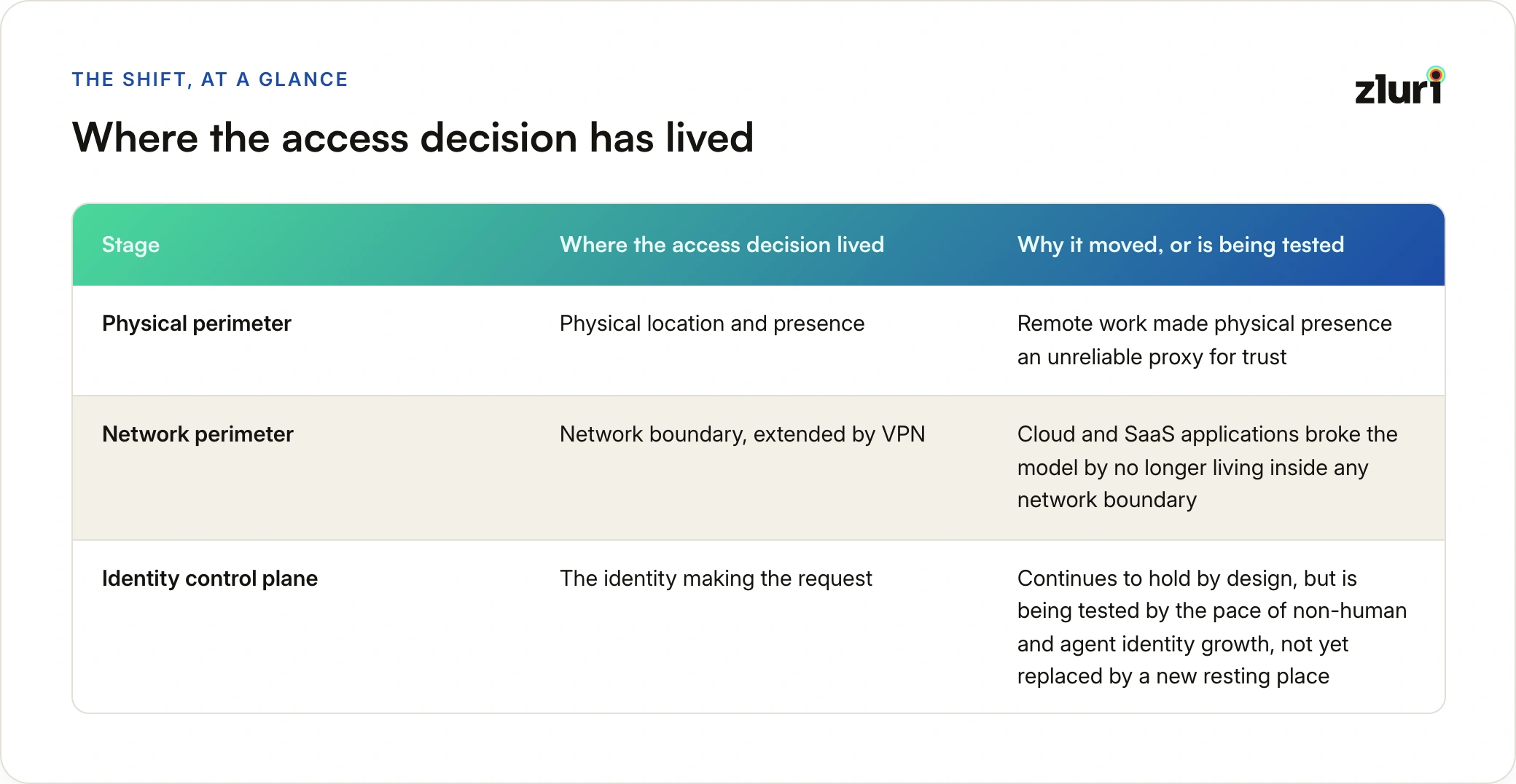
The short version: physical presence → network perimeter (VPN-extended, broken by cloud and SaaS) → identity as the only constant left, now being tested by the pace of non-human and agentic identity growth. Two real moves, one ongoing test, each happening because the previous answer stopped matching reality.
"Identity is the control plane" can sound like a trend, another phrase that will get replaced by the next one in a few years. It's easier to see why it's actually a conclusion baked into how access decisions have evolved, not a fashion, once you trace where the access decision lived before this, and why each previous answer eventually broke.
Era One: The Physical Perimeter
For most of enterprise computing's early history, the access decision was almost entirely physical. Systems lived in a specific building, on a specific network, and getting access meant being in the right physical location with the right physical credentials. Trust was implicit in presence: if you were inside the building, on the internal network, you were largely assumed to belong there.
This worked reasonably well because it matched reality. Employees worked from the office. Systems didn't move. The set of people who could physically reach a terminal was a meaningful proxy for the set of people who should have access to it.
Era Two: The Network Perimeter Extends
As remote work and multi-site organizations became more common, the physical perimeter stopped being sufficient on its own, so the access decision shifted to a virtual equivalent: the network perimeter. Firewalls defined the boundary. VPNs extended that boundary to remote employees, effectively simulating physical presence over a network connection. The core assumption didn't change, being inside the trusted network still meant being trusted, it just became possible to be "inside" without being physically present.
This era is where a lot of organizations' access models still fundamentally live today, even ones that have adopted identity tooling on top of it. The VPN became the mechanism for extending network-based trust rather than replacing it with something else, which is exactly the gap discussed elsewhere in this series: VPN-based trust surviving quietly inside otherwise modern access models.
Era Three: Identity Becomes the Only Constant
This is the second real move, and it happened because the network perimeter stopped working, not gradually, but at the architecture level. The shift to cloud infrastructure and SaaS applications is what broke it: applications no longer lived inside a network boundary an organization controlled. They lived on someone else's infrastructure, accessed directly over the public internet, often without ever touching the corporate network at all.
An employee accessing a SaaS app from their home network, with no VPN involved, was doing something the network perimeter model had no good way to evaluate. The perimeter hadn't just extended, it had effectively disappeared, because there was no longer a consistent network boundary that corresponded to what was actually being accessed.
Once applications lived everywhere and users connected from everywhere, network location stopped being a usable signal for anything. What remained constant, regardless of where an application lived or where a user connected from, was the identity making the request. That's the built-in reason identity became the next place for the access decision to live, not because it was a better idea in the abstract, but because it was the last remaining variable that was still present and meaningful in every scenario, cloud or on-prem, office or remote, managed device or personal one.
This is where zero trust architecture and identity-first security emerged as the practical response: if network location can no longer tell you whether to trust a request, and it can't by design in a cloud and SaaS environment, the decision has to move to something that's still reliably present in every access scenario, which is the identity itself.
Era Four: The Model Gets Tested, Without a New Place to Move To Yet
Identity as the control plane is where most mature organizations are trying to operate today, but the model is already being tested by the same kind of pressure that broke the network perimeter model before it. Unlike the first two shifts, this test hasn't produced a fourth resting place, the answer is still identity, it's that what counts as an identity is expanding faster than most governance programs have caught up to.
Non-human identities, service accounts, API keys, and now AI agents, are growing faster than the human workforce, and many of them were provisioned under assumptions that predate serious identity governance: static credentials, broad standing access, no natural offboarding trigger.
AI agents in particular represent a new version of the same underlying challenge each era has faced: the previous model's assumptions no longer match reality. A few ways that shows up:
- Agent behavior is dynamic rather than fixed, so it's harder to define in advance exactly what access an agent should have
- Provisioning happens faster than governance processes were built to handle
- Accountability can span multiple identities in a single workflow, when one agent delegates to another
It's not that identity stops being the right place for the access decision to live, it's that the population of identities routing through it keeps expanding faster than most governance programs have caught up to.
The shift, at a glance:
Why "Now" Specifically
Both real moves happened because the volume or nature of access outgrew what the existing model could evaluate meaningfully. That same pressure is what's making the current test feel urgent:
- SaaS sprawl means the average organization has far more applications, and far more access relationships, than an identity model built even five years ago was sized for
- Agentic AI is adding a new, fast-growing identity population on top of that, often provisioned faster than governance processes can keep pace
None of that means identity stops being the right foundation. It means the discipline of actually making identity function as the control plane, full discovery, continuous evaluation, consistent treatment of every identity type, human and non-human, matters more now than it did when the workforce and app stack were smaller and slower-growing.
Whether this test eventually forces a genuine third move, or whether it's resolved by governance simply catching up to identity's expanding scope, is the open question. For now, the work is making sure identity is genuinely doing the job the last two shifts have already handed it.
Ready to See What a Genuinely Identity-First Control Plane Looks Like?
Book a 20-minute demo to see how Zluri keeps identity, not network or device, as the actual deciding factor behind every access decision.
Frequently Asked Questions
Does this mean the network perimeter model is completely obsolete now?
Not entirely obsolete, network-level controls still play a role as one signal among several. What's obsolete is treating network location as the primary or sufficient basis for an access decision, which is the assumption that broke once applications stopped living inside any consistent network boundary.
Is "identity as the control plane" likely to be replaced by something else eventually, the way network perimeter replaced physical presence?
It's less likely to be replaced outright than it is to keep expanding in scope, identity remains the one consistently present factor across environments, but what counts as an identity, adding non-human and agentic identities to the traditional human population, is what's actively evolving right now.
Why did it take so long for organizations to move from network-based to identity-based access models, given that SaaS adoption has been growing for over a decade?
Migrating access models is disruptive and expensive, and network-based controls didn't fail all at once, they degraded gradually as more of the app stack moved to the cloud, which meant the urgency built slowly enough that many organizations kept extending the old model (through VPNs and similar tools) well past the point where it actually matched their environment.
Is the AI agent pressure described here actually a fourth era, or something else?
Something else, deliberately framed that way here. The first two shifts changed where the access decision lived, physical to network to identity. What AI agents are doing is testing whether identity can keep functioning as the control plane as the population of identities routing through it grows and diversifies quickly, not creating a new place for the decision to move to. Whether that test eventually produces a genuine fourth era is still an open question.


.svg)