
Choose Zluri if your environment is SaaS-heavy, you need governance live in weeks without a consulting engagement, or your biggest risk is identity you can't currently see — shadow IT, AI tools employees adopted independently, non-human identities operating outside your stack.
Choose Saviynt if you're running SAP or Oracle environments that require deep, entitlement-level SoD enforcement and you have the internal team or partner budget to manage a vendor-dependent configuration model.
If you're evaluating Saviynt, you're already past the point of asking whether you need converged identity security. You know you need discovery, governance, and posture management working together as one system, not three tools stitched together after the fact. The question is which platform gets you there without the implementation that eats a year and a budget that needs board approval.
The crux of the decision comes down to this: Saviynt and Zluri are both cloud-native, but only one of them lets your team make changes without going through the vendor. Saviynt has the deeper bench in ERP-heavy governance. Zluri has the faster path to a working system and the broader reach into SaaS identity. Which one wins depends on what your environment actually looks like.
Most teams land on this comparison after running into a wall with whatever they have today, usually a legacy IGA tool that wasn't built for a SaaS-heavy stack, or a manual access review process that's stopped scaling with headcount. Saviynt and Zluri both solve that problem on paper. They diverge on how much of your own team's time it takes to keep solving it, month after month, as your app stack and access policies keep changing.
In this article, we break down where Saviynt and Zluri genuinely differ, where each platform has a real edge, and how to figure out which one fits your environment.
Who this comparison is for
If your stack is SaaS-heavy and you need SoD enforcement for apps like Salesforce, Okta, and GitHub rather than SAP and Oracle, this comparison is built for you. If you're running a complex on-prem ERP environment with deep, entitlement-level SoD requirements, Saviynt's strength in that specific area is worth weighing seriously, and we say so plainly below.
This also matters if you're coming off an on-prem SailPoint deployment and evaluating cloud alternatives. Both vendors market themselves as the natural next step for that migration, but they get you there through different operating models, one consultant-led, one self-serve.
The core difference between Saviynt and Zluri is who controls configuration
Both platforms are cloud-native. That part of the pitch is identical. The difference shows up the moment you need to change something.
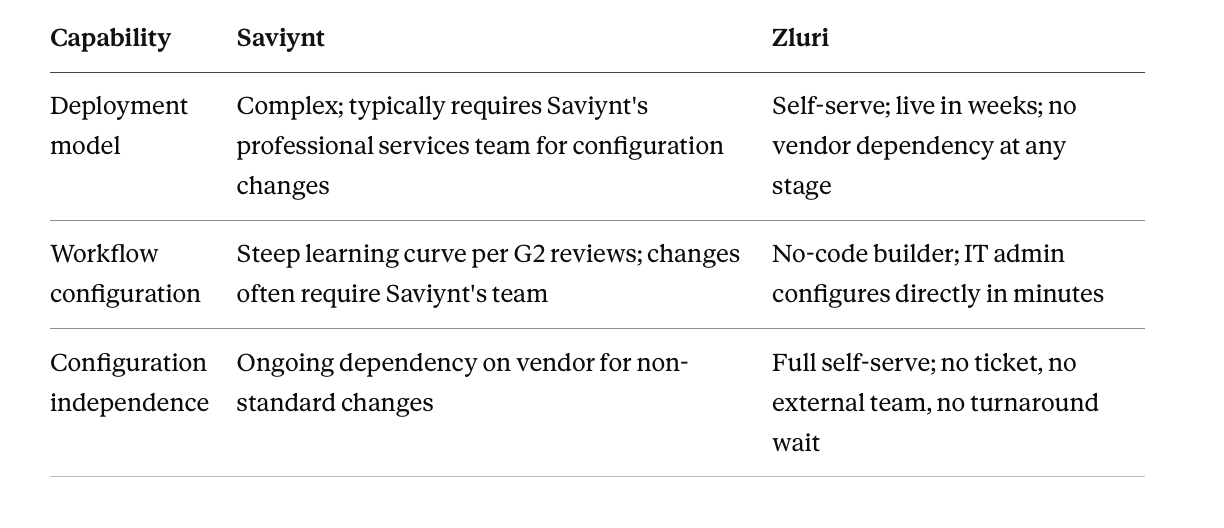
Saviynt deployments are commonly described by G2 reviewers as having a steep learning curve, with workflow and configuration changes often requiring Saviynt's own team or a partner. That's not a one-time cost at implementation. It's an ongoing dependency every time your access model needs to evolve, which for most security and IT teams is constantly. New app gets onboarded, a department restructures, a new compliance requirement lands on your desk: each of these typically means a new workflow, a new policy, or a new review campaign. If every one of those touches your vendor's services queue, the platform's real cost is measured in calendar time, not just license fees.
Zluri is self-serve from day one. Workflow changes go through a no-code builder that IT admins configure themselves, typically in minutes, not through a change request to a vendor's professional services team. This is the same self-serve workflow engine behind Zluri's broader lifecycle management platform, which automates provisioning and deprovisioning across the entire user lifecycle without requiring developer resources.
This single difference compounds. A platform you can't reconfigure without outside help doesn't just cost more over time. It slows down every policy change, every new app onboarding, and every audit response that requires a quick adjustment.
How this plays out in practice: a workflow change
Picture a common scenario. Your finance team adopts a new SaaS expense tool, and now you need SoD rules ensuring the person who submits an expense isn't the same person who approves it, on the new platform specifically, not just at the ERP level.
On Saviynt, that typically means working through the platform's configuration layer, which G2 reviewers consistently describe as requiring Saviynt's own team for anything beyond the basics. You're scoping the request, possibly opening a ticket, and waiting on a turnaround that depends on your contract and your vendor's bandwidth, not your own.
On Zluri, an IT admin builds that rule directly inside the no-code SoD policy engine: select the application, define the Set A and Set B conflict pairs, decide whether violations trigger an alert, a manual review, or automatic remediation, and the rule is live. No ticket, no external dependency, no waiting on someone else's calendar.
Multiply that single example across a year of access changes, new app onboarding, role restructures, and audit-driven policy updates, and the gap between the two operating models becomes the real story behind this comparison, more than any single feature on the capability table below.
Where Zluri wins
Zluri lets your team make configuration changes without depending on the vendor
Self-serve deployment and configuration from day one. Saviynt's reliance on its own team for configuration changes is a recurring theme in user reviews, and it shapes the total cost of ownership well beyond the initial contract. Zluri's no-code policy engine, by contrast, uses triggers, conditions, and webhooks that IT admins configure directly, with no developer resources or vendor tickets required.
Zluri ships pre-built reports instead of requiring you to write SQL for one
Pulling audit documentation or a custom report out of Saviynt commonly means writing SQL directly against the platform, a workflow IAM and IGA practitioners have flagged publicly as painful, with error messages that don't make troubleshooting any easier. For a junior engineer or a lean IT team without a dedicated reporting specialist, this turns a routine documentation request into a multi-hour debugging exercise.
Zluri ships with premade reports covering the access and identity data teams actually need for audits and reviews. If something specific isn't already built, you can typically pull and download the data directly through the platform's interface without writing a single line of code. That difference matters most for the people actually doing the day-to-day work: junior team members who don't yet have deep SQL fluency, or teams without a dedicated database specialist on staff, get the same reporting output without the same skill prerequisite.
Zluri's SoD engine is built for SaaS apps, not retrofitted from ERP systems
Saviynt's SoD strength is concentrated in traditional ERP applications rather than modern SaaS environments, which tracks with what teams find when they try to configure SoD rules for Salesforce or GitHub: it takes complex custom work rather than native support.
Zluri's SoD engine is SaaS-first, with support for traditional systems as well, which matters if your environment is majority cloud apps rather than majority ERP. It detects and remediates toxic access combinations across SaaS, ERP, and custom apps with continuous monitoring rather than point-in-time checks.
Zluri finds shadow IT that never touches your SSO
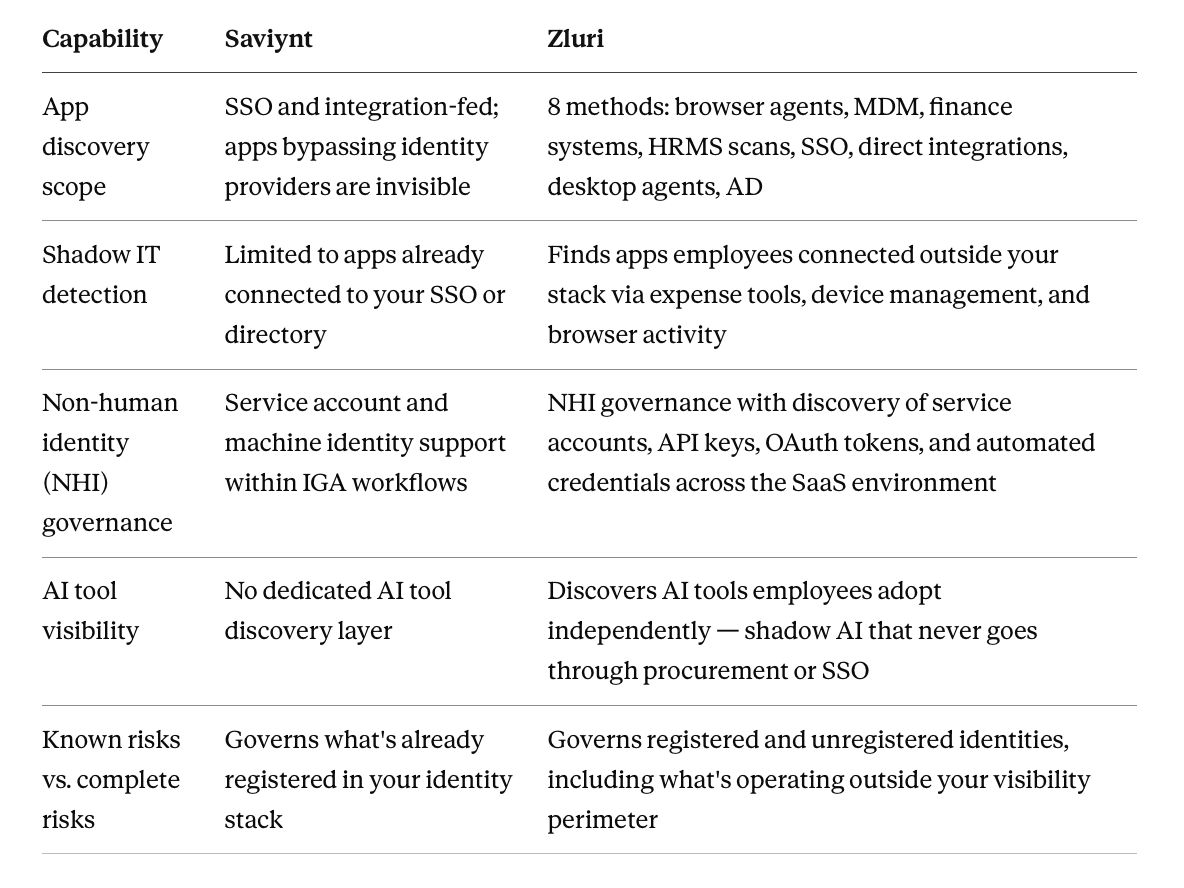
Saviynt's discovery is SSO and integration-fed, meaning anything connecting outside those channels is invisible by default. Zluri uses eight discovery methods, including browser, MDM, finance, and HRMS scans, which means apps employees connect to through expense reports or device management show up even when they never touch your identity provider. Customers typically find three times more apps than they expected once they turn this on.
This matters more than it might initially sound. Most SSO-fed discovery tools assume that if an app isn't federated through your identity provider, it isn't part of your access risk surface. In practice, the opposite is usually true: unfederated apps are exactly where shadow IT tends to accumulate, since nobody's actively managing them.
Zluri runs discovery, governance, and posture management on one connected platform instead of three
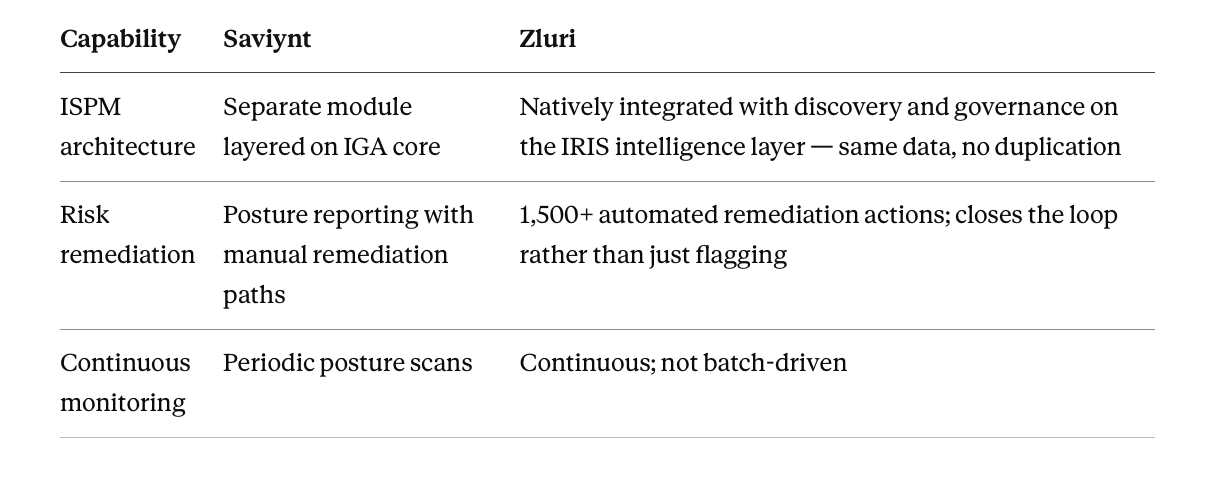
Saviynt's posture management is a separate module layered on top of its IGA core. Zluri's identity visibility, governance, and posture management run on a shared intelligence layer, IRIS, that connects and contextualizes every identity signal across the environment. That's the architectural reason Zluri's ISPM can lean on the same discovery and governance data instead of duplicating it in a standalone module.
Zluri's ISPM continuously discovers, prioritizes, and remediates identity risk, from over-privileged accounts to orphaned access and policy drift, with more than 1,500 automated actions available to close the loop instead of just flagging the problem.
Zluri gets you to a working system in weeks instead of quarters
Live in weeks, not quarters, with no consulting engagement required before you see results. This is the practical consequence of everything above: when configuration doesn't require a vendor's team, deployment timelines compress.
Where Saviynt leads
Saviynt goes deeper on SAP and Oracle SoD enforcement
Saviynt offers instantaneous SoD supervision for SAP and Oracle, with compensating controls and fine-grained, entitlement-level conflict detection built for complex ERP environments. If your compliance requirements center on deep ERP governance, this is genuinely Saviynt's strongest ground. Organizations with mature, audit-heavy SAP environments have historically been Saviynt's core buyer, and the product reflects that origin.
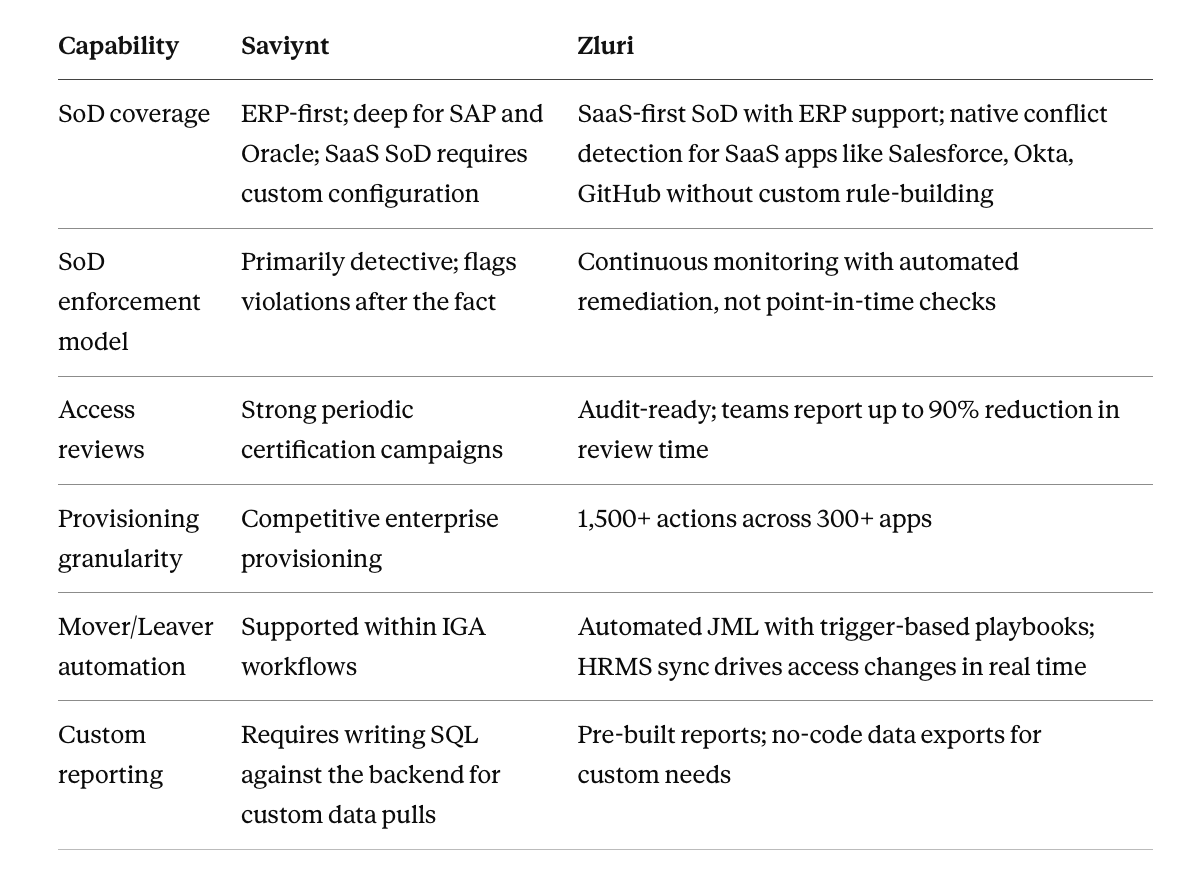
The redirect worth sitting with: Saviynt's edge in ERP SoD is real, but it comes attached to a platform that needs its own team for routine changes. Zluri is self-serve from day one, with governance and discovery natively integrated rather than layered on as separate modules.
Questions to ask in your evaluation
A few questions surface the gaps that matter most before you sign anything, regardless of which platform you lean toward.
Who makes configuration changes today, and what does a typical change take? If the honest answer involves opening a ticket with your vendor's professional services team, factor that into both cost and speed for the life of the contract.
Have you tried configuring SoD for SaaS apps like Salesforce, Okta, or GitHub? This is where ERP-first SoD engines tend to show their limits. If the answer involves custom rule-building rather than native support, that's worth surfacing early.
How are you discovering apps that connect outside your SSO? Finance-purchased tools, MDM-installed apps, and HRMS-driven access often bypass identity providers entirely. If your current or prospective platform only sees what flows through SSO, you have a visibility gap whether you've measured it yet or not.
Customer proof
Assured Allies needed to run bi-monthly SOC 2 access reviews across more than 70 SaaS applications with a single person handling the audit manually through spreadsheets. After implementing Zluri, what previously took a full workday now takes about 30 minutes of configuration, cutting audit prep time by 90%. Omri, their Global IT Manager, pointed to the pace of new feature releases and integration depth as what set Zluri apart from other options they evaluated. Read the full Assured Allies case study for the complete breakdown.
Roller Networks cut provisioning time from 30 minutes to 1 minute per user, self-configured by their own IT admin without vendor involvement.
When to position Zluri
Zluri is the stronger fit when accelerated deployment matters and you don't have a standing consulting budget to lean on. It's also the better fit when SaaS SoD for apps like Salesforce, Okta, or GitHub is your primary compliance requirement rather than SAP or Oracle, when you need shadow IT discovery beyond what SSO can see, and when your stack is SaaS-heavy rather than ERP-dominant. If governance needs to be live this quarter rather than next year, that timeline pressure usually settles the decision on its own.
This is also the right fit for teams that expect their access model to keep changing. Fast-growing companies adding new departments, SaaS tools, and compliance frameworks every few quarters benefit disproportionately from a platform their own team can reconfigure without a vendor dependency slowing each change down.
When Saviynt may be the better fit
If you're running a heavy SAP or Oracle ERP environment that needs deep, entitlement-level SoD, Saviynt's depth in that area is a legitimate factor.
Organizations with a large, established internal IAM or GRC team comfortable owning a complex configuration layer, or that already has a relationship with a Saviynt implementation partner, may also find the professional services dependency less of a constraint than it would be for a leaner IT team.
The verdict: pick based on what's breaking today, not what looks complete on paper
Saviynt's roadmap reads stronger if you score every box equally. But most teams aren't choosing a platform to satisfy a checklist, they're choosing one to fix what's actually broken right now. If that's a six-month SAP SoD project that needs entitlement-level precision, Saviynt's depth is worth the configuration overhead. If it's a SaaS environment your current tools can't see into, governance that's stuck behind a vendor's services queue, or an audit deadline that can't wait for a quarter-long deployment, Zluri closes that gap in weeks, not quarters, without a consulting contract attached.
Frequently Asked Questions
Is Saviynt or Zluri better for SaaS-heavy environments?
Zluri's discovery and SoD engines are built SaaS-first, with eight discovery methods that catch apps bypassing SSO. Saviynt's strength is concentrated in ERP systems like SAP and Oracle, so SaaS-to-SaaS SoD typically requires more custom configuration on that platform. For organizations where Salesforce, Okta, GitHub, and similar SaaS tools make up the bulk of the access surface, Zluri's native SaaS support generally means less custom rule-building to get the same coverage.
Does Saviynt require professional services to implement?
G2 reviewers commonly cite a steep learning curve and dependency on Saviynt's team for configuration changes, both at implementation and on an ongoing basis. Zluri is built for self-serve configuration through a no-code workflow builder, with no vendor team required for routine changes. This affects not just upfront implementation cost but the speed of every policy update afterward.
Can Zluri handle SAP and Oracle SoD requirements?
Zluri supports traditional systems alongside its SaaS-first SoD engine, but Saviynt's entitlement-level conflict detection for SAP and Oracle is deeper. Organizations with heavy ERP governance needs, particularly those running compensating controls across complex SAP and Oracle environments, should treat this as one of Saviynt's strongest areas and weigh it accordingly.
How long does it take to deploy each platform?
Zluri customers typically go live in weeks through self-serve configuration. Saviynt deployments tend to run longer and more often involve a consulting engagement, particularly for complex configuration changes. The gap isn't just about initial setup speed, it's about how quickly each platform can adapt afterward as your access model evolves.
Can I run Saviynt and Zluri side by side during an evaluation?
Most teams evaluating identity governance platforms run a proof of concept with their actual SaaS stack rather than relying on vendor demos alone. Given the implementation timeline difference, Zluri's self-serve setup typically makes a parallel evaluation faster to stand up, while a Saviynt POC may need to be scoped around its services-led configuration process from the start.
.webp)


.svg)