
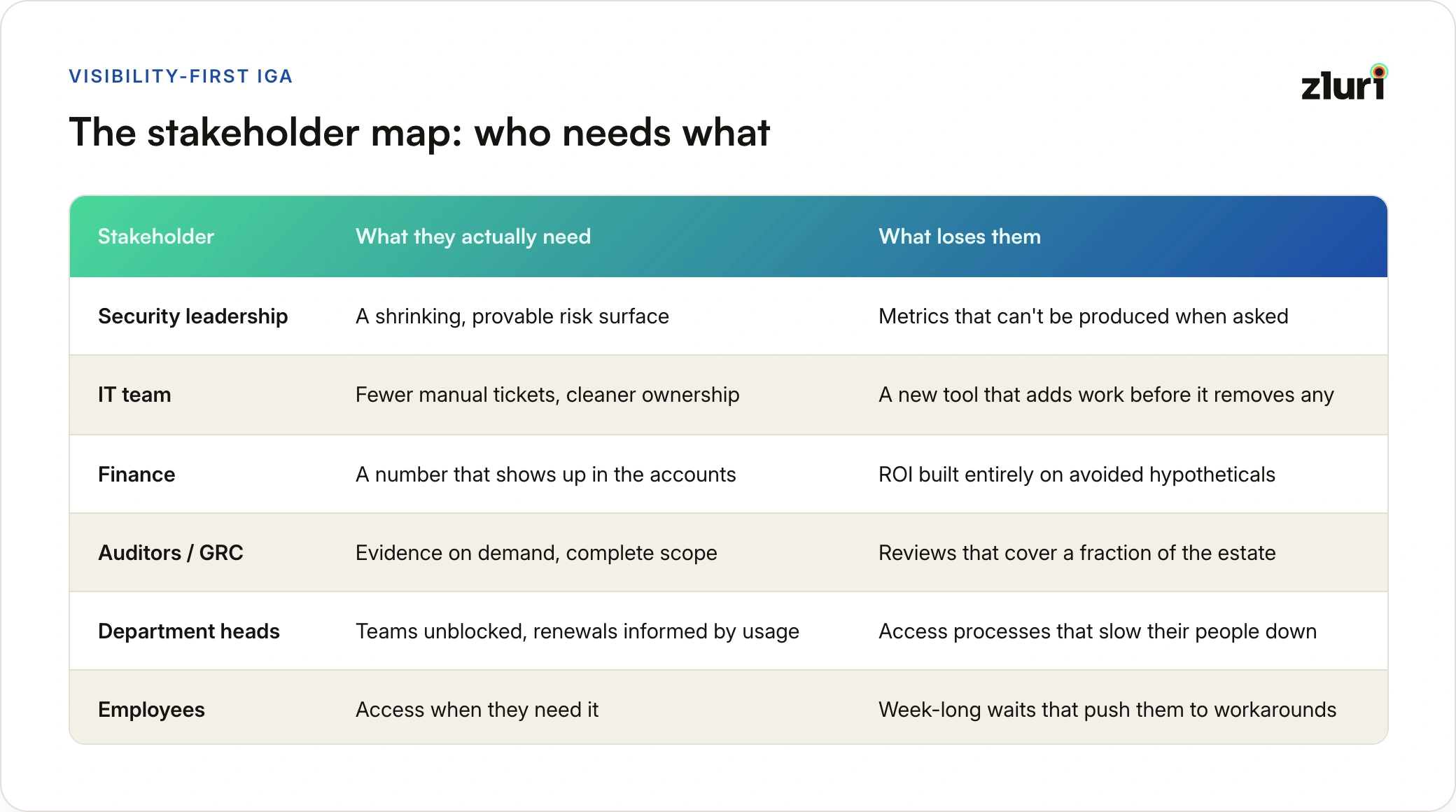
IGA stakeholders don't disagree because they have different priorities. They disagree because they're looking at different maps, and each team's map is missing the part where the other team's problem lives.
Sit in the kickoff meeting for a typical IGA program and you'll watch four teams argue past each other:
- Security wants reviews on the crown-jewel apps first.
- IT wants offboarding automation, because that's where the ticket pain is.
- Finance is asking why this platform costs what it costs when "we already have Okta."
- HR isn't in the room, which everyone will regret in month three.
The standard diagnosis is competing priorities, and the standard prescription is more alignment meetings. But the real problem sits one level down.
Each of these teams is reasoning from a different partial picture of the environment. IT's picture is the IdP's federated app list. Finance's picture is the software spend report, which contains hundreds of apps IT has never seen. Security's picture is whatever the logs cover. HR's picture is headcount and role data that nothing downstream consumes.
Nobody is wrong about their slice. Everybody is wrong about the whole.
Disagreement about priorities is usually downstream of disagreement about facts. Which is why the sequencing decision most organizations treat as purely technical, whether governance or visibility comes first, is actually the biggest political decision in the program.
(For the tactical side of winning each of these four teams over, what specifically to say to Security, IT, HR, and business units, see our guide to IGA buy-in. This article is about a different lever: the sequencing decision that makes those conversations easier in the first place.)
Governance-first forces stakeholders to commit before they can see
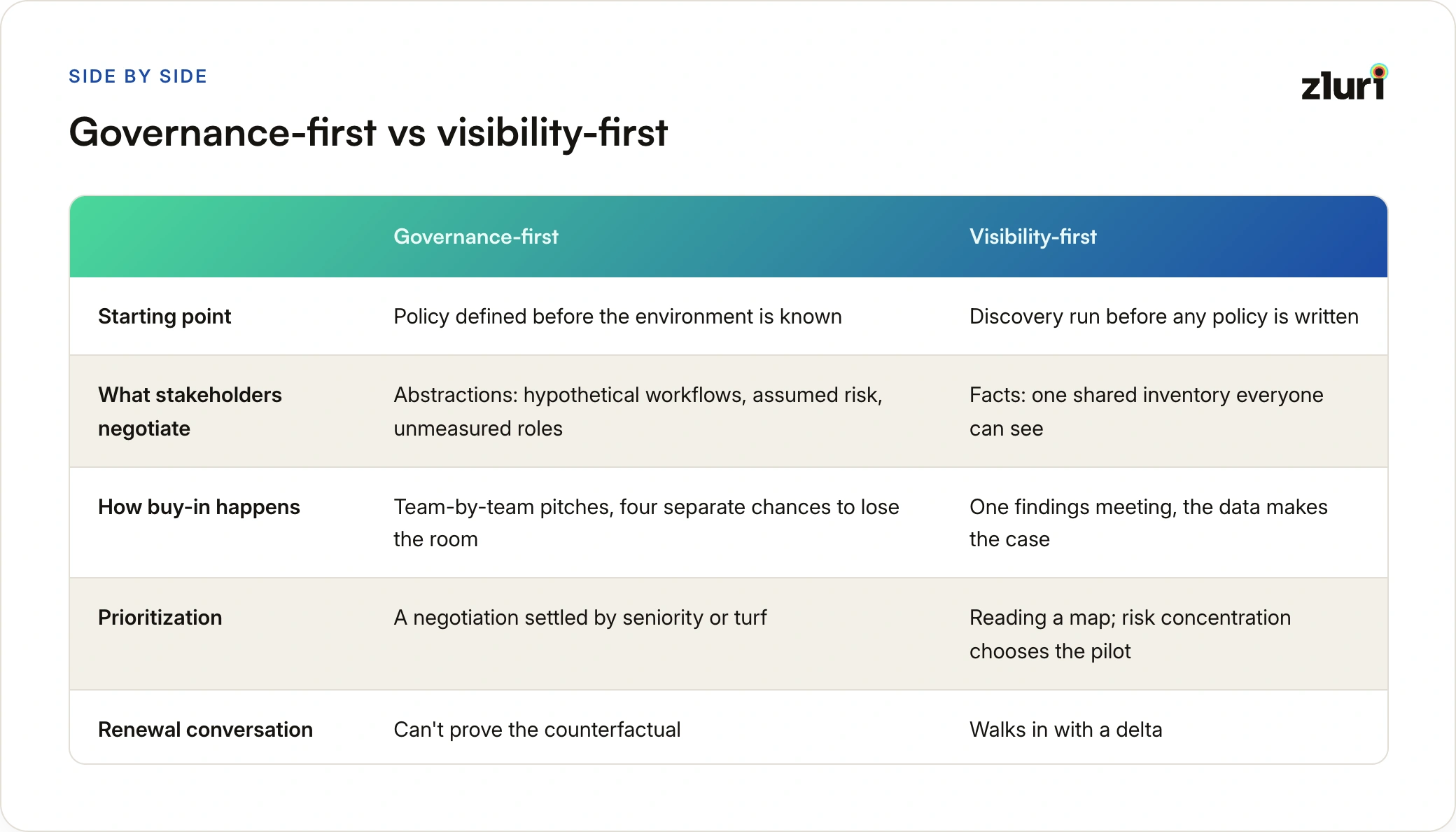
The traditional IGA rollout starts with policy: define roles, design approval workflows, decide review cadences, assign ownership. The platform gets configured to enforce all of it, and only then, gradually, does anyone find out what the environment actually contains.
Notice what this sequence demands of stakeholders. It asks them to negotiate and commit to abstractions:
- Hypothetical workflows for an app inventory nobody has verified
- Review scopes based on assumed risk
- Role definitions for access patterns nobody has measured
Every debate happens in the realm of opinion, because there are no shared facts to appeal to yet. And debates held in the realm of opinion get settled by seniority, persistence, or turf, which is precisely how programs accumulate quiet resentment before they've governed a single account.
The governance-first sequence also hands skeptics their best argument. When a business unit leader asks "what problem are we actually solving here," the honest answer is "we'll know once it's deployed." That's not an answer that wins budget defense in month six.
What changes when visibility runs first
Flip the sequence, run discovery before any policy is written, and the alignment problem starts solving itself. Five specific reasons why.
1. Everyone argues from the same map
Multi-method discovery (SSO and IdP as one signal among several, alongside HR systems, finance and expense data, browser and desktop agents, and APIs) produces a single inventory of applications, identities, and access that no individual team's partial view could have assembled.
The first consequence is subtle but decisive: the kickoff debate stops being IT's list versus finance's list versus security's assumptions, because there is now one list. You cannot align four teams around four pictures. You can align them around one.
2. Each stakeholder finds their own problem in the data
The same discovery run surfaces different findings for different audiences: orphaned accounts and standing privileges for security, unfederated apps for IT, redundant spend for finance, broken lifecycle triggers for HR. (Our buy-in guide walks through what each team is dealing with day to day in more depth; the point here is narrower.)
The point that matters for alignment specifically: nobody has to be persuaded that a problem exists once they've seen their own version of it in their own environment. In a governance-first program, someone has to make the case to each team, four separate pitches, four separate chances to lose the room. In a visibility-first program, the data makes the case, simultaneously, to all four. The pitch stage collapses into a findings meeting.
That collapse is the actual mechanism behind faster buy-in. It isn't that visibility makes the pitches more persuasive. It's that it removes the need to pitch at all.
3. Prioritization stops being a negotiation
When the environment is visible, risk concentration is visible. The question "what do we govern first" changes from a turf contest into something closer to reading a map.
If discovery shows 60 dormant accounts with admin privileges in the finance stack, the pilot scope has effectively chosen itself, and no stakeholder has to lose an argument for the program to proceed. Sequencing decisions made from shared evidence don't generate the resentment that sequencing decisions made from rank do.
This is worth sitting with, because it's counterintuitive. Most people assume prioritization fights are about competing values, security cares about risk, IT cares about workload, the business cares about speed. In practice, a surprising share of those fights are actually about incomplete information dressed up as a values conflict. Once everyone can see the same concentration of risk, the values mostly turn out to agree.
4. The "this will slow us down" objection never gets its footing
Business units resist governance programs because their experience of security initiatives is friction. But visibility asks nothing of them: no workflow changes, no new approval paths, no process to learn.
By the time governance controls actually arrive, they arrive scoped to demonstrated problems, aimed at access that discovery showed to be dormant, orphaned, or excessive, rather than blanket restrictions on access people actively use. Controls that visibly target waste get a very different reception than controls that plausibly target everyone.
5. The baseline writes itself
Every number discovery produces on day one is the before-picture the program will be judged against: orphaned account count, time-to-revocation, unfederated app share, standing privilege volume.
Governance-first programs struggle at renewal time because they can't prove the counterfactual. Visibility-first programs walk into the renewal conversation with a delta they can measure.
This has a second-order effect worth naming: the stakeholders who signed off on the pilot are the same ones who see the delta at renewal. Alignment earned at launch either gets reinforced by visible proof or quietly erodes without it, and which one happens depends entirely on whether anyone can point to a number.
What this looks like in practice
The sequence is compact enough to describe in four moves.
1. Connect discovery before scheduling any policy discussion. Resist the instinct to hold design workshops first. Every hour of policy debate held before the inventory exists is an hour of opinion that the inventory may contradict.
2. Hold a findings meeting, not a pitch meeting. Present the discovered environment to all stakeholders at once, with each team's findings called out in their terms. Let the reaction in the room do the persuasion. This single meeting replaces most of the stakeholder-by-stakeholder evangelism a governance-first program requires.
3. Scope the pilot from the worst finding. The data has already ranked your options. Pick the concentration of risk that is meaningful, contained, and fixable within a quarter, and attach the success metrics directly to the discovered numbers.
4. Write policy for the environment you found, not the one you assumed. Role definitions, review scopes, and approval paths designed after discovery fit reality on the first draft. This is the quiet, compounding benefit: governance-first programs spend their second year retrofitting policies written for an imagined environment. Visibility-first programs mostly don't.
Alignment is an information problem before it's a political one
The instinct when an IGA program stalls in cross-functional friction is to treat it as a people problem: run more alignment meetings, escalate for executive air cover, negotiate harder. Sometimes that's right.
More often, the friction is a symptom of asymmetric information: four teams making reasonable arguments from four incompatible datasets. No amount of meeting cadence fixes that, because the meetings just give the incompatible datasets more chances to collide.
Visibility-first sequencing works because it fixes the information problem before asking anyone to make a political commitment. It's a lot easier to agree on what to do when everyone has already agreed, implicitly, effortlessly, by looking at the same screen, on what is.
How we've built for this at Zluri
This sequencing is Zluri's architecture, not just our advice. The platform runs discovery first as a design principle: eight discovery methods, spanning SSO and IdP, HR systems, finance and expense tools, browser and desktop agents, and direct API integrations, cross-referenced into one inventory that includes the unfederated apps, shadow IT, and non-human identities no single team's view contains.
That inventory, with risk context from IRIS layered on it, is what makes the findings meeting possible in the first weeks rather than after a quarter of log archaeology.
The practical offer, if you're the person trying to align stakeholders right now: run discovery against your real environment before you commit to anything, take the findings into one meeting with all four teams, and see how much of the alignment work the map does on its own. In our experience, it does most of it. And once the room is aligned, our guide to IGA buy-in covers what to do with that momentum, from pilot scoping through scaling the program.
Keeping the Executive Layer Aligned
The stakeholder map doesn't stop at the working team. Two relationships above it decide whether the program keeps its funding, and a shared inventory helps both.
The CIO and CISO often want different things from access, enablement and a smaller blast radius respectively, and a common fact base gives them something to agree from instead of competing anecdotes. That specific dynamic is covered in CIO-CISO collaboration.
The budget conversation changes too, from an annual re-justification into something the program continuously earns by producing numbers finance recognizes. Building that wider coalition, sponsors, champions, and a sequence of internal wins, is its own discipline: our guide to IGA buy-in covers it end to end, and stakeholder alignment for IT leaders covers the broader art of earning budget and a seat at the table.
And once the room is aligned, our guide to IGA buy-in covers what to do with that momentum, from pilot scoping through scaling the program.
Frequently Asked Questions
What does "visibility-first IGA" mean?
It means running discovery, building a complete inventory of applications, identities, and access relationships, before designing or enforcing governance policies. The alternative, governance-first, configures policies and workflows up front and discovers the environment gradually through enforcement, which means policies get written for an assumed environment rather than the real one.
Why do IGA stakeholders disagree so often?
Usually because each team reasons from a different partial dataset: IT from the identity provider's app list, finance from spend data, security from logs, HR from headcount systems. Each view is accurate and incomplete, so each team's priorities are rational and mutually incompatible. A shared inventory removes the factual disagreement underneath the priority disagreement.
Doesn't starting with visibility delay the actual governance work?
The opposite, in practice. Discovery with a modern platform takes days to weeks, and it eliminates the two biggest sources of downstream delay: policy debates held without facts, and policies that need rewriting once the real environment surfaces. Governance work that starts after visibility starts later and finishes earlier.
How do we run a findings meeting well?
Present one shared inventory, then walk each stakeholder through the findings in their own terms: orphaned accounts and standing privileges for security, unfederated apps for IT, redundant licenses and spend for finance, broken lifecycle triggers for HR. End by letting the group scope the pilot from the worst concentration of risk, so the first governance decision is made jointly, from evidence, in the same meeting.
What if discovery finds less than expected and undercuts the case for IGA?
It almost never does; most organizations discover their identity provider covers only 30 to 40 percent of actual application use. But if your environment genuinely comes back clean, that's worth knowing before you buy a governance program sized for a problem you don't have, which is itself a form of stakeholder alignment: alignment on proportionality.

.svg)