.png)




Hand someone a name, an application, and a requested access level, then ask them to decide in ten seconds whether to approve it, and you've built a system that produces exactly two outcomes: reflexive approval or reflexive caution. Neither one is actually a judgment. Both are what happens when a person is asked to assess risk with nothing to assess it against.
The blind approval problem
Every access request management workflow eventually comes down to the same moment: a request lands in front of a person, and that person has to decide whether to grant it. Most platforms hand the approver almost nothing to work with, a requester's name, an application, a requested role, and expect a risk judgment to happen anyway.
That setup reliably produces one of two failure modes, and both come from the same root cause: a decision made blind.
- Reflexive approval. With no information suggesting caution, and no realistic way to deeply review every request at volume, approval becomes the path of least resistance. The approve button turns into a rubber stamp.
- Reflexive friction. The opposite failure, an approver who can't distinguish a routine, low-risk request from a genuinely unusual one starts treating everything with the same caution, slowing down access that should have moved in seconds.
Neither failure mode is really about the approver. It's about what they were given to work with. A person can't tell routine from unusual without a baseline for what's routine, and they can't tell risky from safe without knowing what's actually being granted.
What a good approval decision actually requires
Strip the problem down, and a genuinely informed approval decision depends on three separate questions, each answered by a different kind of context.
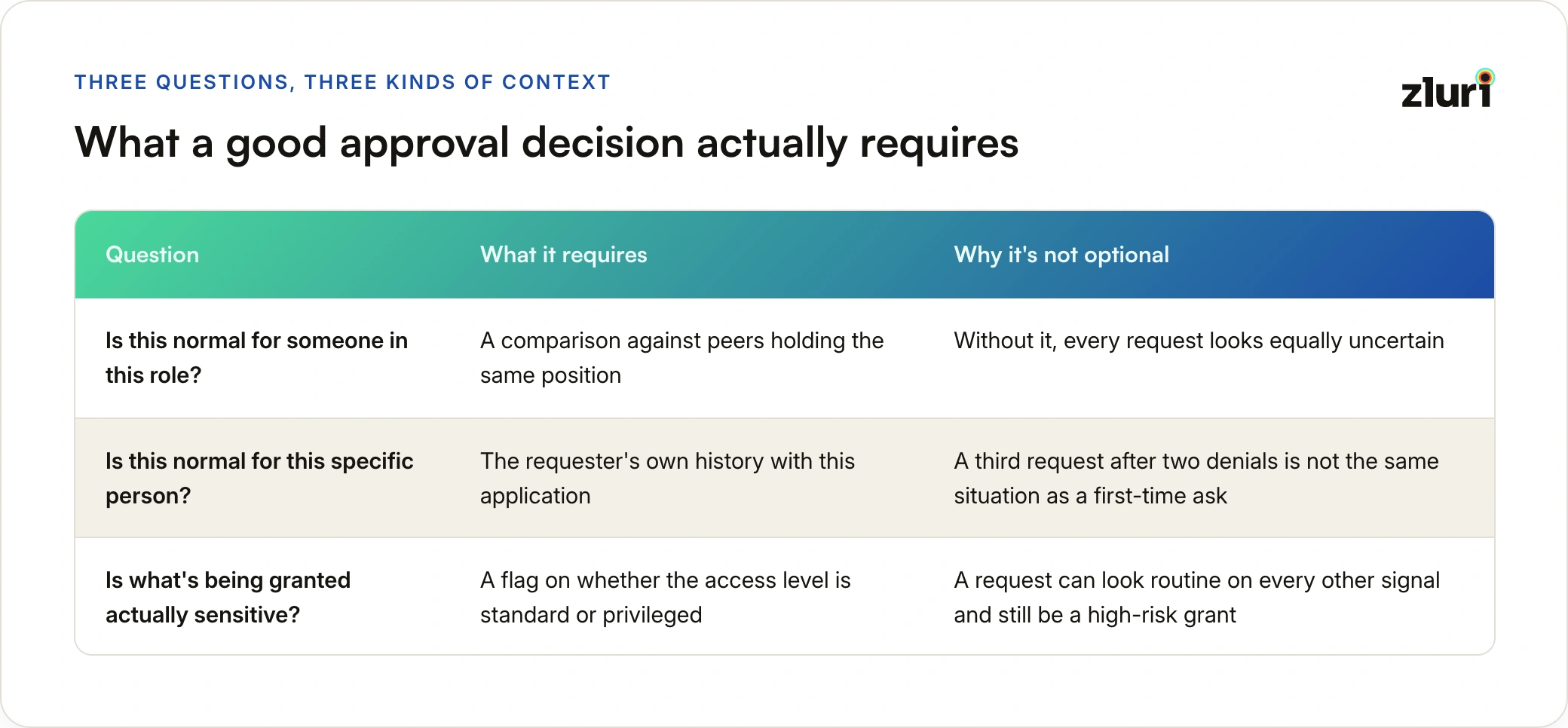
Miss any one of these, and an approver is working with an incomplete picture, even if the other two are covered. A request can be entirely typical for the role, first-time requester, no red flags, and still deserve real scrutiny if what's actually being granted is a privileged tier instead of the standard one. Peer and individual context alone would wave that request through without ever surfacing the one thing that mattered.
And even with all three answered, there's a fourth problem: volume. An approver moving through a queue of requests doesn't have time to manually weigh three separate data points on every single one. Without a way to compress that judgment into something fast, the context exists but doesn't get used, and the workflow reverts to the same blind guessing it was supposed to fix.
Why this has to happen at the moment of decision, not before or after
Where this context shows up matters as much as whether it exists at all.
- As a separate report someone has to go pull up before reviewing requests, it gets skipped under time pressure. Context nobody looks at isn't context.
- As part of a later audit, it can explain what happened after the fact, but it can't change the decision that has already been made.
- Injected directly into the approval moment, right where the approver's attention already is, it's the only version that actually changes what gets decided.
This is the design constraint that matters most, and it's the one most access request tools get wrong. Context that requires a separate step to access is context that mostly goes unused.
How we built Approver Insights around this
This is the exact gap we built Approver Insights to close inside Zluri's Access Requests module. It answers the three questions above, directly, at the point where a human approver is actually about to make a call, not before, not after, and never for requests an auto-approval rule already handled without needing a person's judgment at all.
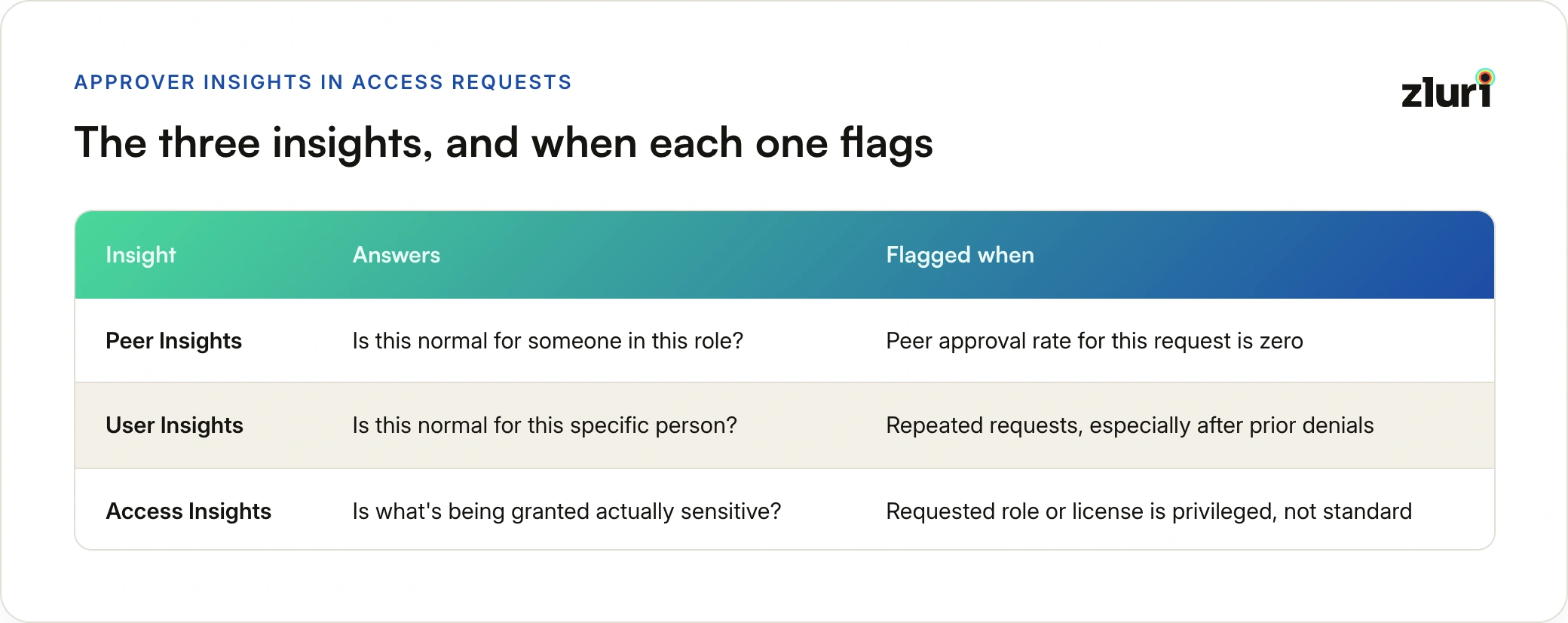
Peer Insights answers the role-normalcy question: what percentage of people holding the same job title already use this application, at what access level, and what's the historical approval rate for people in that position. It's specifically flagged when that peer approval rate is zero, since a request nobody in a similar role has ever had approved before is a meaningfully different situation than a routine one.
User Insights answers the individual-pattern question: how many times this specific person has requested this specific application, their own approval rate, and the outcome of their most recent request. Someone asking for the third time after two denials is a different situation than a first-time request, even when their peer group's overall approval rate looks perfectly ordinary.
Access Insights answers the sensitivity question directly: a flag on whether the requested role or license is standard or privileged. This is what catches the case where everything else looks fine but the actual grant deserves a closer look.
And to solve the volume problem, these three signals synthesize into one interpreted status: Approval Recommended, Review Carefully, or Potential Risk Detected, with the underlying detail still available for anyone who wants to look closer. An approver can move through routine requests quickly and open up the specifics only for the ones actually flagged as worth a second look.
What this looks like in practice
- Approval Recommended requests move through the queue quickly, with real confidence instead of a blind guess.
- Review Carefully or Potential Risk Detected requests are where the underlying Peer, User, and Access Insights actually get opened, giving the approver the specific reason the request stood out before they approve with a note, ask a clarifying question, or reject it outright.
The context is there for every request. The approver's time only goes toward the ones that actually need it.
Frequently Asked Questions
Does every access request show Approver Insights, or only some?
Only requests that actually reach a human approver for a decision. Requests handled entirely through an auto-approval rule, based on predefined criteria, never need this context, since there's no judgment call for a person to make on them.
What's the difference between Peer Insights and User Insights?
Peer Insights compares the request against what other people in the same job title typically have and get approved for. User Insights looks at the specific requester's own history with that particular application: how often they've asked, their own approval rate, and their most recent outcome. One is about the role in general, the other is about this specific person's pattern.
Can a request look fine on Peer and User Insights and still get flagged?
Yes, specifically through Access Insights. A request can be entirely typical for the role and have no concerning history behind it, and still warrant a closer look if what's actually being requested is a privileged access level rather than the standard tier most peers in that role hold.
Why show a summary status instead of just the three underlying data points?
Because an approver working through a queue of requests needs a fast, actionable signal, not three separate figures to manually interpret every time. The summary status does that interpretive work directly, Approval Recommended, Review Carefully, or Potential Risk Detected, while keeping the underlying detail available for anyone who wants to look closer before deciding.
Isn't more context just going to slow approvers down?
Only if it's delivered as something they have to go looking for. Delivered directly at the point of decision and compressed into a single status for routine cases, context speeds up the majority of requests instead of slowing them down, since an approver no longer has to guess whether something is safe to move through quickly.