
This piece breaks down how each category actually handles granting and revoking access, where general-purpose tools genuinely work fine, where they create real gaps, and where Zluri fits into that picture.
A meaningful number of IT teams already use Zapier, Workato, or similar workflow automation tools to grant SaaS access, not as an accident, but as a deliberate, working setup: a new hire triggers account creation across a handful of connected apps, and it functions. This piece isn't arguing that setup is broken. It's looking closely at what it actually covers, where it holds up fine, and where it starts to show real gaps once revoking access correctly, not just granting it, becomes the harder part of the job.
What Zapier, Workato, and Similar Tools Are Built For
Zapier and Workato are general-purpose automation and integration platforms. Their core value proposition is breadth: connect almost any two apps with an API, define a trigger and an action, and let the workflow run without writing code. Zapier supports workflows up to 100 steps with conditional if/then logic. Workato adds a stronger enterprise integration layer, event-triggered workflows, and a visual builder for defining triggers, actions, data mappings, and more complex automation logic.
Using this for SaaS access isn't a misuse of the tool. It's a reasonable extension of what it already does well: a new hire event in an HR system triggers account creation and group membership in a handful of connected apps, which is exactly the trigger-and-action pairing these platforms are built for. The same tools are also genuinely excellent at connecting disparate business tools for marketing, sales, and general operations, pushing a new Salesforce lead into a Slack channel, or syncing a form submission into a spreadsheet, so it's not unusual for the same Zapier or Workato instance already running those workflows to pick up access provisioning too.
Where This Approach Breaks Down for Granting and Revoking Access
The same flexibility that makes Zapier and Workato powerful for general automation creates specific, compounding problems once they're used to grant and revoke SaaS access specifically.
Granting access is a simple trigger-and-action pairing. Revoking it usually isn't. A new hire triggers account creation, that's straightforward, and general-purpose tools handle it well. Revoking access is harder in practice, because it's rarely a single clean event. The clearest failure case shows up when someone changes roles or departments rather than leaving the company entirely: the workflow that fires grants the new access, but nothing in the logic explicitly forces the old access to be removed. The person ends up with both the new permissions and everything they had before, and that leftover access just sits there, unnoticed, until someone happens to go looking for it.
Execution logs aren't the same as current access state. Workflow platforms are built to execute actions, run this provisioning step, fire that deprovisioning task, not to maintain a queryable record of who currently has access to what. You can confirm a workflow ran. Answering "who has admin access to this app right now, and why" is a different question entirely, one these tools weren't built to answer directly, since they log task execution rather than access state.
Access events get buried in unrelated workflow traffic. The same Zapier or Workato instance handling access provisioning is frequently also running marketing, sales, and finance automations in parallel, a new lead pushed to a CRM, an invoice approval, a Slack notification. All of it lands in the same execution log. Isolating just the access-related events from everything else becomes its own manual task, exactly when you need that data fastest, during an audit.
Policy changes mean touching every workflow individually. There's no central rule layer sitting above the individual workflows. Adding a second approval step for a specific role, or changing which apps get revoked by default on a role change, means finding and editing every relevant recipe separately, then hoping the logic stayed consistent across all of them. Nothing in the platform's architecture makes it a global setting.
Workflow proliferation with no standardization. Visual builders make it genuinely easy to create a new workflow. That ease has a side effect: it's almost always faster to build a new grant or revoke variation than to understand and modify an existing one. In practice, this means Sales ends up with seven onboarding variations, Engineering has nine, and every one of those variations needs separate maintenance whenever a connected app changes. Nobody owns the full picture, and the workflow count keeps growing because creating new is easier than reconciling old.
Thin audit trails for what access actually changed. Compliance and audit require a clear, centralized record of what access changed, when, why, and who approved it. General-purpose tools log workflow executions, but that log isn't built around identity and access as a first-class concept, which means proving old access was actually revoked often means manually reconstructing what happened across dozens of separate workflows rather than pulling a single report.
Coverage limited to apps with clean APIs, and manual setup even then. Zapier and Workato both depend on the target application exposing a workable API, and even where that API exists, each connection typically needs to be configured manually: mapping fields, defining triggers, and building the logic from scratch for every app in the stack. That setup burden multiplies with every new application added, and legacy systems, homegrown internal tools, and applications with limited or no API access fall outside what these platforms can automate cleanly regardless, meaning access can only be revoked from apps someone remembered to manually wire in.
No visibility into what access actually exists before revocation fires. General-purpose tools automate whatever workflow you build, but they don't discover a user's actual access footprint first. Revoking access correctly on a role change requires knowing everything that access included in the first place, and if an app isn't already known and manually connected, it simply isn't part of the automation at all.
Tribal knowledge risk. When workflows are built ad hoc by whoever needed one at the time, institutional knowledge about how a given grant or revoke workflow actually works tends to live with one person. That's manageable at small scale. It becomes a real liability once dozens of workflows exist and the person who built the "Sales-Enterprise-International" onboarding flow leaves the company.
None of this means Zapier or Workato are poorly built tools. It means granting and revoking access correctly has requirements, explicit removal logic, standardization, audit-first design, and pre-existing visibility into what access already exists, that a general-purpose automation platform wasn't built around.
Where This Actually Breaks: A Question of Scale
None of the gaps above are usually visible early. At 100, 200, even 500 employees, a handful of workflows covering the most-used apps genuinely holds up. Headcount is low enough that one or two people can keep the recipe list in their head, role changes are infrequent enough that occasional leftover access doesn't compound into a real problem, and the app portfolio is small enough that manually wiring in each new integration is a manageable, if tedious, task.
That stops being true well before 1,000 employees, and the breakdown shows up across three areas at once rather than one at a time:
Compliance. Audit scope grows with headcount and app count together, and a workflow-execution log was never built to answer "who has access to what, right now, across the full application portfolio" at that volume. Audit prep stops being a few hours of pulling reports and becomes a multi-week reconstruction project, because the underlying data was never stored in a queryable, access-first format to begin with.
Security. Leftover access from an incomplete revocation is a small, containable problem at 200 employees. At 1,000-plus, with proportionally more role changes, department switches, and reorganizations happening continuously, the accumulated gap between what a general-purpose workflow revoked and what actually should have been revoked becomes a real, standing attack surface, not a rare exception.
Productivity. The IT time spent maintaining and debugging recipes scales roughly with headcount and app count multiplied together, not with either one alone. What was a manageable maintenance task at 500 employees and 30 connected apps becomes a full-time job at 1,000-plus employees and a proportionally larger app portfolio, pulling IT attention away from actual security and strategic work toward keeping a growing pile of individual workflows from silently breaking.
The threshold isn't a hard number so much as the point where headcount, app count, and organizational change velocity together outgrow what a set of individually maintained workflows can absorb. For a lot of organizations, that point lands somewhere around 1,000 employees, sometimes earlier if the app portfolio or reorg pace is unusually high.
Zluri vs Zapier vs Workato: At a Glance
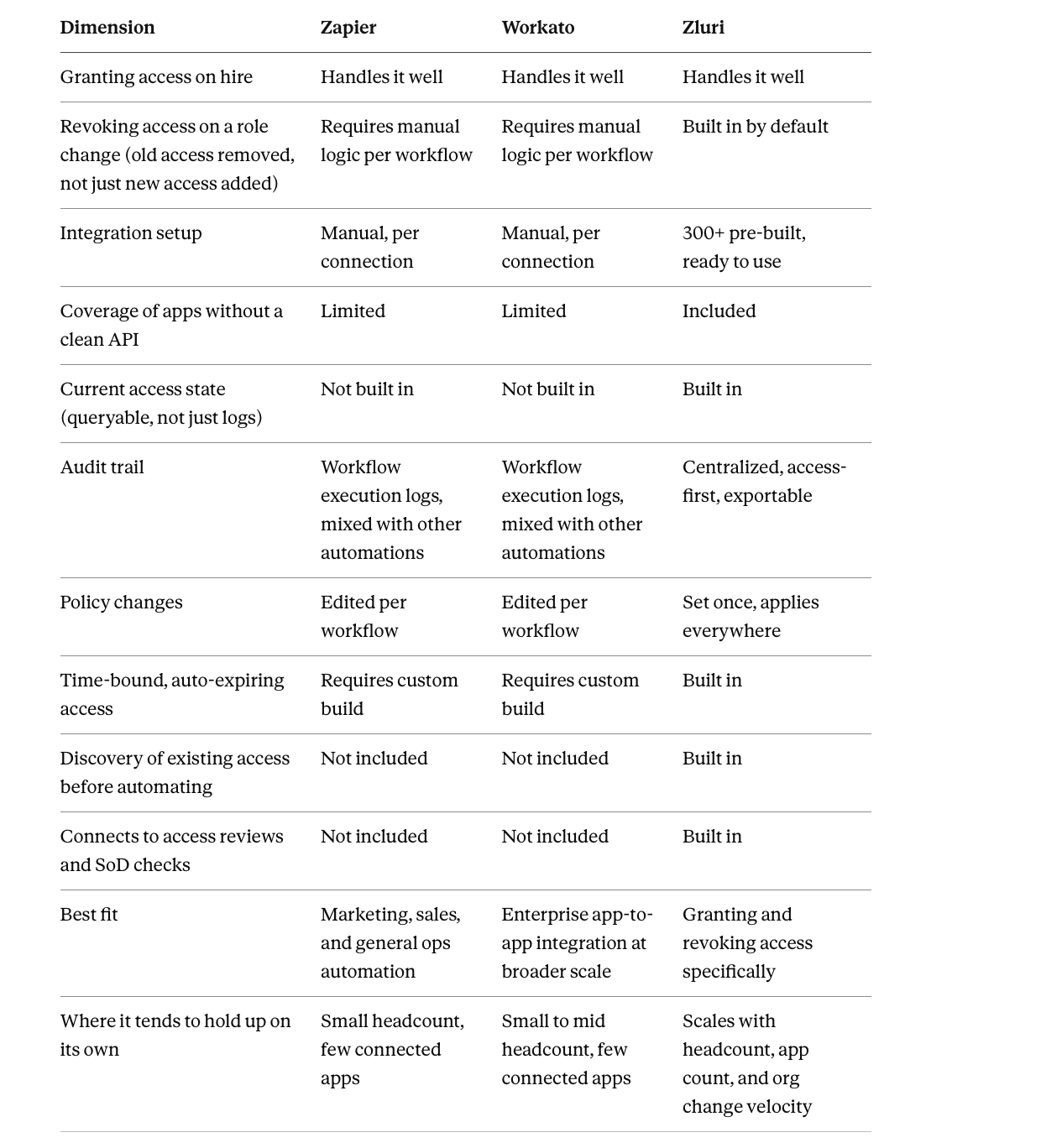
This isn't a claim that Zapier and Workato are worse products overall, they're not being evaluated for the same job here. It's a comparison scoped specifically to granting and revoking access.
What Granting and Revoking Access Correctly Actually Requires
Getting this right needs a few things that general-purpose tools don't prioritize by default:
- Explicit revocation logic, so a role change removes old access in the same transaction that grants new access, rather than treating it as a pure addition
- Pre-existing visibility into current access, so the automation knows exactly what to revoke, not just what to grant
- A queryable current-access state, not just execution logs, so "who has access to what right now" is a direct lookup rather than a manual reconstruction from task history
- A central policy layer, so changing an approval rule or default access set happens once and applies everywhere, rather than requiring every individual workflow to be found and edited separately
- Pre-built, ready-to-use integrations rather than manually configured connections for every application, so revocation can actually reach every app someone has access to, not just the ones manually wired in
- Structured, reusable playbooks rather than one-off workflows, so granting and revoking access follows a consistent, governed process regardless of who's building it
- A single audit trail covering exactly what access changed and when, not workflow execution logs that require manual reconstruction
- Coverage beyond SSO-federated apps, since a meaningful share of a user's real access footprint sits outside clean API access
- HRMS-driven triggers tied to actual lifecycle events (hire date, role change, termination) rather than manually initiated automations
- A closed loop back into governance, so provisioning and deprovisioning connect directly to access reviews, segregation of duties checks, and access requests, instead of automation and governance living as two disconnected systems
Where Zluri Fits
Zluri's automation is purpose-built around granting and revoking access specifically, rather than general business process automation.
Explicit revocation logic built into every role change. When a user changes role or department, Zluri grants the new access and removes the old access as part of the same workflow, rather than treating the change as a pure addition. This directly closes the gap that's the most common source of leftover access when general-purpose tools handle the same use case.
Pre-built integrations instead of manual setup. Where Zapier and Workato require each connection to be configured from scratch, field mapping, trigger logic, and all, Zluri's 300+ direct integrations come ready to use out of the box, including coverage for applications with limited or no API access, so revocation can actually reach the full scope of a user's access rather than whatever apps were manually wired in.
Discovery before automation. Zluri's visibility layer surfaces a user's real application and identity footprint first, including shadow IT and apps nobody centrally tracked, so a role change knows exactly what access exists and needs to be revoked, rather than only acting on whatever list someone remembered to manually connect.
Structured playbooks over ad hoc workflows. Rather than every team building its own grant and revoke variation from scratch, workflows run through a reusable playbook model, which keeps standardization intact even as the organization scales and different teams need slightly different processes.
HRMS-triggered lifecycle automation. Access grants and revocations trigger directly off HR system events. Zluri evaluates a new employee's job profile, seniority, and department to grant access automatically, and a role or department change fires the corresponding grant-and-revoke logic without manual follow-up.
Automation connected directly to governance. Granting and revoking access aren't a standalone workflow layer sitting apart from access reviews, segregation of duties checks, and access requests. They're part of the same system, so an access review can trigger revocation automatically, a segregation of duties conflict can block a grant before it executes, and an access request runs through the same policy engine that governs the rest of the lifecycle. General-purpose automation tools can execute the individual actions, but they don't close that loop back into governance on their own.
Audit trail built around identity and access as the core object. Every grant, revocation, and access change is logged in a way that's directly usable as compliance evidence, rather than requiring manual reconstruction across scattered workflow logs.
A queryable access state, not just execution logs. Every grant and revocation action updates a current, centralized record of who has access to what, so answering "who has admin access to this app right now" is a direct lookup rather than a reconstruction project across scattered workflow history.
One policy change applies everywhere. Approval rules and default access sets live in a central policy layer rather than being embedded separately inside each individual workflow. Adding an approval step for a specific role, for instance, is a single change that applies consistently across every relevant workflow, not an edit repeated across however many separate recipes touch that role.
Self-service access requests with automatic expiry. Employees request additional SaaS apps directly, with IT-defined triggers and conditions driving fast, precise approvals instead of the ticket-and-email loop general-purpose automation tools weren't designed to replace. Access can be granted for a specific duration, with revocation firing automatically when that period ends, removing the manual cleanup step that time-bound access otherwise requires.
Do These Tools Compete, or Serve Different Purposes?
Realistically, most organizations end up using both categories, just for different things. Zapier or Workato remain a reasonable choice for connecting marketing, sales, and general operational tools where workflow logic is simple and standardization matters less, and they handle granting access on hire fine. Revoking access correctly and consistently, especially on a role change rather than a departure, is a different problem with different requirements, and that's the specific gap Zluri is built to close.
The mistake isn't choosing a general-purpose tool. It's using one to grant and revoke access without accounting for the revocation logic, visibility, and audit requirements that category was never built around, and discovering the gap only once leftover access has already accumulated across a real employee population.
Frequently Asked Questions
Can Zapier or Workato grant access when someone new is hired?
Yes, reasonably well. Granting access is a simple trigger-and-action pairing, new hire triggers account creation and group membership, which is exactly what general-purpose automation tools are built for. The gap shows up specifically on revocation.
Why does revoking access specifically break down in Zapier or Workato?
Because revocation usually needs to happen alongside a grant, most commonly on a role change, where new access is added and old access needs to be removed in the same event. General-purpose workflows are typically built around simple trigger-and-action pairs, so most implementations handle the granting half and stop there, leaving old access in place with nothing forcing its removal.
Why does workflow proliferation happen more with general-purpose tools than with identity-specific platforms?
Visual builders make creating a new workflow genuinely easy, easier than understanding and modifying an existing one. Without a structured playbook model enforcing reuse, different teams tend to build their own grant and revoke variations of the same process, and each variation then needs separate maintenance whenever a connected app changes.
At what company size does using Zapier or Workato for access grants and revocations actually start to break down?
There's no exact cutoff, but the pattern shows up consistently somewhere around 1,000 employees, sometimes earlier depending on app portfolio size and how frequently roles change. Below that, a handful of workflows covering the most-used apps genuinely holds up. Past it, compliance audit prep, security exposure from accumulated leftover access, and the IT time spent maintaining a growing pile of individual workflows all tend to break at roughly the same time.
Why do problems that were manageable at 200 or 500 employees suddenly become serious at 1,000-plus?
Because the underlying issues, leftover access from incomplete revocation logic, workflow-execution logs standing in for real access state, recipe maintenance overhead, don't scale linearly with headcount. Role changes, app count, and reorg frequency all increase together, and a set of individually maintained workflows absorbs that compounding growth far worse than a purpose-built platform with centralized policy and a single access-state record.
Is Zluri a replacement for Zapier or Workato?
Not for general business automation. Zluri is purpose-built for granting and revoking access specifically. Most organizations continue using Zapier or Workato for other automation needs, marketing, sales, and general operations, while using a platform built around identity for provisioning and deprovisioning.
Why can't Zapier or Workato answer "who currently has access to this app" directly?
Because they log task execution, not access state. You can see that a provisioning workflow ran successfully, but that's a record of an event, not a current, queryable snapshot of who has access to what right now. Answering that question means manually piecing together data from workflow history and the target applications themselves.
Does using Zapier or Workato for access provisioning make audit prep harder?
It often does, mainly because access-related workflow runs sit in the same execution log as every other automation the platform handles, marketing, sales, finance, and so on. Isolating just the access events from that combined log, and reconstructing current access state from a series of past executions, tends to be the specific part of audit prep that takes the longest.
What's the real risk of using a general-purpose tool for access revocation long-term?
The most consistent risk is leftover access accumulating quietly: old access that never got explicitly removed on a role change, spread across however many apps and however many role changes have happened since the workflow was first built. It tends to surface all at once during an audit rather than gradually, since there's no centralized log forcing visibility into it earlier.
Does identity-specific automation cover applications that don't have a clean API?
Purpose-built identity platforms generally invest specifically in this gap, since it's one of the clearest limitations of API-dependent general-purpose tools, and it directly affects whether access can actually be revoked everywhere it exists. Coverage varies by platform, so it's worth confirming directly against the specific applications in your stack rather than assuming universal coverage.
Why does it matter if provisioning automation connects to access reviews and segregation of duties, rather than just executing on its own?
Without that connection, automation and governance operate as two separate systems that have to be manually reconciled. Access reviews can't automatically trigger revocation, a segregation of duties conflict won't block a grant before it happens, and audit teams end up cross-referencing workflow logs against a separate governance system rather than pulling one consistent record.



.svg)