

The scenario is increasingly common. Someone on the finance team discovered that an AI tool could summarize investor reports in minutes instead of hours. Nobody asked IT. Nobody asked compliance. They just started using it, because it worked.
The security problem is real: non-public financial data going through an external API with unknown retention policies, no audit trail, and no access controls. The productivity reality is also real: that person saved five hours a week. Banning the tool does not make the workflow go away. It makes the workflow invisible, which is worse.
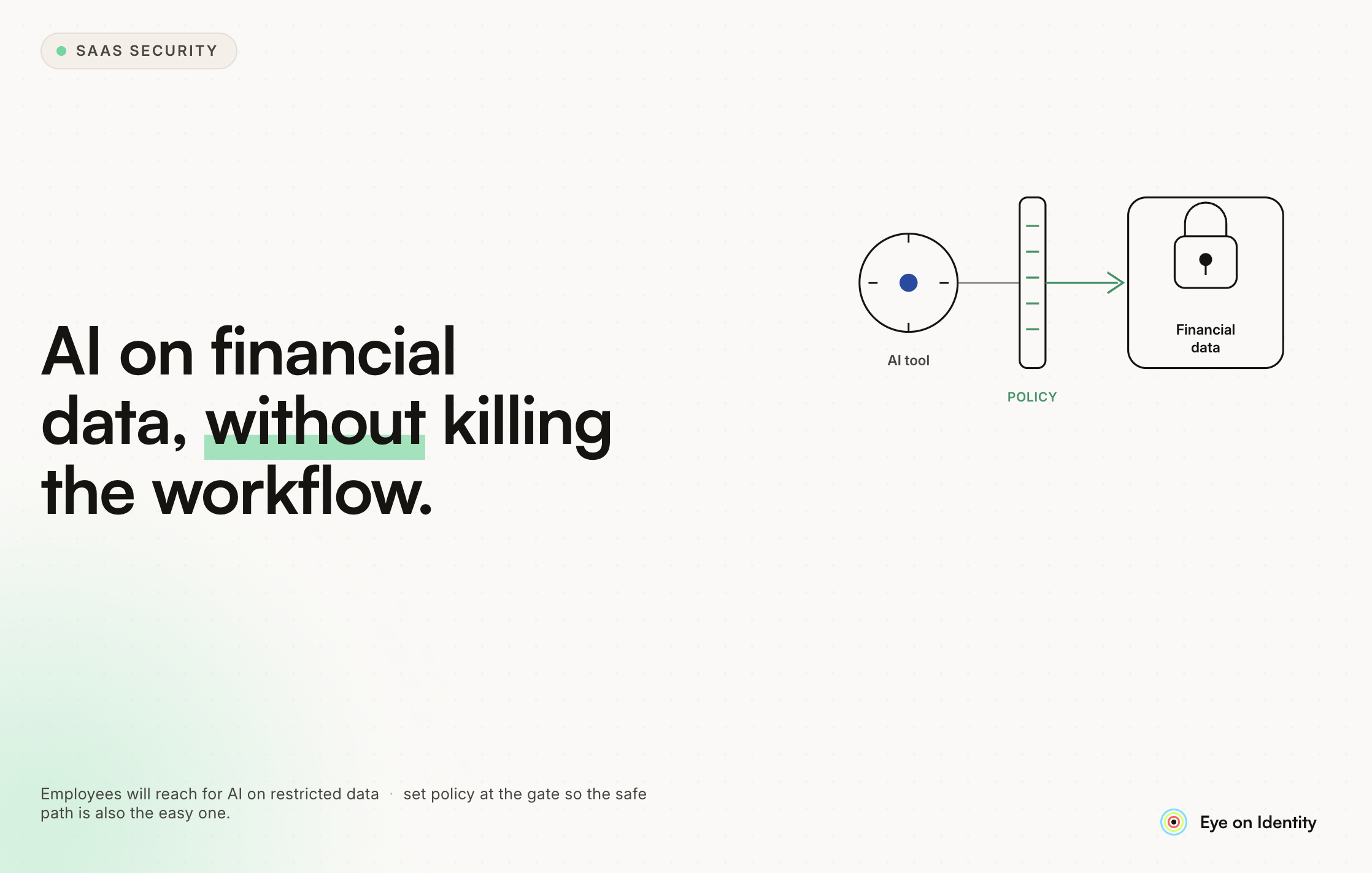
The right response is not a prohibition. It is identity governance applied to AI tool usage: visibility into what tools are in use, policy enforcement that distinguishes approved from restricted tools, and audit trails that create accountability without eliminating productivity.
Why Banning Does Not Work (And What Happens When You Try)
The pattern is consistent across organizations that have tried blanket AI bans. The tools move to personal devices. Usage continues on home networks or phones. IT has less visibility than before, not more. The compliance risk does not go away; it becomes harder to detect.
The insight that practitioners keep landing on is that the control point is not the network. By the time AI traffic reaches your firewall, it is encrypted HTTPS traffic to an external API endpoint. You can block the domain, but you cannot inspect the payload. You cannot see what data left your environment or what the model retained.
The actual control point is the moment of interaction: when the user opens the AI tool and begins submitting data. That is where browser-layer visibility tools and identity governance intersect.
The Architecture of the Problem
Governing AI tool usage on sensitive data requires addressing three distinct problems simultaneously:
Discovery and visibility. You cannot govern what you cannot see. The first step is knowing which AI tools are in use, who is using them, how frequently, and whether they are officially sanctioned. This requires discovery beyond network logs: browser agents that capture URL-level activity, SSO log analysis, and financial system monitoring to catch AI subscriptions purchased outside IT procurement.
Identity and session context. Knowing that traffic went to api.openai.com is not the same as knowing who sent it and what they sent. Effective governance ties AI tool usage to specific user identities, with enough context to enforce role-based policy: finance staff with access to MNPI should have different AI access policies than marketing staff working on public content.
Policy enforcement with appropriate granularity. Blocking everything is too blunt. Allowing everything is too permissive. The right model is classification-based: approved AI tools for appropriate use cases, restrictions on sending specific data categories to specific endpoints, and automated enforcement that runs as a consistent policy rather than depending on individual judgment calls.
What the Browser Layer Can and Cannot See
The most useful practitioner insight from organizations that have tackled this problem is where the real control point is.
Browser-layer tools, like LayerX, operate at the moment of interaction. They sit inside the browser as an extension, intercept submissions to external AI endpoints, and can apply DLP rules before data leaves the device. This gives you the ability to classify what is being submitted, redact specific data categories, block submissions that violate policy, and create an audit trail tied to actual user identity.
The key distinction: this is categorically different from network-level monitoring. A firewall or CASB sees domain-level traffic. A browser agent sees the interaction layer: what is being pasted into a prompt, what data is being submitted, which user is doing it.
For the specific problem of non-public financial data going to external AI APIs, browser-layer DLP is currently the most effective technical control because it operates before the data leaves the device rather than trying to inspect encrypted traffic after the fact.
The Identity Governance Layer: AI Tools as Identities
Beyond the browser-layer DLP question, the longer-term solution involves treating AI agents and AI tool usage as an identity governance problem, not just a security monitoring problem.
This means two things:
Governing which humans can access which AI tools. Once AI tools are classified (approved, restricted, or prohibited), that classification should feed into access policy the same way SaaS application access is governed. Users should be able to request access to approved AI tools through a formal workflow. Requests for restricted tools should require additional justification and manager approval. Access should be reviewable and revocable through the same lifecycle management processes that govern SaaS access.
Governing the AI agents themselves. When AI tools are connected to internal systems, the integrations create non-human identities: API keys, OAuth tokens, and service connections that have access to internal data and systems. These are identities in the same sense that service accounts are identities, and they carry the same governance requirements: ownership, least privilege, expiration, and regular review.
If a finance team's AI tool is connected to your financial data systems, that connection is a non-human identity with permissions that should be governed, reviewed, and revocable.
How Zluri Addresses the AI Governance Layer
Zluri's role in this problem is the identity and access governance layer, complementary to browser-layer DLP tools rather than a replacement for them.
GenAI App Visibility Engine. Zluri's Discovery Engine, which ingests signals from browser agents, SSO logs, and financial systems, feeds into a GenAI visibility module that automatically discovers and classifies AI tools in use across the organization into more than 37 sub-categories. This surfaces the full shadow AI footprint: which tools are in use, who is using them, and how frequently, including tools that never went through IT procurement.
Classification and policy automation. Once AI tools are discovered, administrators can classify them as approved, restricted, or prohibited within Zluri. Classification triggers automated policy responses: a user accessing a restricted AI tool can generate a security alert, push an event to the SIEM, or trigger a revocation playbook that removes their access through the tool's API. This creates dynamic enforcement rather than static IP blocks.
Non-human identity governance for AI agents. For AI tools that are integrated with internal systems, Zluri's IVIP module discovers and maps the resulting non-human identities: which AI agent connects to which internal systems, what permissions it holds, who owns it, and what its current secret state is. This is the infrastructure that makes AI agents governable in the same way human access is governed.
Prompt-level visibility limitation. Zluri's browser agents capture URL-level activity and identify AI tool usage, but they do not capture prompt text or data payloads. For organizations that need to enforce data classification rules at the prompt level, pairing Zluri's identity governance with a dedicated browser DLP tool like LayerX provides the coverage that neither tool provides alone: Zluri handles identity visibility, access policy, and lifecycle governance; the browser DLP tool handles prompt-level inspection and data classification enforcement.
The Approved Channel Model: Making Security the Path of Least Resistance
The practitioners who have solved this problem consistently describe the same end state: not a ban, and not uncontrolled usage, but an approved channel that provides the same productivity value with appropriate controls.
For the finance team scenario, that means:
Identifying an approved AI tool (or deploying a controlled AI gateway) that can handle the summarization use case with enterprise data retention commitments, prompt logging, and no model training on submitted data.
Routing financial workflows through the approved channel with DLP policies that classify and control what can be submitted.
Formally sanctioning the workflow while making the unapproved alternatives subject to policy enforcement.
The finance person continues saving five hours a week. The data stays within a governed boundary. IT has visibility. Compliance has an audit trail. The workflow that was driving shadow AI adoption is now driving adoption of the approved channel.
That transition requires both the policy framework (what is approved, what is restricted, who can access what) and the technical controls (browser DLP, identity governance, automated enforcement) to make the approved path genuinely easier than the workaround path.


.svg)