

Access reviews are one of the most time-consuming and error-prone processes in identity governance — and also one of the most audited. When the tooling does not actually close the loop between "reviewer says revoke" and "access is revoked in the downstream app," the entire process produces compliance theater rather than actual security improvement.
The Reddit thread behind this article is from a team currently on Saviynt being pushed by management to evaluate Veza. The concern is real: not all tools marketed for access reviews are doing the same thing. Here is what to evaluate, how to run a demo that actually tells you something, and what capabilities separate a genuine access review platform from a compliance checklist wrapper.
Why Access Review Tooling Varies More Than Vendors Admit
Access reviews sit at the intersection of two different product categories that both claim to solve the problem:
Compliance monitoring tools — Vanta, Scrut, Drata and similar — track whether access reviews have been completed. They connect to your identity provider, pull a user list, and tell you that a review is due or overdue. They do not execute the review. When a reviewer decides to revoke access, the tool records that decision and leaves the actual revocation to someone else — typically an IT administrator manually logging into the application.
IGA platforms — SailPoint, Saviynt, Omada, Zluri and similar — provide the execution engine. The review is run inside the platform, and when a reviewer decides to revoke or downgrade access, the platform executes that change directly in the downstream application. The loop closes automatically.
The gap between these two approaches matters operationally. A compliance tool that records revocation decisions but requires manual follow-through to execute them introduces a delay between the decision and the action — and creates a log of decisions that may or may not have been acted on. An IGA platform with auto-remediation executes the change immediately and logs the execution, not just the decision.
If you are evaluating access review tooling, the first question to ask any vendor is: when a reviewer clicks "revoke," what happens next? If the answer involves any manual step to execute the change in the application, you are looking at a compliance monitoring tool, not an IGA execution engine.
The Demo Test That Actually Works
One practitioner in the Reddit thread described an evaluation method that is worth adopting directly: pick five real applications — large, messy ones with complex user populations and non-standard access structures — and ask each vendor to import them, map users, and start a live review in a one-hour demo. They should be able to do it in 30 minutes.
This test surfaces several things that standard vendor demos obscure:
How the setup actually works. Vendor demos typically use pre-configured environments with clean data. Your environment has messy apps, users with inconsistent attributes, and access that was never formally provisioned. Watching a vendor work through real data shows you whether the platform handles that complexity or whether it only works in ideal conditions.
How long configuration actually takes. If mapping a single application takes 20 minutes in a demo, your team of one is going to spend weeks onboarding your full app catalog. Speed of setup matters as much as features, particularly for smaller teams.
How reviews are actually configured. The difference between vendors often shows up not in whether they support multi-level reviews, but in how easy it is to configure them. Can a non-developer set up a two-level review workflow in under 10 minutes? Can they modify it without IT involvement?
How remediation works. Ask the vendor to complete a revocation action during the demo and show you what happened in the downstream application. If they cannot demonstrate live remediation in a demo environment, ask why.
What Full-Cycle Access Review Capability Looks Like
For teams evaluating IGA platforms specifically for access review depth, the capabilities that separate platforms from each other:
Auto-remediation tied to reviewer decisions. When a reviewer marks access as revoke or downgrade, the platform executes the change in the connected application without requiring IT to manually process it. This requires native integrations — the platform has to actually be able to write to the downstream application, not just read from it. Verify the specific applications in your stack are supported before assuming this works end-to-end.
Multi-level review workflows. Complex compliance environments often require sequential review — the user's manager validates business need before the application owner validates technical permissions. Platforms that support configurable multi-level workflows (typically up to four or five sequential levels) handle regulated industries and complex org structures where a single reviewer does not have sufficient context.
AI-driven reviewer recommendations. Access reviews are only as good as the decisions reviewers make — and reviewers who are presented with a flat list of users and access with no context tend to rubber-stamp approvals. Platforms that surface relevant signals alongside each review decision — dormant accounts, outlier privileges compared to peers, access linked to users who have changed roles — give reviewers the context to make accurate decisions rather than guesses.
Self-review prevention and fallback assignment. Reviewers should not be able to certify their own access. Platforms that automatically detect and reassign self-review scenarios eliminate a governance gap that is easy to miss in manual processes. Fallback reviewer assignment — automatically routing review tasks when a manager position is vacant — prevents campaigns from stalling when org structure is incomplete.
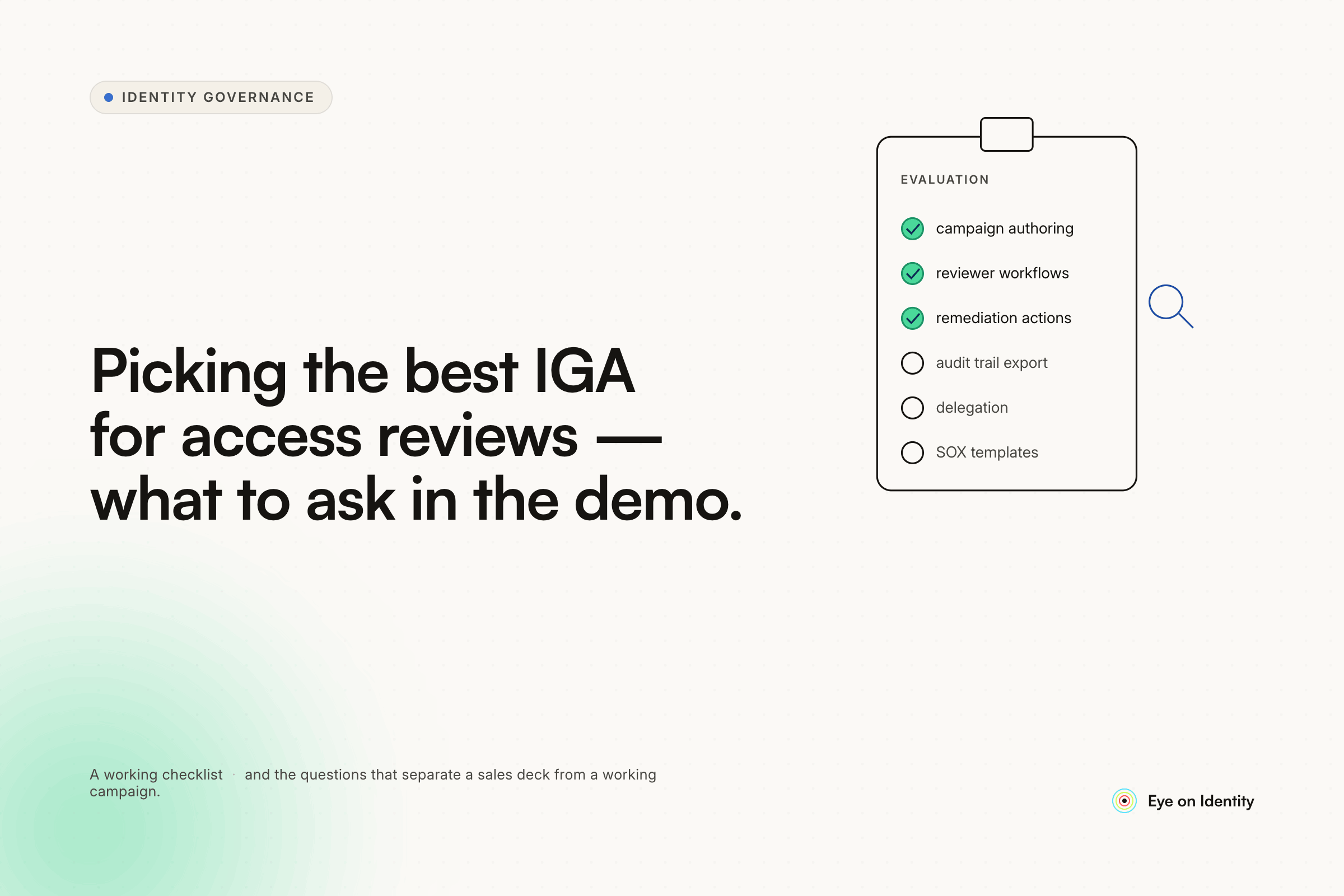
Audit-ready evidence generation. The output of a completed certification campaign should be a timestamped, immutable report that documents who was reviewed, what decisions were made, who made them, what justifications were provided, and when remediation was executed. This report goes directly to auditors for SOC 2, ISO 27001, HIPAA, and similar frameworks. Ask vendors to show you a sample report from a completed campaign — if it requires manual assembly or additional formatting before it is auditor-ready, factor that into the evaluation.
Group-based reviews. For organizations where SSO group memberships drive access to multiple downstream systems, reviewing group membership is more efficient than reviewing each downstream application individually. Platforms that support group-level certification — auditing Azure AD or Okta group memberships as the governance layer — reduce reviewer burden significantly in IdP-centric environments.
The Cost and Complexity Trade-Off at Different Scales
The Reddit thread captures a dynamic that is common in access review evaluations: the enterprise platforms (SailPoint, Saviynt) have deep capability but come with corresponding complexity and cost. For a team of one managing 2,000 users with messy apps and complicated workflows, implementation overhead and ongoing maintenance burden are real factors that feature depth alone does not justify.
The evaluation framework that the practitioner in the thread used — speed of import, speed of configuration, ability to start a real review in 30 minutes — is a direct proxy for operational burden. A platform that can set up a complex review campaign quickly in a demo will also be faster for your team to operate day-to-day. A platform that requires extensive configuration before it works is a platform that requires ongoing configuration effort to maintain.
For mid-market teams, the relevant question is not which platform has the most features — it is which platform your team can actually operate without dedicated identity engineering staff. That filters the field significantly and often points toward next-generation platforms designed for faster time-to-value over legacy enterprise tools designed for maximum configurability.
FAQ
What is the difference between a compliance tool and an IGA platform for access reviews?
Compliance tools like Vanta or Drata track whether access reviews have been completed but do not execute the changes reviewers decide on. IGA platforms provide the execution engine — when a reviewer decides to revoke access, the platform executes that change directly in the downstream application without requiring a manual IT step.
What should I look for in an access review platform demo?
Ask the vendor to import real applications, map users, and start a live review in under 30 minutes using your actual app data rather than a pre-configured demo environment. Then ask them to demonstrate a live revocation and show you what happened in the downstream application. This reveals whether the platform works in realistic conditions and whether remediation is genuinely automated.
How do multi-level access reviews work in IGA platforms?
Multi-level reviews route certification decisions through sequential reviewers before access is confirmed or revoked. A typical configuration might require a user's manager to validate business need at level one, then the application owner to validate technical permissions at level two. Platforms support between two and five sequential levels, with each stage requiring approval before the next reviewer is notified.
What makes an access review audit-ready?
Audit-ready evidence from an access review includes a timestamped, immutable record of who was reviewed, what access they held, what decision was made, who made it, what justification was provided, and when the remediation action was executed. This documentation should be generated automatically by the platform at campaign close and exportable in formats auditors accept — typically PDF and CSV.


.svg)