

Compliance management software has become a standard part of how mid-market and enterprise security teams prepare for audits. Tools like Vanta, Drata, Tugboat Logic, and Sprinto have made it possible to automate evidence collection, track control status, and manage the documentation burden that frameworks like SOC 2, ISO 27001, and HIPAA require.
But there is a gap between what these tools do well and what auditors actually need to see, and it shows up most clearly in the access control layer.
What Compliance Management Software Actually Does
Modern GRC platforms are, at their core, evidence collection and framework mapping tools. They connect to your cloud infrastructure (AWS, GCP, Azure), your identity provider, your endpoint management system, and your ticketing system, then pull signals that map to specific control requirements.
For a SOC 2 audit, that means collecting evidence that your encryption is enabled, your logging is configured, your vulnerability management program is running, and your access controls are in place. The platform organizes this evidence against the Trust Service Criteria, tracks which controls are passing or failing, and produces the documentation package that your auditor reviews.
This is genuinely valuable. The alternative is months of manual evidence gathering, spreadsheet tracking, and screenshot collection. GRC platforms reduce that burden significantly and make the audit process repeatable across cycles.
What they don’t do is enforce the controls. They observe and document. The actual security posture depends on the underlying systems.
Where the Access Control Gap Shows Up
The access control section of most compliance frameworks is where GRC platform coverage gets thin.
SOC 2’s CC6 logical access criteria require demonstrating that access is granted through an approved process, that it’s reviewed regularly, and that it’s revoked when no longer appropriate. A GRC platform can pull a list of current users from connected systems and flag accounts that haven’t been reviewed recently. What it can’t do is run the access review itself, enforce an approval workflow for new access requests, or automatically revoke access when someone leaves.
HIPAA’s technical safeguards require unique user identification, audit controls, and demonstrable access management for systems that touch protected health information. Again, a GRC platform documents what’s in place. It doesn’t create the access logs or enforce the controls that the safeguards require.
ISO 27001’s access control domain (A.9) requires user registration and deregistration procedures, access provisioning processes, review of user access rights, and removal or adjustment of access rights when employment ends. A GRC platform can document that these procedures exist. It can’t run them.
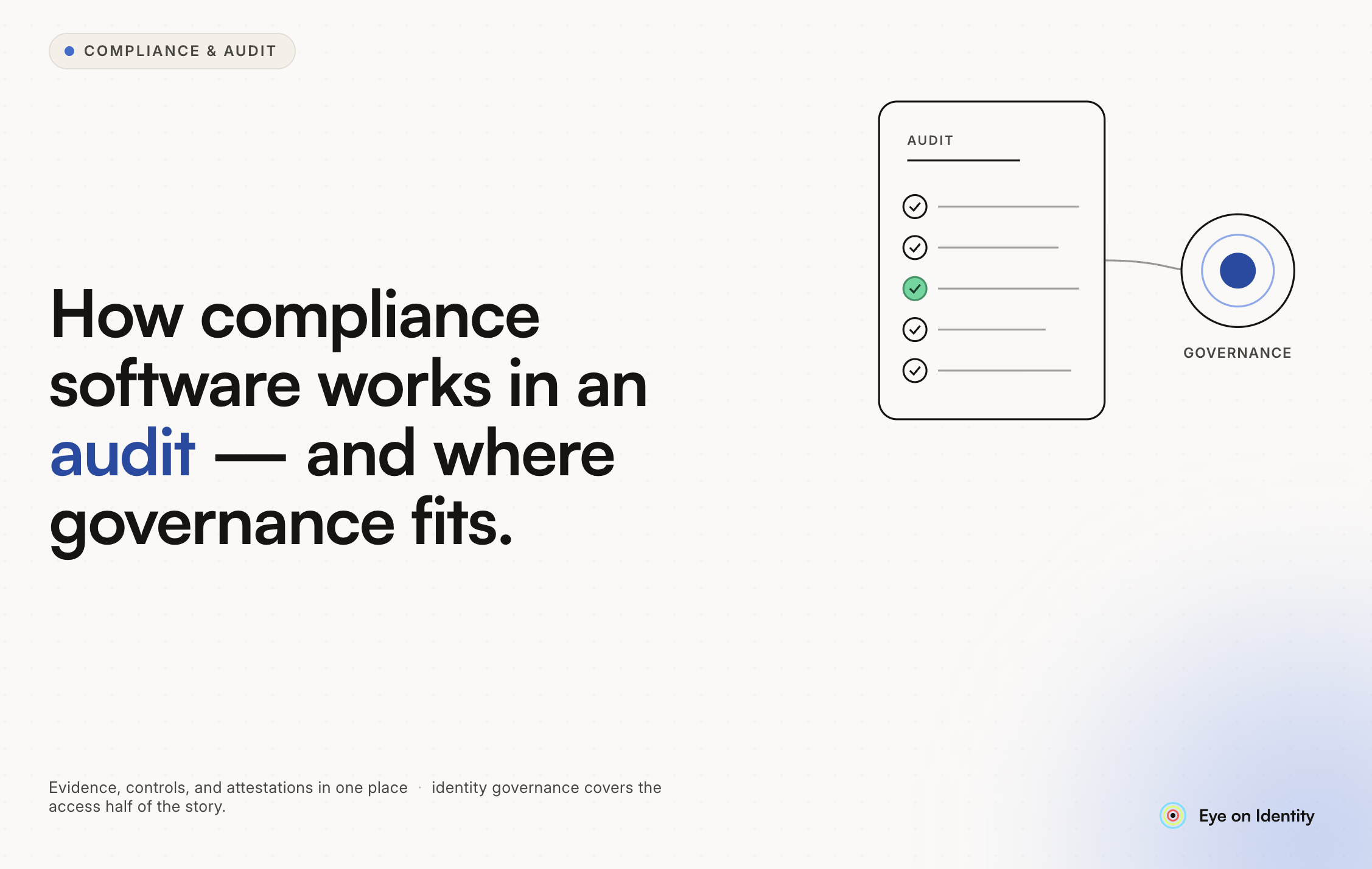
The gap is between documentation and enforcement. Auditors want to see both. They want the policy documentation and the evidence that the policy is actually being executed.
What Auditors Actually Look For
In access control reviews specifically, auditors typically ask for:
- A list of who has access to which systems, including privileged access
- Evidence that access was granted through an approved request process (approver name, date, justification)
- Evidence that access reviews were conducted (reviewer, date, outcome for each user reviewed)
- Evidence of timely deprovisioning when employees left (termination date vs. access revocation date)
- Evidence that access rights were adjusted when employees changed roles
A GRC platform can pull current access lists from connected systems. The approval records, review outcomes, and deprovisioning timestamps need to come from wherever the actual governance processes ran. If those processes ran through IT tickets, Slack messages, and manual spreadsheet updates, the evidence is fragmented, hard to retrieve, and easy for an auditor to poke holes in.
If those processes ran through an identity governance platform, the evidence is structured, timestamped, and queryable.
How Identity Governance Fills the Gap
Identity Governance and Administration platforms operate in the layer that GRC tools observe but don’t control. They handle the access request workflows, the provisioning and deprovisioning automation, the access review campaigns, and the audit logging that compliance frameworks require.
Zluri, for example, captures every access request with the submitter, the approver, the justification, and the timestamp. When an employee leaves, a deprovisioning playbook runs automatically and logs every revocation event across all connected applications. Access review campaigns generate structured reports showing who reviewed which access, what decisions were made, and when.
When an auditor asks for evidence of your access control program, the answer comes from the platform rather than from reconstructed Slack threads and helpdesk tickets.
The integration with GRC platforms matters here. Vanta and Drata both support integrations that pull evidence directly from connected systems. An identity governance platform that produces structured, machine-readable access logs and review records can feed that evidence directly into the GRC platform’s evidence repository, closing the loop between the governance layer and the compliance documentation layer.
Choosing Compliance Management Software: What to Evaluate
For organizations evaluating GRC platforms, the framework coverage and integration breadth are the obvious starting points. But the access control gap is worth evaluating specifically.
Questions worth asking:
- Which identity providers does the platform integrate with, and what evidence does it pull from each?
- Does the platform support access review workflows natively, or does it depend on evidence from an external system?
- Can it pull provisioning and deprovisioning timestamps, or only current access state?
- Does it integrate with IGA platforms to pull structured access governance evidence?
For organizations that already have an IGA platform in place, the GRC integration question is: can the IGA platform push evidence to the GRC tool automatically, reducing manual evidence assembly before each audit cycle?
For organizations that don’t yet have an IGA platform, the audit preparation experience often surfaces the need for one. The first time an auditor asks for timestamped deprovisioning records and the answer is “we have IT tickets somewhere”, the case for structured identity governance becomes concrete.
The Practical Architecture
The compliance stack that handles audits well tends to look like this: a GRC platform for framework mapping and evidence organization, a security layer for continuous posture monitoring, and an identity governance layer for access control enforcement and audit evidence generation.
None of these layers replaces the others. The GRC platform maps controls to frameworks and tracks audit readiness. The identity governance layer ensures that the access control controls the GRC platform is documenting are actually being enforced, and produces the evidence that makes that enforcement demonstrable.
The audit goes better when the evidence assembles itself.


.svg)