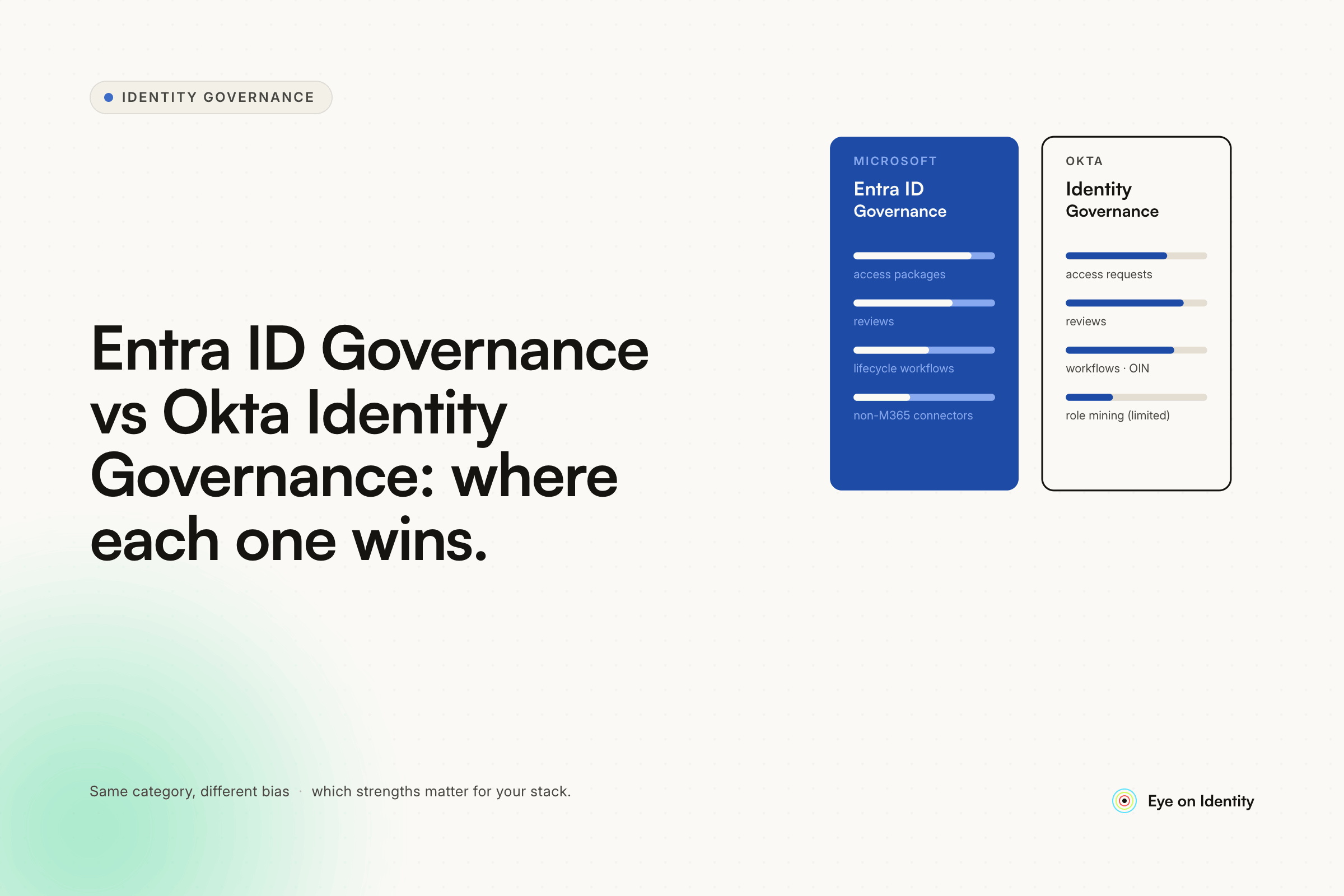


Both Microsoft and Okta entered the IGA space relatively recently — Microsoft by building Entra ID Governance as an extension of its existing identity platform, Okta by acquiring an IGA tool and integrating it into the Workforce Identity stack. Neither started as a dedicated governance platform, and that origin matters when you're evaluating either against the requirements that traditionally drove organizations to SailPoint, Omada, or Saviynt.
The honest framing from practitioners who have worked with both: if your environment is predominantly or entirely within the respective vendor's ecosystem — all apps federated to Entra, or everything running through Okta SSO — the native governance layer may be sufficient for standard use cases. The gaps appear at the edges: disconnected apps, non-API resources, on-prem systems, and governance scenarios that require more polished tooling than either platform currently provides.
What Entra ID Governance Actually Covers
A Microsoft employee who focuses on Entra IGA capabilities laid out the full feature set in the thread this article draws from, and it's more comprehensive than most practitioners realize without dedicated focus on the platform.
Entra ID Governance includes Lifecycle Workflows for automating joiner/mover/leaver tasks without writing scripts, Entitlement Management for packaging applications and groups as access bundles with approval policies, and Access Reviews with ML-assisted reviewer recommendations that flag inactive users and low-affiliation group members. HR-driven provisioning flows from multiple HRIS sources (Workday, SuccessFactors, and others) into both on-prem AD and Entra ID. Group writeback via cloud sync lets you manage groups in Entra and selectively write them back to on-prem AD for hybrid environments. Provisioning covers 300+ applications via the Entra app gallery, SCIM for modern apps, and ECMA connectors for on-prem applications including SQL, LDAP, and web services.
For B2B external users, Entitlement Management handles the lifecycle of guest access including access packages that external partners can self-service request, multi-level approval policies, and automatic expiration.
The extensibility layer — Azure Logic Apps integration for custom workflow steps — means that disconnected apps with no API can still be incorporated into the governance framework through ticketed provisioning: an access request generates a service ticket to the relevant team, the human completes the action, and the request is tracked within Entitlement Management.
That's a substantive feature set. The honest practitioners in this thread who called it a "v1 product" are noting polish and depth relative to the established IGA vendors, not that it's missing core functionality entirely.
Where Entra ID Governance Has Gaps
The gaps identified by experienced practitioners in this thread are worth taking seriously:
On-premises PIM. Privileged Identity Management for on-prem AD roles and groups isn't currently in Entra ID Governance in the same way cloud PIM works. This is reportedly on the roadmap but not yet delivered.
Provisioning log retention. Provisioning logs are retained for 90 days natively. For compliance investigations that need to trace how someone gained access more than 90 days ago, the workaround is routing logs to Azure Monitor — which works but requires additional setup and cost.
Access review delegation and exceptions. Manager-based access reviews — where an employee's direct manager reviews everything that person has access to across applications — are available, but the granularity of exceptions and delegation within a review (assigning specific items within a campaign to different reviewers, handling exceptions at the item level) is less polished than dedicated IGA platforms. One commenter noted they want a manager to identify exceptions within their team's access, which Entra can approximate but not with the same flexibility as SailPoint.
Governance for identities outside the Entra perimeter. As one commenter put it directly: the gap most IdPs have is that they stop caring about identities outside their border. Ideally, when you disable an account in your IdP, you want confirmation that it's disabled everywhere the account was federated — not just in Entra. For organizations with identities spread across AWS, GCP, on-prem systems, and applications that don't federate to Entra, the governance scope is limited to what Entra can see.
Custom extension approver data. A specific frustration surfaced in the thread: when using Azure Logic Apps for custom workflow extensions, the approver information isn't included in the JSON payload, which limits what you can do with approval notifications and audit logging downstream.
What Okta Identity Governance Covers and Where It Falls Short
Okta IGA was built through acquisition rather than native development, and that origin is reflected in practitioner feedback. The tool provides access request workflows, access certifications, and governance reporting within the Okta ecosystem. For organizations that have standardized on Okta for SSO and provisioning, it extends that foundation into access review and lifecycle governance.
The limitations practitioners cite most frequently: it's expensive for what it delivers at the mid-market tier, and the tool's depth and polish relative to dedicated IGA platforms falls short for complex governance requirements. The same boundary problem applies as with Entra — Okta IGA governs what Okta can see, which means applications outside the Okta integration catalog are outside the governance scope without additional tooling.
Both platforms share the same fundamental characteristic: they excel at the authentication and SSO layer and have extended into authorization and governance, but they lack the deep granular visibility into what specific permissions users hold inside downstream third-party applications, or what activities they're performing within those applications, that dedicated IGA platforms provide.
Where a Dedicated IGA Platform Fills the Gaps
The use cases that consistently push organizations from native IdP governance to a dedicated IGA platform cluster around three areas.
Multi-ecosystem environments. When your identity footprint spans Entra, Okta, on-prem AD, AWS IAM, GCP, and applications that authenticate through none of the above, neither Entra IGA nor Okta IGA provides a single governance view. A dedicated IGA platform that treats all of these as connectable sources rather than being architecturally centered on one vendor gives you unified access visibility regardless of how the application authenticates.
Disconnected and legacy applications. Both platforms handle disconnected apps through ticketed provisioning or manual task workarounds. Dedicated IGA platforms like Zluri extend this with native discovery (surfacing which applications employees are actually using, including shadow IT), direct API integrations where available, AI-powered browser automation for apps with no API, and manual task routing with tracked completion for the genuinely non-automatable cases. The governance scope matches the real access footprint rather than the portion that's formally integrated.
Access review depth and compliance reporting. For organizations with SOC 2, ISO 27001, HIPAA, or SOX requirements, the access review features in Entra IGA and Okta IGA satisfy basic requirements but lack the depth that auditors at larger or more regulated organizations expect: multi-level reviewer workflows, granular exception handling, non-editable timestamped audit reports, and access certification campaigns that cover applications across the full stack rather than just the IdP-connected subset.
Zluri connects to Entra ID and Okta as identity sources while extending governance to the applications and identity types that sit outside each platform's native scope — providing a neutral orchestration layer that doesn't require choosing one vendor's ecosystem as the governance boundary.
Frequently Asked Questions
What is the difference between Entra ID Governance and Okta Identity Governance?
Both are governance extensions of existing IdP platforms rather than purpose-built IGA tools. Entra ID Governance extends Microsoft's identity platform with Lifecycle Workflows, Entitlement Management, and Access Reviews, with deep integration into hybrid on-prem AD and cloud environments. Okta IGA extends Okta's SSO platform with access certification and request workflows. Both are limited to governing identities and applications within their respective ecosystems — applications outside their integration catalogs require additional tooling or workarounds.
What does Entra ID Governance not cover that SailPoint or dedicated IGA platforms do?
Key gaps noted by practitioners include: on-prem AD PIM (in-progress), provisioning log retention beyond 90 days without Azure Monitor, granular exception handling in access review campaigns, and governance for identities and applications outside the Entra perimeter. Dedicated IGA platforms provide broader multi-ecosystem coverage, deeper access review workflows, and governance for disconnected applications that don't authenticate through Entra.
Is Entra ID Governance sufficient for SOC 2 compliance?
For organizations where most applications are federated to Entra, the Access Reviews and Lifecycle Workflows in Entra ID Governance can satisfy the access management controls required for SOC 2. The gaps appear when the application scope extends beyond Entra-connected apps, when provisioning log retention beyond 90 days is required for audit investigations, or when the access review granularity required by the auditor exceeds what the platform's current delegation and exception handling supports.
When should you use a dedicated IGA platform instead of Entra or Okta governance features?
Consider a dedicated IGA platform when your environment spans multiple identity ecosystems (Entra plus Okta, or Entra plus on-prem AD plus cloud infrastructure), when a significant portion of your application stack is outside your IdP's integration catalog, when your compliance requirements demand access review depth and audit reporting that the native tools don't yet provide, or when you need continuous governance visibility across shadow IT and unmanaged applications that neither IdP can discover.
See Where Zluri Fills the Gaps in Your IdP Governance
If you're evaluating whether Entra ID Governance or Okta IGA covers your full governance requirements — or where a dedicated IGA platform fills the gaps — book a walkthrough with Zluri to see how it extends governance across the applications and identity types outside your IdP's native scope.


.svg)