

If your organization has had SailPoint running for a year and you still can't articulate what it does that Entra doesn't, you are not alone. This exact confusion is common in organizations that implement a governance platform on top of an existing identity provider — particularly in higher education, healthcare, and other environments where the identity stack grew organically before anyone formalized it.
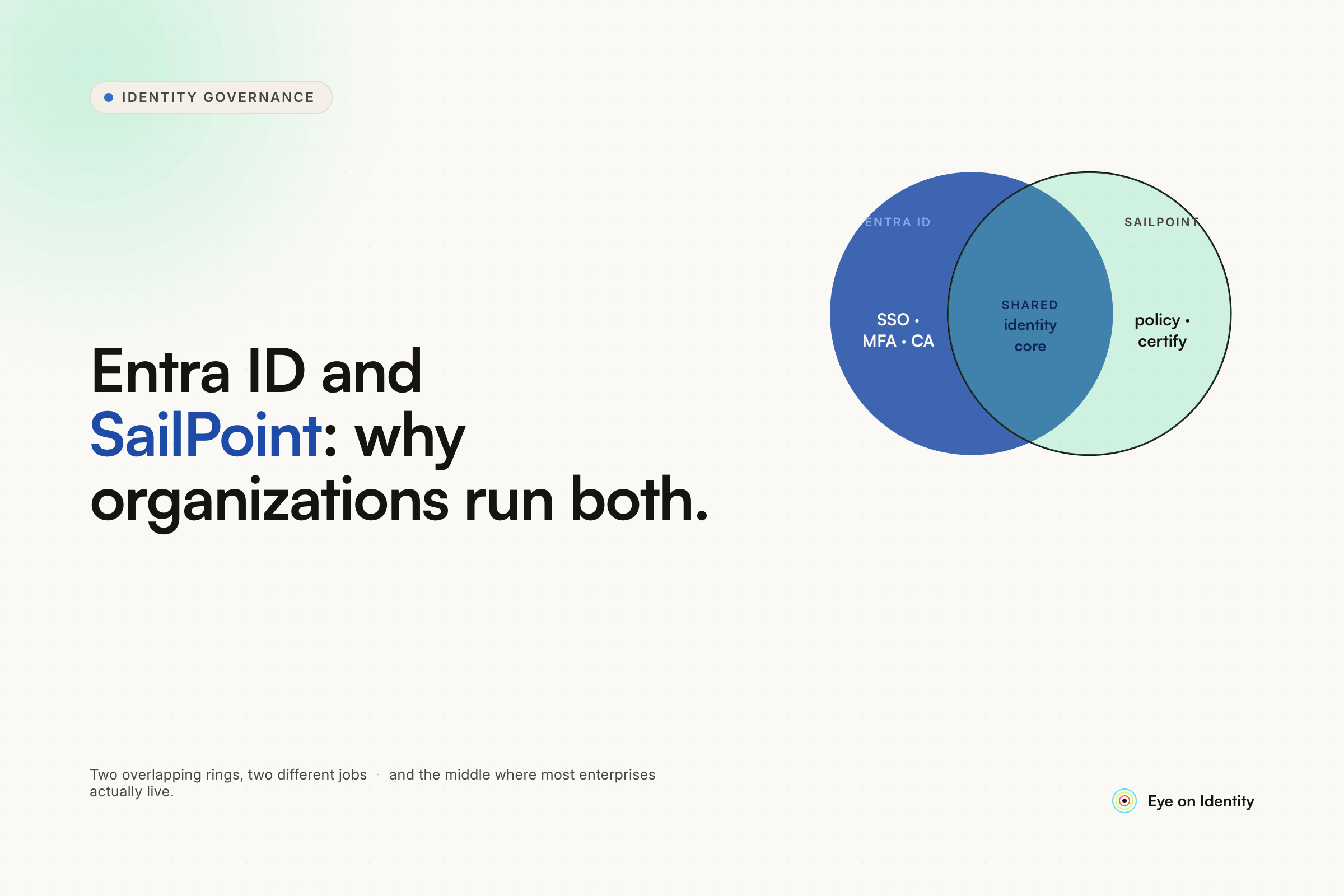
The short version: Entra ID and SailPoint are not competing products doing the same job. They operate at different layers of your identity architecture. The overlap is real but narrow. Here is what each one actually handles and where the line is.
The Authentication Layer vs. the Governance Layer
The clearest way to understand the split is through what each platform was designed to answer.
Entra ID answers: Is this person allowed in? It handles SSO, MFA, conditional access, and real-time authentication. When a user logs into an application, Entra is what checks their credentials, validates their session, and grants them entry. It is very good at this. It is the actual engine powering access across your M365 environment and any application federated to it.
SailPoint answers: Should this person have this access, based on policy, and can we prove it? It manages the governance layer — who holds what entitlements across which systems, whether those entitlements comply with your organization's policies, whether any combination of permissions creates a Segregation of Duties conflict, and whether all of that is auditable when a regulator asks.
In practice this means Entra handles the front door and SailPoint walks the halls inside. They are not redundant; they are sequential. Entra lets people in. SailPoint governs what they can do once they're there and ensures the right people are the only ones with keys.
What SailPoint Does That Entra Cannot
Segregation of Duties enforcement. This is the capability gap that matters most in regulated environments. If someone's role or attributes inadvertently give them both the ability to initiate a financial transaction and the ability to approve it, Entra will provision both without raising a flag. SailPoint's governance engine is built specifically to catch that conflict and block or escalate it before the entitlement is granted. Dynamic security groups in Entra are clean and useful — they do not enforce SoD.
Deep entitlement visibility inside applications. Entra tracks authentication: who logged in, when, from where. It generally does not track what a user can do inside an application — what specific roles, permission sets, or granular entitlements they hold. SailPoint builds Access Profiles that map fine-grained permissions across every connected system, not just the ones federated to Entra. For access reviews, that distinction is everything. Reviewing whether someone "has access to Salesforce" is not the same as reviewing whether they hold a permission set that lets them export the entire customer database.
Centralized audit trail for privileged access. The push to have SailPoint assign Azure roles directly rather than through Entra security groups is about auditability, not about saving steps. When SailPoint orchestrates the role assignment, every step is logged in a single governance system: who requested it, who approved it, what policy evaluation ran, when it was granted, and when it expires. Entra logs the authentication. SailPoint logs the governance lineage. For SOX, HIPAA, or any compliance framework requiring proof of access review, that lineage matters.
Complex workflow logic across disconnected systems. Entra's access request and lifecycle workflows are built for cloud-native Microsoft environments. SailPoint's workflow engine handles multi-system provisioning — AD, mainframes, SAP, cloud platforms, on-prem databases — with branching approval logic, SoD checks at each step, and the ability to aggregate identity data across all of them into a unified view. The complexity that breaks Entra's out-of-the-box workflows is exactly what SailPoint was designed for.
Where the Confusion Comes From
The overlap is real in one specific area: access requests and provisioning for cloud apps that support SCIM. For straightforward SaaS provisioning in a Microsoft-centric environment, Entra handles it fine and SailPoint can feel like overhead.
The confusion compounds when SailPoint is implemented in phases. In year one, the visible output is often just what Entra was already doing — groups populated from HR data, access assigned by attributes. The deeper governance capabilities — SoD enforcement, entitlement-level access reviews, audit-ready reporting — come online as connectors are built and policies are configured. An organization that is still in the build phase will reasonably question what they bought.
The practitioner community is consistent on this: SailPoint earns its place in environments with multiple ADs, mainframes, legacy on-prem systems, complex regulatory requirements, or identity data spread across multiple disconnected sources. In those environments it is not duplicating Entra — it is governing the parts of the stack Entra cannot see.
On the ITSM Request Portal Question
Keeping your request interface in your ITSM portal and routing fulfillment to SailPoint is not a compromise — it is the recognized best practice. The request layer and the fulfillment layer do not have to be the same system, and for organizations with complex provisioning logic, they should not be.
The hybrid workflow runs like this: a user submits a request in your ITSM portal, the portal routes it to SailPoint via API, SailPoint evaluates eligibility against governance policies and handles provisioning, then signals back to close the ticket. The user sees one interface. The governance engine runs in the background. The audit trail lands in SailPoint where it belongs.
Replacing a working ITSM request portal with a SailPoint-native interface adds friction for users without improving governance. The two things are separable.
Which Environments Actually Need Both
The clearest signal that you need a dedicated IGA layer on top of Entra comes down to a few specific conditions.
You have identity data spread across multiple disconnected sources — HR systems, student information systems, an ERP — and need those sources reconciled into a single authoritative view. Entra can consume one HR source cleanly. Aggregating across multiple systems with conflict resolution logic is IGA territory.
You have compliance requirements that demand entitlement-level access reviews, not just authentication logs. SOC 2 is manageable with Entra. SOX, HIPAA, NERC-CIP, and similar frameworks require the kind of granular access audit trail that only a purpose-built governance platform provides.
You have applications outside the Microsoft ecosystem — on-prem systems, mainframes, SAP, legacy databases — that need to be governed alongside your cloud apps. For the parts of your stack Entra cannot reach, SailPoint's connector architecture fills the gap.
You need SoD enforcement. If any two permissions in your environment should never coexist in the same account, you need a system explicitly designed to catch and enforce that. Entra is not that system.
FAQ
What is the difference between Entra ID and SailPoint?
Entra ID is an IAM platform focused on authentication — SSO, MFA, and access control at the login layer. SailPoint is an IGA platform focused on governance — managing who holds what entitlements across all systems, enforcing access policies, running access reviews, and producing compliance audit trails. They operate at different layers and are commonly used together.
Can Entra ID replace SailPoint for identity governance?
For organizations with primarily cloud and Microsoft-centric environments, straightforward compliance requirements, and no need for granular entitlement visibility inside third-party apps, Entra covers a meaningful portion of IGA needs. For environments with complex on-prem systems, multiple identity sources, SoD requirements, or regulated access review obligations, SailPoint handles capabilities Entra does not.
Why do organizations use both Entra ID and SailPoint?
Entra provides the authentication layer — SSO and access control for users logging into applications. SailPoint governs the entitlements behind that access — defining what each role should include, enforcing SoD policies, reviewing whether access is still appropriate, and maintaining the audit trail compliance programs require. The two systems are complementary, not redundant.
What is Segregation of Duties and why does it matter for IGA?
Segregation of Duties is a control that prevents any single user from holding two permissions that, in combination, create a conflict of interest or compliance risk — such as the ability to both create and approve a financial transaction. IGA platforms like SailPoint enforce SoD by evaluating entitlement combinations against policy rules before access is granted. Authentication platforms like Entra do not perform this check.



.svg)