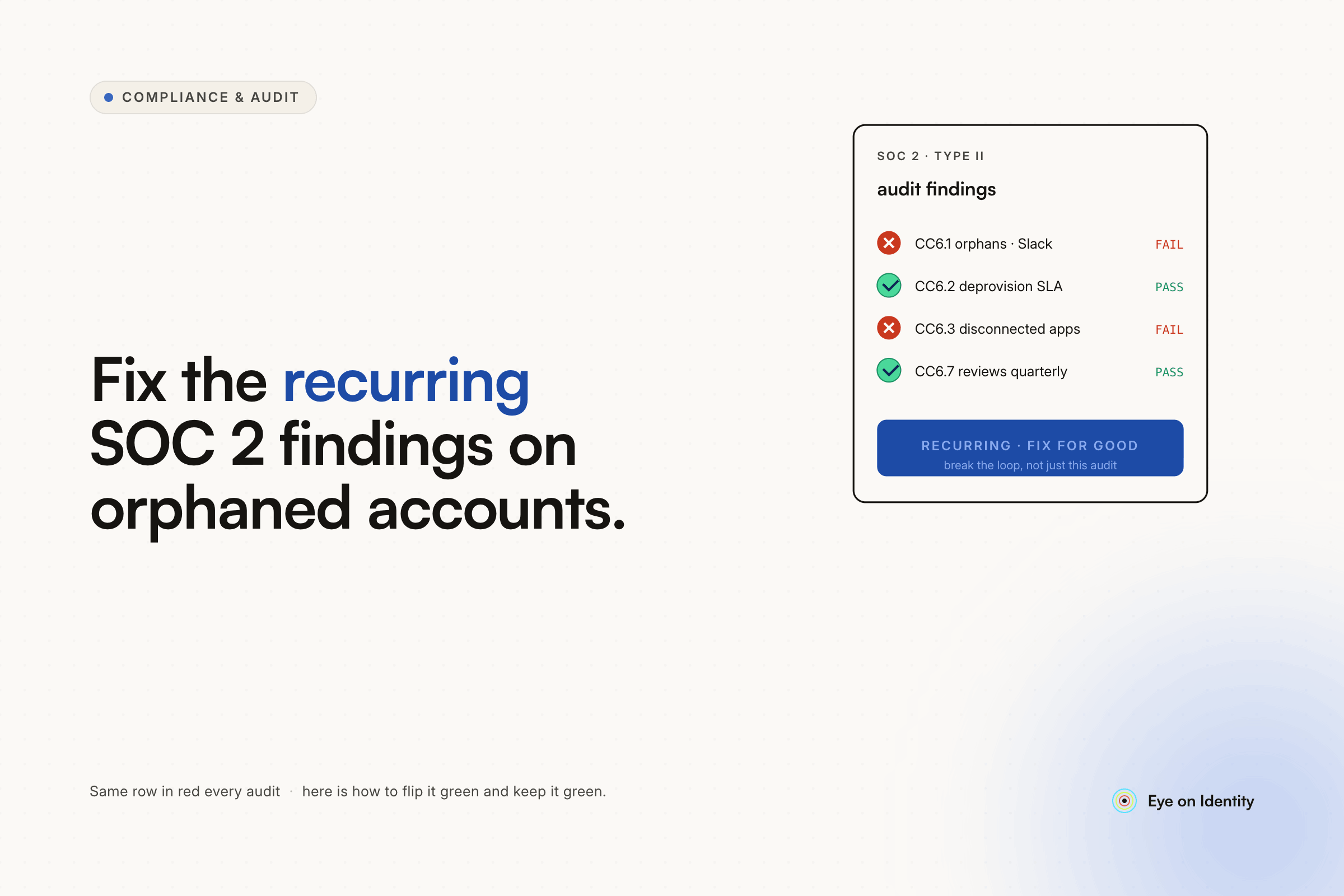


The pattern you've described has a name in the IGA world: compensating control drift. You get the finding, you remediate manually, you document the process, you present it to the auditor. It satisfies the audit. Then twelve months pass, the manual process doesn't hold, and the same orphaned accounts accumulate in the same systems because nothing structurally changed. Second year, same finding.
Manual cleanup doesn't fail because the people doing it are careless. It fails because it's a point-in-time intervention in an environment that changes continuously. People join, move, and leave on a cadence that doesn't align with your audit cycle. Without continuous enforcement in the disconnected systems, the gap reopens the moment the remediation sprint ends.
The practitioners in this thread who've actually broken the cycle — not patched it — describe a consistent approach: build a central inventory of all applications with designated owners, extend discovery and access review to disconnected systems using whatever data those systems can produce, and make the governance process continuous rather than seasonal.
Why the Audit-Remediate-Repeat Cycle Keeps Happening
Your IGA platform sees what it's connected to. For the 50 applications outside your Entra ID perimeter — custom internal tools, legacy on-prem systems, contractor-built apps with local auth, vendor portals — the platform has no visibility. Governance stops at the SSO boundary.
Everything outside that boundary relies on manual processes: manual provisioning when someone joins, manual deprovisioning when someone leaves (if anyone remembers), and periodic manual reviews that happen because an audit is approaching rather than because a lifecycle event occurred. The manual process works when everyone follows it correctly and completely. It drifts when anyone is busy, absent, or simply doesn't know that a tool they never provisioned needs to be cleaned up at offboarding.
The FormerElk6286 comment in this thread is worth reading carefully — they have nearly 100 apps with no connectors, banking vendor systems that release no APIs, and they've found semi-automation paths for most of them anyway. The insight is that "no API" doesn't mean "no automation path." It means you have to use a different data source: scheduled report exports, PDF files the IGA tool can parse, RPA bots that log in and pull reports, file dumps from legacy systems. The key is getting data into the governance layer by whatever means available, not waiting for a native connector that may never exist.
The Structural Fix: Inventory First, Then Continuous Governance
The flywhee007 comment in this thread describes the right sequence for teams that have inherited this problem:
Build a central inventory of all applications with their authentication model — SSO, local auth, vendor portal, legacy — and designate an owner for each. Without an owner, there's no one accountable for periodic review or for responding to offboarding tasks. An application without a designated owner is a governance gap waiting to become an audit finding.
Get account data from disconnected apps into your governance system regularly, not just during audit season. This is where the data source question matters: can the system export a CSV? Can it email a report? Can a scheduled task pull a file to a share? Can a bot log in and extract the user list? Even a monthly manual export that someone uploads to the governance platform is better than no visibility between audits. The goal is normalizing the data flow so orphaned account detection runs continuously rather than being triggered by an upcoming audit.
Match incoming account data against your active employee directory. Any account that doesn't match an active employee is a candidate for review. Any account belonging to someone who left more than 30 days ago is a finding — surfaced automatically rather than discovered by an auditor.
How Zluri Handles Disconnected Apps With No Native API
Zluri's approach to the no-API problem uses multiple discovery paths rather than requiring a native connector for each application.
Browser agents and desktop agents detect application usage at the endpoint level — surfacing which applications employees are actively using regardless of whether those applications are connected to SSO. This gives you a usage-based picture of the disconnected app landscape that complements whatever account data you can extract from the applications themselves.
For applications that can generate reports — even CSVs, PDFs, or file dumps — Zluri can ingest that data and cross-reference it against the active employee directory to identify orphaned accounts. The data doesn't have to come through a clean API. It comes through whatever the application can produce.
For applications where even report generation is limited, Zluri's AI-powered browser automation can navigate the admin interface and extract or act on user account data without requiring the vendor to expose an API. This covers the category of systems where "manual" currently means someone logging in and clicking through pages to find and remove accounts.
For applications that genuinely require a human to take action, Zluri generates Manual Tasks routed to the designated app owner. When an employee leaves and Zluri detects the termination in the HRMS, the offboarding workflow generates a deprovisioning task for every application in that employee's access profile — including the manually-tracked non-SSO ones. The task is assigned, tracked to completion, and logged in the audit record. The auditor doesn't see "we did a manual cleanup" — they see a structured offboarding workflow with completion timestamps for every application.
Building the Audit Trail That Satisfies SOC 2
The reason compensating controls don't satisfy repeat auditors is that they document a point-in-time cleanup without evidence of continuous monitoring. The auditor is looking for two things: evidence that you know what access exists at any point in time (not just during audit prep), and evidence that lifecycle events — joiners, movers, leavers — trigger access changes in a documented, repeatable way.
Continuous visibility requires the data flow described above: regular ingestion of account data from disconnected systems, automated matching against the active employee directory, and surfacing of orphaned accounts as they accumulate rather than once a year. If your governance platform is seeing the disconnected app account lists monthly, you can demonstrate that orphaned accounts are being identified and remediated continuously — not in a sprint before the audit.
The lifecycle evidence requires that offboarding triggers a documented workflow for the disconnected apps, not just the SSO-connected ones. When Zluri's offboarding playbook generates a Manual Task for WidgetFactory.com's designated owner and that owner marks it complete, the audit record shows the termination date, the task assignment, and the completion timestamp. That's the evidence of lifecycle management that a compensating control narrative doesn't provide.
Prioritizing Which 50 Apps to Tackle First
Not all 50 disconnected apps represent equal risk. The practitioners in this thread consistently recommend the same triage framework: start with applications that store sensitive data or have elevated privileges (local admin accounts, financial systems, systems with customer data), then move to high-usage applications, then address low-risk or rarely-used tools last.
The apps with no API and no automation path — the genuine manual-only cases — should be the smallest category. The FormerElk6286 approach of testing each app's actual automation potential (scheduled reports, file drops, bot-accessible interfaces) often reveals that the "no API" category is smaller than expected. The ones that remain genuinely manual get the structured task routing and owner accountability model; the ones that turn out to have semi-automated paths get the data ingestion model.
Frequently Asked Questions
Why do the same SOC 2 audit findings on orphaned accounts keep recurring?
Manual remediation addresses the finding at a point in time but doesn't change the underlying process. Without continuous monitoring of disconnected app account data matched against the active employee directory, orphaned accounts accumulate again between audit cycles. The structural fix is making discovery and access review continuous rather than triggered by an upcoming audit.
How do you extend identity governance to apps with no API or native connector?
Most applications can produce some form of account data even without a full API: CSV exports, scheduled report emails, PDF reports, or file system outputs. IGA platforms that can ingest these formats allow you to import account data from legacy and disconnected systems and cross-reference it against your active directory. For systems where even this is limited, RPA bots or AI-powered browser automation can extract account lists from admin interfaces. The goal is getting any regular data feed into the governance layer rather than waiting for a native connector.
What does a SOC 2-compliant offboarding workflow look like for non-SSO apps?
A compliant workflow documents the trigger (termination in the HRMS), the action required for each application (deprovisioning task assigned to the designated app owner), and the completion evidence (timestamp and owner identity when the task is marked done). For disconnected apps, this means the offboarding workflow must explicitly include them — not as a verbal commitment to check manually, but as tracked tasks in the governance system with completion timestamps that an auditor can review.
How do you build a central inventory of disconnected applications for governance?
Start by cataloging every application in use with its authentication model (SSO, local auth, vendor portal, legacy), its data sensitivity classification, and a designated owner accountable for access reviews. Usage discovery through browser or desktop agents surfaces applications employees are using that IT may not have inventoried. Once the catalog exists, each application gets a periodic review cadence and an owner who receives offboarding tasks when users of that application leave the organization.
Break the Audit-Remediate-Repeat Cycle
If you're facing a second year of the same SOC 2 findings and need continuous governance rather than seasonal cleanup, see how Zluri extends access review and offboarding workflows to your disconnected apps — including the ones with no native API — so the audit trail exists year-round rather than only during remediation sprints.


.svg)