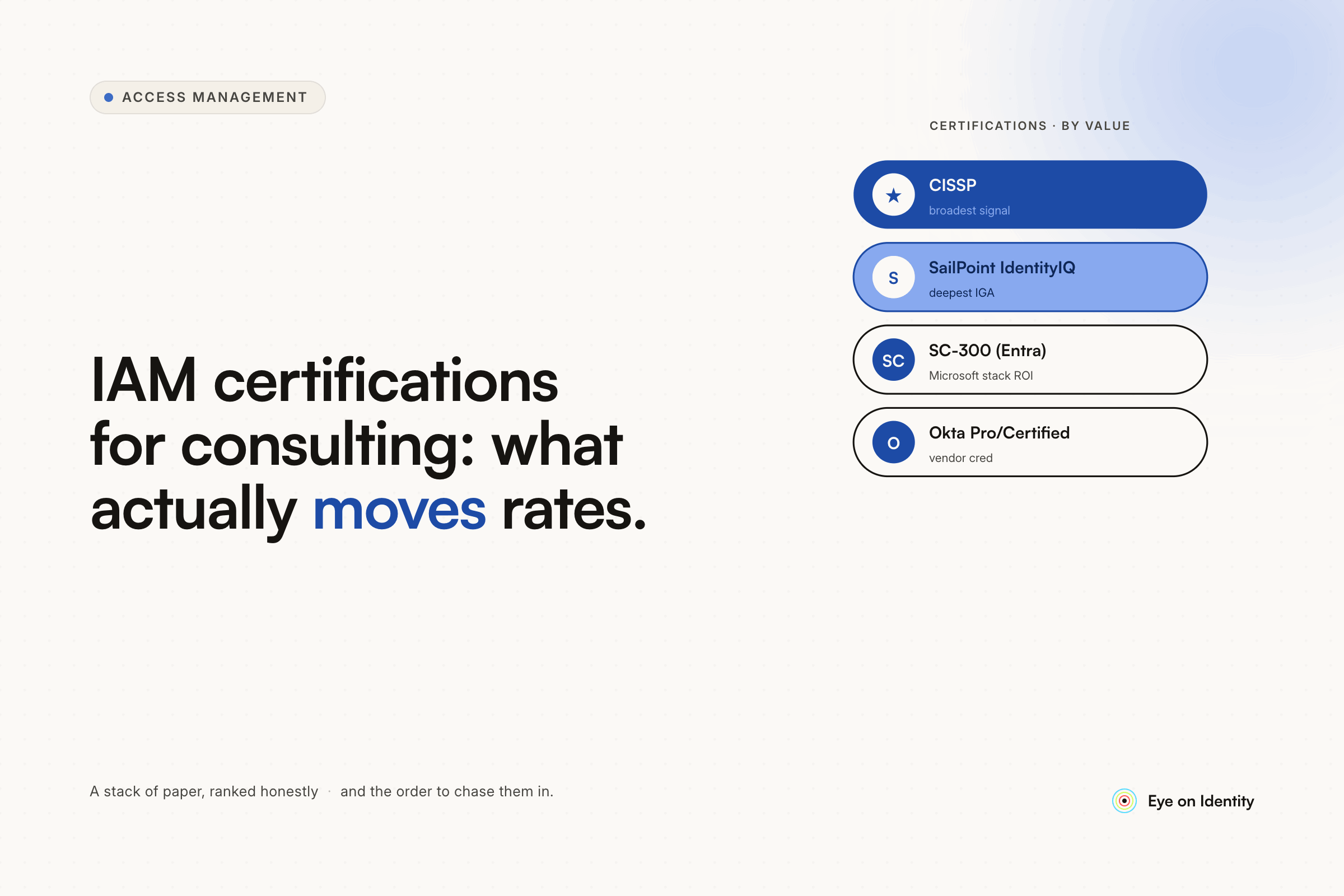


The certification landscape for IAM consulting has two distinct tracks that are easy to conflate: technical implementation certifications that prove you can configure a platform, and governance-oriented certifications that prove you can design and advise on identity programs at an organizational level. For a consulting role — where your value is helping clients understand what to build and why, not necessarily building it yourself — the distinction matters.
That said, the commenter in the thread that prompted this article made a point worth taking seriously: consultants who turn off their technical side aren't credible in a technical field. The strongest consulting career combines enough technical depth to earn trust in the room with enough governance and program management knowledge to speak to executive stakeholders. The certifications below reflect both dimensions.
Vendor-Neutral Governance Certifications
CIDPRO (Certified Identity Professional) from IDPro is the most-cited vendor-agnostic identity certification among practitioners who work across the full IGA landscape. IDPro maintains a Body of Knowledge covering provisioning, authentication, authorization, governance, and compliance across platforms — not tied to any single vendor's implementation approach. Multiple practitioners in the thread this article draws from called it the most technical vendor-agnostic identity cert available, with difficulty and rigor comparable to the CISSP. For a consultant who needs to credibly advise on identity strategy regardless of whether the client is using Okta, SailPoint, Entra, or something else, this is the cert that signals cross-platform depth.
CIAM (Certified Identity and Access Manager) from the Identity Management Institute focuses on IAM program management, identity risk, compliance, and governance strategy. It's designed for practitioners who design enterprise identity programs and advise leadership rather than configure individual platforms. For consulting roles where the engagement is helping a client define their IGA strategy, this aligns well.
CAMS (Certified Access Management Specialist), also from IMI, goes deeper into the access control and user provisioning side — closer to the IGA implementation layer, useful if your consulting focus is helping clients achieve compliance certifications (SOC 2, ISO 27001) through identity governance programs.
If you already have the CISSP, the CISM (Certified Information Security Manager) or CRISC (Certified in Risk and Information Systems Control) from ISACA add value specifically for the executive-facing side of consulting — bridging IAM concepts to business risk and compliance requirements. These are worth considering if client engagements regularly involve presenting to CISOs or boards rather than working at the technical implementation level.
Vendor-Specific Certifications Worth the Investment
The IAM consulting market has consolidated heavily around a small number of platforms, and vendor certifications from those platforms carry real weight in sourcing and staffing decisions.
SailPoint certifications — specifically SailPoint IdentityNow (the cloud platform, not the legacy IIQ on-prem product) — are among the most in-demand in enterprise IGA consulting. One practitioner in this thread specifically noted that the market has shifted toward the cloud version; if your organization is implementing IIQ today, getting exposure to IdentityNow in parallel is worth it given where client demand is heading. SailPoint certifications focus on designing and governing IGA solutions rather than purely technical configuration, which aligns with a consulting track.
Okta Certified Consultant focuses on identity architecture, SSO and MFA strategy design, and structuring complex Okta integrations for enterprise environments. If your consulting pipeline is likely to include Okta-heavy clients — which is a large share of the mid-market — this is the right investment. The Consultant track is explicitly distinct from the Administrator track in that it emphasizes design and advisory work over operational configuration.
Microsoft Certified: Identity and Access Administrator Associate (SC-300) covers Entra ID (formerly Azure AD) governance, hybrid identity, and lifecycle management. Consulting firms that serve Microsoft-centric clients recruit heavily for this certification. It has technical elements, but the governance and architecture portions align with a consulting advisory role. Given how many enterprise clients are running Entra ID as their primary identity platform, this certification has broad applicability regardless of whether you specialize in Microsoft environments.
How to Sequence These
If you're starting with a CISSP and moving into IAM consulting, a practical sequence is:
Start with one vendor-specific certification aligned to the platforms your current or target clients use — Okta, SailPoint, or SC-300 depending on the market you're entering. This gives you immediate credibility for client conversations and positions you for sourcing at consulting firms. Layer in CIDPRO or CIAM as your vendor-agnostic credential, which signals that your knowledge extends beyond any single platform and positions you for senior advisory roles where clients are evaluating multiple platforms. Add CISM or CRISC if your consulting practice involves significant executive-level engagement or risk and compliance work.
The key point one practitioner made in this thread: the technical and consulting tracks aren't as separate as they appear. Consultants who lack technical depth rely on "fluff" — strategic frameworks that can't be grounded in implementation reality. The certifications above that have technical depth (CIDPRO, vendor-specific tracks) are worth taking seriously even if you don't intend to be the person writing integration code.
What the Market Is Actually Asking For
The IGA consulting market is currently shaped by a few converging trends worth understanding before investing in a certification path.
The shift from on-prem to cloud IGA platforms (SailPoint IIQ to IdentityNow, legacy RACF and Tivoli environments to Entra or Okta) is creating a consulting demand surge as organizations modernize. Consultants who understand both the legacy architecture and the target cloud platform are particularly sought after during these migrations.
Identity Governance is expanding in scope beyond traditional human user access reviews into privileged access management (PAM), Identity Security Posture Management (ISPM), and non-human identity governance — service accounts, API keys, AI agent credentials. Consulting practices that position in these adjacent areas are growing faster than traditional IGA-only practices.
Compliance-driven demand — SOC 2, ISO 27001, HIPAA, SOX access review requirements — continues to generate consistent consulting work because organizations need help both implementing the controls and producing the audit evidence. Certifications that demonstrate governance and compliance knowledge (CIAM, CAMS, CISM) are directly marketable for this work.
Frequently Asked Questions
What is the best IAM certification for a consulting career?
For a consulting track, the combination most frequently cited by practitioners is CIDPRO for vendor-agnostic technical depth, plus one vendor-specific consultant certification (Okta Certified Consultant, SailPoint IdentityNow, or SC-300) aligned to your target market. If you already have the CISSP, CISM or CRISC from ISACA add value for executive-facing engagements. CIAM from the Identity Management Institute is the governance-oriented alternative to the more technical CIDPRO.
Is SailPoint IIQ or IdentityNow the better certification investment?
For new certifications, practitioners recommend the IdentityNow (cloud) track over IIQ (on-prem). The market is shifting toward cloud IGA platforms, and most new client implementations are on IdentityNow or its equivalent rather than the legacy on-prem product. If your current organization is implementing IIQ, gaining exposure to both is valuable for transitions — but invest in the cloud certification for forward-looking market positioning.
Do IAM consulting roles require deep technical skills?
Yes, in practice. The strongest consulting careers combine governance and program management knowledge with enough technical depth to credibly evaluate implementation decisions. Consultants without technical grounding struggle to establish credibility in client environments where engineering teams are evaluating the advice. Vendor-specific certifications that include architecture and design components (not just operational configuration) help bridge this gap.
What is the CIDPRO certification and how does it compare to CISSP for IAM work?
CIDPRO is a vendor-neutral IAM certification from IDPro, covering provisioning, authentication, authorization, governance, and compliance across platforms. Multiple practitioners in the field describe it as the most rigorous vendor-agnostic identity credential available — comparable in difficulty and depth to the CISSP but focused specifically on identity and governance rather than the broader security domain. For practitioners who want to demonstrate cross-platform identity expertise independent of any single vendor, CIDPRO is the benchmark credential.


.svg)