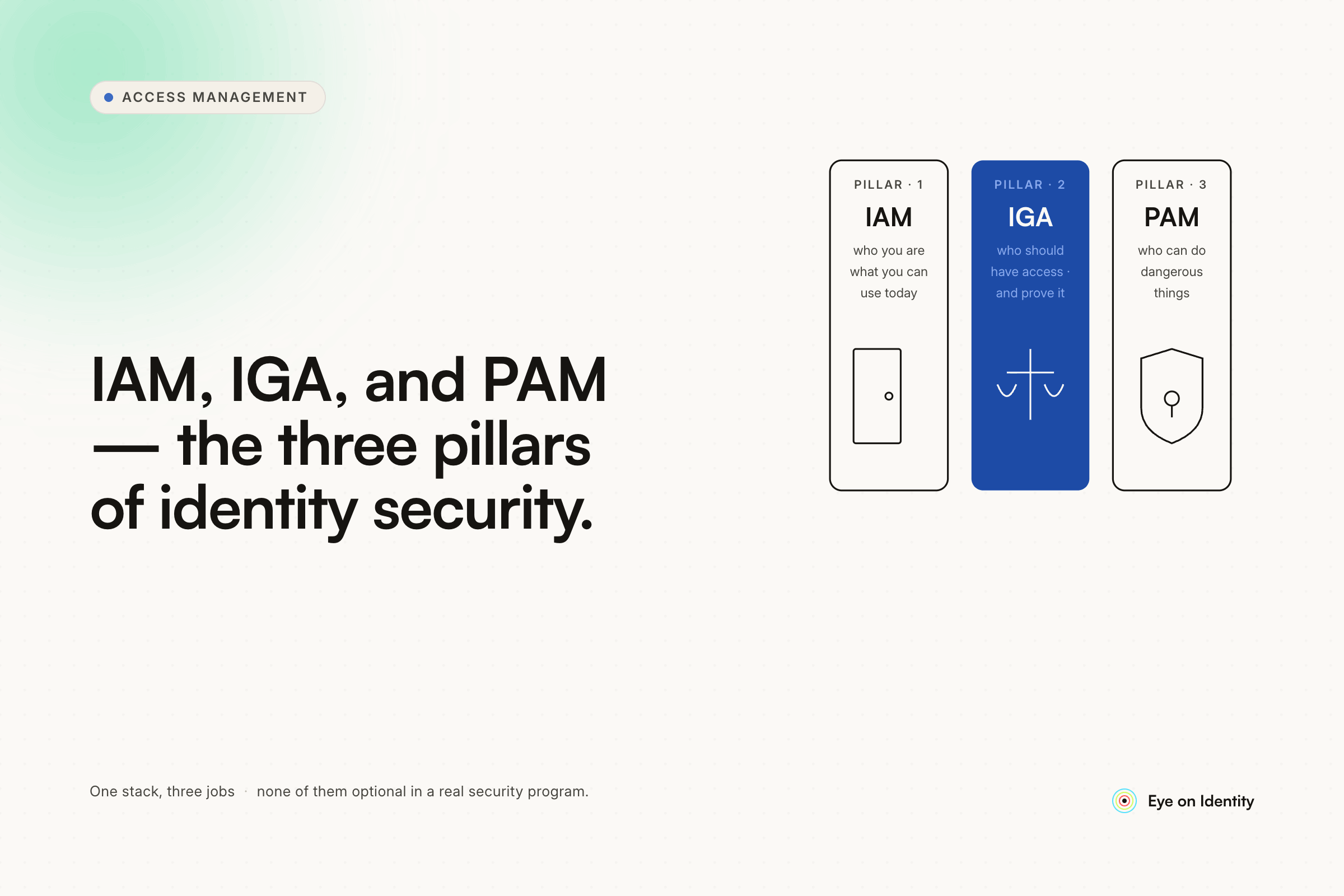


Identity security in modern enterprises rests on three distinct disciplines that are frequently confused with each other: Identity and Access Management (IAM), Identity Governance and Administration (IGA), and Privileged Access Management (PAM). Each addresses a different threat vector at a different layer of the identity stack. Understanding what each does — and where each one's responsibility ends — is the foundation for building a coherent identity security program.
IAM: The Authentication and Authorization Layer
Identity and Access Management is the real-time enforcement layer. When a user attempts to access a system, IAM makes the decision: is this person who they claim to be, and are they allowed to access what they're requesting?
Authentication is identity verification. The IAM system checks credentials — a password, an MFA token, a biometric scan, a hardware key — against the directory to confirm the user's identity. This is the first gate: before any access decision can be made, the system needs to establish who is making the request.
Authorization is the access decision that follows authentication. Once identity is confirmed, the IAM system checks whether that specific user is permitted to access the specific resource they're requesting — an application, a file share, an API endpoint. Authorization is typically enforced through roles, groups, and policies defined in the directory.
The core components that make IAM function: a directory service that stores user identities and attributes, an SSO layer that allows users to authenticate once and access multiple applications without re-entering credentials for each, MFA to strengthen the authentication step, and Conditional Access policies that add context to authorization decisions (requiring stronger authentication from unmanaged devices or unusual locations, for example).
IAM is essential and foundational. Without it, there is no controlled access perimeter. But IAM alone doesn't answer the question of whether the access it's enforcing is still appropriate — it only enforces what has been granted.
IGA: The Governance and Compliance Layer
Identity Governance and Administration operates on a different time horizon than IAM. Where IAM makes real-time individual access decisions, IGA manages the lifecycle of access over time and ensures that access remains appropriate, documented, and compliant with organizational policy.
The three questions IGA continuously answers that IAM cannot:
Who has access to what? This requires discovery beyond what the directory shows — mapping the actual applications each user has access to, including tools that were never formally provisioned through IT, applications adopted by individual departments, and tools employees signed up for with their work email. IGA's discovery function extends the governance scope beyond the SSO perimeter.
Should they have that access? Access that was appropriate for a user's role six months ago may not be appropriate today if they've changed departments, changed roles, or left the organization. IGA enforces the lifecycle: provisioning access when people join, adjusting it when they move, and revoking it completely when they leave. Periodic access certification campaigns give managers and application owners the mechanism to verify that current access still reflects current roles and responsibilities.
What are they doing with that access? This is where IGA intersects with behavioral monitoring — identifying dormant accounts (access that exists but isn't being used), unusual access patterns, and privilege accumulation that doesn't match job function. This question is increasingly being addressed through integration with Identity Security Posture Management (ISPM) tools.
The compliance dimension of IGA is what drives most implementations at mid-market organizations. SOC 2, ISO 27001, HIPAA, and SOX each require evidence that access is periodically reviewed, that access is removed when no longer appropriate, and that access grants follow a documented approval process. IGA platforms produce this evidence natively — timestamped, non-editable audit reports from access certification campaigns, provisioning and deprovisioning logs tied to HR events, and approval records from access request workflows.
PAM: The Privileged Access Layer
Privileged Access Management addresses a specific and high-risk subset of identities: accounts with elevated permissions to critical infrastructure. Admin accounts, service accounts, database credentials, root access, and shared privileged accounts are the PAM domain.
The reason PAM exists as a separate discipline is that privileged accounts represent asymmetric risk. A compromised standard user account gives an attacker the access that user had. A compromised privileged account — a domain admin, a cloud console root account, a DBA with full database access — can give an attacker the ability to access, modify, or destroy entire systems. The blast radius is categorically different.
PAM addresses this through several core mechanisms:
Credential vaulting — privileged credentials are stored in a secured vault rather than being known by individual users. Administrators check out credentials for use and return them when done, with full logging of who accessed what and when.
Session recording — privileged sessions are recorded so that what was done during an elevated access window is fully auditable, even if the operator didn't create their own logs.
Just-In-Time (JIT) access — rather than assigning standing privileged access, JIT grants elevation for a specific, time-limited window tied to a specific task. When the window closes, the elevated access expires automatically. This is the PAM equivalent of the IGA principle of least privilege: never hold more access than you need, and hold it for no longer than necessary.
Password rotation — privileged credentials are automatically rotated on a schedule or after each use, eliminating the risk of credential reuse and reducing the window of exposure if credentials are compromised.
How IAM, IGA, and PAM Work Together
The three disciplines are complementary rather than substitutes for each other.
IAM is the prerequisite for both IGA and PAM. You need a trusted identity foundation — a reliable directory, functioning authentication, enforced authorization — before governance or privileged access management can function effectively. If the authentication layer is broken, nothing else matters.
IGA governs the access that IAM enforces. IAM allows the access that has been granted; IGA determines whether what has been granted is still appropriate. An organization with strong IAM but no IGA will have controlled access that accumulates privilege creep, orphaned accounts, and compliance gaps over time. An organization with IGA but weak IAM is auditing access through an identity foundation that can't be fully trusted.
PAM secures the highest-risk accounts that both IAM and IGA may not adequately protect on their own. Standard IAM controls — password policies, MFA, SSO — apply to privileged accounts, but the risk profile of those accounts justifies dedicated controls: vaulted credentials, session recording, JIT access, and automated rotation. PAM is not a replacement for IAM's controls on privileged accounts; it's an additional layer specifically calibrated to the risk level those accounts represent.
Together, the three layers create defense in depth for identity: IAM controls who gets in, IGA governs what they hold and whether it's appropriate, and PAM applies intensive controls to the accounts where a compromise would be most damaging.
The Identity Security Maturity Sequence
For organizations building or maturing an identity security program, the sequence practitioners consistently recommend is: IAM first, then IGA, then PAM.
IAM first because governance processes run against an identity foundation. If the authentication layer is compromised — weak credentials, no MFA, shared accounts — access reviews and privilege management are addressing symptoms rather than causes.
IGA second because it addresses the internal risk that accumulates once IAM is in place: privilege creep, orphaned accounts, compliance gaps, and the visibility into what's actually in the environment. This is where most mid-market organizations find they're most exposed when a SOC 2 audit surfaces unexpected findings.
PAM third — or in parallel with IGA for organizations where privileged account compromise is an immediate and identified risk. For highly regulated industries, financial services, healthcare, or organizations with significant cloud infrastructure, PAM may be prioritized earlier based on specific threat modeling.
Frequently Asked Questions
What is the difference between IAM, IGA, and PAM?
IAM handles real-time authentication and authorization — who can log in and what they can access at the moment of access. IGA handles governance over time — who has access, whether it's still appropriate, access reviews for compliance, and lifecycle automation when people join, move, or leave. PAM handles privileged accounts specifically — vaulted credentials, session recording, JIT access, and automated rotation for the highest-risk accounts in the environment. The three layers are complementary: IAM is the prerequisite, IGA governs what IAM enforces, and PAM applies specialized controls to the accounts where compromise would be most damaging.
What is authentication vs. authorization in IAM?
Authentication verifies identity — confirming that the person attempting access is who they claim to be, typically through passwords, MFA, biometrics, or hardware tokens. Authorization determines what an authenticated user is permitted to do — which applications, resources, and data they can access based on their role, group memberships, and policy conditions. Authentication happens first; authorization follows once identity is established.
Why is IGA needed if IAM already controls access?
IAM enforces the access that has been granted. It makes real-time decisions based on current directory state. IGA governs whether that state is accurate and appropriate — auditing whether access assignments reflect current roles, whether access from previous roles has been removed, whether terminated employees still have active accounts, and whether periodic reviews have verified that current access is still appropriate. IAM and IGA answer different questions: IAM answers "can this person access this now," IGA answers "should this person have this access at all."
What is Just-In-Time access in PAM?
Just-In-Time (JIT) access is a privileged access model where elevated permissions are granted for a specific, time-limited window rather than as standing access. Instead of an administrator holding permanent admin rights, they request elevation for a defined period (the time needed to complete a specific task), the access is granted, and it automatically expires when the window closes. JIT reduces the standing attack surface for privileged accounts and limits the blast radius if credentials are compromised — the window of elevated access is measured in hours rather than indefinitely.


.svg)