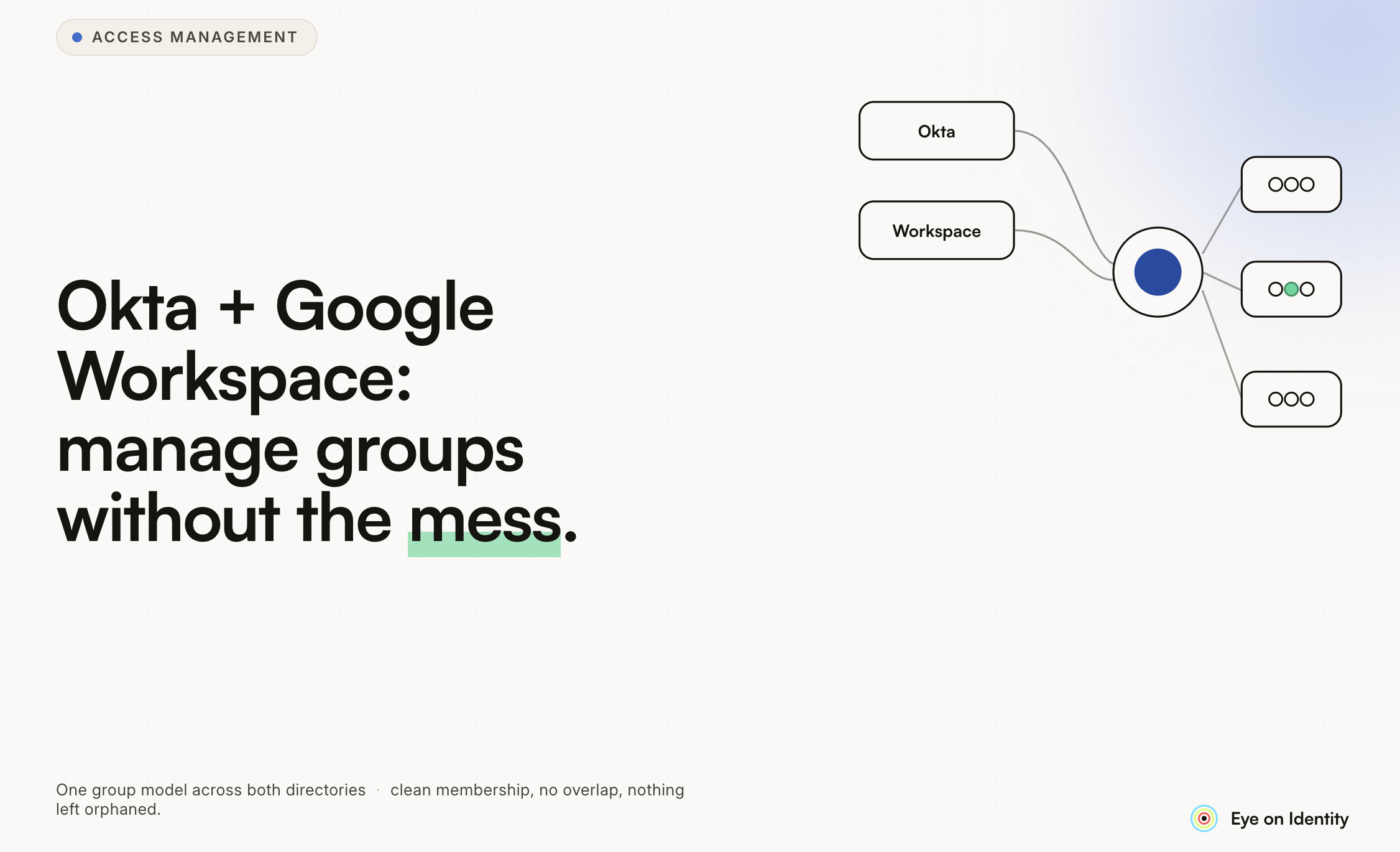


Group management in Okta and Google Workspace starts simple and gets complicated fast.
The instinct at most organizations is to mirror the HR hierarchy: create groups that reflect departments, teams, and reporting lines, then use those groups to control access. It makes sense in theory. The org chart is a known structure, HR keeps it updated, and it's easy to explain to stakeholders.
The problem surfaces when the org chart and the access model start pulling in different directions. An engineer moves from one team to another and keeps their old Slack channels and GitHub repository access because nobody updated the groups. A contractor joins a cross-functional project and gets added to five different groups manually. A new SaaS tool gets provisioned for a team, someone creates a new group for it, and six months later nobody knows who owns it or whether it's still accurate.
This is not a tooling failure. It's a structural one. Mirroring organizational hierarchy in access groups conflates two things that need to stay separate: who someone is, and what they're allowed to do.
The Core Distinction: Hierarchy vs. Access
An organizational hierarchy describes reporting relationships and team membership. An access model describes what resources people need to do their jobs.
These two structures overlap but they are not the same. A product manager and an engineer on the same team need completely different system access. Two engineers on different teams might need access to the same repository. A department head might not need access to every system their team uses.
When you build your access model on top of your org chart, you end up with groups that are doing double duty: they're both identity containers and access control mechanisms. That dual purpose is what causes group sprawl. Every time the org chart changes, you have to update the access model. Every time access requirements change, you have to either update existing groups or create new ones. The two concerns entangle and compound.
The cleaner approach separates them. The identity layer describes who someone is (their role, department, employment type, location). The access layer describes what that identity class is allowed to do. Role-based access control is the pattern: roles are defined by job function, not by org chart position, and groups are assigned to roles rather than to reporting structures.
Practical Group Design in Okta and Google Workspace
Okta and Google Workspace handle groups differently, and the strategy needs to account for both.
In Okta, groups are primarily used for application assignment and policy enforcement. A group in Okta controls which applications its members can access and which authentication policies apply to them. Okta also supports group push to downstream directories, which means Okta groups can propagate to Google Workspace, Active Directory, and other connected systems.
In Google Workspace, groups serve two functions: access control for Google-native resources (Drive folders, shared calendars, Meet rooms) and email distribution lists. The dual function creates a complication: a group you create for resource access ends up also being an email distribution list unless you explicitly manage it otherwise.
A workable design separates these functions explicitly:
- Role groups in Okta: define access to applications by job function. Engineer, Product Manager, Sales Rep, Finance Analyst. These are the authoritative groups that control application assignment. They are managed in Okta and pushed to downstream systems as needed.
- Resource groups in Google Workspace: control access to specific shared resources (a project Drive folder, a shared calendar). These are scoped and time-limited where appropriate. They are not used for application access.
- Distribution lists in Google Workspace: separate from resource groups, used only for email. Not used for access control.
This separation prevents the situation where you add someone to an email list and accidentally grant them access to a sensitive Drive folder, or where you remove someone from a resource group and knock them off a distribution list.
Managing Group Lifecycle: The Part That Usually Breaks
Creating a clean group structure is the easy part. Keeping it clean over time is where most organizations struggle.
Group lifecycle has three common failure modes:
Orphaned groups. A project ends, a team reorganizes, or a product is deprecated. The groups created for that context persist. Nobody owns them. They accumulate over months and years until someone does an audit and finds hundreds of groups with no clear owner and membership lists that haven't been reviewed since they were created.
Stale membership. Someone changes roles or leaves the organization. The group memberships that reflected their old role don't get updated. This is the access accumulation problem: identities collect permissions over time instead of having their access adjust with their role.
Manual provisioning drift. Access requests come in through Slack, email, or ticketing systems. Someone with admin access manually adds a user to a group. There's no record of why, no expiration, and no review scheduled. The group membership diverges from the intended access model.
The structural fix for all three is connecting group membership to an authoritative source of truth (the HRMS) and automating the lifecycle events that update it. When someone's role changes in the HR system, the downstream group memberships update automatically. When someone leaves, all group memberships are revoked. When someone joins, they're added to the role groups that correspond to their position.
Where Zluri Fits
Zluri is an Identity Governance and Administration platform that integrates with both Okta and Google Workspace to manage the access lifecycle layer that neither tool handles natively.
Okta and Google Workspace are excellent at enforcing access once it's been granted. They're not designed to govern the decision-making process around who should have what, automate lifecycle changes based on HR events, or provide the audit trail that compliance frameworks require. That's the IGA layer.
Zluri connects to the HRMS as the source of truth for identity lifecycle events. When an employee joins, changes roles, or leaves, Zluri triggers the appropriate provisioning or deprovisioning actions across Okta, Google Workspace, and every other connected application. Group memberships update automatically rather than through manual IT requests.
For access requests that fall outside the automatic provisioning model, Zluri's self-service portal gives employees a governed way to request access to specific applications or resources. Requests route to the appropriate approver, provisioning runs on approval, and everything is logged. This replaces the informal Slack request that ends up as an undocumented manual group addition.
Access reviews in Zluri surface current group memberships for review on a defined schedule, giving application owners and department heads the ability to confirm or revoke access with a structured record of the decision. This addresses the stale membership problem without requiring an annual manual audit.
The Group Hygiene Principle
The underlying principle is straightforward: groups should reflect access requirements, not organizational history.
A group that no longer corresponds to an active access requirement should be deprecated. A group member whose role no longer requires that access should be removed. The access model should reflect the current state of the organization, not an accumulated record of every access grant that was ever made.
Achieving that in practice requires both a structural approach (separating role groups from resource groups, keeping distribution lists separate) and an operational discipline (connecting group membership to authoritative HR data, automating lifecycle events, reviewing access on a schedule). The tools exist to make this manageable. The discipline is what prevents the mess from accumulating in the first place.


.svg)