

The question comes up consistently in identity security conversations: IAM and IGA both claim to solve access problems, but they solve different ones. If you are evaluating where to invest or trying to explain to leadership why the organization needs both, the distinction matters more than the acronyms.
Here is how their security value actually differs, where each one leaves the other blind, and what that means at different stages of organizational maturity.
Why the Confusion Exists
IAM and IGA overlap in exactly one place: provisioning access when someone joins or leaves. Both categories of tool can create accounts, assign access, and disable users. That overlap is where most of the confusion comes from.
The divergence is everything else.
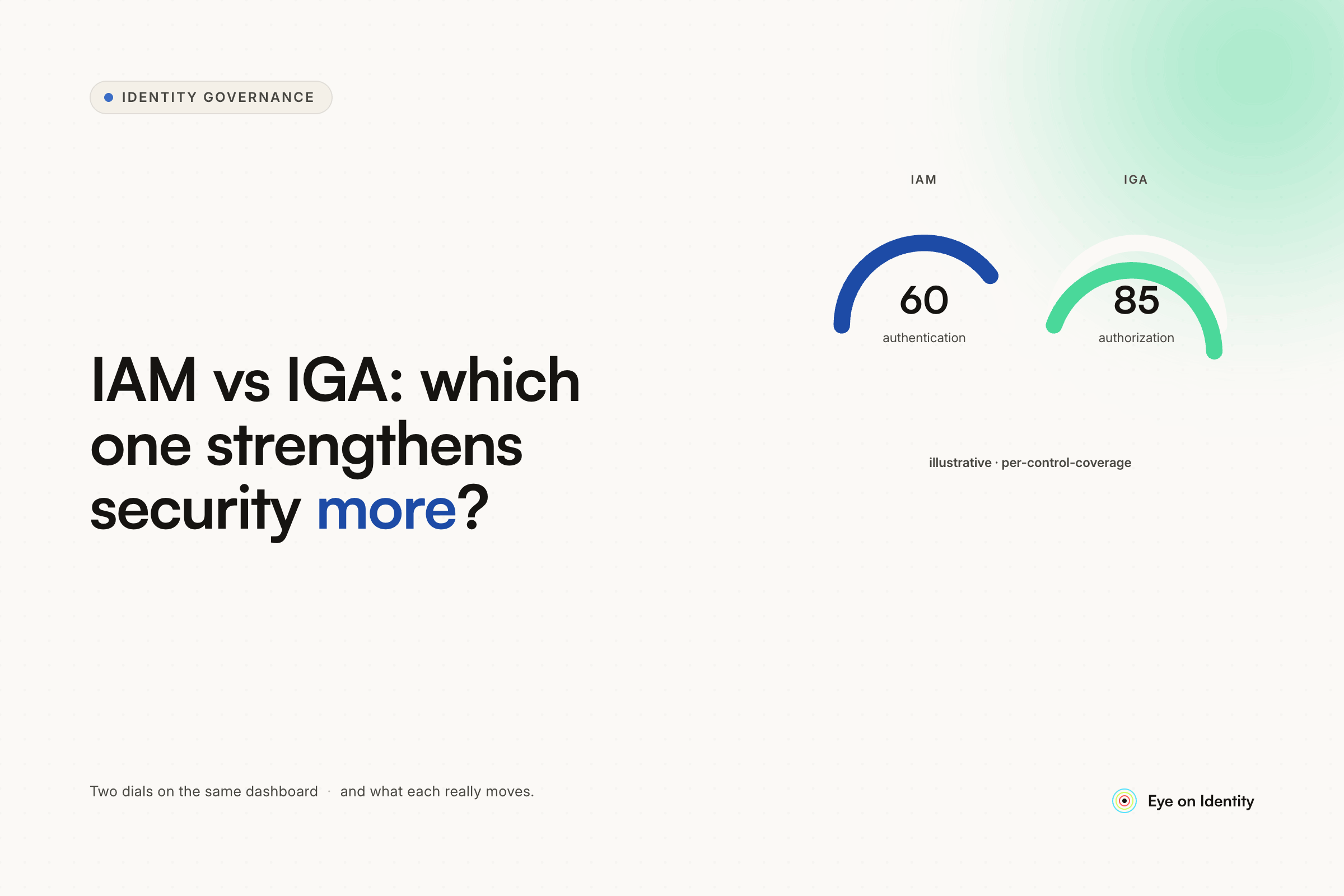
IAM tools — Okta, Microsoft Entra ID, Google Workspace — are built around the login event. Their security value is concentrated at the moment a user attempts to authenticate: is this the right person, are their credentials valid, does their device and context meet policy, are they allowed in right now. SSO, MFA, conditional access, and session control all operate at this layer. When the login is successful, IAM's job is largely done.
IGA tools are built around what happens after authentication. The questions they answer are not about the login event — they're about the state of access over time: who holds what entitlements, whether those entitlements are still appropriate, whether any combination of permissions creates a compliance or fraud risk, and whether the organization can prove all of that to an auditor. These are not real-time questions. They are governance questions, and they require a different architecture to answer.
The Security Value of IAM: Real-Time Perimeter Protection
IAM secures the perimeter at the moment of entry. By centralizing authentication through SAML, enforcing MFA, and applying conditional access policies, IAM tools prevent external attackers from getting in and protect against credential-based attacks — stuffing, brute force, phishing-driven account takeover.
This is non-negotiable. No organization has a functional security posture without it. MFA alone eliminates the overwhelming majority of credential-based account compromises. SSO reduces the attack surface that comes from employees managing separate credentials for dozens of applications — each one a potential breach point if reused or weakly set.
IAM's security value is immediate, measurable, and concentrated at the front door. It is the mandatory first layer, and it does its job well within that scope.
What it cannot see is anything happening inside the building after the door opens.
The Security Value of IGA: Long-Term Internal Risk Reduction
IGA's security value operates on a different timescale and addresses threats that IAM is structurally blind to. These are not perimeter threats — they are internal, administrative, and they compound silently over time.
Orphaned accounts. When an employee leaves, disabling their SSO account does not automatically remove their underlying accounts in disconnected or non-SCIM applications. Those accounts remain active, credentialed, and accessible — by the former employee if their app-level credentials are unchanged, or by an attacker who compromises them. IGA platforms actively hunt down and deprovision these lingering accounts across the full application stack, including the apps that do not federate to your identity provider.
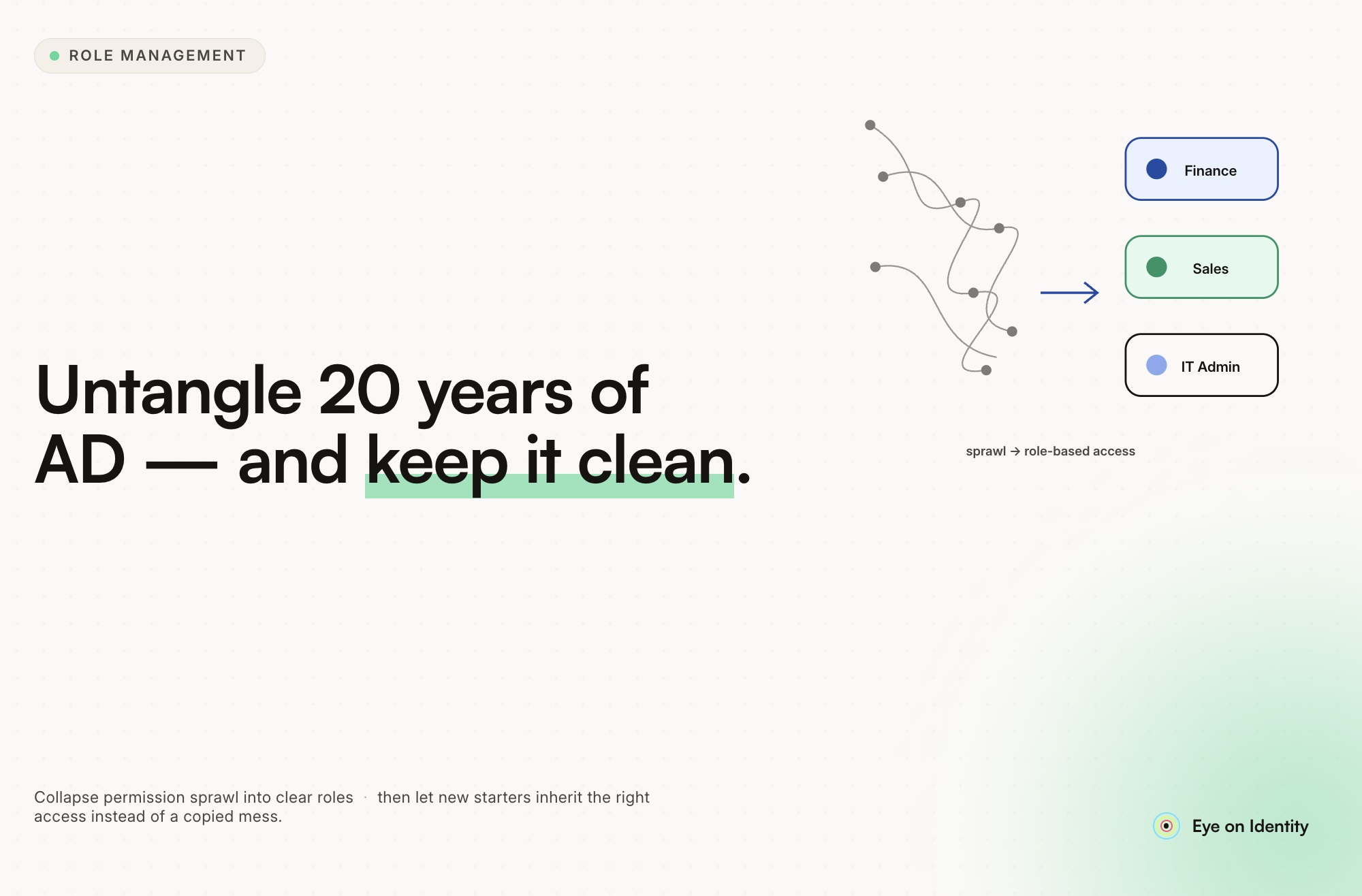
Privilege creep. As employees change roles, they accumulate access they no longer need. A developer promoted to engineering manager retains their repository access, their staging environment credentials, and the half-dozen tool permissions they picked up on specific projects. Over time, the gap between what someone needs and what they have grows wide enough to represent a meaningful insider threat surface. IGA access reviews and automated revocation policies close that gap systematically rather than relying on anyone to remember to clean it up.
Segregation of Duties violations. Some permission combinations are not just unnecessary — they are a fraud risk. The ability to both initiate and approve a financial transaction. The ability to both request and independently fulfill a software purchase. IAM provisions both permissions without flagging the conflict. IGA evaluates entitlement combinations against policy rules before access is granted and catches conflicts that would otherwise go undetected until an audit finds them.
Shadow IT and ungoverned SaaS. Employees adopt tools outside IT's purview constantly — including generative AI tools that may process sensitive data, productivity apps that store company information, and integrations built without security review. IGA discovery engines surface these applications and bring them into the governed environment before they become breach vectors. Zluri's discovery engine identifies apps through browser extension data, desktop agents, and financial transaction analysis, covering the tools that never touch your SSO layer.
Where Each One Falls Short Without the Other
An IAM-only environment has a clean perimeter and a governance blind spot. Every authentication is verified. No one knows what access people have accumulated, whether it is still appropriate, or whether any of it violates policy. Access reviews are manual or nonexistent. Orphaned accounts accumulate in every application that does not connect to the identity provider. The organization passes the front-door security check and fails the hallway audit.
An IGA-only environment — theoretically — has excellent visibility into entitlements and strong governance over access decisions, but no coherent authentication layer. In practice this does not exist; IGA platforms depend on a directory or identity provider as the source of truth for user identities. IGA without IAM has nothing to govern.
The practical failure mode for most organizations is the first one: they implement IAM early because SSO and MFA are visible, urgent, and relatively fast to deploy. IGA comes later, if at all — and the longer it waits, the more entitlement entropy has accumulated.
Which One Provides More Security Value?
The honest answer is that it depends on where the organization is, and what threats it is actually exposed to.
For early-stage or smaller organizations with straightforward app stacks and no regulatory requirements, IAM is the correct investment. The perimeter threats it addresses are immediate and high-probability. IGA overhead at that scale often exceeds the risk it mitigates.
For organizations that have scaled — more employees, more applications, more role changes, any meaningful regulatory exposure — IGA frequently delivers the more transformative security improvement. The perimeter is already locked. The threats that remain are internal: the employee who accumulated permissions across three role changes, the contractor whose access was never fully revoked, the service account that looks dormant but is running a critical process, the SaaS tool finance added without telling IT. IAM cannot see any of those. IGA is built specifically to find and address them.
One way to assess where your organization sits: if your last security incident or near-miss involved a credential stolen at login, IAM is the gap. If it involved access that should not have existed, an account that should have been deprovisioned, or a permission combination that slipped through — that is an IGA gap.
Most mature organizations have both because the threats are genuinely different and neither tool substitutes for the other.
FAQ
What is the difference between IAM and IGA in security?
IAM secures the login event — SSO, MFA, authentication, and real-time access control. IGA governs what happens after login — managing entitlements over time, enforcing access policies, running access reviews, and ensuring compliance. IAM addresses perimeter threats. IGA addresses internal, long-term risk like privilege creep, orphaned accounts, and Segregation of Duties violations.
Which is more important for security: IAM or IGA?
IAM is the non-negotiable foundation — no organization can operate securely without controlling who can authenticate. IGA becomes the higher-value investment as organizations scale, because it addresses the internal vulnerabilities that IAM cannot see: accumulated excess access, ungoverned SaaS, and entitlement combinations that create compliance or fraud risk.
What is privilege creep and how does IGA prevent it?
Privilege creep is the accumulation of access permissions over time as employees change roles without having previous access revoked. IGA platforms address it through automated access reviews, time-limited entitlements, and policies that trigger revocation when role attributes change — ensuring the gap between what someone has and what they need stays narrow.
What are orphaned accounts and why are they a security risk?
Orphaned accounts are user accounts that remain active in applications after an employee leaves, even after their SSO access is disabled. Because many applications do not connect to the identity provider, disabling the SSO account does not remove the underlying app account. IGA platforms discover and deprovision these accounts across the full application stack, eliminating a persistent backdoor that IAM alone cannot close.


.svg)