

Being handed a stack that includes AD, Azure AD, SailPoint, and BeyondTrust without much context on how they fit together is a common starting point for new IAM specialists. Each of those tools is deep enough to be a specialty on its own — the most useful early investment is understanding the conceptual framework that connects them before going deep on any individual platform.
One piece of advice from an experienced IAM consultant in the thread this article draws from: the problems in most bad IAM implementations aren't technical — they're strategic. Organizations try to do too much at once and don't have a clear vision of what they're trying to accomplish. Understanding the framework first helps you ask the right questions and prioritize correctly.
The Three Pillars: IAM, IGA, and PAM
Your current stack maps to three distinct categories of identity security that operate at different layers:
IAM (Identity and Access Management) is the operational layer — AD and Azure AD live here. IAM handles authentication (verifying who you are) and authorization (determining what you're allowed to access). It's the real-time enforcement layer that makes access decisions at the moment someone tries to log in. Everything starts here because you need a trusted identity foundation before governance or privileged access management can function effectively.
IGA (Identity Governance and Administration) is the governance layer — SailPoint lives here. IGA operates on a longer time horizon than IAM. Where IAM answers "can this person access this right now," IGA answers "should this person have this access at all, is there a documented approval, and is there evidence the access is still appropriate?" Access reviews, certification campaigns, Segregation of Duties enforcement, and lifecycle automation for joiners, movers, and leavers are the core IGA functions. The access certifications use case — the ability for managers to easily review who has access to what — is the most common initial driver for IGA implementations.
PAM (Privileged Access Management) is the privileged layer — BeyondTrust lives here. PAM specifically addresses the security and monitoring of accounts with elevated privileges: admin accounts, service accounts, database access, root access, and similar. The core PAM pattern is Just-in-Time access — instead of leaving elevated privileges permanently assigned, grant them for a defined window (a few hours to resolve a specific ticket, for example), then automatically expire them. This limits the blast radius of compromised privileged credentials.
Understanding which tool belongs to which pillar helps you understand what each is designed to solve and where the handoffs are between them.
The Core Best Practices That Span All Three Pillars
Establish a single source of truth. Every automated access decision is only as good as the data driving it. Your organization needs a single authoritative system — usually an HRMS like Workday or BambooHR, or a primary Active Directory — that holds the accurate, current record of each employee's status, department, role, and manager. When that data is wrong or stale, every downstream automation produces wrong results. Before worrying about any specific platform capability, understand where your source of truth is and how reliable it is.
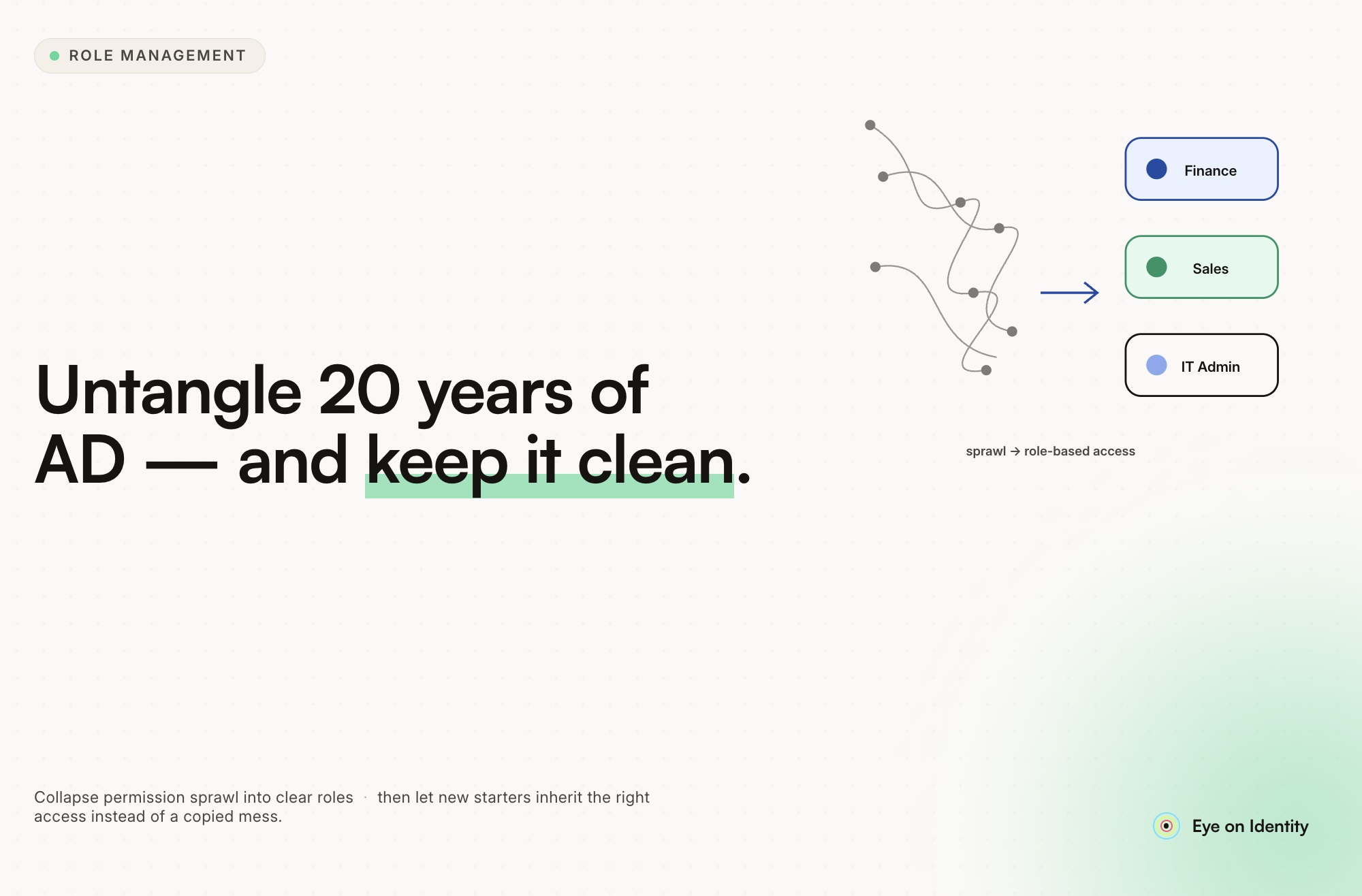
Master the Joiner-Mover-Leaver lifecycle. JML is the operational framework for access management. Joiners need birthright access — the standard set of entitlements appropriate for their role — provisioned automatically from day one without waiting for IT tickets. Movers need their old role's access revoked simultaneously with their new role's access being provisioned — the failure to do the removal side is how privilege creep accumulates. Leavers need complete offboarding that covers all applications, not just the ones managed by your IdP — the accounts in tools the company doesn't know about are the orphaned accounts that show up in audits.
Enforce least privilege. Users should have the minimum access necessary to do their job, and nothing more. In practice, this means role-based access control (RBAC) as the baseline — access defined by job function rather than by individual — and moving toward attribute-based access control (ABAC) for more complex scenarios where context (time of day, location, device state) should modify what's accessible. Periodic access reviews are the mechanism that keeps least privilege from drifting as people change roles and accumulate entitlements.
Separate compliance work from lifecycle work. If your organization is trying to solve compliance problems with SailPoint, tackle that first. Access reviews are the easiest SailPoint use case to implement, produce the most immediate visible value (cleaner data, documented evidence), and build organizational goodwill before you start the harder work of lifecycle automation. Starting with the joiner-mover-leaver automation before you've cleaned up the access data tends to automate a mess rather than fix it.
Learning Resources Worth Your Time
For conceptual foundation:
NIST Special Publication 800-63 (Digital Identity Guidelines) is the authoritative federal standard for digital identity. It's dense but worth reading for the conceptual vocabulary and framework — particularly the sections on identity proofing and authentication assurance levels.
IDPro's Body of Knowledge is a practitioner-maintained reference covering provisioning, authentication, authorization, governance, and compliance across platforms. More accessible than NIST for someone building practical skills, and vendor-neutral.
The CISSP Domain 5 coverage on identity and access management is another good starting point for breadth. The Sunflower CISSP PDF is a solid quick-reference for the terminology — it's not deep coverage, but knowing what abbreviations like RBAC, ABAC, OIDC, SAML, and SCIM refer to helps when following technical documentation.
For platform-specific learning:
John Savill's YouTube channel is consistently recommended by Microsoft practitioners for Azure AD and Entra ID content. His weekly update format with indexed chapters makes it easy to find specific topics without sitting through an entire video.
The SC-300 (Microsoft Identity and Access Administrator Associate) learning path covers Entra ID, conditional access, and identity governance in a structured sequence. Even if you don't take the exam, the learning path is a useful curriculum for Microsoft-specific IAM skills.
SailPoint's own documentation and community forums are the primary resources for IIQ and IdentityNow. Finding experienced practitioners willing to share context on specific implementations is more valuable than documentation for the nuanced judgment calls.
Community resources:
r/cybersecurity, r/sysadmin, and r/IdentityManagement are the most relevant subreddits for real-world IAM discussions, vendor comparisons, and implementation questions. Knowing what typically goes wrong is as useful as knowing how things are supposed to work.
Where to Focus First Given Your Current Stack
The strategic advice: start with what your organization cares most about — compliance, lifecycle management, or zero trust — and don't try to tackle everything at once.
If your organization is primarily compliance-driven (SOC 2, ISO 27001, HIPAA), start with access certifications in SailPoint. It's the most straightforward initial implementation, produces auditor-ready evidence quickly, and establishes the foundation for more complex governance work.
If your organization's biggest pain is onboarding and offboarding (people waiting for access or accounts lingering after departures), start with the leaver use case first. Getting offboarding right is faster to implement than onboarding, produces immediately visible security value, and sets up the data cleaning you'll need before joiner automation works correctly.
If privileged access is the primary concern — admin accounts without oversight, standing privileges that should be time-limited — BeyondTrust and Azure PIM are the right starting points, and the Just-in-Time access pattern is the first thing to understand in depth.
Whatever you tackle first, keep expectations in check with your team and leadership. Any one of these platforms is complex enough to be a career specialty. Progress measured in months on a single well-defined use case is more valuable than trying to deploy all three pillars simultaneously.
Frequently Asked Questions
What is the best way to learn identity and access management from scratch?
Start with the conceptual framework: understand the difference between IAM (authentication and authorization), IGA (governance, access reviews, lifecycle management), and PAM (privileged access management). Then map your organization's current tools to those categories. For learning resources, NIST 800-63, IDPro's Body of Knowledge, and the SC-300 Microsoft learning path provide structured conceptual foundations. John Savill's YouTube channel is highly recommended for Azure AD and Entra ID specifically.
What is the JML lifecycle in identity management?
Joiner-Mover-Leaver (JML) describes the three key identity lifecycle events: a new employee joining (requiring access provisioning), an existing employee changing roles or departments (requiring simultaneous access adjustment — removing old role access and adding new role access), and an employee leaving (requiring complete access revocation across all systems). Automating all three phases from a single authoritative HR source of truth is the core objective of IGA implementations.
How is SailPoint different from Azure AD or Okta?
Azure AD and Okta are identity providers (IAM tools) focused on authentication — verifying who you are and controlling access at the login layer. SailPoint is an IGA platform focused on governance — managing who should have access, running periodic access reviews, enforcing Segregation of Duties, and automating the joiner-mover-leaver lifecycle. IAM handles the front door; IGA governs what happens inside. Most enterprise environments use both layers.
What is Just-in-Time (JIT) access and why does it matter?
Just-in-Time access is a privileged access management pattern where elevated privileges are granted only for a specific, time-limited window rather than being permanently assigned. Instead of a system administrator having standing admin rights, they request elevation for a defined period (a few hours to resolve a ticket), access is granted, and it automatically expires. This limits exposure from compromised privileged credentials — an attacker who obtains the account only has admin rights until the window closes.


.svg)