

A two-person IT team managing 200 devices and a growing SaaS stack across multiple disconnected tools is not a systems problem. It is a governance problem waiting to surface.
The setup is familiar: one tool for device management, another for SSO, a spreadsheet for asset tracking, and a manual offboarding checklist that someone has to remember to run. Each tool works reasonably well in isolation. The gaps appear at the seams, when an employee leaves and their laptop gets returned but their Salesforce access stays active, or when a contractor's account outlives their engagement because nobody connected the termination record to the provisioning system.
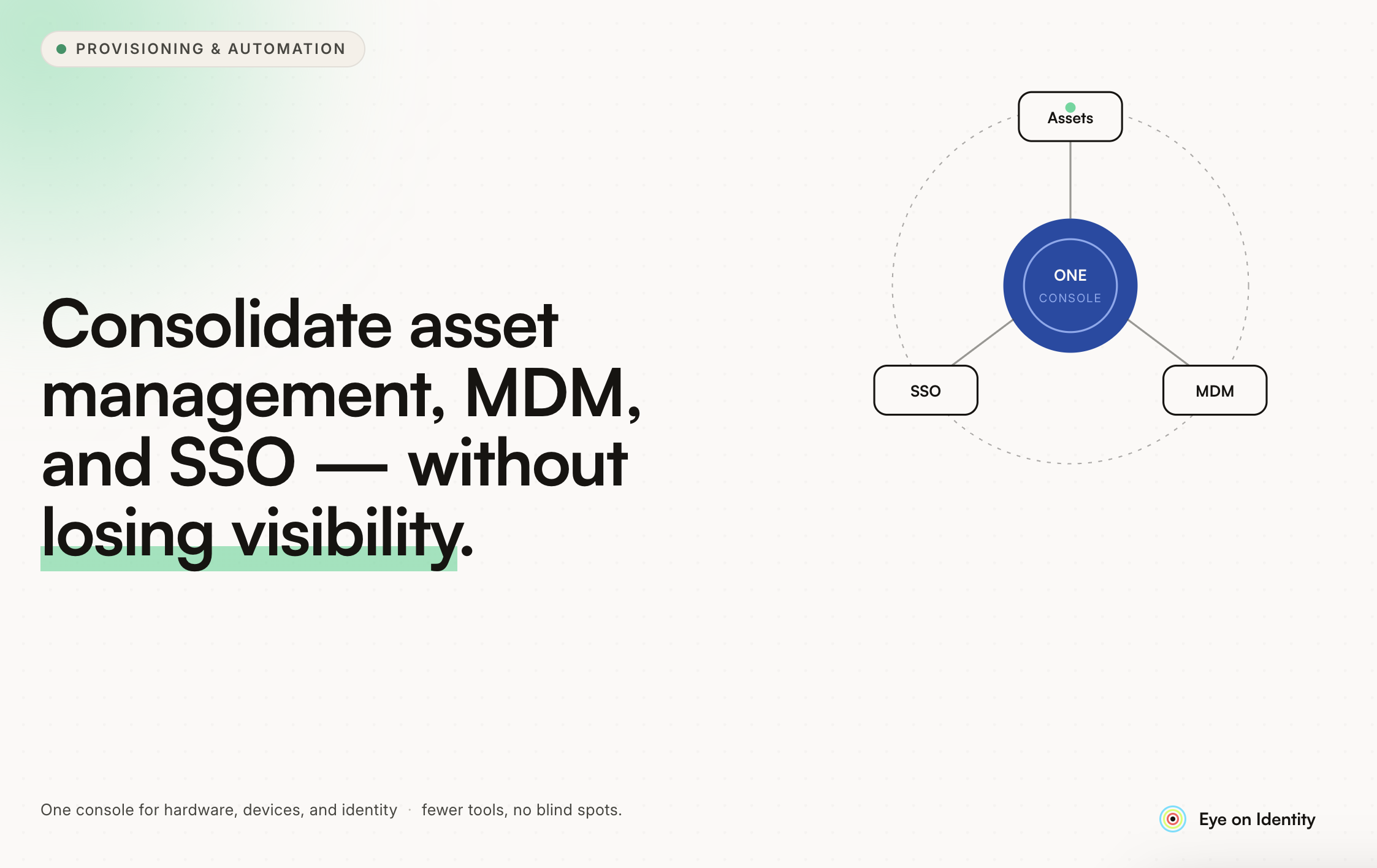
This guide covers what a consolidated IT management approach actually looks like, what each layer is responsible for, and where identity governance fits into the picture alongside MDM, SSO, and asset management.
The Problem With Running IT Across Disconnected Tools
The core issue with fragmented IT tooling isn't the number of tools. It's that the tools don't share a common source of truth, so identity lifecycle events fall through the gaps between them.
When an employee joins, IT has to manually provision accounts in each system separately. When they leave, every system has to be updated individually, and the offboarding checklist is only as reliable as whoever is running it that day. Shadow IT (SaaS tools purchased by teams without IT involvement) doesn't appear in any of these systems at all.
The result is a gradual accumulation of risk: stale accounts, over-provisioned users, devices that were returned but never wiped, and licenses still being paid for tools that nobody uses. At 50 employees it's manageable. At 200 it becomes a compliance and security liability.
The consolidation instinct is right. The question is which layer to consolidate around, and what each layer is actually responsible for.
The Four Layers of Modern IT Management
A coherent IT management architecture separates concerns across four layers, each with a distinct function.
The HRMS (Source of Truth). Your HR system, whether Workday, BambooHR, or another platform, is where identity lifecycle events originate. A hire record, a role change, a departure date. This is the authoritative source that should drive downstream access and device provisioning automatically, not manually.
The Identity Provider (SSO and Authentication). Platforms like Microsoft Entra ID, Okta, and Google Workspace handle authentication: verifying who users are, issuing tokens, and enabling SSO across connected applications. This is the front door to your environment. Users authenticate once and access everything connected to the IdP without separate logins.
Device Management (MDM). Tools like Microsoft Intune, Jamf, and Kandji manage physical devices: enforcing policies, deploying software, encrypting disks, and enabling remote wipe when a device is lost or a user is offboarded. MDM operates at the operating system level and integrates with the identity layer to know which user a device belongs to.
Identity Governance and Administration (IGA). This is the layer that connects the others. An IGA platform takes lifecycle events from the HRMS, governs access across the full SaaS stack (not just what's in the IdP), triggers MDM actions during offboarding, and maintains the audit trail that compliance requires. It's the control plane that makes the other layers work together rather than in isolation.
Most consolidation conversations focus on the first three layers. The IGA layer is what prevents the gaps between them.
What Each Layer Is Responsible For (and What It's Not)
Understanding where each layer's responsibility ends is as important as knowing what it covers.
SSO and the IdP handle authentication and, to some degree, authorization within Microsoft or Google-native applications. They don't govern access within the internal structures of third-party SaaS tools, manage software licenses, or automate lifecycle workflows based on HR events without significant custom configuration.
MDM manages devices and can enforce basic application policies. It doesn't govern SaaS access, track software licenses, or run access reviews. It also can't know that an employee was terminated unless something tells it.
Asset management tools track what you own and who it's assigned to. They don't automatically reclaim assets or revoke access when employment ends. The connection to the identity layer is manual unless something bridges them.
IGA platforms connect these layers around the identity lifecycle. They watch for HR events, trigger provisioning and deprovisioning playbooks across all connected applications, call MDM integrations to wipe or lock devices during offboarding, and maintain a continuous access inventory that feeds access reviews and compliance reporting.
The consolidation value of an IGA platform isn't that it replaces MDM or SSO. It's that it coordinates them around a shared source of truth so the gaps between them close.
How Zluri Fits the Consolidated IT Stack
Zluri operates in the IGA layer, connecting HRMS, identity provider, SaaS applications, and MDM tools into a governed identity lifecycle.
Automated onboarding and offboarding. When a new hire record appears in the HRMS, Zluri triggers a role-specific onboarding playbook that provisions access across every application the role requires. When a departure date is set, Zluri's offboarding playbook revokes access across all connected applications and triggers MDM integrations with tools like Jamf, Kandji, or Microsoft Intune to remotely lock or wipe the employee's device. Nothing in the checklist depends on someone remembering to do it.
SaaS discovery and shadow IT visibility. Zluri's Discovery Engine integrates with your network, financial systems, and browsers to surface every application in use across the organization, including tools that IT didn't approve or know about. That visibility is the prerequisite for governing access effectively. You can't revoke access to an application you don't know exists.
Access governance across the full stack. Unlike SSO-native governance, which is scoped to applications registered in the IdP, Zluri governs access across 300+ SaaS integrations. That means the roles and permissions users hold inside Salesforce, Jira, GitHub, and dozens of other applications are visible, reviewable, and manageable from a single platform.
Self-serve access requests. Instead of routing every access request through IT tickets, Zluri's App Catalog gives employees a self-service portal to browse approved applications and request access. Requests route automatically to the right approver and, once approved, provisioning runs without IT involvement.
Audit-ready access records. Every provisioning event, access review, and deprovisioning action is logged in an immutable audit trail. When a compliance audit asks who had access to a specific system during a specific period, the answer comes from the platform.
On Account Takeovers and Identity Security
The Reddit thread that surfaced this topic included an account that was reportedly taken over by an unauthorized user, which is a vivid illustration of why identity security matters beyond provisioning and offboarding.
In a governed IT environment, the kind of lateral movement an account takeover enables is where Identity Security Posture Management (ISPM) and Identity Threat Detection and Response (ITDR) capabilities come in. These systems continuously monitor for anomalies: logins from unusual locations, access requests to systems a user doesn't normally touch, privilege escalation patterns.
Zluri's ISPM capabilities surface identity misconfigurations and risks across the environment: dormant accounts, over-privileged users, accounts without MFA enforced, and similar signals that indicate elevated risk before an attacker has the chance to exploit them. When a compromised identity starts behaving unusually, the governance layer can detect it.
The Practical Starting Point for Consolidation
For a two-person IT team evaluating consolidation options, the decision framework isn't which single tool does everything. It's which tool coordinates the tools you already have around a shared identity lifecycle.
MDM is a layer you need. SSO is a layer you need. Asset tracking is a layer you need. What makes them work together without gaps is connecting them to a central identity source of truth that knows when people join, move, and leave, and triggers the right actions in each system automatically.
That's the layer Zluri is built to be. It doesn't replace Intune or Jamf or Entra. It connects them to the HR system and the SaaS stack so lifecycle events propagate correctly and nothing falls through the gap between tools.


.svg)