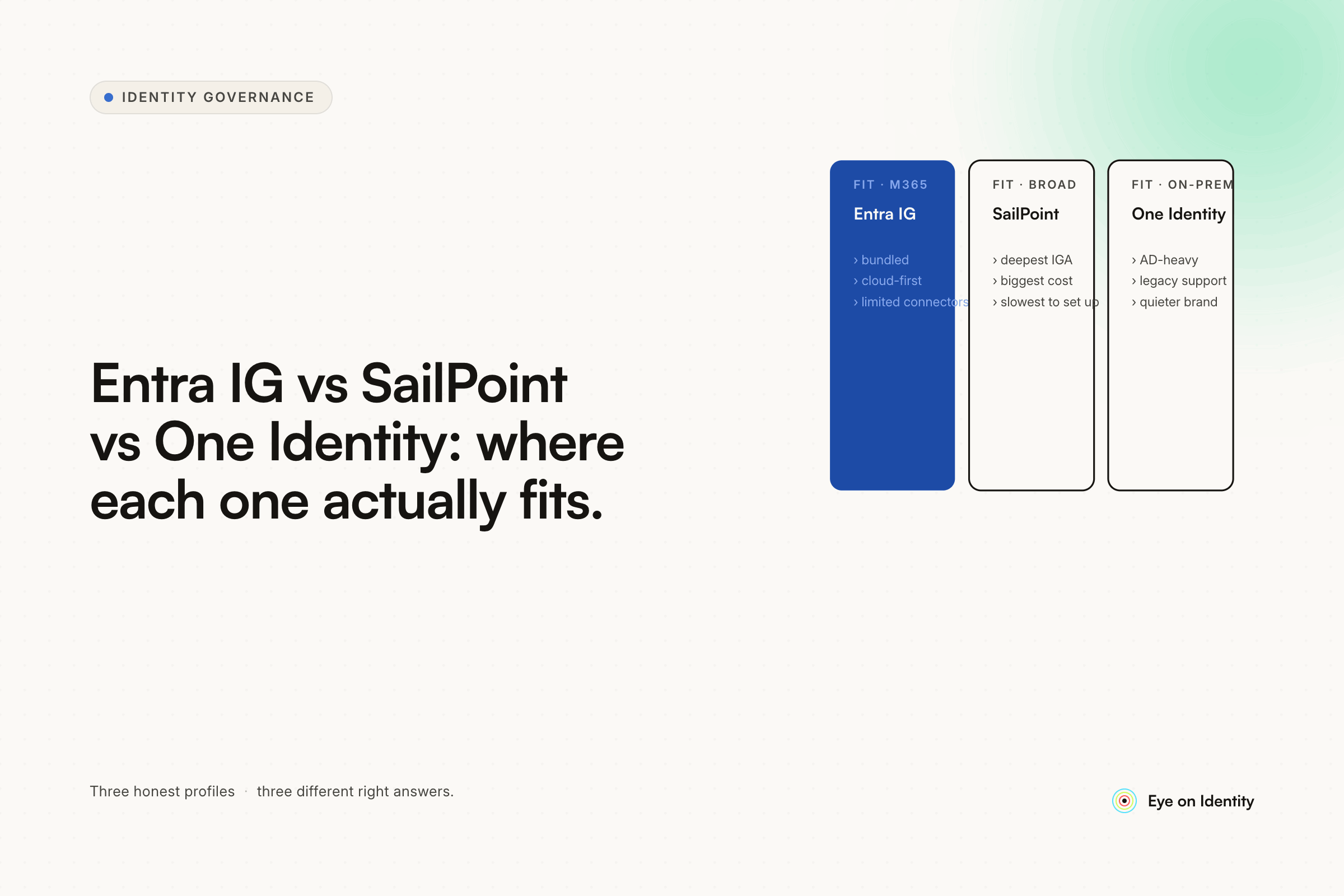


If your organization runs Active Directory, uses some cloud apps, and has a handful of on-prem systems that predate modern APIs, the pitch for Microsoft Entra Identity Governance sounds reasonable: you're already paying for it, your IT team knows the Microsoft stack, and adding a standalone IGA platform means another vendor, another implementation, another maintenance burden.
The gap between that pitch and reality shows up in specific places. Here is where Entra holds up, where SailPoint and One Identity Manager are genuinely stronger, and what that means for how you actually architect identity governance.
The Foundational Difference: Authentication Tool vs. Governance Platform
The most useful framing for this comparison is what each product was originally built to do.
Microsoft Entra ID (formerly Azure AD) is an IAM platform. Its core job is the front door: SSO, MFA, conditional access, verifying who is allowed to log in. "Entra Identity Governance" is a suite Microsoft added on top of that foundation — Access Packages, Entitlement Management, Privileged Identity Management, Lifecycle Workflows, Access Reviews. Most of these features have existed for years under the Azure AD P2 license; the Entra branding is largely a marketing reorganization rather than a new product. That context matters because the governance layer inherits the architecture of the authentication platform it was built on.
SailPoint and One Identity Manager were built from the start as governance platforms. Their center of gravity is what happens after a user is authenticated — deep role structures, access profiles, segregation of duties enforcement, fine-grained entitlement management across connected systems. They were designed for the enterprise world that existed before cloud-first became the default: complex on-prem infrastructure, legacy applications, regulatory environments requiring detailed access audit trails.
Neither architecture is inherently better. They were built for different problems, and where they overlap is where the comparison gets interesting.
On-Prem and Non-API Connectivity: The Sharpest Differentiator
This is consistently the first gap practitioners identify when they push Entra into a full IGA use case.
Entra is cloud-native. It connects to systems through modern, standard protocols — primarily SCIM and OAuth-based APIs. When an application supports those protocols, Entra provisioning works cleanly. When it doesn't — legacy on-prem apps, relational databases, custom internal systems, apps that restrict API access behind expensive licensing tiers — Entra's automated workflows stop at the perimeter. What's left is custom middleware, Azure Functions, Logic Apps, or manual IT intervention. Those custom builds work, but they're now sitting with your team to maintain, not with the vendor.
SailPoint and One Identity Manager were built specifically for that legacy enterprise world. SailPoint uses on-prem satellite components that connect directly to relational databases and local servers to execute provisioning commands. OIM similarly handles complex on-prem infrastructure through connector-based architecture designed for the kind of systems that were standard in large enterprises before cloud migration began. The trade-off is architectural complexity and implementation cost, not connectivity.
For organizations with primarily cloud-based environments and modern SaaS apps, this gap is minor — most of what needs connecting supports SCIM. For organizations with on-prem apps, custom databases, or any system without a usable API, it's the deciding factor.
Lifecycle Workflows: Where Entra's Rigidity Shows Up
Entra's Lifecycle Workflows handle the basics of joiner/mover/leaver automation for cloud-native environments. New hire detected in the HR system, M365 account created, access packages assigned. The feature is relatively new and still expanding — practitioners who have implemented it note that the out-of-the-box workflow options can feel constrained compared to what dedicated IGA platforms offer.
The email notification example from the original question is illustrative: Entra's leaver workflow supports notifying a manager, but routing custom notifications to colleagues or other stakeholders requires additional configuration that isn't available out of the box. That kind of customization in SailPoint or OIM is handled through workflow builders that allow multi-branching logic, custom notifications to any stakeholder, and integration with ITSM platforms like ServiceNow. The flexibility is genuinely greater — but so is the implementation complexity. SailPoint implementations with deeply customized lifecycle workflows routinely take 50+ weeks to stand up.
The practical question for mid-sized organizations isn't just which platform is more flexible. It's whether the organization has the implementation resources to fully configure and maintain that flexibility, or whether a simpler workflow structure that actually gets deployed is more useful than a powerful one that stalls in the configuration phase.
Entitlement Visibility Inside Applications
Entra knows who logged into an application. It generally does not know what that person can do inside it — what specific roles, permissions, or entitlements they hold at the application level.
This is the authorization blindspot that comes from building governance on top of an authentication platform. For access reviews and compliance programs that require fine-grained visibility — not just "does this user have access to Salesforce" but "what Permission Sets do they hold in Salesforce, and are any of them in conflict" — Entra's visibility ends at the login event.
SailPoint pioneered the concept of Access Profiles specifically to address this. It reads back entitlements from connected applications, maps them into a centralized model, and makes them available for access reviews, SoD policy enforcement, and audit reporting. OIM approaches this similarly with its connector architecture. For organizations in regulated industries where granular entitlement visibility is a compliance requirement rather than a nice-to-have, this capability gap is significant.
What "Good Enough" Actually Means in Practice
One IAM architect who evaluated this at the Gartner IAM summit framed it usefully: Microsoft covers SSO and SCIM provisioning well, but custom API integrations and governance outside the Azure ecosystem require custom builds. SailPoint and Saviynt solve that with a connector catalog, but the implementation is complex enough that many organizations stall partway through.
The practical breakdown for mid-sized organizations:
Entra Identity Governance is a reasonable fit if your environment is predominantly Microsoft and modern SaaS, most of your apps support SCIM or Azure app integrations, you don't need entitlement-level visibility inside third-party applications, and you have the Azure expertise to extend lifecycle workflows through custom scripting when the out-of-the-box options fall short.
SailPoint or OIM are the stronger fit if you have complex on-prem infrastructure that requires deep connector-based access, regulatory requirements demand granular entitlement visibility and SoD enforcement, and you have the implementation resources to see a 12–18 month deployment through to production.
Neither solves the full picture out of the box for hybrid environments. Organizations with a mix of cloud apps, on-prem legacy systems, and non-API workloads — which describes most mid-sized companies that have been around for more than a decade — typically need either heavy customization on top of Entra, or a next-generation IGA platform that connects to the full environment without the implementation overhead of traditional enterprise platforms.
A Note on Architecture for Hybrid Environments
The approach that avoids both Entra's connectivity gaps and the implementation weight of traditional IGA is to use Entra ID as the core directory and SSO layer, and layer a dedicated IGA platform on top for the applications and systems it cannot reach.
Zluri integrates with Entra as the identity source of truth, handles SCIM-supported apps natively across 300+ integrations, and extends governance to non-API and on-prem systems through browser automation and lightweight on-prem agents — the same kind of agent-based connectivity that makes SailPoint and OIM effective in legacy environments, without the satellite architecture complexity. For the apps Entra cannot govern and that don't warrant a full SailPoint implementation, this is how mid-market organizations are closing the gap.
FAQ
Can Microsoft Entra Identity Governance replace SailPoint or One Identity Manager?
For cloud-first Microsoft shops with modern SaaS apps, Entra covers a meaningful portion of IGA requirements. For organizations with complex on-prem infrastructure, legacy apps without APIs, or compliance requirements demanding granular entitlement visibility, purpose-built IGA platforms like SailPoint or OIM cover capabilities Entra does not.
What are the main weaknesses of Microsoft Entra for identity governance?
The primary gaps are: limited connectivity to on-prem apps and systems without modern APIs, no native visibility into fine-grained entitlements inside third-party applications, relatively constrained out-of-the-box lifecycle workflow customization, and no provisioning to Active Directory (Entra syncs from AD, not to it).
How does SailPoint connect to on-prem and legacy systems?
SailPoint uses on-premises satellite components that connect directly to relational databases and local servers to execute provisioning and de-provisioning actions. This architecture was designed for the legacy enterprise environment and handles systems that cloud-native platforms cannot reach through standard APIs.
What is the difference between IAM and IGA?
IAM (Identity and Access Management) covers authentication — verifying who is allowed to log in, managing SSO and MFA. IGA (Identity Governance and Administration) covers what happens after authentication — managing which entitlements a user holds, automating joiner/mover/leaver lifecycle workflows, enforcing segregation of duties, and providing audit trails for access reviews. Entra is primarily an IAM platform with governance features added on top. SailPoint and OIM were built as dedicated IGA platforms.


.svg)