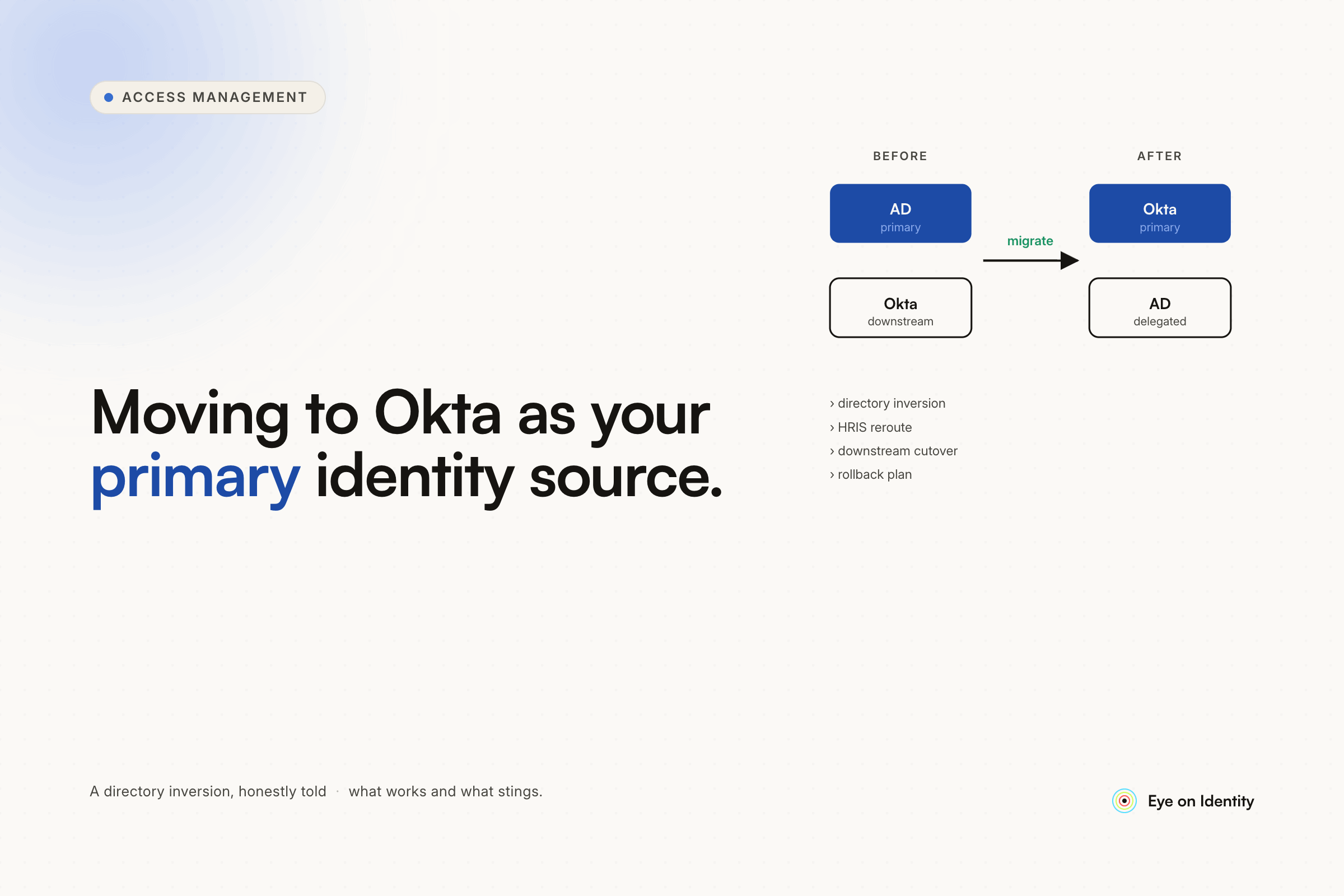


The community consensus for cloud-first hybrid-to-cloud migrations is consistent: Okta is worth it for SSO and centralizing authentication, and it's better than a well-maintained Entra ID for organizations that aren't deeply Microsoft-centric. The "paranoid vibes" you're describing are legitimate and specific — they're not about whether Okta works, but about what Okta doesn't solve that you might expect it to.
The experienced practitioner take from this thread: "If you don't have governance discipline now, Okta won't magically create it. The tooling changed but the people and process problems followed them over." That's the most important framing going into this migration.
What Okta Actually Does Well
SSO and authentication centralization. This is Okta's core strength and the reason it's the most recommended IAM platform at mid-to-large scale. Centralizing authentication through a single identity provider eliminates password fatigue, enables universal MFA enforcement, and gives you consistent conditional access controls across your application stack. If you're currently managing authentication across a hybrid AD environment with manual sync processes, this improvement is real and immediate.
Smaller attack surface than AD. Active Directory is notoriously difficult to secure at scale — Kerberoasting, pass-the-hash, GPO abuse, nested group complexity, and decades of accumulated technical debt are the common failure modes. A well-configured Okta instance is significantly easier to achieve and maintain in a secure state than a comparable AD environment. Okta's attack surface is smaller and the security model is more modern.
Reliable identity directory for downstream integrations. Okta's standardized attribute model — email, department, employment status, manager — is what downstream tools can reliably map against. Once Okta is the source of truth for these attributes, any tool you connect can trust the data it receives. This is particularly relevant for automation: provisioning workflows and access review tools can pull from Okta with confidence that the data reflects current state.
Okta + HRIS integration. The combination that practitioners in this thread and elsewhere consistently cite as the best available is Okta plugged into your HRIS (Workday, BambooHR, etc.) as the identity source of truth. When HR is the trigger and Okta is the directory, the joiner-mover-leaver lifecycle can be automated more reliably than most alternatives.
The Gaps: Where Okta Will Disappoint
SCIM coverage on your app stack. Okta's provisioning model relies heavily on SCIM for automatic account creation and deletion in downstream applications. The practical reality: a significant portion of SaaS applications either don't support SCIM or require enterprise-tier licensing at the application level to enable it. For every app in your stack that doesn't support SCIM, Okta can handle authentication (they log in via SSO) but can't automatically provision or deprovision the account. That means manual offboarding remains necessary for those apps, or you build custom Workflows logic per application.
Before committing to Okta as your primary identity source, audit your current application stack for SCIM support. The number of non-SCIM apps will tell you how much of the provisioning problem Okta actually solves versus how much stays manual.
No visibility into what users do inside applications. Okta tracks authentication events — it knows when someone logged in. It doesn't know what they did inside the application, whether they've used a feature recently, or whether their license tier matches their actual usage. For SOC 2 access reviews that require demonstrating appropriate access levels rather than just access presence, and for license optimization based on actual usage, you need additional tooling beyond Okta.
Granular permission visibility. Okta tells you a user has access to Salesforce. It doesn't tell you whether they're a standard user, an admin, or a super admin inside Salesforce. For access reviews that require attesting to permission levels (not just application membership), Okta's native visibility falls short.
Governance doesn't come from the tool. The j_sec-42 comment is worth taking seriously: Okta doesn't fix governance problems — it just moves them. Unclear group structures, tangled entitlements, and inconsistent role definitions in AD will follow you to Okta if you don't address them as part of the migration. The advantage is that cleaning this up in Okta is significantly easier than cleaning it up in AD. But it still requires the work.
Okta's recent security track record. The concerns about Okta's own security incidents are legitimate context. Okta has had notable breaches in recent years. This doesn't make the product the wrong choice — the risk needs to be weighed against the alternatives — but having compensating controls (monitoring for anomalous Okta API activity, reviewing admin account usage, MFA on all Okta admin accounts) and contingency plans is appropriate. Putting all your identity eggs in any single basket warrants defense in depth regardless of vendor.
Cost. Okta prices by user, including service accounts, which makes it expensive as your identity infrastructure scales. Okta IGA (the governance module) adds further cost and practitioners consistently describe the native governance features as complex and priced for enterprise rather than mid-market.
The Architecture That Actually Works
The community recommendation for organizations that need both strong authentication and complete lifecycle governance is to separate the two responsibilities: Okta for SSO and authentication, a dedicated IGA platform for provisioning, deprovisioning, access reviews, and shadow IT governance.
This isn't a commentary against Okta — it's the correct architectural separation of concerns. Okta is the authentication layer. IGA is the governance layer. Trying to make Okta handle both fully leads to the same gaps described above, while trying to find a single tool that does both typically means compromising on depth in one area.
Zluri sits on top of Okta as the governance layer — connecting to both Okta and your HRIS, handling provisioning for non-SCIM apps through direct API integration or AI-powered browser automation, running access certification campaigns across your full app stack (not just Okta-connected apps), and surfacing shadow IT that exists outside Okta's visibility. The operational model is: Okta handles the front door, Zluri handles everything that happens after authentication.
Should You Go Entra Instead?
Several practitioners in this thread raised Entra ID (Azure AD) as a question given the hybrid AD starting point. The honest comparison: if you're deeply invested in Microsoft 365 and your application stack is primarily Microsoft-connected, Entra is the natural path and avoids adding a new vendor. If you're cloud-first with a diverse SaaS stack and want the strongest SSO library and the most mature authentication platform regardless of vendor, Okta is the common recommendation.
The commenter who noted that Okta is "not comparable" to AD or Google Workspace for this use case, while Rippling and JumpCloud are "nice but not as advanced," reflects the general mid-market consensus. Entra is the legitimate Microsoft-centric alternative; Okta is the vendor-neutral default.
Frequently Asked Questions
Is migrating to Okta as your primary identity source worth it for a hybrid environment?
Yes, for most cloud-first transitions. Okta provides a smaller attack surface than Active Directory, better SSO library coverage, and a more maintainable security posture for cloud-centric environments. The caveat is that Okta solves the authentication problem well and the full lifecycle management problem incompletely — apps without SCIM support still require manual provisioning, and granular governance requires additional tooling. Go in knowing what Okta does and doesn't cover.
What are the main limitations of Okta for identity governance?
Okta's core limitations for governance are: SCIM dependency for automated provisioning (apps without SCIM aren't automatically deprovisioned), no visibility into in-app usage or permission levels, no shadow IT discovery for apps outside the Okta perimeter, and high cost and complexity for native governance features through Okta IGA. These gaps are typically addressed by layering a dedicated IGA platform over Okta rather than relying on Okta alone.
How do you handle provisioning for non-SCIM apps in an Okta environment?
Options in order of automation level: Okta Workflows with custom API calls for apps with REST APIs but no SCIM; AI-powered browser automation for apps with admin UIs but no programmatic interface; governed manual task routing where a tracked task is assigned to the app owner with required completion confirmation. A dedicated IGA platform like Zluri handles all three paths from a single offboarding trigger, triggered by Okta deactivation or HRIS termination.
What's the difference between using Okta for identity governance vs. a dedicated IGA platform?
Okta governs the applications it's connected to through SSO and SCIM. Apps outside Okta's perimeter — shadow IT, non-federated tools, apps without SCIM — are outside Okta's governance scope. A dedicated IGA platform extends governance to the full application stack including shadow IT discovery and non-SCIM apps, provides deeper access review capability with permission-level visibility, and typically integrates with Okta as the authentication source while handling governance independently.


.svg)