

Every IAM engineer knows how to govern human identities. There are established processes: onboarding when someone joins, access updates when they move, revocation when they leave. HR systems feed the directory. The JML workflow runs. The audit trail exists.
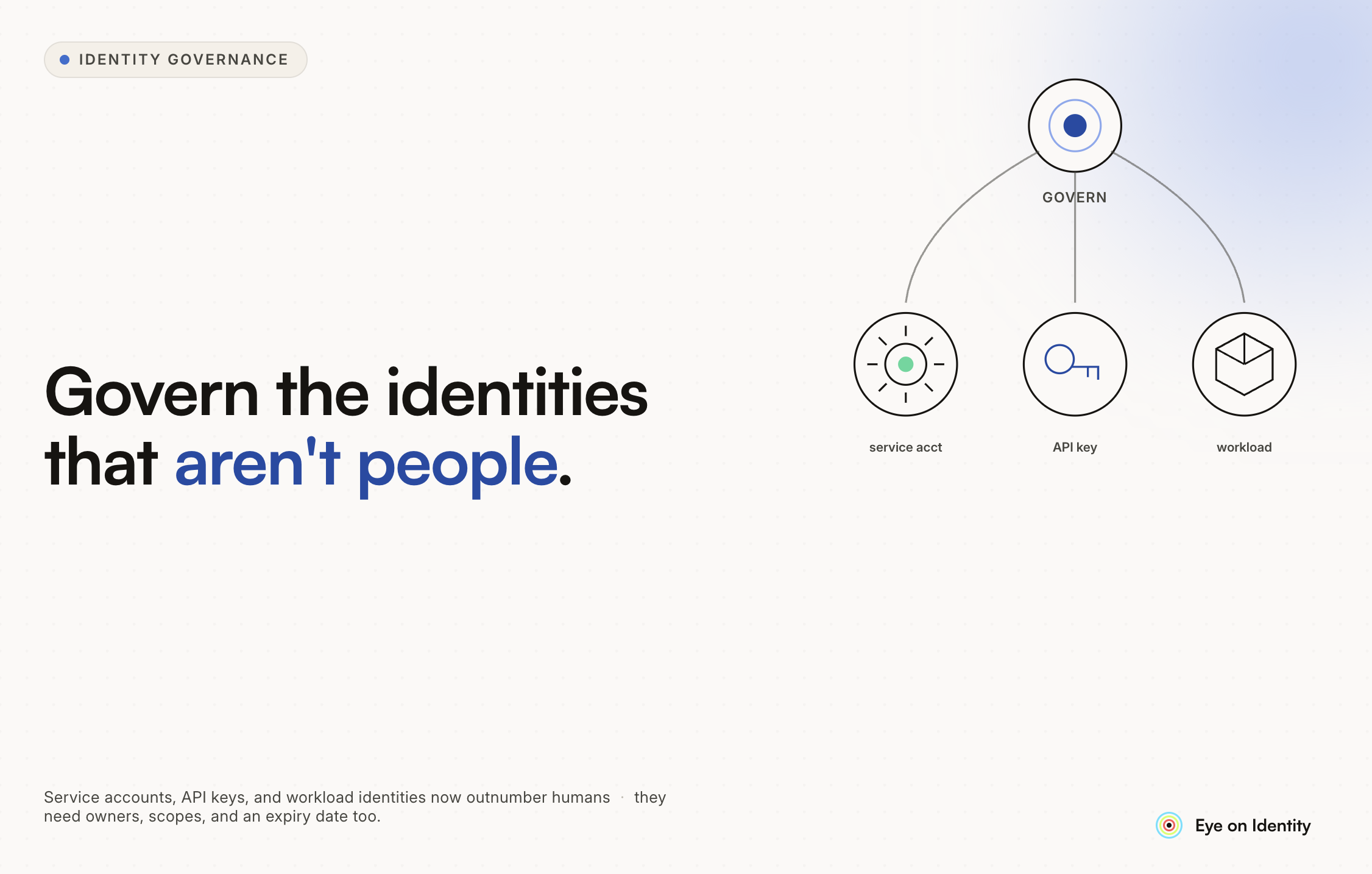
Non-human identities (NHIs) do not work this way. Service accounts, API keys, service principals, managed identities, OAuth tokens, and AI agents are created by developers to solve immediate problems. They live in cloud infrastructure, CI/CD pipelines, secrets managers, and SaaS platforms. They are rarely tied to a formal procurement process. They often outlive the projects they were created for. And when the developer who created them leaves the company, nobody inherits ownership because nobody knew who the owner was in the first place.
This is the governance gap that IAM engineers transitioning into DevOps and cloud environments are confronting. The tools and frameworks built for human identity management were designed around HR-driven events and directory-based user records. Non-human identities do not fit that model.
This guide covers the practical strategies for governing workload identities in DevOps environments and the tooling that can extend your existing governance framework to cover them.
Why NHIs Are the Fastest-Growing Identity Risk
The scale of the non-human identity problem has grown significantly faster than most organizations' governance programs have adapted to it.
In a typical DevOps environment, non-human identities outnumber human identities by a substantial margin. Every microservice needs a service account. Every CI/CD pipeline needs credentials to deploy to cloud infrastructure. Every integration between SaaS tools uses API keys or OAuth tokens. Every AI agent that acts on behalf of a user or application has its own identity and permission set.
The risks are concentrated in a few specific failure patterns:
Orphaned accounts. A developer creates a service principal with contributor-level access to a cloud subscription to complete a project. The project ends, the developer moves on, and the service principal remains active with broad permissions and no owner. Months later it appears in an access review and nobody can explain what it does or whether it is still needed.
Excessive privilege. Service accounts are frequently granted more access than they need because "contributor at the subscription level" is easier to configure than narrowly scoped role assignments. Least privilege is a principle most organizations endorse and few actually enforce for non-human identities.
Secret sprawl. API keys and credentials get copied into environment variables, configuration files, and CI/CD secrets without systematic tracking of where they exist or when they were last rotated. When a key needs to be revoked, nobody knows all the places it lives.
Accidental deprovisioning. Automated cleanup scripts that flag and disable inactive accounts are built for human users. A service account that has not authenticated recently can look identical to an abandoned user account, and disabling it can break production workflows at the worst possible time.
Three Strategies That Actually Work for NHI Governance
Strategy 1: Discover Before You Govern
The most consistent finding in NHI governance is that organizations systematically undercount their non-human identities. The service accounts visible in Active Directory or Azure AD represent the formally created ones. Significant NHI surface area lives in AWS Secrets Manager, GitHub Actions, Snowflake service users, Kubernetes service accounts, Bedrock API credentials, and dozens of other places that traditional identity discovery tools do not reach.
Before any governance program can be effective, discovery needs to extend to where the NHIs actually live: cloud infrastructure IAM, secrets management systems, developer tooling, and SaaS platform service users. The inventory you have from the directory is a starting point, not a complete picture.
Strategy 2: Assign Ownership and Context to Every NHI
Human identities have natural context: a name, a department, a manager, an HR record. Non-human identities are frequently created without any of this. A service account named "svc-integration-prod" tells you almost nothing about who created it, what it does, which team depends on it, or what happens if it is disabled.
Effective NHI governance requires establishing and maintaining context for every non-human identity:
- Who created it and when
- Which team or system owns it
- What it is used for and which downstream resources it has access to
- What its current secret state is (valid, expiring, expired)
- What privilege level it holds
This context cannot be retrofitted after the fact at scale. It needs to be built into the NHI creation process and maintained through a governance platform that tracks it continuously.
Strategy 3: Isolate NHIs From Human Governance Automation
The accidental deprovisioning problem is real and preventable. Automated inactive user cleanup campaigns, continuous optimization workflows, and access reclamation rules are built to handle human identities. Applying them to service accounts without explicit exclusions will eventually disable something critical.
The correct approach is to establish explicit identity categories in your governance platform: employees, external users, service accounts, group accounts, AI agents, and any other NHI type that exists in your environment. Once categorized, governance automation rules can explicitly exclude service account categories from human-lifecycle workflows. A separate governance track can then handle NHI-specific processes: secret rotation, privilege reviews, and deprovisioning workflows triggered by project completion or ownership changes rather than by inactivity signals designed for human users.
Tooling for NHI Governance
The tooling landscape for non-human identity governance is less mature than for human IAM, but it is developing quickly.
For cloud infrastructure: Native cloud IAM tools (AWS IAM, Azure RBAC, Google Cloud IAM) provide the access model for cloud workload identities. OIDC-based authentication (service principals authenticated via OIDC rather than long-lived secrets) is the current best practice direction for CI/CD credentials, eliminating the need to manage rotating secrets by tying authentication to the pipeline's identity. For Azure DevOps specifically, OIDC workload identity federation removes the need to manage service principal secrets entirely.
For secrets management: AWS Secrets Manager, HashiCorp Vault, and Azure Key Vault handle credential storage and rotation. The governance challenge is inventory: knowing which secrets exist, who has access to them, and ensuring they are referenced in the governance program.
For IGA platforms with NHI coverage: Most legacy IGA tools were not designed for non-human identities and are retrofitting this capability. Platforms that treat NHI governance as a first-class use case rather than an extension offer better coverage for discovery, ownership tracking, and integration with the human identity lifecycle.
How Zluri Approaches NHI Governance
Zluri positions itself as an Identity Control Plane designed to govern human, machine, and AI agent identities within a unified framework rather than treating them as separate programs.
Identity Visibility and Intelligence (IVIP). Zluri's IVIP module automatically discovers and classifies non-human identities across cloud and SaaS environments, going beyond standard directory discovery to surface NHIs in deeper infrastructure including cloud IAM systems, developer platforms, and SaaS service users.
Relationship and context mapping. Rather than producing a flat list of service accounts, Zluri maps the relationships around each NHI: which human or team owns it, which accounts it connects to, which roles it holds, and which downstream resources it has permissions for. This context is what makes governance decisions actionable rather than theoretical.
Unified governance framework. NHIs discovered and classified by Zluri can be brought into the same governance processes used for human identities: access reviews, SoD policy enforcement, and risk-based remediation workflows. The distinction between human and non-human governance tracks is maintained, but they operate within the same visibility and control framework rather than in separate silos.
Explicit NHI categorization. Zluri supports classification of identities into distinct categories, which is the prerequisite for the isolation strategy described above. Once service accounts and workload identities are accurately categorized, they can be explicitly excluded from human-lifecycle automation while being subject to their own governance workflows.
The Bigger Picture: NHIs in the Human Identity Lifecycle
Non-human identity governance does not replace human JML processes. It extends them.
The connection is more direct than it might appear. When a developer who created and owns a service account leaves the company, that NHI becomes orphaned unless the offboarding process explicitly identifies and reassigns or reviews NHIs associated with departing employees. An offboarding workflow that only revokes the human's access without reviewing the service accounts they owned leaves a significant access risk behind.
Similarly, when a team is disbanded or a project ends, the NHIs created for that team or project should trigger a review workflow. The lifecycle of non-human identities is connected to the lifecycle of the humans and teams that create and own them, even if the governance mechanics are different.
Building NHI governance into your existing JML framework, rather than treating it as a completely separate program, is the approach that produces a more complete identity security posture over time.


.svg)