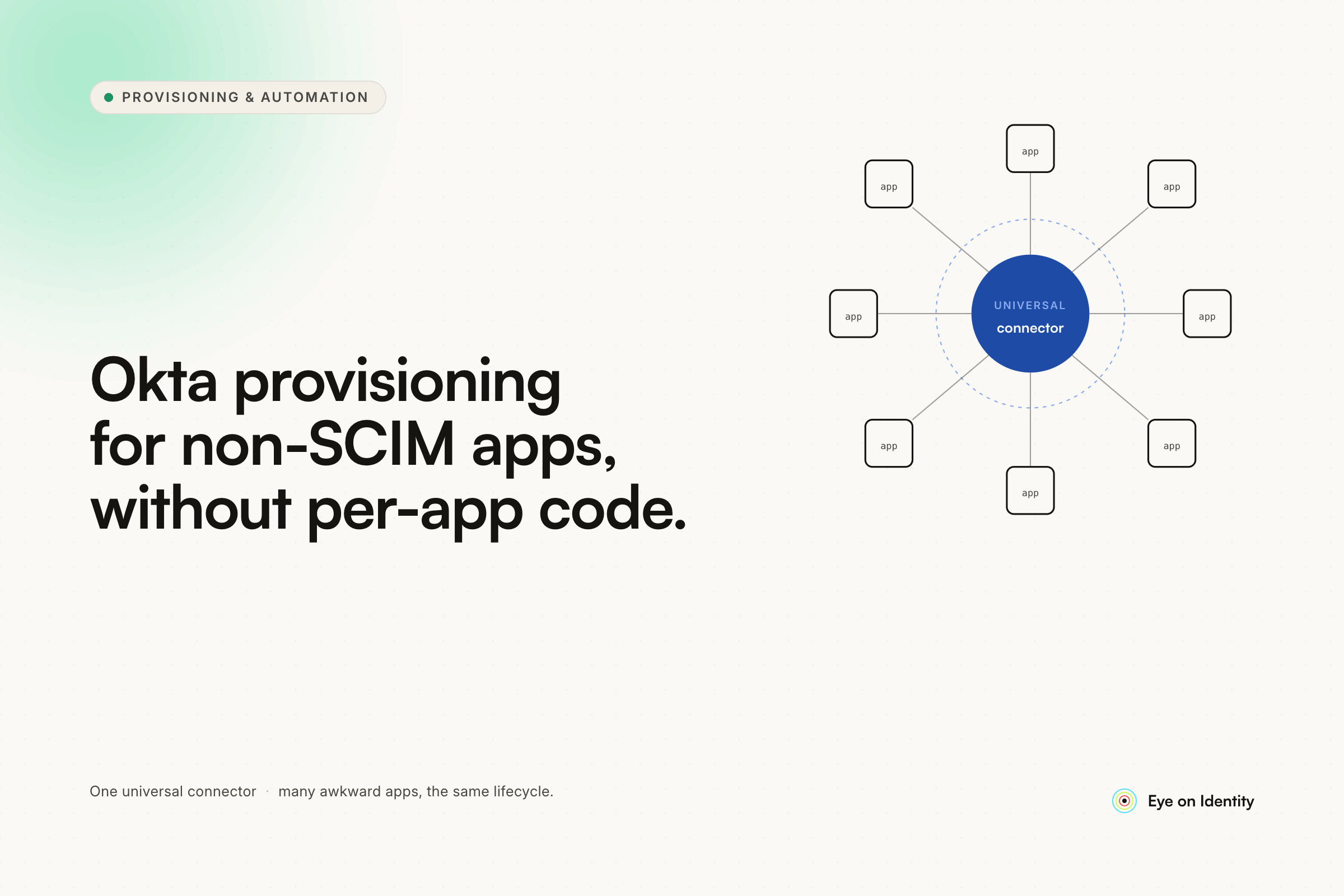


The idea makes sense on paper: build one SCIM server that Okta talks to, configure it to route provisioning commands to each downstream app's native API, and solve the non-SCIM problem once rather than app by app. The problem is that "universal" falls apart almost immediately when you look at what's actually different across downstream apps — authentication methods, payload formats, attribute mappings, deprovisioning semantics, retry behavior, group handling. A SCIM server can present a standard interface to Okta. What sits behind it is still a per-app integration problem.
If you're trying to automate Okta provisioning for apps that don't support SCIM natively, the question isn't really whether to build a SCIM bridge — it's whether to build and maintain the downstream connectors yourself or use a platform that already has them.
Why a Universal SCIM Server Doesn't Eliminate Per-App Work
The Python/Flask/Gunicorn SCIM server approach that comes up in this thread works. It's a legitimate engineering pattern — build a SCIM-compliant endpoint, have Okta provision to it as if it were a standard app, and write routing logic that translates the inbound SCIM call into whatever the downstream app expects. For a small number of internal apps with stable APIs, this is reasonable.
The ceiling appears when you try to generalize it. Even the front-end SCIM APIs need to be customized to support application-specific attributes and entitlements, as one commenter in this thread put it directly. Oracle DB and Ellucian Banner, for example, have nothing in common at the API layer. The SCIM server can abstract the Okta side cleanly, but the downstream connectors are still unique. You've shifted the problem from "build automation per app" to "build a connector per app inside a SCIM server" — which is the same work with a different architecture.
The edge cases compound this. PATCH idempotency and ordering, group membership churn during renames, deprovision semantics — disable vs. delete — and safe retries with stored ID mappings all need to be handled correctly per app. Miss one of these in a production environment and you get silent provisioning failures, orphaned accounts, or users getting deprovisioned during a username rename because the workflow fired on an unassign event rather than an actual termination.
Commercial middleware options like Stitchflow cover some of this ground but price per app — the OP noted the cost in this thread — which means the economics of the per-app problem don't change, just who's maintaining the connector.
The underlying reality, articulated by an Okta Certified Consultant in the thread, is that there isn't a genuinely universal solution because the downstream apps are genuinely different. What changes with a platform approach is who owns the maintenance burden when those apps change their APIs, update their auth methods, or modify their provisioning behavior.
Three Ways Zluri Handles Okta Provisioning for Non-SCIM Apps
Zluri sits between Okta and the downstream application layer, detecting identity events and executing provisioning actions through three paths depending on what each app exposes.
Apps with native API integrations. For applications that lack SCIM but have well-documented REST APIs, Zluri uses maintained native connectors. When a user is added to an Okta group or an identity event triggers a provisioning action, Zluri executes the lifecycle operation — create, update, deprovision — directly against the downstream app's API. The connector is maintained by Zluri's engineering team, which means when an app updates its API or changes its authentication method, the connector is updated on Zluri's side rather than yours. This covers over 300 applications natively.
Apps with APIs outside the native library. For applications that have admin APIs but aren't in Zluri's native catalog, playbooks include a Make an HTTP Request action. You configure the endpoint URL, authentication headers, and payload structure once — using dynamic variables like {{user.user_email}} and {{user.user_name}} to inject identity data at runtime — and the action executes automatically when the provisioning workflow fires. No script to write, no middleware to deploy, no retry logic to implement. The HTTP Request action handles the API call, and the result is logged in the audit trail.
Apps with no accessible API. For legacy systems, browser-only tools, or applications that restrict API access to enterprise tiers most organizations aren't on, Zluri uses AI-powered integrations — browser automation that navigates the application's admin interface and executes provisioning or deprovisioning actions the way a human administrator would. This covers the category of apps that can't be reached programmatically, without requiring manual IT intervention for each event.
How This Differs From Building Your Own SCIM Bridge
The architectural difference is maintenance ownership. A custom SCIM server gives you control and flexibility, and for engineering teams that want to own the identity stack fully, that's a legitimate choice. The cost is that every downstream connector you build is a connector you maintain — when the app changes, when the auth method rotates, when a new attribute needs to flow through, the work comes back to your team.
Zluri's approach keeps Okta as the authentication layer and shifts the provisioning orchestration to a maintained platform. Okta handles SSO and authentication. Zluri handles what happens downstream when an identity event fires — across API-connected apps, custom HTTP endpoints, and browser-automated tools — without requiring your team to build or maintain per-app connectors.
The audit trail is a secondary benefit worth noting. Every provisioning and deprovisioning action Zluri takes is logged — which app, which user, which action, when, and the result. For SCIM-based provisioning through Okta, the audit record lives in Okta's system log. For the non-SCIM apps that Zluri handles, the same structured record exists without requiring you to implement logging in each downstream connector yourself.
A Note on Okta's Role in This Architecture
Okta remains the identity provider and authentication layer. Zluri doesn't replace Okta — it extends what Okta can reach. Okta manages authentication, group membership, and SCIM provisioning for apps that support it natively. Zluri handles provisioning for the apps that don't, triggered by the same identity events that Okta manages. The two layers work in parallel rather than one replacing the other.
Frequently Asked Questions
Can you build a universal SCIM server to provision multiple non-SCIM apps through Okta?
A universal SCIM server can present a standard interface to Okta, but the downstream connectors for each application still need to be built and maintained individually because each app has different APIs, authentication methods, and attribute requirements. The per-app work doesn't disappear — it shifts from per-app automation scripts to per-app connectors inside the SCIM server. A platform like Zluri handles this with maintained connectors across 300+ apps, custom HTTP Request actions for others, and AI-powered browser automation for apps with no API.
How do you automate Okta provisioning for apps that don't support SCIM?
For apps with APIs but no SCIM support, an orchestration platform like Zluri uses native API connectors or configurable HTTP Request actions to execute provisioning operations when an Okta identity event fires. For apps without any API access, AI-powered browser automation handles the provisioning action without manual IT intervention. This removes the need to build per-app automation or maintain a custom SCIM bridge.
What are the main edge cases to handle when building a custom SCIM server for Okta?
The most common production issues are PATCH idempotency and event ordering, group membership churn during user renames (Okta processes renames as unassign/reassign, which can trigger false deprovisioning events), deprovision semantics (disable vs. hard delete varies by app), and retry logic with stored ID mappings for failed provisioning calls. Each of these needs to be implemented correctly per downstream app, which is the core reason a "universal" SCIM server is harder to generalize than it appears.
What is the difference between SCIM provisioning and IGA orchestration in an Okta environment?
SCIM provisioning is a protocol that Okta uses to create, update, and deactivate users in applications that implement the SCIM spec. IGA orchestration sits above that layer and handles provisioning across both SCIM-supported and non-SCIM apps from a single platform — using native API connectors, custom HTTP actions, or browser automation depending on what each app exposes. Okta handles authentication and SCIM-connected provisioning; the IGA layer extends that coverage to the rest of the stack.
See How Zluri Maps to Your Specific App Stack
If you're evaluating whether to build a custom SCIM bridge or use a platform that already maintains the downstream connectors, see how Zluri maps to your specific app stack — including which apps are covered natively, which need an HTTP Request action, and which require the browser automation path.


.svg)