

Two questions come up repeatedly among IAM engineers trying to understand where Okta fits in the broader identity stack: how are organizations actually wiring Okta Workflows into their IGA deployments, and does Okta Advanced Server Access replace the need for a traditional PAM solution? The answers are more nuanced than vendor documentation suggests — and they have direct implications for what skills are worth developing next.
Here is the full picture from organizations that have run these architectures in production.
Okta Advanced Server Access: Where It Works and Where It Doesn't
ASA solves a specific problem cleanly: human-to-server access in cloud-native environments. Instead of managing static SSH keys and shared RDP passwords, ASA mints ephemeral, short-lived certificates on demand, tied directly to the user's Okta SSO session and MFA policies. When someone needs server access, they authenticate through Okta, get a time-limited certificate, and the certificate expires after the session ends. No persistent credentials sitting in a key store somewhere.
The practical wins are the SSO integration — server access uses the same identity and MFA policies as everything else in the Okta environment — and the audit trail, which ties every server session to a verified identity rather than a shared credential.
The challenges organizations report:
Hybrid environment complexity. ASA works well in cloud-native infrastructure. Legacy on-premises environments and systems that do not easily support agent-based certificate injection require more work to integrate, and some edge cases — particularly around service account handling — require additional configuration that is not straightforward.
Cost scaling. Licensing scales with server count, which becomes a meaningful line item as the server footprint grows. Organizations that piloted ASA selectively found the economics workable; those who tried to deploy it comprehensively across large server fleets found the cost harder to justify.
Learning curve for operations teams. The shift from static credentials to ephemeral certificates requires operations teams to change how they think about server access. That transition is achievable but not instant.
Is ASA a PAM replacement? The consistent answer from practitioners who have evaluated both is no — not fully, for most environments. ASA handles human-to-server access through Okta exceptionally well. It does not handle what traditional PAM platforms like CyberArk or Delinea are specifically built for: vaulting and rotating shared service account credentials, deep session recording for compliance, and privileged access management for systems entirely outside Okta's reach.
The pattern that works in practice: use ASA for engineering team access to Linux servers in cloud environments, and maintain a traditional PAM solution for service accounts, shared administrative credentials, and any privileged access that ASA cannot reach. One practitioner described a lightweight gateway layer between Okta and the servers as an alternative that captures most of ASA's benefits — SSO integration and just-in-time approvals — without the full ASA complexity and cost. The right architecture depends on how much of your privileged access footprint is human-to-server vs. service account driven.
How Okta Workflows and IGA Tools Actually Divide the Work
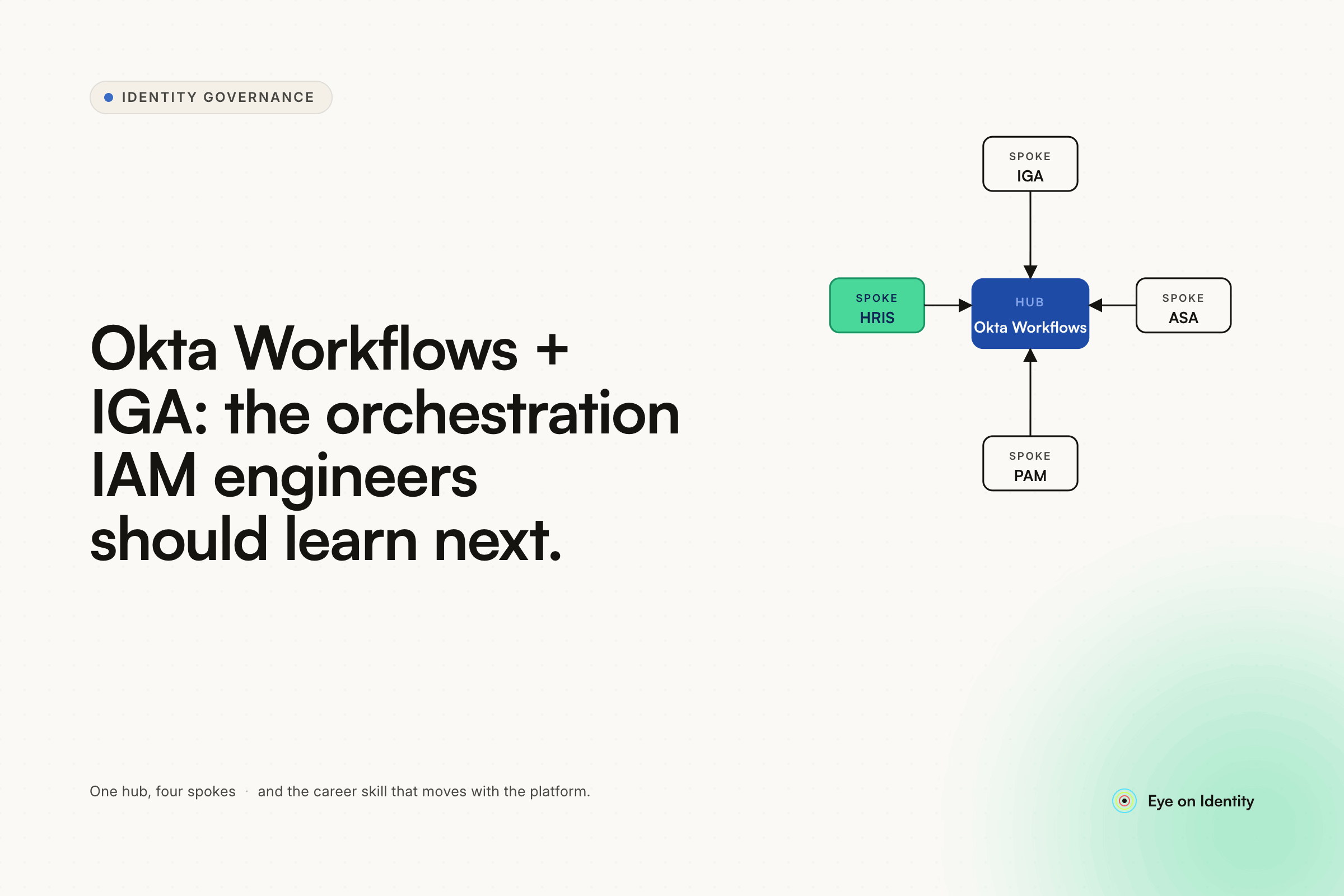
When organizations run Okta alongside a dedicated IGA platform, the division of labor is relatively consistent: Okta handles the front door — authentication, SSO, MFA, initial authorization — and the IGA platform handles the governance engine — access reviews, Segregation of Duties enforcement, compliance reporting, and entitlement management. Okta Workflows act as the connective tissue between the two.
Bridging API gaps for downstream applications. IGA platforms provision access through APIs. When a downstream application lacks a standard API but can be manipulated through an Okta Workflow, the IGA platform sends an HTTP request to a custom Okta Workflow endpoint and Okta handles the multi-step provisioning routine inside the target application. The IGA platform does not need to know how to interact with that application directly — it just needs to know the Okta Workflow endpoint.
Managing timing and sequencing. Standard IGA provisioning rules often lack the flexibility to handle complex timing requirements. Okta Workflows handle the gap: create the Okta profile the moment an HR record is created, but hold downstream provisioning until exactly three days before the start date. That kind of precise timing logic is difficult to express in IGA rule sets and straightforward to build in Okta Workflows.
Keeping IGA governance data accurate. The IGA platform can only govern access it knows about. Okta Workflows pass data between the IAM layer and the IGA layer — user status changes, group membership updates, access events — so the IGA platform always has current data to run access reviews and SoD checks against. Without this data pipeline, IGA governance operates on stale information.
The failure mode that surfaces directly: trying to use Okta Workflows as the primary lifecycle automation layer, supplemented by SailPoint for governance, becomes complex and gap-prone. One organization described abandoning that combination for a dedicated lifecycle automation platform that handled their HRIS-to-AD provisioning end-to-end. Okta Workflows are well-suited for orchestration and gap-filling — less well-suited as the primary engine for JML lifecycle automation across a full enterprise stack.
The IGA Governance Layer: What Okta Cannot Do Alone
Okta is an authentication and access management platform. It manages who can log in and what they can access at the session level. It does not manage, in any depth, what entitlements a user holds inside an application — what specific roles, permission sets, or granular permissions they have been granted within Salesforce, or ServiceNow, or any other downstream system. Okta knows the user authenticated. It does not know what they can do once they are in.
IGA platforms fill that gap through deep entitlement management: reading back the specific permissions each user holds inside connected applications, mapping them against role definitions and policy rules, running access review campaigns that ask application owners and managers to confirm whether those permissions are still appropriate, and enforcing SoD policies that prevent conflicting entitlement combinations from coexisting.
For organizations with regulatory compliance requirements — SOC 2, ISO 27001, HIPAA, SOX — this governance layer is not optional. Okta logs who authenticated. Compliance auditors want to know who had access to what, whether that access was reviewed, and whether any access violated policy. That answer comes from the IGA platform, not from Okta.
What IAM Engineers Should Focus on to Increase Employability
The market for IAM engineers is strong and getting more specialized. The base skills — Okta, Microsoft Entra ID, Ping, basic provisioning — are table stakes that most candidates have. The differentiation is in governance.
Organizations are failing compliance audits because their SaaS stacks have grown faster than their governance programs. Employees accumulate excess access across role changes, contractors' accounts stay active after engagements end, and nobody has a complete picture of who holds what entitlements across which applications. The people who can design and implement IGA programs that address this are genuinely scarce.
IGA platform depth. Get hands-on with a full IGA platform — SailPoint, Saviynt, or a next-generation platform like Zluri. Understand how access profiles and entitlement management work, not just provisioning. Know how to architect a multi-level access certification campaign. Understand how SoD policies are configured and enforced. These are the skills that translate to IGA-specific roles and to the governance side of broader identity architect positions.
Access certifications. The ability to design and run access review campaigns — periodic certifications where managers and application owners confirm whether users' access is still appropriate — is a specific skill set that maps directly to SOC 2 and ISO 27001 audit requirements. Knowing how to configure these campaigns, define review scope, track completion, and produce audit-ready reports is highly valued.
Non-API application coverage. A growing frontier in IGA is governing applications that lack APIs or SCIM support. Modern platforms handle this through AI-assisted browser automation — navigating application UIs programmatically to provision and deprovision access the way a human administrator would, with AI fallbacks that adapt when the UI changes. Understanding how this works, and where it applies in an enterprise environment, sets you apart from engineers who only know the standard SCIM/REST provisioning model.
Architecture pattern fluency. Being able to articulate the Okta-as-IdP, IGA-as-governance-engine architecture — how Workflows connect them, where the division of responsibility sits, and where each tool's limitations are — is the kind of systems thinking that interview panels at larger organizations are looking for. Most IAM engineers know one tool well. Fewer can explain how the full stack fits together.
FAQ
Does Okta Advanced Server Access replace traditional PAM solutions?
Not fully for most environments. ASA handles human-to-server access through Okta using ephemeral certificates, which works well for engineering team access to cloud infrastructure. Traditional PAM platforms handle service account credential vaulting, password rotation, and deep session recording for compliance — capabilities ASA does not cover. Most organizations use both for different parts of the privileged access problem.
How do Okta Workflows integrate with IGA tools like SailPoint?
Okta Workflows act as orchestration and gap-filling between the IAM and IGA layers. Common uses: exposing custom API endpoints for applications that lack native IGA connectors, managing timing and sequencing in provisioning workflows, and passing identity data between Okta and the IGA platform to keep governance data current. Okta handles authentication; the IGA platform handles governance; Workflows connect them.
What is the difference between Okta and an IGA platform for access management?
Okta manages authentication and authorization at the session level — who can log in and what applications they can access. IGA platforms manage entitlements at the permission level — what specific roles and permissions users hold inside applications, whether those permissions comply with policy, and how to review and certify them for compliance. The two layers are complementary, not redundant.
What should IAM engineers learn to increase their employability?
IGA platform depth — access reviews, entitlement management, SoD policy configuration — is the most differentiated skill set in the current market. Hands-on experience with a full IGA platform beyond basic provisioning, the ability to design access certification campaigns, and understanding of non-API application governance through browser automation are the capabilities that distinguish candidates in a crowded IAM field.


.svg)