

SailPoint documentation gives you the concepts. It does not give you the muscle memory that comes from actually standing up provisioning workflows, debugging a failed sync, or building a role that enforces Segregation of Duties. The gap between reading about JML lifecycle automation and being able to talk about it from experience is the gap that open source IGA labs exist to close.
The Reddit thread this draws from is a practitioner who cannot access SailPoint University and is building interview-ready experience through open source tools. The community's recommendations are consistent and worth organizing into a practical starting point.
Why Open Source IGA Is a Legitimate Path to Interview-Ready Skills
One commenter in the thread raised a fair point: standing up midPoint is not the same as working with SailPoint, and it will not prove SailPoint proficiency directly. That is true and worth being honest about. What it does prove — and what matters more in an early IGA career — is that you understand the underlying concepts well enough to implement them in a real system.
The core IGA capabilities are largely platform-agnostic. Provisioning workflows, role management, access reviews, SCIM integrations, Segregation of Duties policies — these exist in every serious IGA platform with similar logic and similar trade-offs. A candidate who has built and operated these in any environment can speak to them from experience, not just from documentation. That is a meaningful differentiator from candidates who have only read about them.
The additional path worth knowing: SailPoint IIQ (IdentityIQ) can be downloaded directly from community.sailpoint.com if you have access through a partner account, a customer organization, or a qualifying business email. If you can get that access, running your own IIQ instance gives you direct SailPoint experience. If you cannot, the open source path is the next best option.
The Tools the Community Recommends
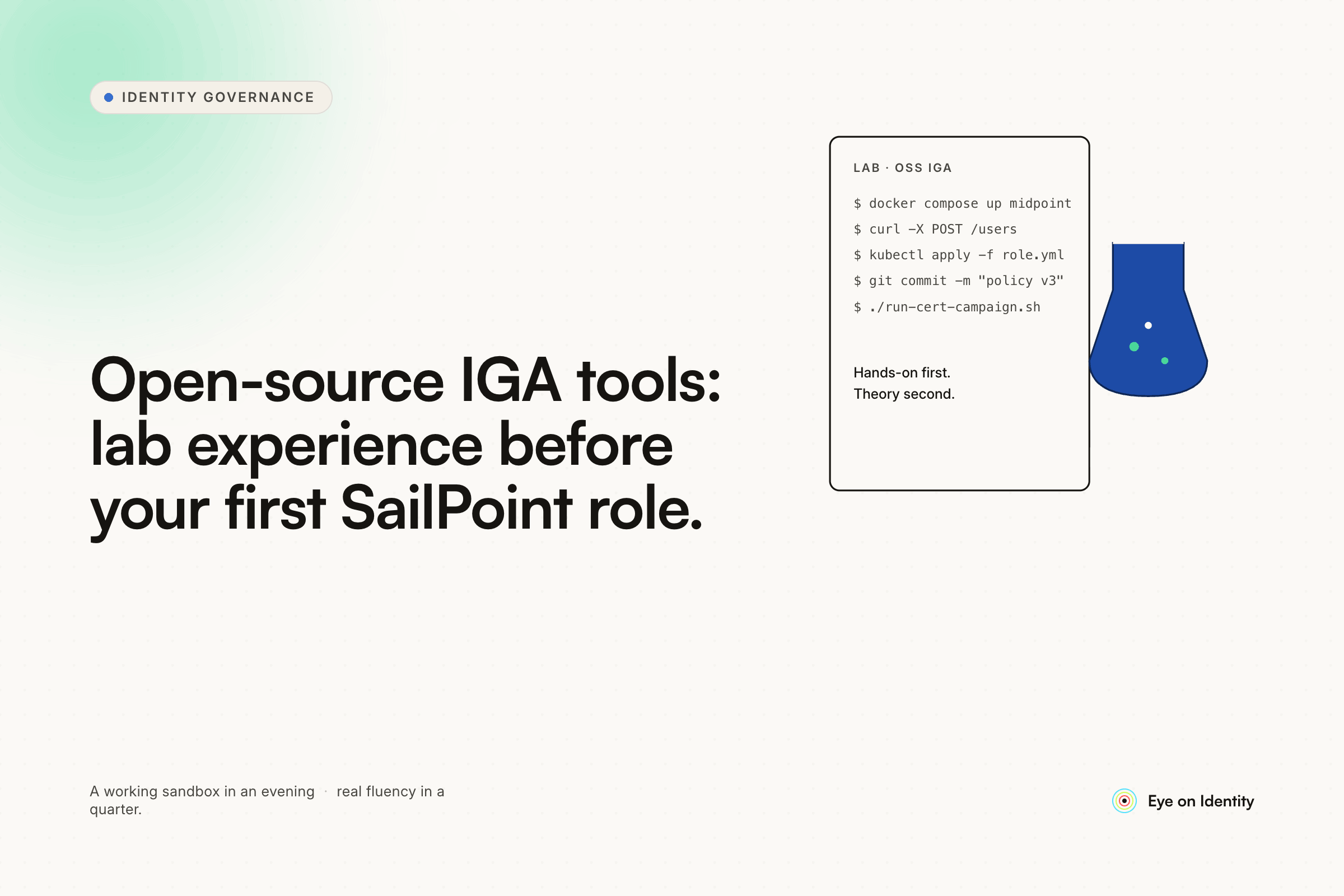
midPoint (Evolveum) is the consistent first recommendation across the thread, and the reasoning is sound. It is the most feature-complete open source IGA platform available — full provisioning, access reviews, role management, organizational structure handling, and RBAC. The concepts it implements map directly to what enterprise IGA platforms like SailPoint do: identity synchronization from a source of truth, lifecycle automation, role-based entitlement assignment, and governance workflows.
The honest caveat from the thread: midPoint has a steep learning curve. The documentation is solid, and Evolveum offers self-paced training options. Expect to spend real time on setup before you get to the interesting parts. Standing up a provisioning workflow that actually works is the payoff — and it is genuinely interview-relevant work.
Apache Syncope is the second most commonly recommended option. Less polished than midPoint, but strong for practicing lifecycle management and provisioning across directories and databases. Its workflow engine is useful for building approval logic and access request flows. If midPoint's complexity is a barrier to getting started, Syncope is a reasonable alternative for the core concepts.
Keycloak, WSO2 Identity Server, and Gluu Server are IAM tools rather than IGA platforms — they handle authentication, SSO, and federation rather than governance. They are worth adding to a lab because SailPoint almost never operates alone: it typically orchestrates access through an IAM layer. Connecting an open source IGA tool to Keycloak or WSO2 lets you practice the governance-to-access-management architecture that enterprise environments actually use. That connection point is something interviewers will ask about.
OpenIAM is another option that comes up less frequently but covers both IAM and IGA capabilities in a single platform. Worth evaluating if you want a single system to run rather than standing up multiple tools.
What to Actually Build in Your Lab
The tool is the vehicle. What matters for interviews is the specific capabilities you can demonstrate. Here is what to build, roughly in order of importance for SailPoint-adjacent roles.
JML lifecycle automation against a dummy HR source. This is the foundational capability of every IGA platform and the one most likely to come up in an interview. Create a simple CSV or database that acts as your HR system — the source of truth. Configure your IGA tool to read from it and trigger provisioning when a new record appears, update access when a record changes, and deprovision when a record is terminated. Walk through a complete hire-to-termination cycle and be able to describe every step.
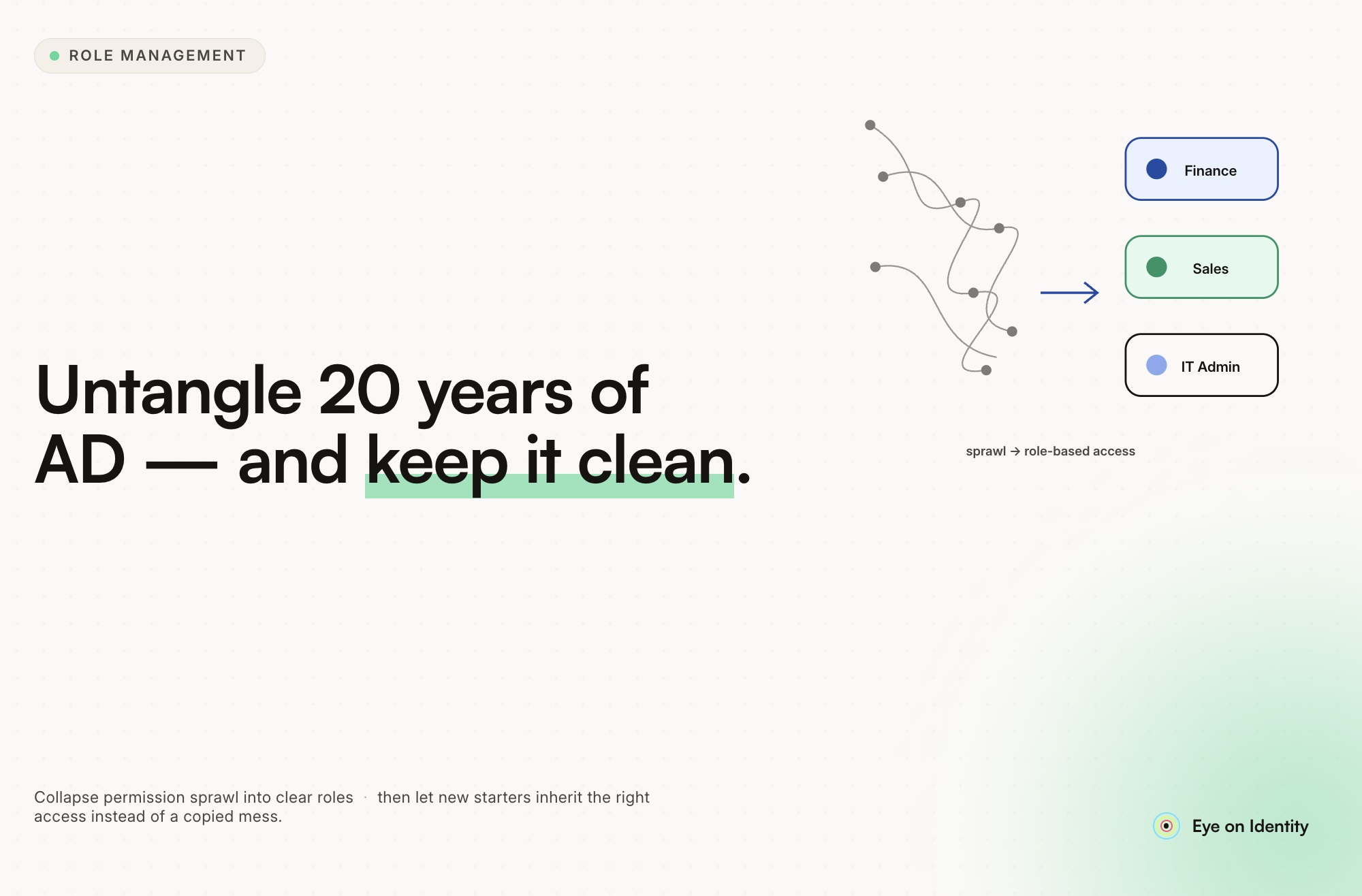
Role and entitlement management. Do not just provision accounts — build roles that define what access each role should include. Practice mapping a job function to a set of entitlements across multiple connected systems. The ability to talk about role modeling — how you define what a "Finance Analyst" role should include and how you enforce that across applications — is something that comes up in IGA interviews consistently.
Segregation of Duties policy. Configure a policy that prevents a single user from holding two conflicting entitlements — the ability to create a purchase order and the ability to approve it, for example. SoD is a core governance concept and showing that you have implemented a working SoD policy in a lab environment, even a simple one, demonstrates understanding that documentation alone cannot.
Access certification campaign. Build a mock access review where a designated reviewer is presented with a list of user entitlements and must approve, modify, or revoke each one. This is a standard IGA feature and a common compliance driver. Being able to describe how you configured and ran a certification campaign — what triggered it, who the reviewers were, how decisions were recorded — is practical interview material.
SCIM provisioning to a connected application. Connect your IGA tool to a SCIM-enabled application and provision a test user through the integration. SCIM is the protocol that most modern IGA platforms use to automate account creation and deletion in downstream SaaS apps. Understanding how SCIM provisioning works — the schema, the API calls, the reconciliation logic — is something that differentiates candidates who have done the work from candidates who have read about it.
How to Frame Lab Work in an Interview
The goal is not to claim SailPoint experience you do not have. It is to demonstrate that you understand IGA deeply enough to be productive quickly in a SailPoint environment. The framing that works:
Describe specifically what you built — not "I used midPoint" but "I stood up a provisioning workflow that pulled identity data from a CSV source of truth, automatically created accounts in a test Active Directory, and triggered a deprovisioning workflow when a user record was terminated. I also configured a basic SoD policy that flagged conflicting entitlements."
Connect it to the platform-agnostic concept — "The same logic applies in SailPoint: the source of truth drives the identity lifecycle, the connector handles the downstream provisioning, and the governance policies enforce what combinations of access are allowed. The implementation details differ but the architecture is the same."
Be honest about the gap — "I have not worked in SailPoint directly, but I understand the core IGA concepts from implementation rather than just documentation, and I am comfortable learning the platform-specific tooling."
That framing is more credible than overstating what midPoint experience proves, and more useful to an interviewer than a candidate who can only recite documentation.
FAQ
What is the best open source IGA tool for learning SailPoint concepts?
midPoint by Evolveum is the most commonly recommended option for hands-on IGA training. It covers provisioning, access reviews, role management, and organizational structure handling — the same core capabilities as enterprise IGA platforms like SailPoint. Apache Syncope is a less polished alternative worth considering if midPoint's learning curve is a barrier to getting started.
Can you download SailPoint for free to practice?
SailPoint IIQ can be downloaded from community.sailpoint.com with a partner account, customer organization access, or a qualifying business email. If that access is not available, open source tools like midPoint provide equivalent hands-on experience with platform-agnostic IGA concepts.
What IGA concepts should I practice in a lab to prepare for SailPoint interviews?
The highest-value concepts to implement are: JML lifecycle automation against a source of truth, role and entitlement modeling, Segregation of Duties policy configuration, access certification campaign setup, and SCIM provisioning to a connected application. These map directly to core SailPoint capabilities and can be demonstrated in any IGA platform.
Is midPoint experience relevant for SailPoint roles?
Directly, no — midPoint is not SailPoint. What it provides is implementation experience with platform-agnostic IGA concepts that translate to any enterprise IGA platform. Candidates who have built provisioning workflows, role structures, and access reviews in midPoint can discuss those concepts from experience rather than documentation, which is meaningful for entry-level IGA roles where everyone is learning the platform.


.svg)