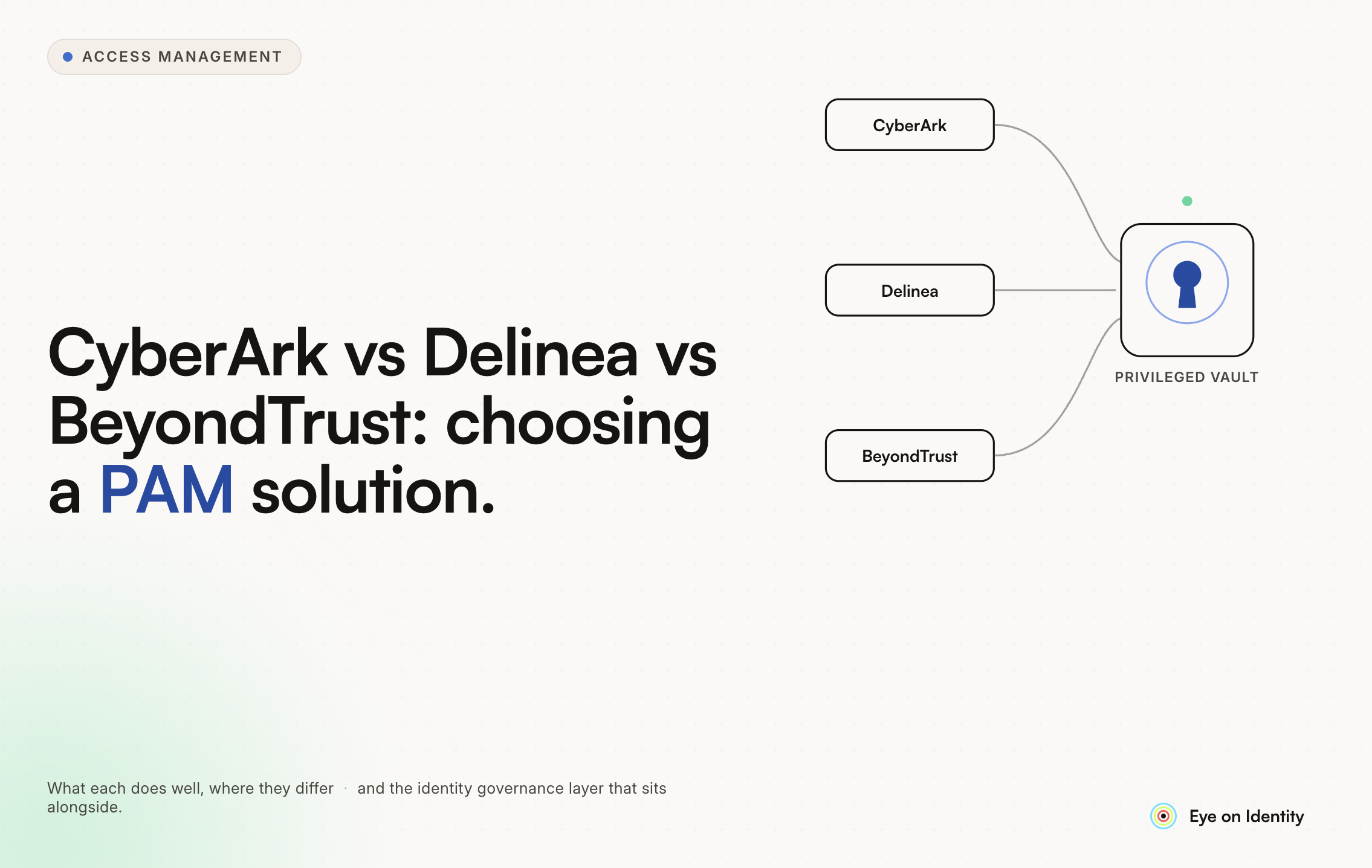


Choosing a privileged access management solution comes down to three things: what you're actually trying to protect, how your team will operate the platform day-to-day, and what sits above or alongside the PAM layer to handle the identity governance problems that PAM tools aren't designed for.
CyberArk, Delinea, and BeyondTrust are the three vendors that appear in almost every serious PAM evaluation. They have meaningfully different architectures, price points, and operational models. This guide covers the real differences, the evaluation criteria that matter, and the layer most organizations end up needing alongside whichever PAM tool they choose.
What PAM Tools Actually Do
Privileged access management addresses a specific risk: the accounts with elevated permissions that, if compromised, can cause catastrophic damage. Domain administrators, root accounts, service accounts, database administrator credentials, cloud infrastructure admin roles. These are the accounts attackers target after initial access because they're the keys to lateral movement and data exfiltration.
PAM tools address this risk through a combination of credential vaulting (storing privileged credentials in an encrypted vault rather than in scripts, spreadsheets, or human memory), session management (proxying privileged sessions so they can be recorded, monitored, and terminated), and just-in-time access (granting elevated privileges only when needed, for a defined duration, then automatically revoking them).
What PAM tools don't do is govern the broader identity lifecycle. They handle privileged accounts. The full population of application access across a SaaS stack, the joiner/mover/leaver workflows, the access review processes for non-privileged access, the self-service request portal for ordinary employees — these are problems that sit in a different layer.
CyberArk: Enterprise-Grade, Complex, Dominant
CyberArk is the market leader in PAM by a significant margin, particularly in large enterprise environments. Its depth is its defining characteristic: the platform covers credential vaulting, privileged session management, secrets management for DevOps pipelines, endpoint privilege management, and cloud entitlements management.
The tradeoffs are real. CyberArk is expensive, complex to implement, and requires significant ongoing operational investment. Implementations routinely take six to twelve months in large environments. The platform rewards organizations that have dedicated PAM engineers or are willing to hire them. For smaller security teams or organizations that need to be operational quickly, the complexity is a genuine barrier.
CyberArk's access review functionality is limited. The platform tracks privileged sessions and can generate access reports, but running structured access certification campaigns across the full application landscape — including non-privileged SaaS access — requires a separate IGA layer.
Best fit: Large enterprises with mature security programs, dedicated IAM teams, complex hybrid environments with significant on-premise infrastructure, and budgets to match.
Delinea: Operational Simplicity, Strong Mid-Market Fit
Delinea was formed from the merger of Thycotic and Centrify. The product has been rationalized into two main offerings: Secret Server (credential vaulting and privileged session management) and Privilege Manager (endpoint privilege management and application control).
The operational model is simpler than CyberArk's. Implementations are typically faster, the interface is more approachable for teams without dedicated PAM expertise, and the pricing is more accessible. Delinea has invested in cloud-native deployment options and has a reasonably strong SaaS story for organizations that don't want to manage on-premise PAM infrastructure.
The depth is shallower than CyberArk in some areas, particularly around DevOps secrets management and cloud entitlements. For organizations whose primary PAM requirement is vaulting admin credentials for servers and network devices and managing privileged sessions, Delinea covers the core use case well without the implementation overhead of CyberArk.
Best fit: Mid-market organizations, IT-driven security programs, environments where PAM needs to be operational within weeks rather than months, and teams that need the tool to be maintainable without a dedicated PAM engineer.
BeyondTrust: Broad Platform, Integrated Approach
BeyondTrust's portfolio covers privileged password management (Password Safe), endpoint privilege management (Privilege Management for Windows/Mac and Unix/Linux), and remote access (Privileged Remote Access). The integrated remote access story is a differentiator: for organizations managing privileged access for remote employees, contractors, and third-party vendors, BeyondTrust's remote access capabilities are more mature than most competitors.
The platform is broader but sometimes shallower than CyberArk in specific areas. Organizations with heavy Unix/Linux environments or significant contractor/vendor remote access needs often find BeyondTrust a strong fit. Organizations primarily looking for a traditional credential vault with deep enterprise integrations often find CyberArk or Delinea more directly applicable.
Best fit: Organizations with significant remote access requirements, contractor and vendor access management needs, or mixed environments including Unix/Linux infrastructure.
Evaluation Criteria That Actually Differentiate
The vendor comparison matrices all look similar at a high level. The criteria that actually drive decisions in practice are:
Time to value. How long before the platform is protecting your most critical accounts? CyberArk implementations in large environments are measured in months. Delinea and BeyondTrust can often have core credential vaulting operational in weeks. For organizations with a specific audit deadline or recent security incident driving the PAM project, time to value is often the deciding factor.
Operational model. Who will run this platform day-to-day? If you have a dedicated IAM team, CyberArk's complexity is manageable. If PAM will be operated by a generalist IT team alongside many other responsibilities, simpler platforms are genuinely better, not just cheaper.
Cloud and DevOps coverage. If your environment is primarily cloud-native, the on-premise-oriented architectures of traditional PAM vendors create integration friction. CyberArk has the deepest cloud entitlements story. Delinea and BeyondTrust are catching up. For heavily cloud-native environments, it's worth evaluating whether Teleport or similar cloud-native PAM alternatives belong in the comparison.
Integration with existing identity infrastructure. PAM doesn't operate in isolation. It needs to integrate with your identity provider, your HRMS, and potentially your IGA platform. Evaluate the integration depth with your specific stack, not the integration list in the marketing collateral.
The Layer Above PAM: Identity Governance
The question that comes up in most mature PAM implementations is: what governs the access lifecycle for the accounts that PAM is protecting?
PAM tools manage privileged session access and credential security. They don't typically run access certification campaigns that ask "should this person still have admin access to this server?" They don't integrate with the HRMS to automatically deprovision privileged accounts when someone leaves. They don't provide a self-service request workflow for employees who need temporary elevated access for a specific task.
These are Identity Governance and Administration functions. Zluri operates in this layer. It connects to CyberArk, Delinea, and BeyondTrust to surface privileged account holders in access review campaigns alongside their SaaS application access. When an employee leaves, Zluri's offboarding playbook triggers deprovisioning across all connected systems, including the PAM vault, rather than requiring a separate manual step for privileged accounts. When someone needs temporary privileged access, the request goes through Zluri's approval workflow, which logs the justification and sets an automatic expiration.
The practical benefit is a unified governance view: privileged access and ordinary SaaS access are reviewed and managed through the same platform rather than through separate processes that don't talk to each other. Auditors reviewing access controls see the full picture rather than two separate audit trails.
The Decision
For most organizations choosing between CyberArk, Delinea, and BeyondTrust, the answer comes from honestly assessing operational capacity and primary use case rather than from feature comparison spreadsheets.
Large enterprises with dedicated security teams, complex hybrid environments, and compliance requirements that demand depth: CyberArk is usually the right choice, cost and complexity acknowledged.
Mid-market organizations that need PAM operational quickly without a dedicated implementation team: Delinea is worth serious consideration.
Organizations with significant contractor/vendor remote access needs or mixed Unix/Linux environments: BeyondTrust's integrated remote access story deserves attention.
Whichever tool you choose, the identity governance layer that sits above it will determine whether privileged access is actually governed across the full lifecycle or just vaulted and monitored while the surrounding access management processes remain manual.


.svg)