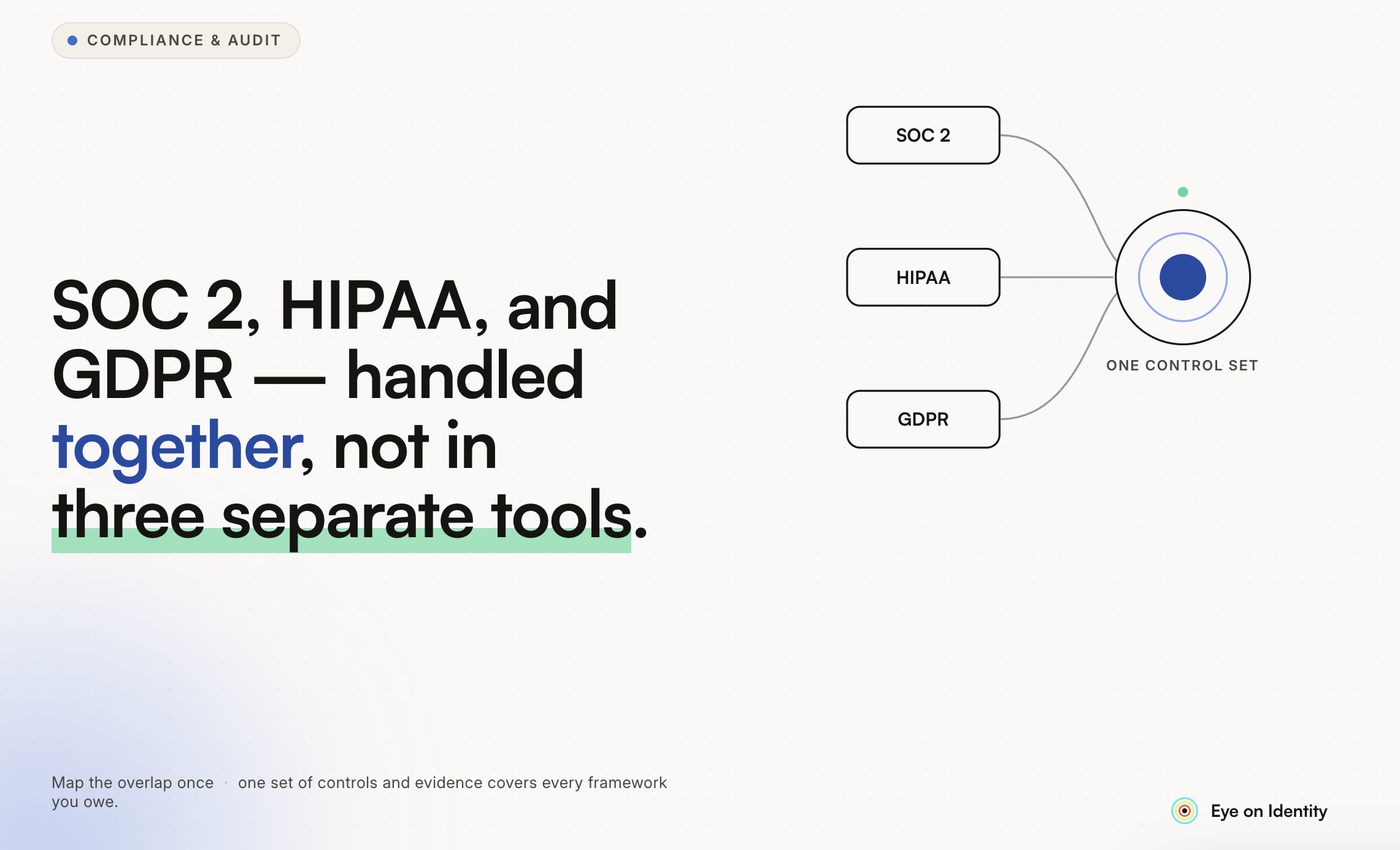


If you're trying to satisfy SOC 2, HIPAA, and GDPR at the same time, the first thing you'll hear is that no single tool handles all three well. That advice is mostly right, but the reason it's right is worth understanding before you go shopping for a three-tool stack.
The three frameworks are genuinely different problems. SOC 2 is about demonstrating operational security controls to auditors. HIPAA is about protecting patient data through technical safeguards, administrative controls, and documented procedures. GDPR is largely a legal and data governance problem: data subject rights, residency requirements, lawful basis for processing, and contractual obligations with subprocessors.
What they share is an identity and access layer. All three frameworks care deeply about who has access to sensitive systems, how that access was authorized, whether it has been reviewed recently, and how quickly it gets revoked when someone's role changes or they leave the organization. That's the layer where a dedicated compliance GRC tool ends and identity governance begins.
The Problem: Why One Tool Never Quite Covers All Three
The most common failure pattern in multi-framework compliance is treating it as a documentation problem rather than an enforcement problem.
A GRC platform like Vanta or Drata does evidence collection and framework mapping well. It integrates with your cloud infrastructure, pulls in signals, and organizes evidence against SOC 2 controls or HIPAA safeguards. For audit preparation, that's genuinely valuable.
What it doesn't do is enforce access governance in real time. You can be fully Vanta-certified on paper and still fail a HIPAA audit because nobody was actually monitoring access to systems that touch protected health information. The technical safeguards section of HIPAA (164.312) requires demonstrable controls: access logs, monitoring, incident response capability, and proof that access is scoped appropriately. Evidence collection tools capture what happened. Identity governance tools control what is allowed to happen and produce the evidence as a byproduct.
GDPR adds another dimension: it's not just about security controls but about what data you hold, where it lives, how long you keep it, and what you do when a data subject asks you to delete or export their information. That problem set requires a combination of legal agreements, data mapping, and data residency controls that no single compliance tool fully addresses.
The practical answer most mature compliance teams land on is a layered architecture: a GRC platform for framework-level evidence organization, a security layer for continuous cloud posture monitoring, and an identity governance layer for access control enforcement across the entire SaaS stack.
What the Identity and Access Layer Covers Across All Three Frameworks
When you map SOC 2, HIPAA, and GDPR requirements back to access governance specifically, the overlap is significant.
SOC 2 requires demonstrable access controls: proof that access to systems is granted through an approved process, reviewed on a regular cadence, and revoked when no longer appropriate. Access reviews, provisioning logs, and offboarding evidence are all direct SOC 2 requirements.
HIPAA technical safeguards require unique user identification, audit controls, automatic logoff, and encryption transmission standards, all of which tie back to how access to systems containing PHI is managed and monitored. Who had access to what, when, and through which authorization is precisely what an identity governance platform tracks.
GDPR requires that personal data is accessed only by authorized personnel, that access is logged, and that data subject rights requests (including deletion and export) can be fulfilled. The access governance layer is where you demonstrate that your employee access to systems containing EU personal data is controlled and auditable.
None of these requirements are satisfied by policy documents alone. They require a system that enforces the controls and produces the evidence automatically.
How Zluri Handles the Access Compliance Layer
Zluri is an Identity Governance and Administration platform that operates as the access control and audit layer across your SaaS stack. It connects to your HRMS, identity provider, and SaaS applications to map access continuously, automate provisioning and deprovisioning, and generate audit evidence without manual assembly.
Here is how it maps to each framework:
SOC 2: Access Reviews and Audit Evidence
SOC 2 Type II auditors want to see that access is reviewed regularly and that the review process produces a verifiable record. Zluri automates access certification campaigns: department heads receive automated prompts to approve or revoke team members' access on a defined schedule, and the outcome is captured in a timestamped, non-editable PDF report that can be provided directly to auditors.
Access request logs, approval records, and deprovisioning events are all captured in Zluri's immutable audit log, which is queryable for any time window an auditor specifies. Zluri itself maintains SOC 2 Type II certification.
HIPAA: PHI Access Controls and Technical Safeguards
For organizations handling protected health information, Zluri tracks exactly which employees have access to which applications, including shadow IT and unsanctioned tools that might inadvertently touch PHI. The Discovery Engine surfaces every application in use across the organization, giving compliance teams visibility into the full access landscape rather than just the tools IT officially approved.
Zluri provides Business Associate Agreements (BAAs) that organizations can customize to align with their HIPAA obligations, and the access governance layer produces the access logs and provisioning records that demonstrate compliance with the technical safeguards section.
GDPR: Data Subject Rights and Residency Controls
Zluri's Master Service Agreement and Data Processing Agreement are aligned with GDPR and CCPA standards. For data subject rights obligations, Zluri supports the retrieval, correction, restriction, and deletion of customer personal data on request.
For organizations with EU data residency requirements, Zluri is testing a Secure PII Data Vault (powered by Skyflow) that tokenizes sensitive personal data, including names and email addresses, and stores it in region-specific vaults rather than the main database. This directly addresses the data localization requirements that GDPR imposes on organizations processing EU personal data.
What Zluri Does Not Cover
It is worth being direct about the limits of what an IGA platform covers in the compliance picture.
Zluri handles the identity and access layer. It does not replace a dedicated GRC tool for framework-level evidence organization or a SIEM for continuous cloud security monitoring. For HIPAA specifically, a compliance officer from Healthcare Compliance Pros noted in a practitioner discussion that cloud GRC tools handle the security rule's technical safeguards well but do not cover the full HIPAA program: workforce training records, BAA inventory and lifecycle management, documented risk analysis, physical safeguards, incident response procedures, and Privacy Officer designations all require separate systems and processes.
The honest framing is that Zluri covers roughly the access governance dimension of compliance across SOC 2, HIPAA, and GDPR. That is a substantial portion of what auditors scrutinize and a genuine source of compliance risk if it's managed manually. But it fits within a broader compliance architecture that also includes a GRC platform, a data mapping tool for GDPR, and documented administrative controls for HIPAA.
Putting It Together: A Practical Compliance Stack
For organizations managing SOC 2, HIPAA, and GDPR simultaneously, a layered approach tends to work better than trying to force one tool to cover everything poorly.
The GRC layer (Vanta, Drata, or similar) handles framework-level evidence collection and audit preparation. The security layer handles continuous cloud posture monitoring and real-time signals. The identity governance layer, where Zluri operates, handles access control enforcement, automated provisioning and deprovisioning, access reviews, and the audit trail that all three frameworks require.
When audit time comes, the compliance officer connects the HRMS and identity provider to Zluri, maps the SaaS ecosystem, exports access request logs, and generates access review reports. The evidence that auditors ask for most often, who had access to what and whether it was properly governed, comes from the platform rather than from manual reconstruction.


.svg)