

Here's a puzzle worth sitting with: companies that own Jamf, a genuinely capable automation platform, still run device onboarding and offboarding on tickets. New Mac for the new hire? Ticket. Wipe the leaver's laptop? Ticket, usually a late one. The reason isn't that Jamf lacks automation. It's that Jamf's automation reacts to device events, and joiners, movers, and leavers are people events, happening in a system Jamf cannot see. This article is about that gap: what the ticket-driven way costs, why Jamf alone can't close it, and everything that becomes possible when HR events start driving your fleet.
How Device Lifecycle Work Runs Today, and Where It Breaks
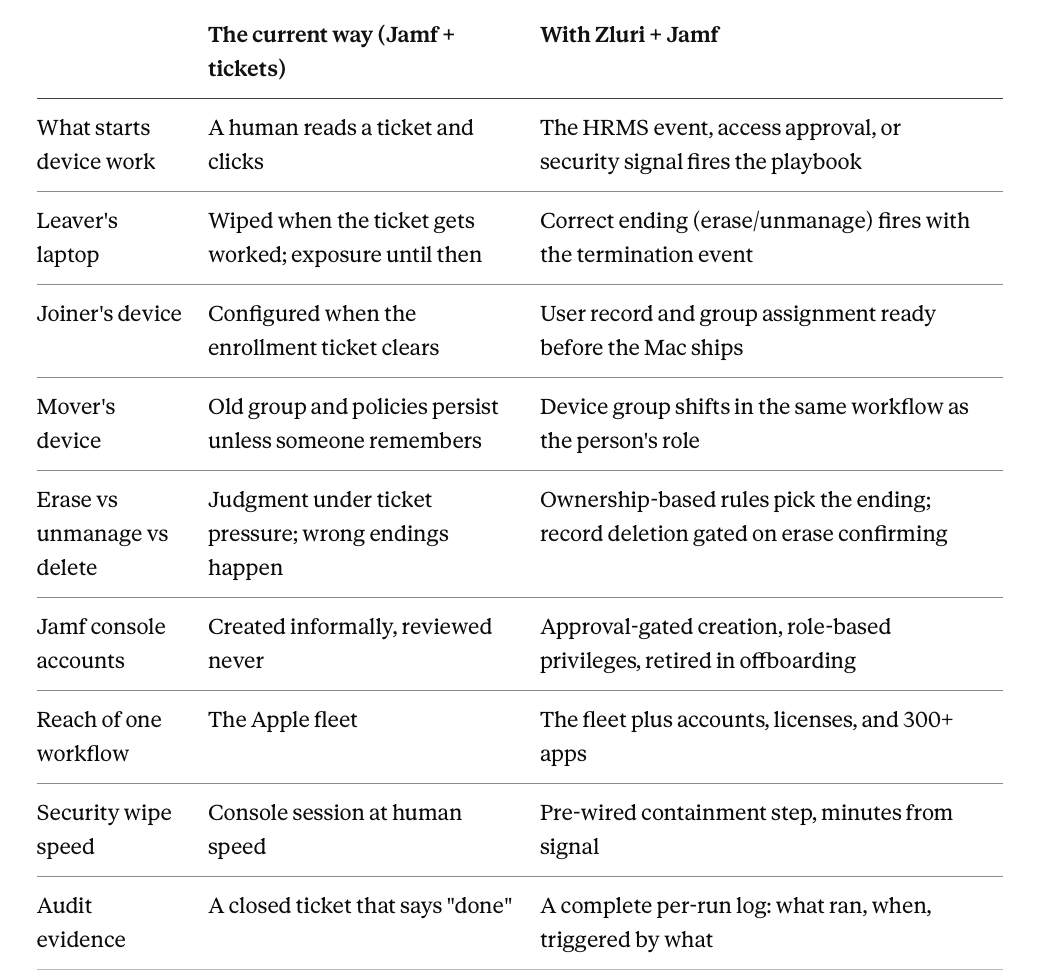
The current way, in most companies: the account side of joiner-mover-leaver gets automated first (provisioning, licenses, groups), and the device side stays manual, because it lives in a different tool, run from a different console, often by a different person. Every people event reaches Jamf the same way: a human reads a ticket and clicks. That loop breaks in specific, costly places:
Offboarding that's complete on paper, incomplete in the world. The account is suspended, the tokens are dead, the checklist is green, and the laptop with cached sessions, synced Drive folders, and saved credentials is in a departed employee's backpack, waiting on a ticket that says "wipe when returned." The account-side response ran in minutes; the device-side response runs on queue time. That gap is not sloppiness, it is architecture: nothing connects the HR event to the device action.
Day-one accounts, day-four laptops. The joiner's identity exists on time because that side is automated; the managed Mac arrives configured whenever the enrollment ticket gets worked. The person is technically productive and practically waiting.
Movers whose devices keep the old rules. Role changes shift a person's groups and access on the account side; the device's Jamf group, and therefore the policies it enforces, changes only if someone remembers a second, separate task. Hardware quietly enforces last quarter's role.
The wrong ending applied. Erase, unmanage, and delete are three very different endings for a device relationship, and under ticket pressure they get confused: data destroyed that should have survived a BYOD separation, or an inventory record deleted before the erase confirmed, which severs your ability to command the device at all.
The console nobody governs. Jamf admin accounts, which can wipe any computer and push scripts fleet-wide, get created informally and reviewed never, sitting outside the privileged-access program because the MDM console is "just an IT tool."
The pattern across all five: the trigger is a human processing a ticket, and the cost is measured in exposure time, waiting time, and wrong endings. The fleet is managed; the connection between the fleet and the organization's people events is not.
The Fix Isn't More Jamf Skill. It's Giving Jamf a Trigger It Doesn't Have.
Let's put the core claim upfront and state it honestly, because Jamf deserves the honesty: Jamf has real automation. Smart groups re-evaluate membership as device state changes, policies execute on schedules and enrollment events, and Jamf's workflow tooling automates common admin sequences. If your automation need lives entirely inside the device world (patch outdated software, apply a profile on enrollment), Jamf handles it alone, and nothing in this article argues otherwise.
The precise claim is narrower and more consequential: Jamf automates on device events. It cannot automate on people events, because it can't see them. The event that should end a device relationship (the termination record in the HRMS) and the one that should begin it (the start-date record) happen in a system Jamf has no native ear for. Smart groups react brilliantly to what a device is; nothing in Jamf reacts to what a person became.
Zluri supplies exactly the missing layer, in three parts:
The people-event trigger. Zluri listens where Jamf can't: the HRMS joiner, mover, and leaver events, approved access requests, security signals. The termination record fires the device offboarding the moment HR saves it, not when the ticket surfaces. The start-date record fires user-record creation and device-group assignment before the Mac ships. The lost-device report fires the erase at 2 AM without waking anyone.
No-code rules that resolve the specifics. One playbook serves the company because rules branch it per person: role decides the device group, ownership type decides erase versus unmanage, department decides the policy set, and whether the person was an IT admin decides if the console-account steps run. No scripts to write, no API to learn; the logic lives in a visual builder maintained by whoever owns the process.
One workflow across the fleet's edge. A person-event is never only a Jamf event. The departure that wipes the Mac should, in the same run, kill the Workspace sessions, revoke the Salesforce license, and remove the Slack account, along with access to whatever else the person was actually using, including apps nobody centrally provisioned and that were only ever found through discovery. Jamf's automation, at its best, ends at the fleet; the event's blast radius doesn't. Zluri runs device actions and account actions as sections of one playbook spanning 300+ directly integrated apps plus the wider discovered footprint: one trigger, one logged run, nothing left as a manual chase list because it was never formally connected.
And the uncomfortable corollary, stated plainly: if you just click these actions in Zluri instead of in Jamf, you've achieved nothing. A different console with the same manual clicking is a lateral move. The buttons are the least interesting part of this article; what you're actually deploying is the sentence "when HR says X, the fleet does Y," running unattended, with a log.
"Can't I Just Bridge HR to Jamf Myself?"
Yes, and honesty requires saying so: the trigger gap can be closed with plumbing you assemble yourself. Four DIY routes exist:
- IdP lifecycle management (Okta, Microsoft Entra ID) can carry HR status changes toward Jamf, though IdP workflows typically require their own paid add-ons and reach device actions shallowly
- An iPaaS (Workato, Tray.io, Make) can catch the HRMS event and fire Jamf Pro API calls directly, which works, and which also means someone builds those API mappings, owns them, and maintains them through every Jamf API change
- ITSM connectors (like ServiceNow's Jamf integration) can run backend device actions from offboarding tickets, keeping a human-in-the-loop trail at the price of keeping the ticket at the center
- Jamf's own Routines covers a growing set of templated automations, within Jamf's walls
So the honest framing is not "Zluri or nothing." It is build versus buy, and the build option has a shape worth seeing clearly: every bridge above solves the trigger problem as custom integration plumbing, connection by connection, maintained by whoever built it, covering the device leg and only the device leg. Zluri solves it as a product: the HRMS trigger, the no-code rules, the pre-built Jamf actions in this catalog, and, in the same playbook, the other 300+ apps the same person-event touches, plus the discovery and governance layer that tells you what those apps even are. If your automation need is one wipe-on-termination pipeline and you have an iPaaS team, build it. If the need is the whole joiner-mover-leaver surface across accounts and devices, with an audit log and without a maintenance backlog, that is the product's argument.
The Ticket-Driven Way vs. the Triggered Way
What Becomes Possible: The Full Action Catalog
With the people-event trigger in place, the question flips from "who will work these tickets?" to "what should the event fire?" Here is every Jamf Pro action Zluri automates, organized by the moment it matters: the user records that tie people to devices, the governance of Jamf's own console, the device endings, the fleet organization, and the hygiene in between. Everything below is available as no-code workflow steps once the Zluri + Jamf integration is connected.
The User Records: Tying People to Devices
Jamf's user records are the join point between your identity layer and your hardware fleet. A device without an assigned user is an orphan in every audit; a user record that doesn't exist can't receive a device.
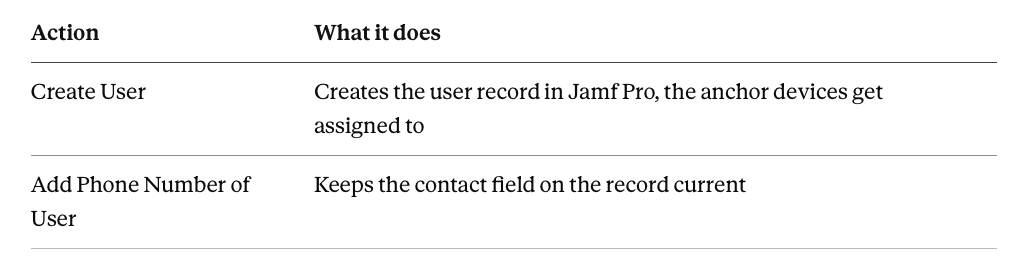
Small set, big role: because Zluri drives these from the HRMS event, the Jamf user record exists before the device ships, which is what lets device assignment and enrollment run zero-touch. When the joiner's Mac arrives, the identity it binds to is already there.
Governing the Console Itself: Jamf Pro Admin Accounts
Here is the set most Jamf automation content skips entirely, and it is arguably the most security-relevant one: the accounts that administer Jamf Pro itself. A Jamf admin account can wipe any computer in the fleet, push scripts to every device, and change enrollment policy. That is among the highest-blast-radius access in the company, sitting inside a tool most privileged-access programs never look at.

Automating these turns Jamf admin access into governed access: console accounts created through the same approval workflows as any other privileged grant, access levels adjusted when roles change instead of accumulating, and a departing IT admin's console account dying in the same offboarding playbook as everything else. Use disable-versus-delete deliberately: disable for investigations and leaves, delete for departures. If your organization runs a privileged access program, this is its SaaS admin layer, and the MDM console belongs on that list ahead of almost anything else.
Device Endings: The Actions That Make Offboarding Real
This is the operational heart, because it is where three very different endings get encoded correctly. Erase, delete, and unmanage sound interchangeable and are anything but; the wrong one either destroys data you needed or leaves data you meant to destroy.

In an offboarding playbook, these run as the closing steps after the account-side actions: sessions and tokens die first, the device gets its ownership-based ending, then the inventory record resolves. In a security response, erase is what turns a stolen laptop from a data breach into a hardware loss, and having it pre-wired is the difference between wiping in minutes and wiping after the weekend. One ordering rule is absolute: never delete an inventory record before the erase confirms, because deleting the record severs your ability to command the device.
Fleet Organization: Groups as Policy Targets
In Jamf, groups are not just organization; they are how policy reaches devices. Configuration profiles, app deployments, and restrictions scope to groups, so which group a computer sits in determines what it enforces.

Automated group placement is what makes enrollment mean something: a new Mac lands in the engineering group and inherits the engineering configuration the moment the joiner playbook runs. The same action serves movers, because a role change that shifts a person's group should shift their device's group in the same workflow, or the hardware keeps enforcing the old role's policy long after the person left it.
Hygiene: Keeping the MDM's Record Honest
An MDM accumulates clutter the way every long-lived system does: departments from an old org structure, scripts from finished projects, policies nobody remembers scoping, groups for teams that no longer exist. The clutter is not cosmetic: stale policies can still execute, and orphaned scripts are unreviewed code sitting in a tool with root on every device.

As workflow actions, cleanup becomes a cadence instead of a someday-project: a periodic hygiene workflow, or cleanup steps appended to the events that create the staleness (a reorg workflow retires the old department, a project-closure workflow removes the project's scripts and groups). The scripts case deserves the most respect: unused executable code with fleet-wide reach is exactly the kind of thing worth deleting on schedule rather than discovering in an incident review.
How the Pieces Compose: Three Playbooks
The joiner playbook, device edition. HRMS event fires; the account layer provisions Workspace, apps, and licenses; the Jamf layer creates the user record and places the assigned device in the right group. Person and machine both ready on day one, from one trigger.
The leaver playbook, completed. Termination event fires; sessions, tokens, and licenses resolve on the account side; then the device side runs its ownership-based ending, and if the leaver was an IT admin, their Jamf console account is disabled or deleted in the same run. The full JML picture, across both layers, is covered in our joiners, movers, and leavers guide.
The security response, extended to hardware. A compromise or lost-device report triggers containment, and the device actions are its final links: erase the machine, resolve the record. Account containment without device containment is half a response; a laptop with cached credentials and local data is an attack surface no token revocation reaches.
Frequently Asked Questions
Why use Zluri when Jamf has its own automation like smart groups and policies?
Jamf's native automation reacts to device events: state changes, enrollment, schedules. It cannot react to people events, because it has no connection to the HR system where joiners, movers, and leavers happen. Zluri supplies that missing trigger layer plus no-code per-person rules, and extends the same workflow beyond the fleet to accounts and 300+ apps.
Can't I connect HR to Jamf using Okta, Workato, or ServiceNow instead?
You can. IdP lifecycle management, iPaaS platforms, and ITSM connectors are all real ways to close the trigger gap as self-built integration plumbing, typically covering one pipeline (like wipe-on-termination) that someone then owns and maintains. Zluri closes the same gap as a product: pre-built Jamf actions, no-code rules, and the same person-event resolving accounts, licenses, and 300+ other apps in one logged playbook.
What goes wrong when device lifecycle work runs on tickets?
Departed employees' laptops stay live for days awaiting the wipe ticket, joiners get accounts on day one and configured devices on day four, movers' hardware keeps enforcing old-role policies, erase-versus-unmanaged judgment gets made under pressure, and Jamf console accounts escape governance entirely. All of it traces to one root: no connection between the HR event and the device action.
What Jamf Pro actions can Zluri automate?
User record creation and updates, full governance of Jamf Pro console accounts (create, disable, delete, access level and privilege set changes), device erase for computers and mobile devices, unmanaging devices, inventory record deletion, static group placement, and cleanup of departments, scripts, policies, and user groups.
What is the difference between erasing, deleting, and unmanaging a device in Jamf?
Erase wipes the device's data and is the ending for departures, losses, and compromises. Unmanage removes Jamf management while leaving the device and its data intact, fitting BYOD separations. Delete removes the inventory record and belongs at the end, for retired hardware, after any required erase has been confirmed.
Why do Jamf Pro admin accounts need governance?
Because a Jamf console account can wipe any device and push scripts fleet-wide, making it among the highest-blast-radius access in the company. Automating its lifecycle (approval-gated creation, role-based privilege updates, disable or delete on departure) brings it under the same discipline as other privileged access.
Can device wipes be triggered automatically for security incidents?
Yes. Erase actions can sit inside security response playbooks, so a compromise or lost-device event triggers the wipe alongside account containment, in minutes rather than after a console session.


.svg)