

Break-glass access has to be genuinely fast, or it defeats its own purpose. It also can't become a quiet backdoor around every control. The resolution isn't slowing the emergency grant down; it's making everything around that grant rigorous instead.
Break-glass access exists because sometimes the normal approval process is exactly what stands between an organization and stopping active damage: a critical system down, an incident actively spreading, an approver unreachable at the worst possible moment.
The tension is real. Break-glass has to be genuinely fast in the moment, or it defeats its own purpose. But it can't become a quiet, permanent backdoor around every control that normally applies.
Done properly, break-glass access is a defined, pre-authorized emergency path, distinct from simply skipping the process because something feels urgent. It's one of two specialized forms of the general JIT access pattern (duration-bound grants with automatic reversion), temporary elevated access being the other. The two are distinguished by trigger and approval path: temporary elevated access is planned in advance and flows through the standard approval process; break-glass access is triggered by an unplanned emergency and is pre-authorized to bypass that process, with rigor concentrated in review after use instead.
The speed lives entirely in the moment of the grant. The rigor lives in everything that surrounds it, and it decomposes into five requirements, each backed by a specific Zluri mechanism:
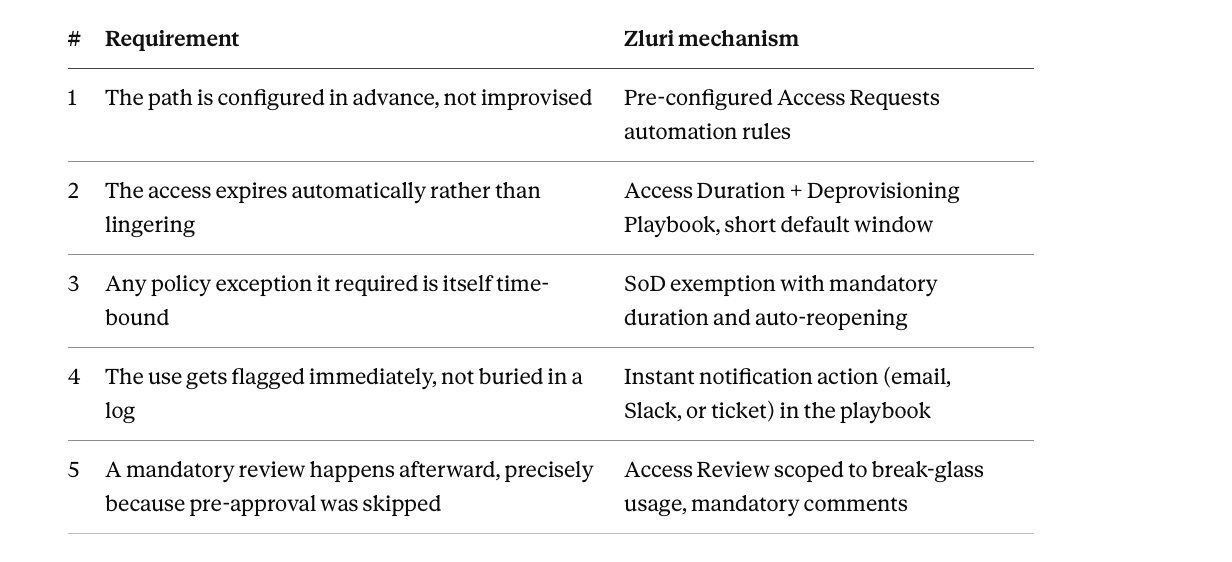
Each requirement is covered in depth below.
Requirement 1: Pre-Authorized, Not Improvised
The single most important property of a genuine break-glass system is that it's configured before the emergency happens, not built on the fly during one.
Access Requests automation rules can be pre-configured specifically for defined emergency conditions: a rule scoped to a specific role combined with a specific context flag, auto-approving instantly instead of routing through the standard approval chain a real crisis doesn't have time to wait for.
This is the mechanism that makes speed and safety compatible. The decision about who qualifies for expedited emergency access, and under what conditions, gets made calmly, in advance, by whoever owns that policy. It is not decided under pressure in the middle of an active incident by whoever happens to be available.
Requirement 2: The Grant Expires on Its Own
Break-glass access that quietly becomes standing access afterward defeats the entire premise. The access was justified for the emergency, not indefinitely.
Access Duration, specified as part of the pre-configured break-glass request pattern and paired with an automatically executing Deprovisioning Playbook, is what makes expiry automatic rather than dependent on someone remembering to revoke emergency access once the crisis has passed.
One design detail matters here: a break-glass grant should default to a short, defined window, hours or a single day, not the longer durations that might suit a genuine temporary project. Building that shorter default directly into the pre-configured pattern is what keeps the emergency exception from drifting into permanent, unreviewed privilege.
Requirement 3: Emergency Policy Exceptions Carry the Same Discipline
Sometimes a genuine emergency requires someone to temporarily hold a combination of access that would normally violate a Segregation of Duties rule: the only available person needs both halves of a normally-separated capability because a second approver simply isn't reachable during the incident.
Zluri's SoD exemption model is the direct mechanism for this case, and it carries the same discipline that makes it safe to use under pressure. An exemption always requires a defined duration; indefinite exemptions aren't a configurable option. Once that duration expires, the underlying violation automatically reopens if the conflict still exists. Even a justified emergency override of a combination-risk rule doesn't quietly become a permanent policy exception simply because it was granted during a crisis and never explicitly revisited.
Requirement 4: Flagged Immediately, Not Just Logged
A break-glass grant is inherently higher-risk than routine access, precisely because it bypassed the normal approval check. Its use deserves real-time notification, not a line item in a log someone might review next week.
Configuring the break-glass playbook to fire an immediate notification (email, Slack, or a created ticket) to security or leadership the moment emergency access is actually invoked turns the event into something a person becomes aware of while it's still relevant. Not a fact discovered well after the fact during a routine audit.
This is a deliberate design choice worth building into the break-glass pattern from the start. The entire justification for skipping pre-approval is that speed mattered; the same urgency argument means the notification should be just as immediate.
Requirement 5: The Mandatory Review That Compensates for the Skipped Approval
This is the step most break-glass implementations get wrong by treating it as optional.
Because pre-approval was deliberately bypassed, a mandatory Access Review covering every break-glass grant is what compensates for that skipped step after the fact: why it was used, whether the access was actually appropriate to what the emergency required, whether it should have been narrower.
In Zluri, that means scoping a recurring or triggered certification specifically to recent break-glass usage, with mandatory comments justifying every decision. The result is exactly the accountability record a normal, front-loaded approval would have produced, just after the fact instead of before. That is the honest tradeoff break-glass access makes on purpose.
The Sixth Discipline: Watch the Pattern, Not Just Each Instance
Beyond reviewing each individual event, the overall frequency of break-glass usage deserves its own scrutiny as a signal.
A genuine emergency path that gets invoked constantly isn't functioning as an emergency path anymore. It's evidence of one of two things: either the normal approval process is too slow for legitimate operational needs and should be redesigned, or the break-glass mechanism itself is being used to routinely skip governance rather than for genuine crises.
Tracking break-glass invocation rates over time, and reviewing them alongside regular Access Reviews, is what catches this pattern-level risk. No single instance-level review, however thorough, would surface it on its own.
Why the Discipline Belongs Around the Grant, Not In It
The design principle underneath all five requirements: trying to make the emergency grant itself slower or more scrutinized defeats the purpose break-glass access exists for. If getting emergency access takes as long as a normal request, it isn't an emergency path.
The correct place for rigor is everywhere except the moment of the grant. Rigorous pre-authorization deciding who qualifies and under what conditions. Rigorous automatic expiry so the exception doesn't outlive its justification. Rigorous handling of any policy exception it required. Rigorous real-time visibility into when it's used. Rigorous mandatory review afterward.
Genuine break-glass access is fast exactly once, at the moment someone actually needs it, and carefully governed at every other point around that moment.
Frequently Asked Questions
Does break-glass access in Zluri mean skipping approval entirely, with no oversight at all?
No. The approval step gets pre-configured to auto-execute for specifically defined emergency conditions, decided in advance rather than improvised. That speed is deliberately offset by automatic expiry, immediate notification when the path is used, and a mandatory review afterward. The oversight moves to before and after the grant rather than disappearing.
Why does break-glass access need to expire automatically rather than being manually revoked when the emergency ends?
Because relying on someone to remember to revoke emergency access once a crisis has passed is exactly the kind of dependency that lets a legitimate exception quietly become permanent, unreviewed standing privilege. Building automatic expiry into the pre-configured break-glass pattern removes that dependency entirely.
Can a break-glass grant override a Segregation of Duties conflict during a genuine emergency?
Yes, through the standard SoD exemption mechanism, which carries its own mandatory duration and automatic reopening once that period expires. Even an emergency override of a combination-risk rule stays time-bound rather than becoming an unreviewed, permanent policy exception.
How would an organization know if its break-glass path was being abused rather than used for genuine emergencies?
By monitoring the frequency of break-glass invocations over time as its own signal, alongside reviewing each individual use. A path invoked rarely, only during genuine incidents, looks very different from one invoked routinely. A pattern of frequent use is itself the warning sign worth investigating, regardless of whether any single instance looks individually justified.


.svg)