Most security and privacy failures are separable. A weak access control is a security problem. A missing consent record is a privacy problem. Shadow IT collapses that separation entirely. The instant real data flows into an undiscovered application, both fail at once, from the same event, and neither team is positioned to have caught it.
Security and privacy get treated, organizationally and procedurally, as related but distinct disciplines, with separate owners, separate frameworks, separate incident classifications. That separation holds up reasonably well for most of the risk each discipline actually deals with. It breaks down completely for shadow IT, because shadow IT isn't a security incident that might have privacy implications, or a privacy gap that happens to have weak security around it. It's a single event that trips both failure modes simultaneously, and the fact that neither discipline was built to own that combination is exactly why it persists longer than almost any other category of risk.
At a glance, before the detail:
Why This Isn't Two Problems, It's One
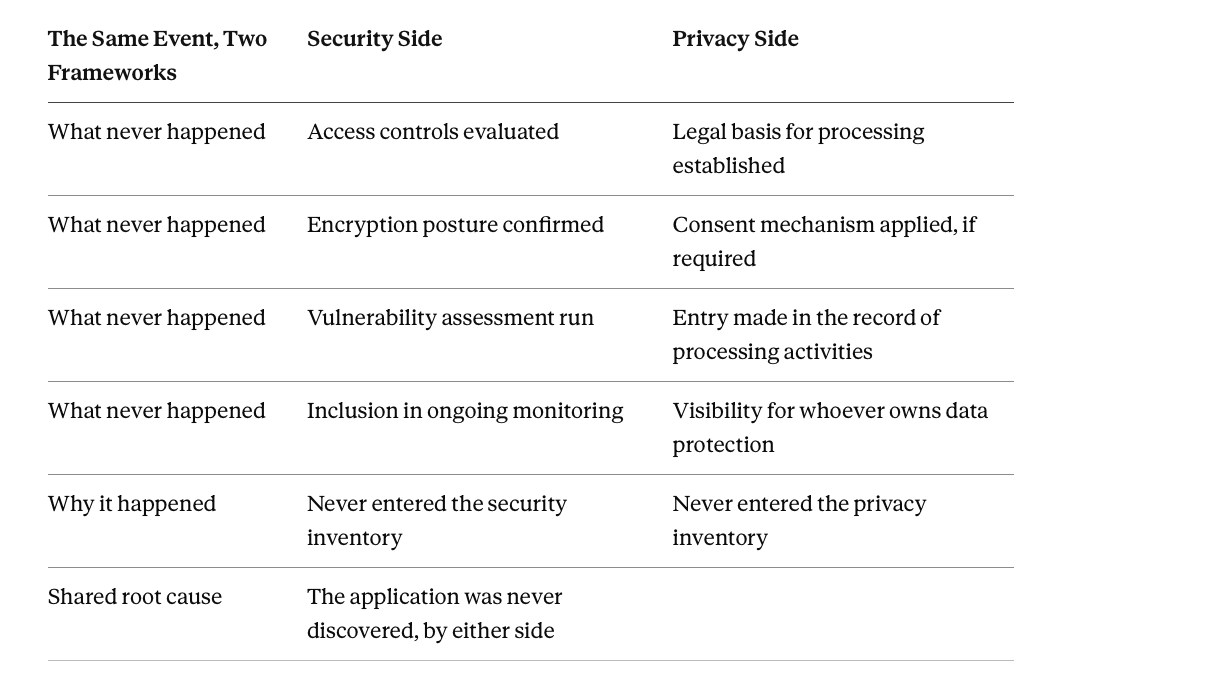
Walk through what happens the moment an employee signs up for an unsanctioned tool with a work email and starts putting real data into it. Nothing about that application gets reviewed on the security side, and nothing about that data processing gets recorded on the privacy side, for the same underlying reason: neither team knows it exists.
These aren't two separate gaps that happen to coincide. They're the same event, viewed from two different frameworks. The application entered the environment outside every official channel, and that single fact is what simultaneously produces the security gap and the privacy gap, because both frameworks depend on the same prerequisite: knowing the application exists in the first place. Neither framework failed independently. The shared prerequisite failed once, and both downstream disciplines inherited the failure at the same moment.
Why Neither Team Is Actually Positioned to Catch It
This is the part that makes shadow IT inherently different from almost every other risk category, and it's worth being precise about the mechanism. A security team's tooling and process generally starts from an inventory: scan what's known, assess what's known, monitor what's known. A privacy team's tooling and process generally starts from a similar place: map data flows for known systems, maintain records of processing for known applications, apply legal basis assessments to known data collection points.
Both disciplines are built to govern what's already been identified, and shadow IT, by definition, hasn't been. This means the standard failure mode isn't "security caught it but privacy didn't" or the reverse. It's that neither discipline's normal operating process was ever going to surface it, because both processes share the same blind spot for the same built-in reason. Security isn't failing to do its job when it misses shadow IT. Privacy isn't failing to do its job either. The job, as each discipline typically defines it, doesn't include actively hunting for applications nobody's reported, which is precisely the population shadow IT belongs to.
The Ownership Gap Makes It Worse, Not Just Invisible
A risk with a clear, if imperfect, owner tends to get addressed eventually, because someone's job depends on addressing it. Shadow IT's dual-failure nature actively works against that.
Ask each team whether shadow IT is their problem, and both answers come back complicated. Security's honest answer: it's a real security gap, but it was never in their inventory to begin with, so it doesn't show up in their metrics or remediation queue until someone else finds it. Privacy's honest answer: it's a genuine processing-without-a-recorded-basis problem, but privacy teams are rarely equipped or resourced to run application discovery, which is generally treated as an IT or security function.
The result is a risk category that satisfies the definition of "someone else's problem" for both disciplines simultaneously, not through negligence on either side, but because the category was never cleanly assigned to either team's actual operating model. It persists specifically because it falls in the gap between two functions that each assume, reasonably, that discovery is happening somewhere else.
What Happens When It Finally Surfaces
The consequence of this dual failure shows up clearest at the exact moment a shadow application finally becomes visible, usually through an incident rather than a proactive discovery. A shadow AI tool leaks data it was never supposed to hold. The immediate question, is this a security incident or a privacy violation, doesn't have a clean answer. It's genuinely both, and most incident response playbooks and breach notification frameworks are built around a primary classification that determines the initial response track.
An event that's simultaneously a security incident, unauthorized access to a system nobody was monitoring, and a privacy violation, personal data processed without a recorded legal basis or consent, tends to expose exactly which framework the organization actually optimized for, because the response usually reveals a scramble to retrofit the other framework's requirements after the fact rather than a coordinated response that anticipated both from the start.
Why Discovery Has to Be the Shared Trigger Point
The underlying fix isn't asking either team to expand its mandate to cover the other's discipline. It's recognizing that discovery, the single act of surfacing an application nobody reported, is the actual shared prerequisite both frameworks depend on, and building the process so that one discovery event feeds both governance tracks simultaneously rather than requiring two separate discovery efforts that neither team is fully resourced to run alone. This is the same underlying reason visibility-first IGA solves the broader stakeholder alignment problem: security, IT, and compliance each reason from a different partial picture of the environment until one shared discovery layer gives everyone the same map to work from.
Once an application is discovered, security and privacy can each apply their own established process to it: access review, risk scoring, and monitoring on one side, processing record, legal basis assessment, and consent evaluation on the other. Both processes are generally mature and well understood. What's missing isn't the downstream discipline. It's the single upstream event that triggers both at once, which is exactly why discovery, not better security process or better privacy process individually, is the actual point of leverage.
This Is What Zluri's Discovery Layer Is Actually Built to Solve
This is the direct, practical connection worth naming rather than leaving implied: closing the shadow IT gap isn't just a security capability or just a privacy capability. It's the shared discovery event both disciplines depend on and neither can reliably produce alone.
Zluri's multi-source discovery, pulling from transaction data, direct integrations, agents, MDMs, CASBs, and plugins rather than any single official channel, surfaces exactly the population that shadow IT belongs to: applications that never went through the process either security or privacy would normally rely on to know they exist. Once surfaced, that application enters the same governed inventory as everything else, closing the security-side gap through access review and risk scoring, while giving whoever owns privacy compliance the visibility they need to actually evaluate legal basis and processing records for data that was previously invisible to that evaluation entirely. One discovery event, feeding both tracks, rather than two separate teams each hoping the other one already caught it.
Frequently Asked Questions
Isn't shadow IT primarily a security problem, with privacy as a secondary concern?
Not inherently. The same event, an application entering the environment outside any official channel, produces both failures simultaneously and for the same underlying reason: neither security nor privacy processes are built to govern something they don't know exists. Treating it as primarily a security problem tends to leave the privacy half unaddressed until an incident forces the issue.
Why don't privacy teams typically catch shadow IT before it becomes a problem?
Because privacy teams generally aren't equipped or resourced to run application discovery, which is usually treated as a security or IT function. Privacy processes typically start from a known inventory of systems and data flows, the same starting assumption that leaves shadow IT invisible to security tooling by design.
What makes shadow IT harder to remediate than a typical security or privacy gap?
The ownership ambiguity. A risk clearly assigned to one team's mandate tends to get addressed because someone's job depends on it. Shadow IT satisfies the definition of "someone else's responsibility" for both security and privacy simultaneously, which means it persists specifically because each team reasonably assumes discovery is happening somewhere else.
How should an organization fix the shadow IT ownership gap at the root?
By treating discovery as a shared prerequisite that feeds both governance tracks from a single event, rather than expecting either security or privacy to independently discover and then hand off to the other. Once an application is discovered, each team's existing, mature process, access review on one side, legal basis and consent evaluation on the other, can run against it independently.
.webp)


.svg)