.png)




By the time a redundant tool shows up in a cleanup audit, someone's already built real workflows around it, and removing it means a migration. Catching it before that point costs nothing more than a suggestion at the moment someone requests a new app. This is what actually makes redundant-app cleanup rare instead of annual. (For the broader case behind this problem, see our guide to redundant apps as a concept.)
Redundant apps usually get treated as one problem: too many tools, cut some. That's too simple. Two genuinely distinct situations hide under that single label, and telling them apart matters more than the label suggests.
This piece covers both. First, catching and resolving genuine redundancy, two different tools that really do overlap. Second, the quieter data-hygiene problem: one tool recorded as if it were two.
The Two Different Problems Called "Redundant Apps"
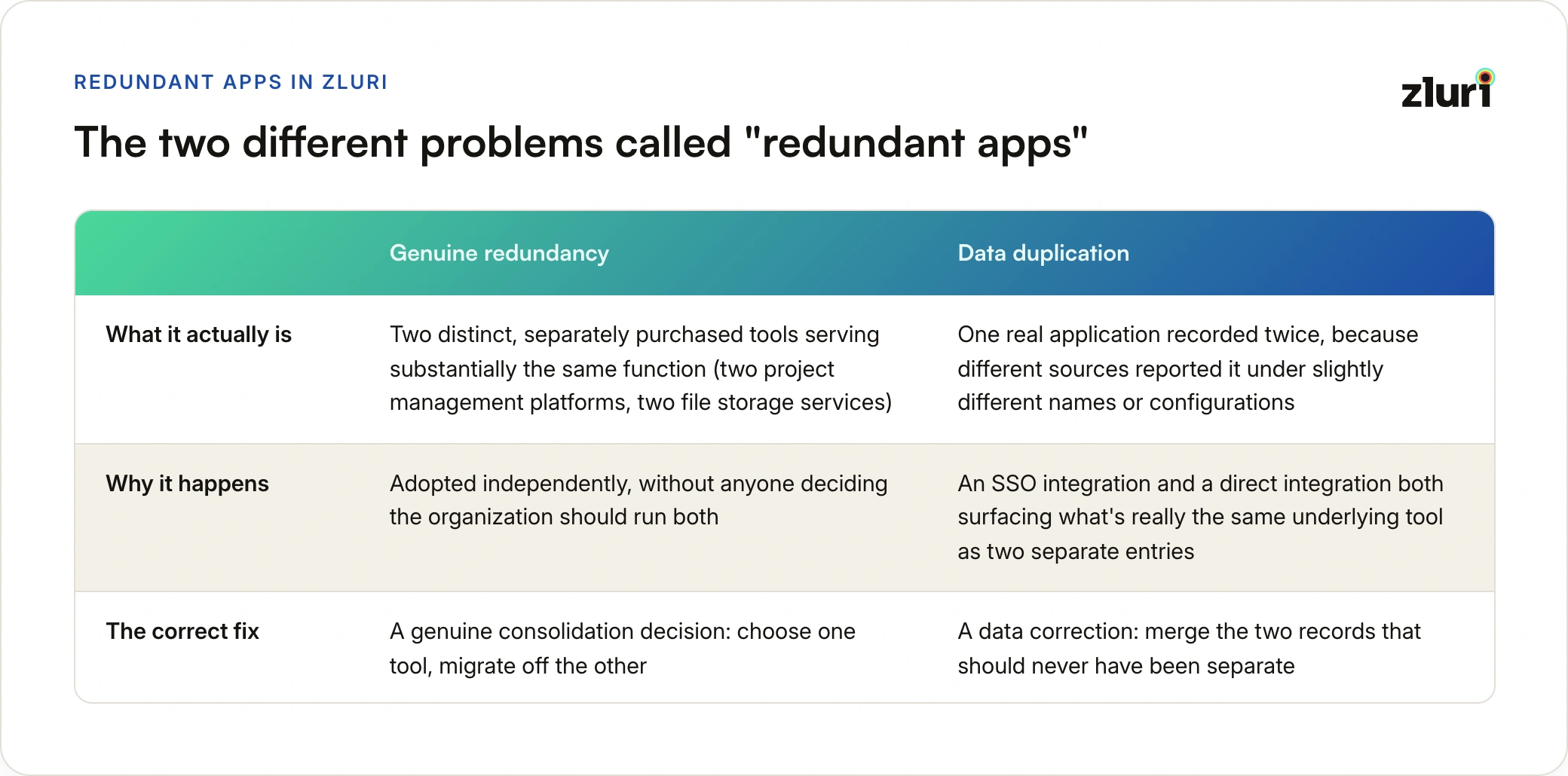
Treating either as the other wastes effort. Trying to "consolidate" a tool that's actually one already-unified product accomplishes nothing. Trying to "merge" two genuinely different products just because they serve a similar purpose doesn't work either, since there's nothing to merge.
Genuine redundancy needs a consolidation decision. Data duplication needs a data fix. Solving one with the other's method wastes real effort on the wrong problem.
How Genuine Redundancy Actually Accumulates
Real redundancy rarely happens through one deliberate decision to run two competing tools. Almost nobody sits down and chooses redundancy on purpose. Instead, it accumulates through a series of small, individually reasonable choices, made without anyone having central visibility into the whole picture.
Three paths account for most of it:
- A team adopts a tool to solve an immediate need, unaware that a different team already uses something that does substantially the same job
- A tool survives past the reason it was originally chosen, while a newer alternative quietly becomes the more widely adopted standard elsewhere in the organization
- A merger or acquisition brings two full, independently built technology stacks together overnight, each with its own version of the same category of tool
None of these paths involve anyone consciously deciding redundancy was acceptable. That's exactly why it needs active detection. Waiting for it to become obvious doesn't work, because nothing about any single decision looks wrong at the time it's made.
Catching Redundancy Before It's Ever Adopted
The cheapest point to fix redundancy is before a second, overlapping tool ever gets adopted.
Prevention beats cleanup, every time, and it beats it by a wide margin.
Two mechanisms make this possible:
- An application's detail page in the employee catalog surfaces Similar Apps in Your Org, so someone browsing sees what the organization already has before requesting something new
- The request form itself can prompt directly for whether other tools were considered, with an alternative suggested at the exact moment someone's about to duplicate something that already exists
This is meaningfully cheaper than catching the same redundancy later. Once a team has real data and workflows built around a newly adopted tool, undoing the redundancy means actual migration effort. Catching it before adoption means nobody has to migrate anything at all.
Distinguishing True Redundancy From Data Duplication
Before treating something as genuine redundancy worth a consolidation decision, it's worth confirming it isn't actually the same tool recorded twice. That confirmation matters more than it sounds like it should.
Application Map and Merge exist specifically for this, covering two situations:
- Folding a naming mismatch into the correct existing record
- Consolidating two detected entries that turn out to represent the same underlying application
Running this check first isn't a formality. A genuine consolidation decision, migrating users, canceling a contract, is real, disruptive work, and none of that effort should go toward solving what was actually a data-hygiene problem a straightforward merge would have fixed in minutes.
Department-Level Redundancy Hiding Inside an Org-Wide View
A meaningful share of real redundancy isn't visible at the organization-wide level at all. It's local. One specific team is quietly running its own version of a tool that already exists somewhere else in the company, and the aggregate numbers never show it.
Department-level application and spend visibility surfaces this directly. It shows which team is driving adoption of a tool that overlaps with something already standardized elsewhere. This pattern is exactly what a company-wide view tends to average out and miss, since neither individual tool looks unusual on its own. Only the department-level comparison actually surfaces the overlap.
Deciding Which Overlapping Tool to Actually Keep
Once genuine redundancy is confirmed, choosing which tool to consolidate onto shouldn't be a guess. It shouldn't come down to whichever tool seems more popular in the moment, either.
Usage and optimization data settles it instead: adoption rates, engagement scores, unused and underused license counts. That gives the decision a real evidence base. Which tool is actually more adopted? How much license waste exists in each? What does the true cost difference look like once that waste is accounted for? Comparing sticker price alone, or defaulting to whichever tool happened to be adopted first, answers none of those questions.
Redundancy at Scale: The Mergers and Acquisitions Case
App redundancy shows up at its most extreme during a merger or acquisition. Two organizations' full, independently built technology stacks combine overnight, and each side is often running its own version of every major tool category. This isn't gradual, accumulated redundancy. It's immediate and comprehensive, all at once.
The underlying mechanics don't change, but the scale does. The same detection and decision-evidence approach applies, just across an entire combined portfolio at once rather than one overlap at a time. For the fuller access and identity picture that comes with it, not just the app overlap, see the risks of mergers and acquisitions.
Consolidation Without Disrupting the Teams Using Either Tool
Worth being direct about scope here. Identifying redundancy and providing the evidence needed to decide which tool to keep is different from executing the actual migration, moving data, retraining users, unwinding a contract. That execution work is real, and it depends on the organization's own change-management process.
What this capability provides instead is the decision-ready foundation: confirmed genuine overlap, evidence-based usage comparison, accurate cost data. Whoever executes the consolidation works from an accurate picture. Nobody has to guess at which tool is actually more embedded in daily use.
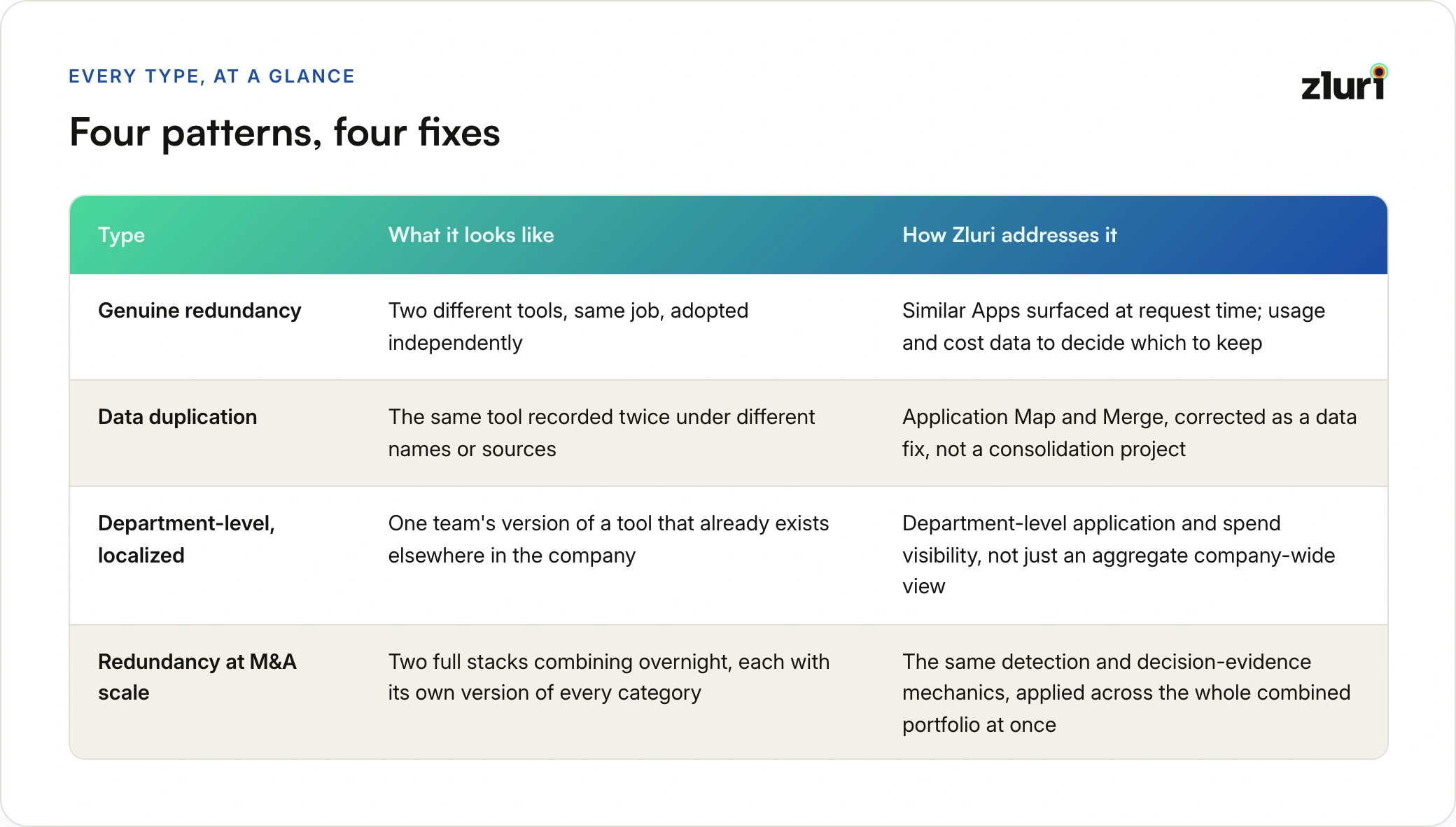
Every Type, At a Glance
Four distinct patterns show up under the "redundant apps" label, and each one has its own detection method and its own fix.
Frequently Asked Questions
Is merging two application records the same thing as resolving redundant apps?
No, and conflating the two wastes effort. Merging fixes data duplication: the same tool recorded twice under different names. Resolving genuine redundancy means deciding between two actually distinct tools and consolidating onto one. That's a real operational decision. A data merge doesn't address it at all.
What's the cheapest point to address app redundancy?
Before a second, overlapping tool gets adopted at all. Surfacing similar existing apps at the moment someone's browsing or requesting a new tool prevents the redundancy from ever being created. That's considerably less disruptive than catching the same overlap months later, once a team has real workflows built around the duplicate.
How would an organization know which of two overlapping tools to actually keep?
By comparing usage and optimization data directly: adoption rate, engagement, and how much license waste exists in each. Guessing based on sticker price, or on which tool happened to be adopted first, doesn't answer the real question. The tool that's genuinely more embedded in daily use, once waste is accounted for, is usually the more defensible one to standardize on.
Why is department-level visibility important for catching redundancy specifically?
Because a lot of real redundancy is localized. One team runs its own version of a tool the rest of the organization already has, and an aggregate, company-wide view tends to average that out and miss it entirely. Seeing adoption broken down by department surfaces the pattern directly, instead of hiding it inside an overall total that looks unremarkable.