Two project management tools, three ways to make a diagram, a design team on Canva while the company pays for Figma. Redundant apps get treated as a spend problem: consolidate, save money, move on. That undersells what they actually are. Every redundant app is a separate place holding company data, a separate account to offboard, a separate thing an access review has to cover.
Redundant apps aren't a discipline failure. They're the default outcome of how SaaS actually gets adopted: any team with a corporate card can sign up for a tool the moment they need one, and nobody's checking first whether an equivalent already exists somewhere else in the company.
Multiply that across every department, every quarter, and overlap isn't an edge case. It's one specific, common shape SaaS sprawl takes, and it's what decentralized adoption produces by default.
Redundant, Overlapping, or Just Split
Not every duplicate is worth killing, and treating all overlap the same way is how consolidation projects lose credibility. Three categories are worth separating before deciding anything:
Genuinely redundant: two tools doing the same job for the same population, with no real reason both exist. Two project management tools used by different teams for the identical purpose, with neither team using anything the other couldn't get from a single shared tool.
Overlapping, not redundant: tools that share some functionality but aren't actually interchangeable. A design team's Figma and a marketing team's Canva both make visual content; they serve different workflows well enough that forcing one team onto the other's tool would cost more in friction than it saves in subscription fees.
Split, not duplicated: the same tool, running as separate workspaces or instances because different teams each signed up independently instead of joining a shared one. This isn't a tool-overlap problem at all, since there's only one product involved. It's a governance-overlap problem: two Slack workspaces, two Notion workspaces, two Airtable accounts, each with its own admin, its own membership, its own offboarding surface, doing the multiplication this whole article is about without a second tool anywhere in the picture.
The distinction matters because the second category doesn't need elimination, it needs a deliberate decision, made once, with usage data, instead of two teams independently paying for similar things because nobody ever compared them. The third needs a different question entirely: not "which tool wins," but "should this actually be one workspace or two."
What actually decides the split case:
- Do the same people hold seats in both workspaces, paying for the same person twice? A strong reason to consolidate.
- Does either workspace hold external guests, a specific client's data, or a legal entity's information that genuinely shouldn't mix with the other? A strong reason to keep them apart.
- Is there real cross-workspace collaboration people currently work around, constantly inviting each other as guests? A sign the split is costing more than it's protecting.
- Would merging cross a real compliance line, a different data-residency requirement, a different security posture one workspace needs and the other doesn't? A legitimate reason to leave it split.
What Redundant Apps Actually Multiply
The subscription cost is real and usually the easiest number to point to, which is exactly why it gets treated as the whole problem. It isn't, and it's only one piece of a broader SaaS-wastage picture worth evaluating together rather than app by app.
Every redundant app is a separate place company data lives, which means it's a separate surface an access review has to cover, a separate account that needs offboarding when someone leaves, and a separate opportunity for orphaned accounts to form, because deprovisioning has to remember every app a person touched, not just the sanctioned ones. Two tools doing the same job don't just cost twice; they double the number of places an offboarding process can fail to reach.
Redundant apps are also disproportionately likely to sit outside SSO. A team adopting a tool nobody else knows about rarely bothers configuring SAML for it, which means it inherits the risk of living outside the identity perimeter: no centralized authentication policy, no automatic inclusion in access reviews, no automatic deprovisioning tied to departure. The app that's easiest to overlook is usually the one carrying the most risk per user.
Why SSO-Only Discovery Misses Exactly This Category
This is the specific reason redundant apps stay hidden longer than almost anything else in a SaaS stack: the apps most likely to be redundant are also the apps least likely to show up in an SSO-based inventory. A team that independently adopted a tool because they didn't know a sanctioned equivalent existed is, by definition, a team that didn't route it through the identity provider either.
Catching these requires discovery across more than the identity provider: SSO and IdPs, direct integrations, HRMS, MDM, finance and expense systems, CASBs, directories, and browser extensions, eight methods combined. Finance-system discovery in particular tends to surface the clearest redundancy signal, two similar charges from two different vendors, hitting the same cost center, in the same quarter, that no one ever cross-referenced.
Who Actually Gets to Decide
Redundancy detection is a technical problem. Deciding what to do about it is an organizational one, and the more distributed a company gets, the further those two things drift apart. A single-office company with one IT team can find an overlap and just fix it. Almost nobody else has that luxury.
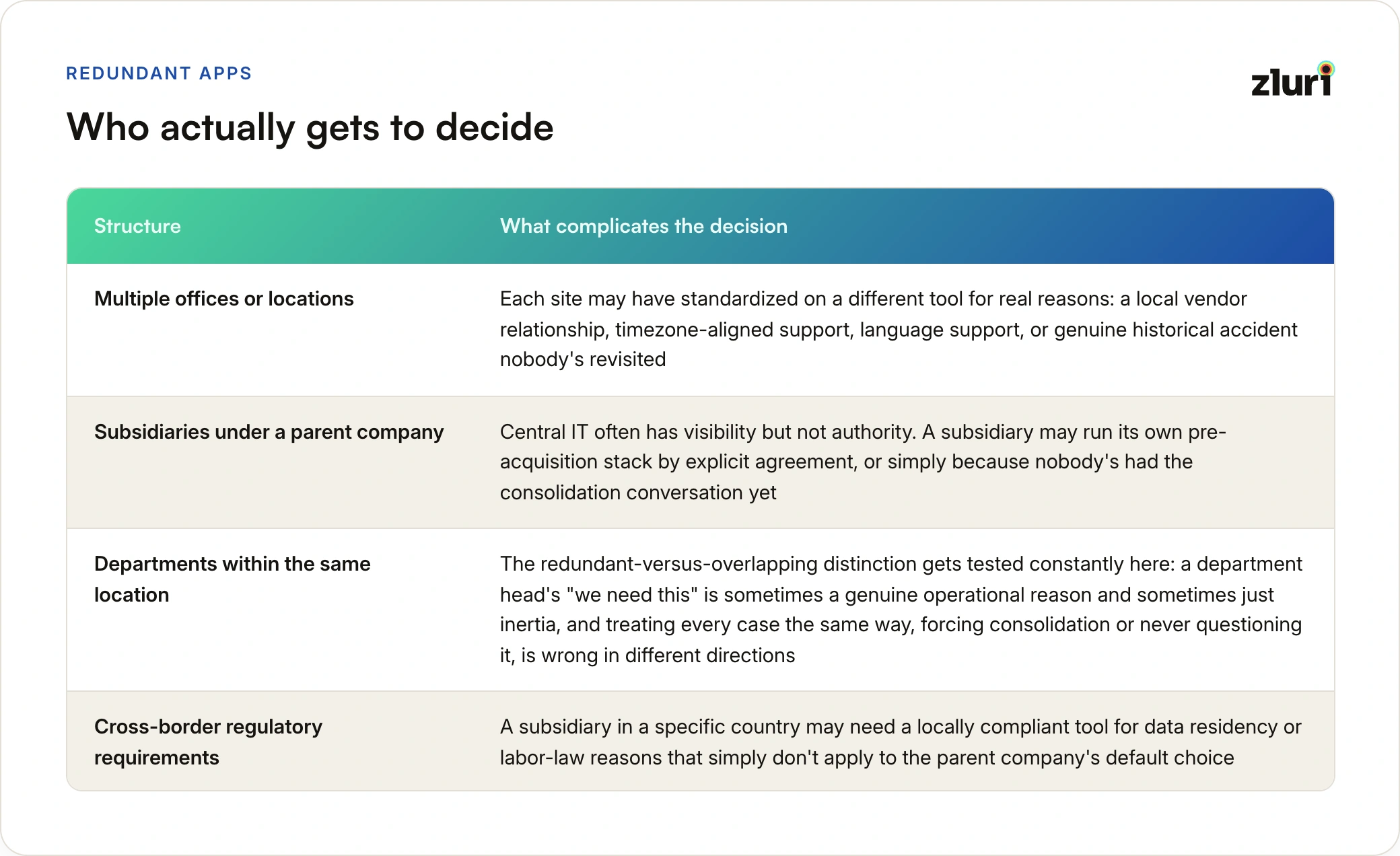
None of these get resolved by IT deciding alone, because IT usually doesn't have standing to override a subsidiary's autonomy, a department head's operational judgment, or a regional compliance requirement, even when the spend data makes the overlap look obvious.
Finance is a stakeholder here too, not a budget line that gets informed after the fact. Finance sees redundant spend clearly, and the instinct to want it cut fast is directionally right, duplicate subscriptions are genuinely some of the easiest, most visible savings available. But that instinct applied bluntly, canceling based on the spend line alone, without checking who's actually using the tool, risks cutting something quietly load-bearing for one team's real workflow. The disruption that creates usually costs more than the subscription saved.
The scenario that actually tests this: a department insists "we need it," and usage data shows nobody's logged in for a year. Neither claim automatically wins.
- The data doesn't prove the tool is unnecessary. It might be used seasonally, or by one specific person the rest of the "team" never touched themselves.
- The assertion doesn't prove it's necessary either. People default to defending what they already have, since nobody wants to be the reason something turns out to matter later.
What actually resolves it is bringing the data into the same conversation as the context: not IT acting unilaterally on the login count, not Finance acting unilaterally on the invoice, one conversation where usage data and department context sit on the same table.
That's also why company-wide overlap detection alone isn't enough. Finding "we have two project management tools" is one level. Knowing which specific team, subsidiary, or department is actually driving each one's usage, and whether that usage is real or nominal, is the level where these conversations actually happen.
Department and entity-level usage visibility is what turns "IT thinks this is redundant" and "Finance wants it cut" into a shared, evidence-based decision instead of two departments guessing at each other's reasoning.
How to Actually Decide
Once two overlapping apps are both visible, the decision should run on a few concrete signals, not a gut call.
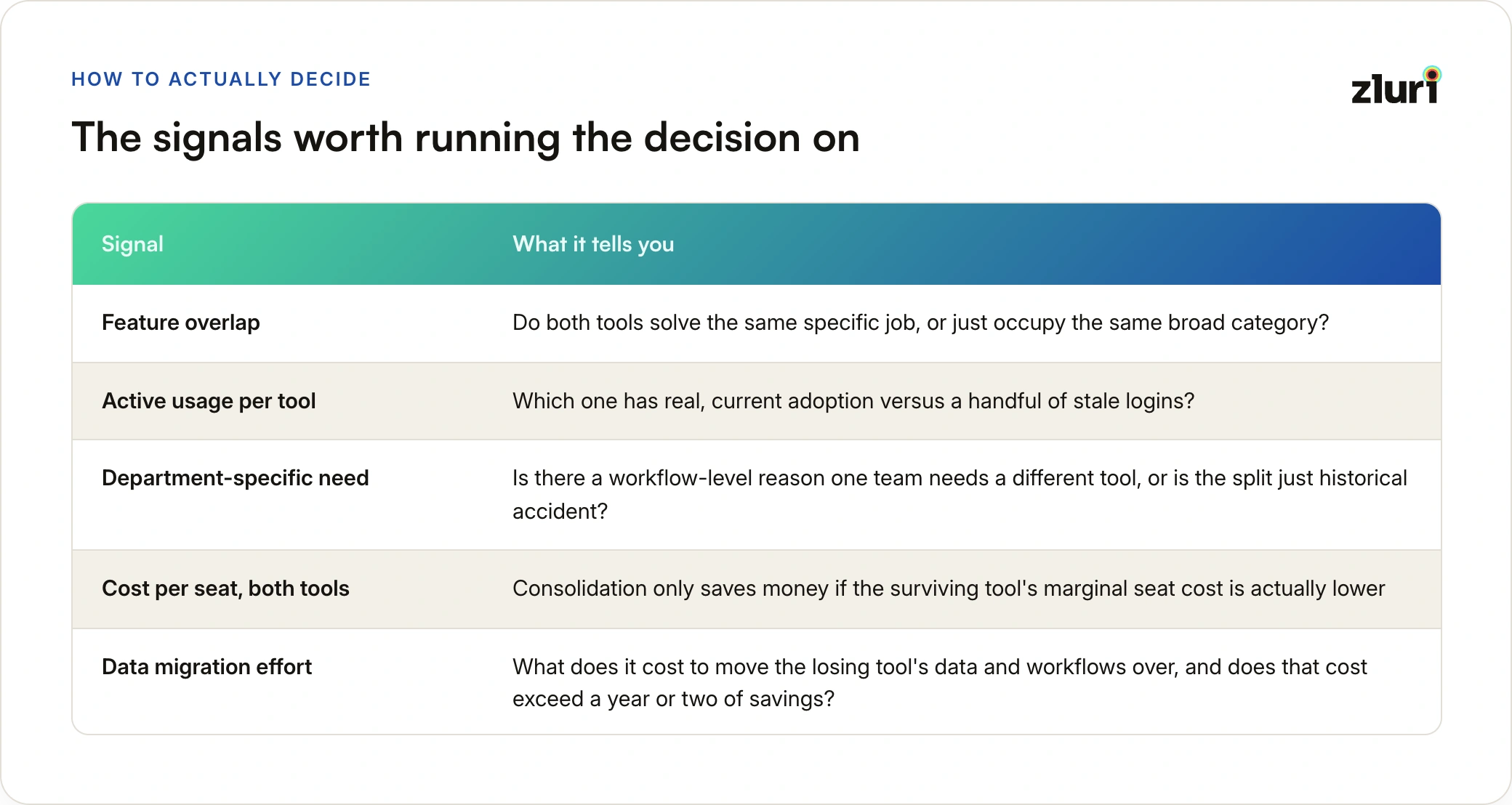
A tool that fails the first two tests (no real feature justification, weak actual usage) is a strong consolidation candidate. A tool that passes the third (a genuine department-specific reason) usually isn't redundant at all; it's a deliberate, justified overlap, and the right move is documenting that reasoning once rather than re-litigating it at every renewal.
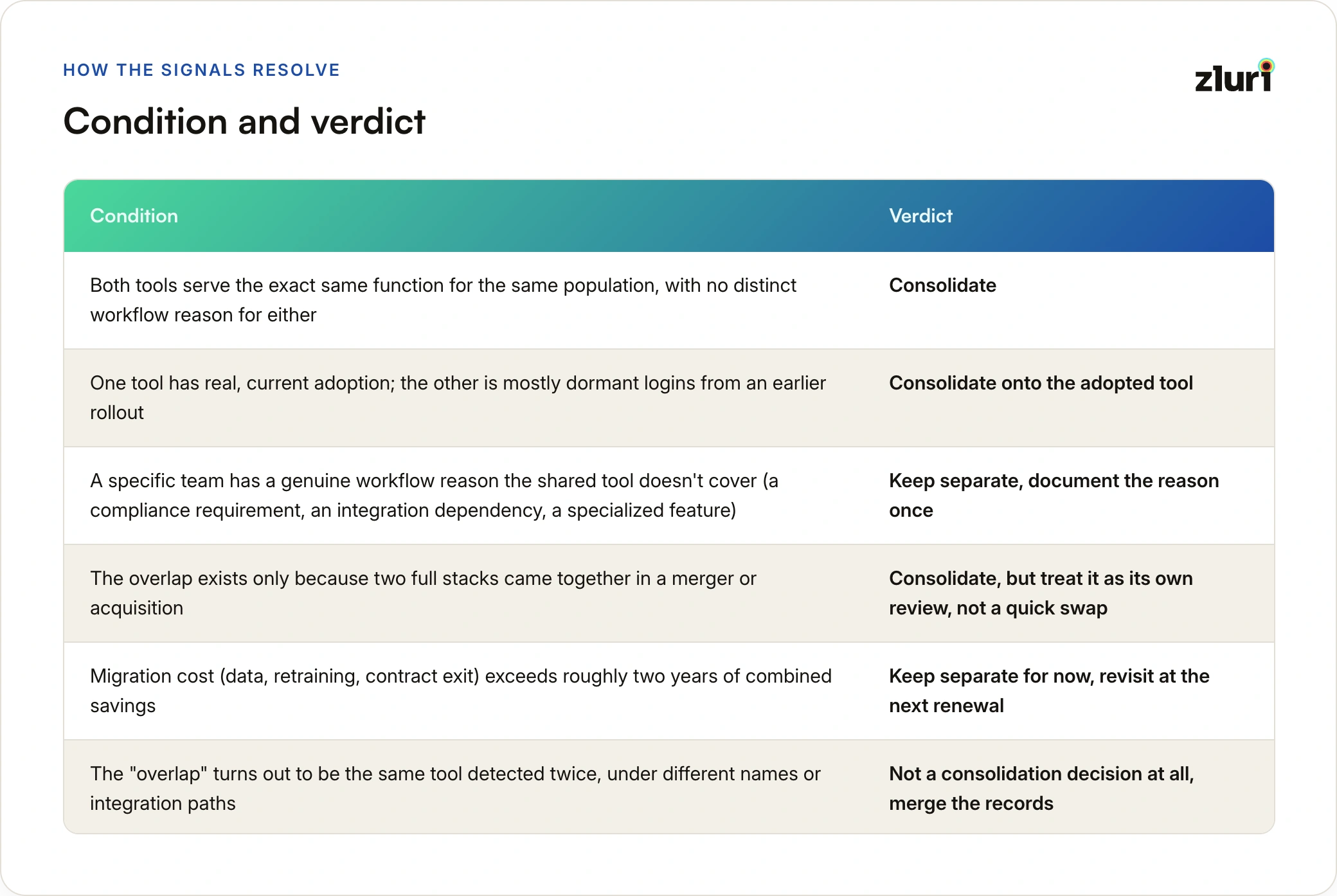
Put plainly, here's how those signals resolve in practice:
Consolidating Correctly, Not Just Cutting the Invoice
Killing a redundant app is not the same as canceling its renewal. The subscription can end while the accounts, the data, and the access inside it quietly persist, turning a cost-saving exercise into a fresh batch of orphaned accounts.
The sequence that avoids this:
- Confirm the surviving tool actually covers what the eliminated one did
- Migrate or archive the data that needs to survive
- Fully deprovision every account in the losing tool, not just letting the subscription lapse
- Only then let the contract end
Lay the whole process out end to end, and the real difference between doing this manually and doing it with Zluri isn't any single step, it's whether the work ever stays done.
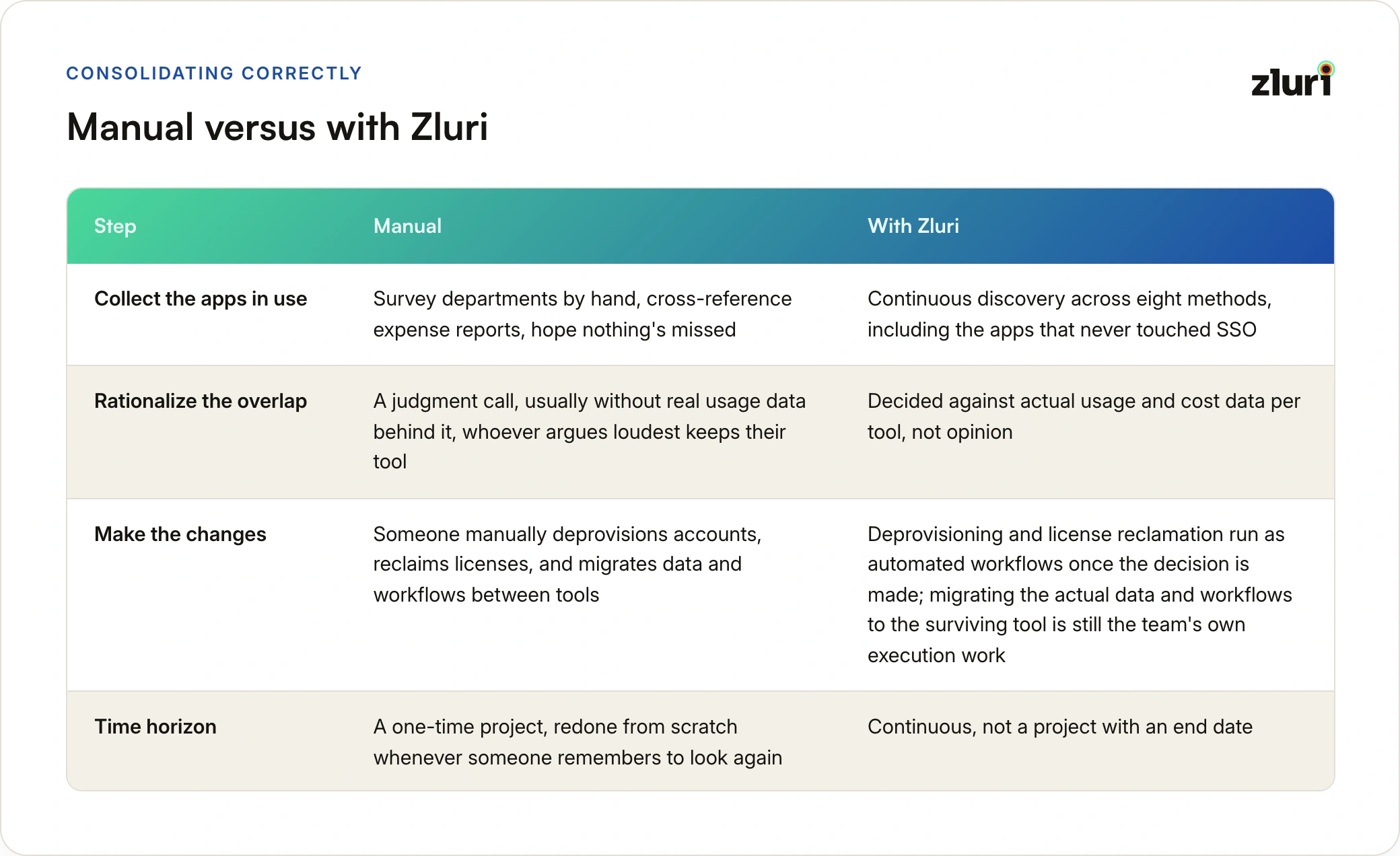
That last row is the difference that actually matters. A one-time cleanup finds today's redundancy and leaves tomorrow's to accumulate exactly the same way, through independent adoption nobody checked against what already exists. The fix that holds sits upstream of the cleanup: when someone requests a new app that isn't already in the company's catalog, surfacing what's already available for a similar need, at the moment of the request, is what keeps the list from quietly refilling every year.
This is one specific problem inside the broader discipline of SaaS management; the detection and consolidation mechanics behind it, from request-time prevention to distinguishing genuine redundancy from a data-duplication error, are covered in how Zluri helps with redundant apps.
Frequently Asked Questions
Is it the same problem when two teams use separate workspaces of the same app?
Not quite. That's not a tool-overlap problem since there's only one product involved; it's a governance-overlap problem. Two separate instances of the same app still mean two admin consoles, two membership lists, and two offboarding surfaces to maintain, the multiplication effect this article covers, just without a second tool anywhere in the picture. Whether to merge the workspaces depends on different questions: whether the same people hold seats in both, whether either workspace holds external guest or client data that shouldn't mix, and whether a real compliance boundary justifies keeping them apart.
What's the difference between a redundant app and an overlapping app?
A redundant app duplicates another tool's exact job for the same population, with no real reason both should exist. An overlapping app shares some functionality with another tool but serves a genuinely different workflow well enough to justify both existing. The first is a consolidation candidate; the second usually just needs a documented reason.
Why are redundant apps hard to find with SSO-based discovery alone?
Because the apps most likely to be redundant are the ones a team adopted independently, without routing them through the identity provider in the first place. Catching them requires discovery methods beyond SSO, particularly finance and expense data, which often surfaces two similar charges from different vendors that nobody had cross-referenced.
Does eliminating a redundant app automatically reduce risk?
Only if the elimination includes full deprovisioning. Canceling a subscription without removing the accounts and access inside that app just creates an orphaned account instead of an active redundancy, which can be a worse outcome than leaving the overlap in place and consolidating it properly later.
How often should redundant apps be reviewed?
Continuously through discovery rather than as a standalone periodic audit. The moment two tools with clear feature overlap and low combined usage appear in the inventory, that's the signal to evaluate them, rather than waiting for a scheduled review to notice the overlap has been accumulating for months.
Is overlap between departments always a problem?
No. Genuine department-specific needs, different workflows that happen to touch a similar category of tool, are common and often legitimate. The problem isn't overlap itself; it's overlap nobody ever evaluated, sitting on the books indefinitely without a documented reason either way.


.svg)