

"Who owns this app" is usually answered with one name, and that's already the wrong resolution. A single SaaS relationship actually involves at least three genuinely different kinds of accountability, is this the right tool, is it worth what we're paying, is it secure, and a generic owner field collapses all three into one person who's rarely equipped to answer all of them equally well.
Ownership is easy to treat as a formality, a name in a field that exists mostly so there's someone to email. Done properly, it's the accountability substrate everything else in SaaS management actually depends on, who gets asked when a renewal decision comes up, who's accountable when a security review flags something, who's responsible for the money being spent at all.
This piece covers Zluri's actual ownership model in full, which is considerably more structured than a single "owner" field, and explains why that structure matters rather than being unnecessary complexity.
At a glance, before the detail:
The Six-Way Split: Application-Level vs. Contract-Level Ownership
A SaaS relationship has two genuinely separate things that need an accountable owner: the application itself and the commercial agreement funding it. Zluri tracks ownership for both, separately, rather than assuming one person naturally covers both.
At the application level: App Owner, App IT Owner, and App Finance Owner. At the contract level: Contract Owner, Contract IT Owner, and Contract Finance Owner.
This distinction exists because the day-to-day administration of an application, managing users, handling support questions, is genuinely a different job than negotiating, renewing, or amending the commercial agreement behind it. The same person frequently isn't both, an IT admin managing a tool day to day is rarely the same person who negotiated its contract terms with procurement.
What Each Application-Level Role Is Actually Accountable For
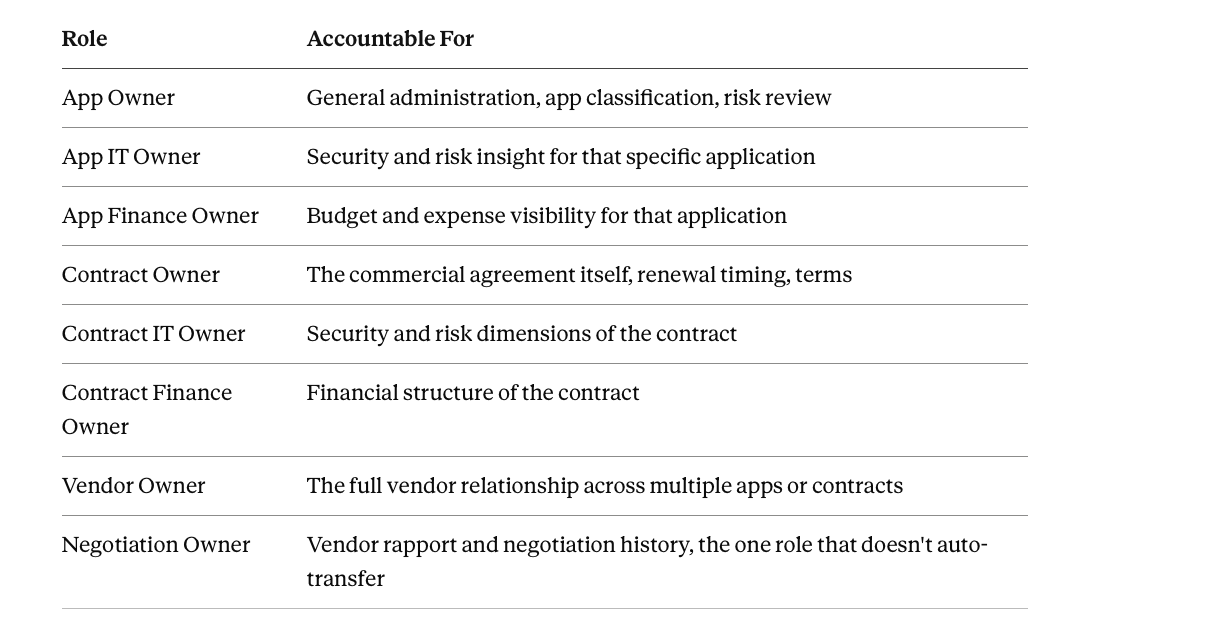
The Application Owner handles general administration, application type classification, and risk review, the person closest to how the tool is actually configured and used day to day.
The IT Owner carries security and risk insight accountability specifically, the one who should be looking at threat scores, compliance posture, and flagged vulnerabilities for that application.
The Finance Owner owns budget and expense visibility, tracking whether spend on the tool is justified and whether it's trending in a direction worth flagging.
These three roles frequently sit with three different people precisely because general administration, security judgment, and financial oversight are three different skill sets. Collapsing them into one generic owner either overloads a single person with responsibilities outside their expertise, or leaves one of the three dimensions with nobody actually watching it.
Contract-Level Ownership: A Distinct Layer of Accountability
The contract-level roles mirror this same three-way split, but for the commercial agreement rather than the application's day-to-day operation. A Contract Owner, Contract IT Owner, and Contract Finance Owner are accountable for the agreement itself, its renewal timing, its terms, its financial structure, which can genuinely differ from who's accountable for the application day to day.
This is precisely why Zluri's contract renewal notification system routes different reminder types to different owner roles specifically, App Owner, App IT Owner, App Finance Owner, Contract Owner, Contract IT Owner, Contract Finance Owner, each potentially a different person, each needing to know about a different kind of upcoming event for a different reason.
Vendor Owner: Accountability for the Relationship Itself
Beyond the application and its specific contract, the broader vendor relationship, spanning potentially multiple applications, multiple contracts, and an ongoing commercial relationship, gets its own distinct Vendor Owner. This role is accountable for the relationship as a whole, not any single application or agreement within it, which matters specifically for vendors supplying more than one tool or service, where no single application-level or contract-level owner naturally has visibility into the full relationship.
Negotiation Owner: The One Role That Doesn't Automatically Transfer
This is a genuinely specific, easy-to-miss detail worth calling out directly. When a user account gets merged, most ownership roles, Application, IT, and Financial ownership at both the app and contract level, along with Vendor Owner, Reporting Manager, and Department Head, transfer automatically to the surviving account. Negotiation Owner is the explicit exception.
The reasoning is worth understanding rather than treating as an arbitrary carve-out: negotiation ownership is frequently tied to a specific relationship a particular person has built with a vendor's own representatives, rapport, history, prior conversations, that doesn't transfer meaningfully just because an account got merged for data-hygiene reasons. Automatically reassigning it the way operational ownership transfers would risk quietly handing negotiation authority to someone who's never actually spoken to that vendor, which is exactly the kind of silent handoff worth requiring a deliberate decision for instead.
Requiring Ownership at the Point of Creation, Not as an Afterthought
Ownership in Zluri isn't something retrofitted onto a record after the fact, it's required at the point a Subscription, Contract, or Perpetual license is actually set up. Primary Owner is a mandatory field during creation, alongside optional Finance and IT Owner assignment at that same step.
This matters because an application or commitment created without an owner from day one tends to stay that way indefinitely, nobody circles back later to assign accountability retroactively, which is exactly why building the requirement into the creation flow itself, rather than treating it as a cleanup task for later, is what actually keeps ownership data complete.
Keeping Ownership Accurate Through Personnel Change
Ownership data decays the moment the person it names leaves the organization or changes roles, unless something actively keeps it current. The automatic transfer mechanic triggered by user merges, moving Application, Contract, IT, Financial, and Vendor Owner roles to a surviving account, is what prevents ownership from silently going stale every time an organizational change happens, rather than requiring someone to manually audit every ownership field whenever personnel changes, a task that realistically never happens consistently enough to catch every gap on its own.
Why Six Distinct Roles Beats One Generic Owner Field
The actual argument for this level of structure is straightforward once stated directly: a generic "owner" field for an entire SaaS relationship either overloads one person with judgment calls outside their actual expertise, asking a Finance Owner to assess security posture, or asking an IT Owner to negotiate contract terms, or leaves a real dimension of accountability effectively unowned because the single named person never thought to cover it.
Six distinct roles, each mapped to a specific kind of decision, general administration, security, finance, contract negotiation, and vendor relationship, means every question that actually comes up, is this still secure, is this still worth the cost, should we renew, who do we call at this vendor, has a specific, appropriate person to route to, rather than defaulting to whoever happens to be listed as the generic owner regardless of whether the question is actually in their wheelhouse.
Ownership as the Foundation Everything Else Depends On
It's worth closing on why this matters beyond bookkeeping. Access reviews need a reviewer to route to. Access requests need an approver. A renewal decision needs someone accountable for making it. A flagged security risk needs someone specific to notify, not a general alert nobody feels personally responsible for acting on.
Every one of these downstream processes, covered in depth elsewhere, quietly depends on ownership data being accurate and appropriately structured in the first place, which is exactly why treating SaaS ownership as a foundational, day-one requirement rather than an administrative afterthought is what makes the rest of the platform's governance actually work as intended.
Frequently Asked Questions
Why does an application need separate IT and Finance owners instead of one person handling both?
Because security judgment and financial oversight are genuinely different skill sets, and the person best positioned to evaluate a compliance certificate or a risk score is rarely the same person best positioned to evaluate whether spend is justified. Splitting these into distinct roles means each question routes to someone actually equipped to answer it.
What's the difference between an Application Owner and a Contract Owner for the same app?
The Application Owner is accountable for the tool's day-to-day administration and use. The Contract Owner is accountable for the commercial agreement behind it, renewal timing, terms, negotiation, which is frequently a different person, since managing a tool operationally and negotiating its contract are different jobs that don't always sit with the same individual.
Why doesn't Negotiation Owner transfer automatically like other ownership roles do during a user merge?
Because negotiation ownership is often tied to a specific relationship a person has built with a vendor's actual representatives, history and rapport that don't meaningfully transfer just because an account got merged for data-hygiene reasons. Automatically reassigning it risks quietly handing negotiation authority to someone with no actual relationship with that vendor.
What happens if a Subscription or Contract is created without assigning a Primary Owner?
It can't be, Primary Owner is a required field at the point of creation, not something added later. This is a deliberate design choice specifically because ownership gaps that aren't caught at creation tend to persist indefinitely, since retroactively auditing every existing record for missing ownership rarely happens consistently in practice.


.svg)