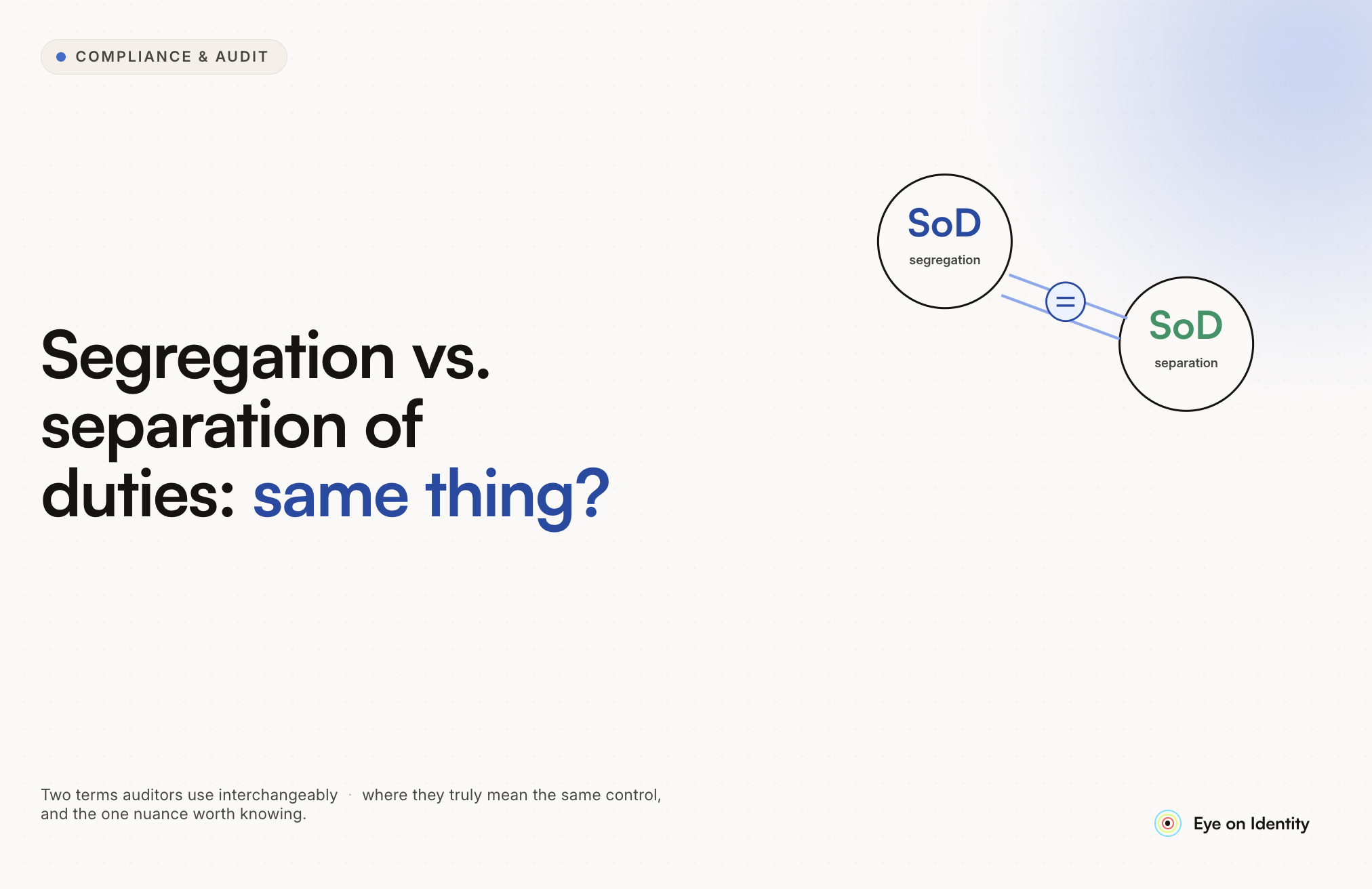


The short answer: for most purposes, they are synonyms. The longer answer, which matters if you are designing a governance program, is that they describe two complementary control layers that can fail independently.
What the Standards Bodies Say
Every major authoritative source treats the two terms as interchangeable.
NIST's CSRC glossary lists "SoD" as a synonym for Separation of Duty. ISACA uses both terms to describe the same principle across different publications. The AICPA uses "segregation of duties" as its preferred term in accounting and audit contexts but cross-references separation of duties throughout. Wikipedia's entry for Separation of Duties notes that it is "also known as segregation of duties."
The consistent pattern: finance and audit communities prefer "segregation of duties," rooted in COSO and SOX language. IT security and government frameworks prefer "separation of duties," following NIST SP 800-53 and ISO 27001 conventions. The abbreviation SoD covers both, which is itself evidence of how intertwined the concepts have become.
For most practical purposes, this is the entire answer. If you are writing compliance documentation, talking to an auditor, or reading a security framework, the terms mean the same thing and you can use either without confusion.
Where a Meaningful Distinction Emerges
Among IAM governance specialists, a distinction is increasingly drawn between what each term emphasizes, and the distinction has practical consequences for how you design controls.
Segregation of duties in its more specific sense refers to the access and permission layer. The question it asks: can one identity accumulate a harmful combination of entitlements? The mechanism is a conflict matrix: identifying which permission pairs are incompatible and enforcing that no user holds both. Vendor creation plus payment approval. Journal entry creation plus journal entry posting. Payroll modification plus payroll execution. The control operates at the entitlement level, applied at provisioning time and verified through access reviews.
Separation of duties in its more specific sense refers to the process and governance layer. The question it asks: is this critical process split across independent functions, so no single team or individual controls it end-to-end? The mechanism is workflow design and organizational accountability: a developer cannot self-approve their own code into production, a security team cannot audit its own controls, the IT department cannot both administer systems and verify their own compliance with security policies.
The practical difference: a process can satisfy segregation of duties (no user holds conflicting entitlements in the system) while failing separation of duties (one team controls the entire end-to-end process with no independent oversight). And vice versa: a process can have strong operational separation while harboring permission-level SoD conflicts buried in inherited roles.
A Concrete Example of Both Failing Independently
The DevOps scenario illustrates separation failing without a segregation failure. A developer may have no direct production deployment permissions, so their individual access profile contains no conflicting entitlements. But if their team's pipeline allows any team member to merge code and trigger automatic deployment without independent review, the operational process has no separation. The permission model looks clean. The governance design is broken.
The finance scenario illustrates segregation failing without an obvious separation failure. An AP clerk and their manager are operationally separate: the clerk enters invoices, the manager approves payments. But if the clerk also has system-level permission to create vendors and the manager has permission to release payments without checking the vendor master, a specific entitlement conflict exists that the operational separation does not catch. Two people are involved, but the wrong person can still initiate and complete a fraudulent vendor payment across the two roles.
Mature control programs check for both: entitlement conflicts at the permission level (segregation) and process independence at the workflow level (separation).
How Compliance Frameworks Emphasize Each
The distinction also maps onto different compliance frameworks.
Frameworks rooted in financial reporting (SOX Section 404, PCI DSS, HIPAA financial controls) tend to emphasize the permission-conflict dimension. They require demonstrating that no user can complete a transaction end-to-end, which maps to entitlement-level conflict detection.
Frameworks rooted in operational security (ISO 27001 Annex A.5.3, NIST SP 800-53 AC-5) tend to emphasize the process-independence dimension. They require that critical functions are distributed across independently accountable roles and teams.
An organization that achieves SOX compliance through entitlement-level SoD controls may still have ISO 27001 gaps if the operational process design allows one team to control sensitive functions without independent oversight. The controls address different dimensions of the same underlying risk.
How Zluri Addresses Both Layers
Zluri's SoD module operates at the segregation (permission-conflict) layer: detecting conflicting entitlement combinations across connected applications in real time, flagging toxic pairs as they form, and routing remediation through configurable workflows. Pre-built conflict rule sets cover financial controls (vendor creation plus payment approval, PO creation plus PO approval), HR and payroll (compensation modification plus payroll execution), and IT access (provisioning plus audit access).
The access governance layer above the SoD module addresses separation more broadly: approval workflows that require independent action before provisioning completes, access reviews that verify role appropriateness across teams, and lifecycle automation that ties access to HR-verified role and employment status. Together, these cover the permission-conflict dimension (segregation) and the process-independence dimension (separation).
Zluri's published guidance treats the terms as synonyms in the conventional sense: "Segregation of Duties, sometimes called Separation of Duties, is an internal control principle that divides responsibilities so no single individual has end-to-end control." The product design reflects the practitioner distinction, operating on both the entitlement and workflow layers.
The Practical Takeaway
For documentation, audits, and general communication: the terms are synonyms. Either works. Your audience will understand both.
For governance program design: treating them as distinct layers is more useful. Check for entitlement conflicts (no user holds incompatible permissions in connected systems) and check for process independence (no individual or team controls an entire sensitive process without independent oversight). The two checks can fail independently, and a program that only performs one has gaps the other would catch.
The abbreviation SoD covers both, which is convenient for documentation but can obscure the distinction in design conversations. When precision matters, being explicit about whether you are referring to permission-level controls or process-design controls helps ensure the right layer is being evaluated.



.svg)