
ConductorOne governs access well — for the apps your SSO already knows about. Here's what to evaluate when that's no longer enough.
If you're evaluating identity governance platforms and ConductorOne is on your shortlist, this article will help you understand what you're comparing it against — and where the meaningful differences lie.
If you're already running ConductorOne and something isn't covering what it should (your last offboarding left access behind, a compliance reviewer asked how you govern shadow IT and you didn't have a clean answer, or your integration catalog has hit a ceiling) this article will help you understand what alternatives look like.
Either way, the core question is the same: how much of your actual access surface do you need to govern, and how much of it sits outside your IdP?
Why Organizations Look for ConductorOne Alternatives
ConductorOne's limitations aren't about quality. They're structural, and they hit harder as organizations grow, diversify their stack, or face compliance requirements that demand broader coverage.
Shadow IT Stays Invisible — By Design
ConductorOne's discovery is SSO-dependent, which means apps employees access outside your identity provider simply don't appear. Not because of a configuration gap. Because the discovery model has no mechanism to find what didn't register in SSO in the first place.
This matters more than it sounds. Employees connect tools outside SSO every day:
- apps purchased on company cards,
- personal credentials used for work tools,
- AI agents calling APIs directly,
- SaaS tools a teammate shared access to informally.
60% of applications in a typical organization operate outside IT control. An SSO-fed discovery model governs the 40% IT already knew about while the rest accumulates unmanaged. IGA is incomplete without visibility into this shadow layer — you can't govern what you can't see, and what you can't see is precisely where the risk lives.
Reviews and Access Decisions Run on Stale Data
ConductorOne doesn't sync IdP and HRMS data in real time. When a review campaign runs on data that's days or weeks old, reviewers are certifying a snapshot of access that may no longer reflect reality — someone whose role changed last week is still showing the old role, a deprovisioned account is still appearing as active.
Access reviews are only as accurate as the data behind them. Running reviews on stale data doesn't reduce risk — it creates a documented but false sense of governance coverage.
No Posture Monitoring Between Review Cycles
ConductorOne has no ISPM (identity security posture management) layer. Over-privilege doesn't wait for the next scheduled certification. When someone's role changes, picks up temporary project access, or accumulates permissions informally over time, that risk sits unmonitored until the next campaign runs. Access creep and privilege accumulation happen continuously between reviews, not in bursts that conveniently align with quarterly certification cycles.
What doesn't get monitored continuously doesn't get remediated until it's already a finding. ISPM as a discipline exists precisely because traditional IGA's point-in-time model leaves this gap open, as Gartner noted at its 2025 IAM Summit, is continuous.
Integration Gaps in Complex Environments
ConductorOne's native integration catalog covers modern SaaS well (Okta, Slack, AWS) but has gaps in legacy enterprise systems. SAP ECC, Oracle E-Business Suite, and mainframe access managers like RACF lack direct out-of-the-box connectors. When a critical app isn't natively supported, engineering teams end up writing custom connectors using ConductorOne's Baton SDK — adding implementation hours and ongoing maintenance that weren't in the original budget.
Advanced Workflows Require CLI Expertise
ConductorOne markets no-code workflows, but more sophisticated automation requires CLI knowledge. Non-technical teams in Finance, HR, Sales, Design, Marketing, and Operations who need to configure or adjust workflows end up dependent on engineering support — which quietly raises the operational overhead of running the platform day to day and introduces a bottleneck every time a workflow needs to change.
Pricing That Can Work Against You as You Scale
ConductorOne's total cost of ownership tends to escalate as organizations expand. Pricing scales with user volume, connected systems, and advanced feature tiers, which makes ongoing costs harder to predict as the identity environment grows.
Mid-market companies in particular find it difficult to align budgets with their growth trajectory, especially when professional services, implementation time, and support packages are factored in.
Organizations that bring non-human identities (service accounts, bots, API integrations) under governance face additional cost pressure, since billing is based on total identities rather than employee headcount alone.
What to Look for in a ConductorOne Alternative
Before evaluating any platform, get specific answers to these five questions. They'll surface more about fit than any feature comparison:
"How many discovery methods do you use, and can you find apps outside SSO?" A platform that answers this with "SSO and integrations" is describing the same ceiling you're trying to get past. Ask for named methods: MDM, finance systems, browser agents, HRMS. The difference between SSO-dependent and multi-method discovery isn't incremental — it's structural.
"What does your offboarding do for an app that IT never formally sanctioned?" If the answer is "it won't appear in the workflow," that's the template-based offboarding problem. Orphaned accounts from ex-employees who used tools outside the SSO perimeter are precisely what IdP-based offboarding misses — and they're the accounts auditors find.
"How current is the data your review campaigns run on?" Ask for sync frequency from HRMS and IdP specifically. Ask what posture monitoring happens between formal review cycles, not just during them.
"Can a non-technical IT admin build and modify advanced automation workflows, or does that require CLI or developer support?" The answer determines who can actually operate the platform day to day.
"How does your SoD module handle conflicts between two SaaS apps — like Salesforce admin and NetSuite approver?" A module built for traditional infrastructure handles this differently than one built SaaS-first. SaaS-to-SaaS conflict combinations are now where most SoD risk concentrates in modern stacks.
The Best ConductorOne Alternatives in 2026
1. Zluri
If your governance requirement extends beyond the apps your IdP already knows about — shadow IT, unregistered service accounts, AI agents, access accumulated informally over employee tenures — Zluri is the platform built specifically for that problem.
ConductorOne's discovery is SSO-dependent. Every capability that runs on top of it (reviews, SoD, provisioning, offboarding) is bound by what SSO found. If a meaningful share of your app environment sits outside that boundary, a more capable discovery layer isn't a nice-to-have — it's the foundation everything else depends on. Most IGA tools see 30–40% of an organization's actual SaaS landscape; the rest is shadow IT that gets governed by no one. That's the structural gap Zluri was built to close.
Discovery That Goes Beyond SSO
Zluri's discovery engine pulls from eight sources simultaneously — SSO, MDM, direct app integrations, finance and expense systems, CASBs, HRMS, directories, and optional browser and desktop agents. The practical result is that organizations consistently discover far more than they expect.
One customer described it plainly: "We thought that we have around 100 SaaS applications, known and also Shadow IT. It appears we have more than 300+ apps. Most of them are unknown to IT" (Shahar Cohen, Assured Allies).
Governance only works on what's visible. When identity is the perimeter, the question isn't "are they inside the firewall" — it's "should this identity have access to this resource right now?" That question can only be answered for access you can actually see. Reviews, SoD rules, and lifecycle automation running against a partial app inventory produce a partial security posture, regardless of how rigorous the review process itself is.
Offboarding From Actual Access, Not a Role Template
Zluri is the only IGA platform that offboards employees from their actual discovered access footprint, including shadow apps. When an offboarding workflow is triggered, Zluri scans that specific employee's real usage and account data across every app they have access to, and pre-populates the workflow with suggested deprovisioning actions per app — including the Figma seat a teammate shared, the Notion workspace from a cross-functional project, and the Slack channels they got added to manually.
ConductorOne's offboarding, like most IGA tools, runs from a role template: "Sales Rep gets X, Y, Z removed," built from the theoretical access model rather than the actual access the person accumulated. Template-based offboarding systematically misses anything outside the model. That's how ex-employees retain access to apps nobody remembered to revoke — not through malice, but through the limitation of governing only what the template knew about.
One G2 reviewer describes Zluri's approach directly: "No more guesswork! You no longer have to figure out on your own what actions to perform while deprovisioning users, because Zluri suggests actions, which are right and applicable for those particular user roles."
Provisioning at the Permission Level, Not Just Account Level
Zluri supports 1,500+ discrete actions across 300+ app integrations, meaning provisioning and deprovisioning operate at the permission level rather than just account creation and removal. A single automation rule can grant GitHub Triage to one role and GitHub Admin to another, based on conditions like department, designation, or location — without a developer writing a custom connector.
ConductorOne's provisioning operates at basic SCIM level for most apps, which works for straightforward joiner and leaver events but doesn't support the granularity needed for mover events or complex role transitions. Mover events are where privilege creep actually compounds — employees who change roles don't reset, they accumulate in both dimensions simultaneously, and SCIM-level provisioning has no way to track or address that.
Automation Rules Built for How Organizations Actually Change
Zluri's automation rules cover the full complexity of identity lifecycle events — role transitions, location changes, department moves, project-based access — not just the joiner and leaver events most IGA tools handle. Automating JML is the most effective way to prevent access creep and privilege accumulation, but only if the automation covers mover events with the same depth it covers joiners and leavers.
The no-code builder lets IT admins self-serve the full configuration, including advanced rules, without CLI knowledge or developer dependency. ConductorOne requires CLI for advanced workflows, which limits who on the team can actually build and maintain them.
Continuous Posture Monitoring, Not Just Periodic Reviews
Zluri's ISPM layer runs continuously between review cycles, flagging over-privilege, dormant accounts, and risk signals as they emerge rather than waiting for the next campaign. Identity security is not a quarterly exercise — risk accumulates quietly between review cycles, and the only defense against it is monitoring that doesn't stop when the campaign ends.
Zluri syncs HRMS and IdP data on a 24-hour default cycle, with real-time sync for key integrations including BambooHR, Google Workspace, Azure AD, and Okta. By the time a formal review runs, the data is updated, and a meaningful share of the posture issues have already been caught and addressed.
SaaS-Native Segregation of Duties
Zluri's SoD is built SaaS-first, treating SaaS-to-SaaS conflict combinations (Salesforce admin combined with finance-system write access, Okta admin combined with GitHub admin) as the default case rather than an edge case. Most SoD risk in modern organizations runs through SaaS-to-SaaS combinations, not within legacy systems in isolation. ConductorOne's dedicated SoD module was built around a more infrastructure-centric model, which means these combinations may not surface as reliably.
In short, organizations whose governance need extends beyond known risks, Zluri covers the broader problem.
2. SailPoint — Best for Large Enterprises With Legacy Infrastructure
SailPoint is the incumbent IGA platform for large, complex enterprises: Gartner Magic Quadrant coverage, deep regulatory compliance tooling, and an integration library built for Fortune 500 environments including mainframe systems and legacy ERP. The tradeoffs are significant — implementation typically runs 6 to 12 months, total cost of ownership is substantially higher than newer entrants, and the platform's depth can become operational overhead for teams without dedicated IAM staff. Worth evaluating if your environment has heavy legacy infrastructure, strict regulatory requirements, and the budget and internal resources to match. Understanding how next-gen IGA addresses the gaps legacy platforms leave open is useful context before committing to either direction.
3. Saviynt — Best for Enterprises Needing IGA and PAM Together
Saviynt covers identity governance and privileged access management in a single platform, with deep compliance tooling for regulated industries (healthcare, financial services). Like SailPoint, it's built for enterprise scale with corresponding implementation complexity and cost. If your requirement spans both IGA and PAM and you're operating in a heavily regulated sector, Saviynt belongs on a shortlist evaluation.
4. Okta Identity Governance — Best as an Add-On to an Existing Okta Investment
Okta IGA extends access certification and governance into the Okta platform, making it a low-friction addition for organizations already running Okta for identity management. The scope is limited: it governs what's connected to Okta, so the same SSO-dependency gap applies. As a standalone IGA evaluation, it's narrower than Zluri or SailPoint. As an extension of an existing Okta investment, it's the lowest-resistance path to basic governance coverage.
5. Lumos — Best for Smaller Teams Prioritizing Fast Setup
Lumos focuses on lightweight access request workflows and app catalog management for smaller, faster-moving organizations. It's genuinely easier to stand up than any platform above and has a clean UI that non-technical teams find approachable. The tradeoff is depth: it doesn't match Zluri, SailPoint, or Saviynt on governance completeness or integration breadth. Worth considering for organizations under 500 employees without complex compliance or SoD requirements yet.
How to Choose
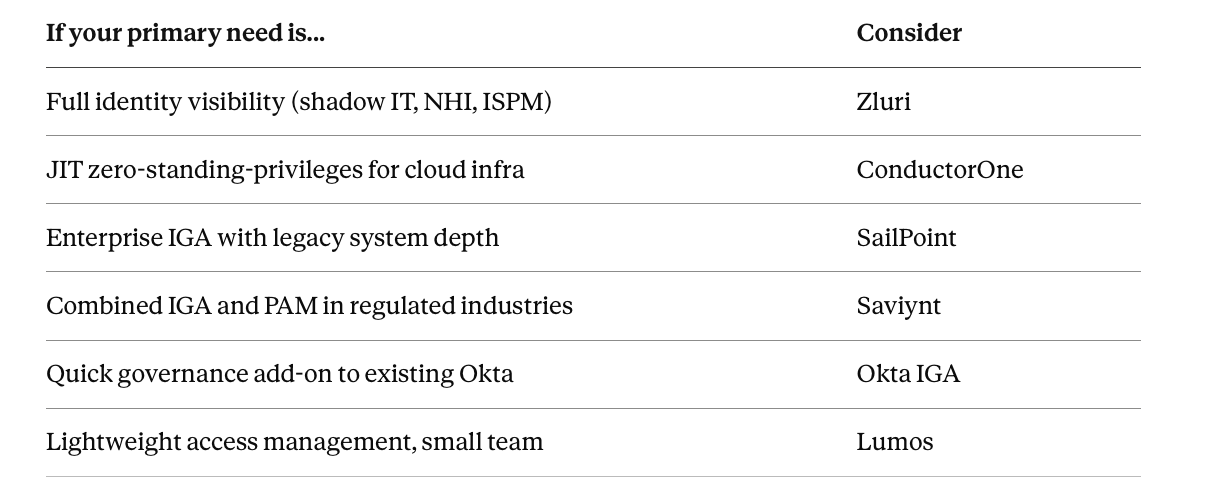
The honest version of this decision comes down to one question: how much of your actual access surface do you need to govern, and how much of it sits outside your IdP? For most organizations, the answer is more than they'd like.
A platform built on SSO-dependent discovery will leave that share unmanaged regardless of how good the certification workflow on top of it is. That's the gap Zluri was built to close.
Frequently Asked Questions
What is the biggest limitation of ConductorOne?
The most significant structural limitation is discovery scope. ConductorOne maps app access through SSO and integrated connectors, which means apps employees access outside those channels (shadow IT, tools connected via personal credentials, AI agents calling APIs directly) don't appear in discovery. Since every downstream governance capability (reviews, SoD, offboarding) only covers what discovery found, this creates a governance ceiling tied to how much of your app environment is SSO-connected. This is the gap that makes IGA incomplete without broader SaaS visibility.
Why do organizations switch from ConductorOne?
The most common reasons are: outgrowing ConductorOne's integration catalog as the stack becomes more complex; needing governance coverage for shadow IT and apps outside SSO; compliance requirements that demand audit-ready output rather than just logging; needing non-technical teams to self-serve access workflows without CLI dependency; and pricing pressure as service accounts and non-human identities are brought under governance.
Is Zluri better than ConductorOne?
For most organizations, yes, and the primary reason is discovery breadth. Zluri's eight-method discovery engine finds apps ConductorOne's SSO-dependent model misses, which means the governance that runs on top of it (reviews, SoD, offboarding, provisioning) covers a more complete access surface. ConductorOne maintains a genuine advantage for JIT access to cloud infrastructure specifically. For organizations whose primary need is broader than that, Zluri covers more of the actual problem.
Can Zluri replace ConductorOne?
Yes, for most use cases. Zluri covers the full IGA stack — identity discovery, access management, access requests, access reviews, and SoD — with broader discovery and deeper provisioning than ConductorOne for most app integrations. Understanding the full scope of what next-gen IGA covers helps clarify where the gaps in any point solution will show up.
What does ConductorOne do well?
ConductorOne does access governance well for the apps it can see. Its JIT access for cloud infrastructure (AWS, Azure, GCP) with auto-expiry and MFA is genuinely best-in-class. Its Slack and CLI-native request experience is well-designed for engineering teams. And its access certification workflows are solid and comparable to other serious IGA platforms. The limitations show up when governance needs to extend beyond what's connected to SSO, or when non-technical teams need to operate the platform day to day.
How does Zluri handle shadow IT that ConductorOne misses?
Zluri's discovery engine scans eight sources simultaneously — SSO, MDM, finance and expense systems, CASBs, HRMS, directories, and browser/desktop agents — to surface apps that never touched SSO. Once discovered, those apps aren't just reported: Zluri's governance layer can act on them, including revoking access during offboarding, flagging them for review, and applying SoD rules. Discovery without governance action is just a list — Zluri closes the loop.
What happens to shadow apps during offboarding in Zluri vs ConductorOne?
In ConductorOne, offboarding runs from a role template built on the organization's known app inventory. Apps an employee connected outside SSO during their tenure won't appear in the workflow, meaning access to those apps typically isn't revoked. In Zluri, offboarding pre-populates from the employee's actual discovered access footprint — including shadow apps — so deprovisioning covers access IT didn't formally sanction. This is the most operationally significant difference between the two platforms for organizations with meaningful shadow IT exposure.
Why is continuous posture monitoring important if I already run access reviews?
Access reviews catch problems periodically; ISPM catches them continuously. Between review cycles, access can drift: roles change, temporary access becomes permanent, over-privilege accumulates. A quarterly review running on data that's already weeks stale misses all of this. Continuous posture monitoring means risks are flagged when they emerge, not months later when the next campaign finally runs. Privilege creep in particular compounds with every role change — the longer the gap between detection and remediation, the more it accumulates.
.webp)


.svg)