
Google Workspace is usually one of the first contracts a company signs and one of the last it ever re-examines. That combination is exactly why it leaks money: everyone has a seat, seats sit on tiers nobody chose deliberately, and the suite quietly duplicates a dozen other apps you're also paying for. Here's where the waste actually hides, and how to close each leak.
Google Workspace spend has a deceptive shape. The per-seat price looks small, the tool is genuinely essential, and so the line item gets renewed on autopilot year after year. But "essential" and "optimized" are different claims. The tool being necessary says nothing about whether every seat is on the right tier, whether departed employees still hold licenses, or whether you're paying other vendors for things your Workspace plan already includes.
Because Workspace covers everyone in the company, small per-seat inefficiencies multiply by your entire headcount. A tier mismatch that wastes a few dollars per user per month is invisible on any single invoice and very visible when multiplied by 2,000 employees and twelve months.
This playbook works through the four places Workspace spend actually leaks, in the order of effort-to-savings ratio: departed users first (easiest, purest waste), tier mismatches second (biggest recurring lever), suite duplication third (savings hiding in other vendors' line items), and renewal posture last (where the first three convert into negotiating power).
The framing that makes this work: Google Workspace license optimization is not a procurement exercise, it is a visibility exercise. Every leak below is invisible in the Workspace admin console alone and obvious the moment usage data across your whole stack sits in one place.
Leak 1: Licenses Held by People Who Left
The purest form of waste: paying for seats attached to people who no longer work for you. It happens for a mundane reason. Offboarding checklists focus on revoking access (a security task), and license reclamation (a finance task) belongs to nobody. The account gets suspended, the license stays assigned, and the invoice never changes.
There is also a Workspace-specific wrinkle: suspended users still consume paid licenses. Suspension is a security action, not a cost action. Unless the license is explicitly removed or the user deleted (after data transfer), you keep paying. Companies that suspend-and-forget accumulate a layer of paid, dormant seats that grows with every departure.
The fix is process, not heroics: make license reclamation an explicit step in offboarding, with data transfer handled first and the seat released after. This is exactly where lifecycle automation pays for itself. When deprovisioning runs as an automated workflow triggered by the HRMS, the license comes back into the pool the same day the person leaves, every time, without anyone remembering to do it.
Leak 2: The Wrong Tier for the Actual Usage
The biggest recurring lever, because it applies to seats you genuinely need. Workspace pricing climbs through tiers (Business Starter, Standard, Plus, and Enterprise plans), and each step up buys more storage, larger meetings, recording, and progressively deeper security and compliance controls. The waste pattern is always the same: the company standardizes on one tier for everyone, chosen for the needs of its most demanding users.
But usage is never uniform. The security team may genuinely need Enterprise-grade controls. The warehouse staff, frontline teams, and half of operations may use email, calendar, and Docs, and nothing else. Paying the top-tier delta across every seat to cover the needs of ten percent of them is the single most common Workspace overspend, and it compounds silently at every headcount increase.
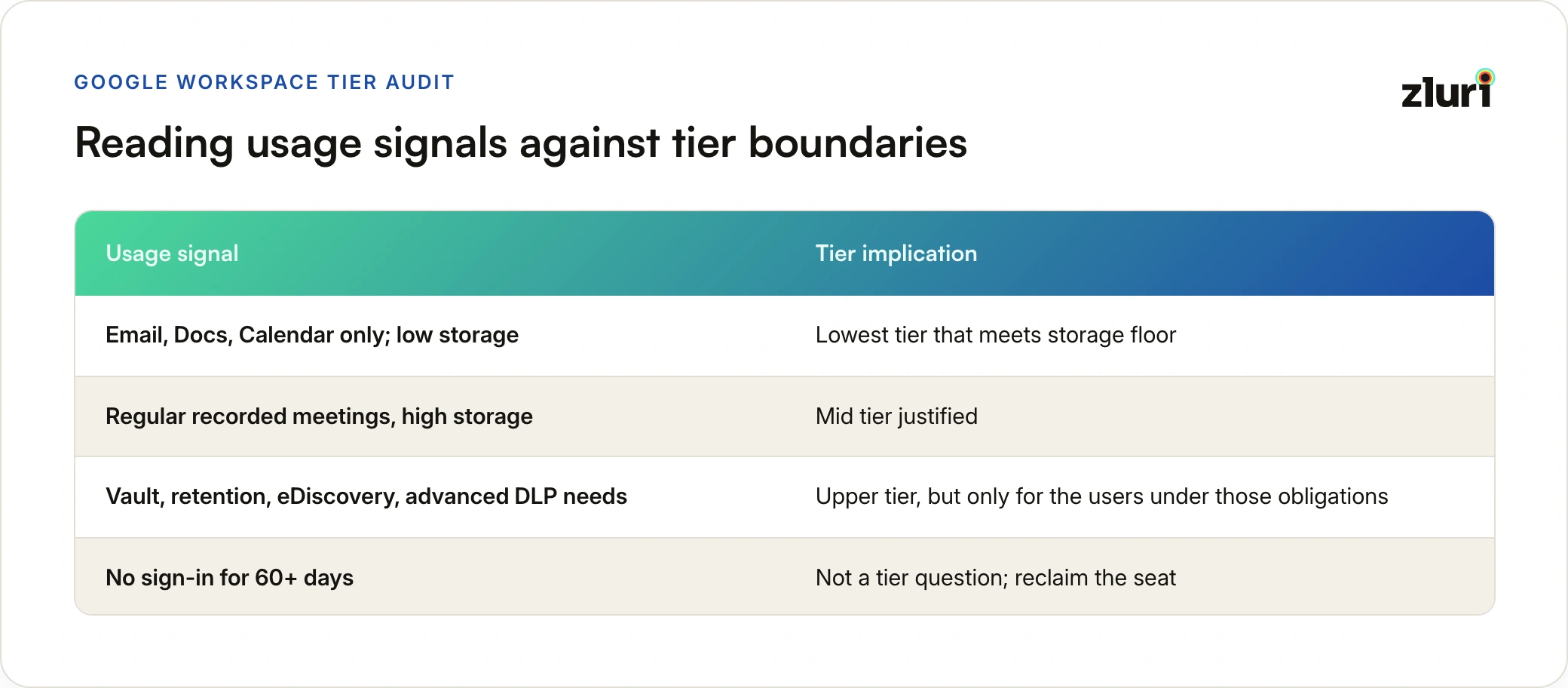
The fix is a usage-based tier audit: for each feature that justifies a tier step (meeting recording, storage consumption, advanced endpoint management, Vault and retention needs), identify who actually uses it, and move everyone else down. Mixed-tier assignment is fully supported; the only reason companies run uniform tiers is that nobody has the per-user usage data to defend a split. That data is precisely what a SaaS management layer provides: feature-level and frequency-level usage per user, so the tier map follows evidence instead of a three-year-old procurement decision.
Leak 3: Paying Twice for What the Suite Includes
The savings that hide in other vendors' invoices. Workspace bundles storage (Drive), video conferencing (Meet), spreadsheets (Sheets), documents, chat, and forms into every seat you already pay for. Meanwhile, teams across the company independently sign up for Dropbox, Box, Airtable, Notion, and standalone conferencing tools that overlap those functions heavily.
None of this shows up as a "Workspace problem," which is why it survives. The duplicate spend sits in expense reports and departmental credit cards, invisible to whoever owns the Workspace contract. Finding it requires discovery across the whole stack: Zluri's discovery engine surfaces these overlapping apps through eight methods (SSO and IdPs, direct integrations, HRMS, MDM, finance systems, CASBs, directories, and browser extensions), which is what catches the tools that never touched SSO and only exist as a recurring charge on someone's corporate card.
The decision that follows discovery is genuinely case-by-case: sometimes the overlapping tool earns its keep (a team's Airtable workflow may do things Sheets shouldn't be forced to do), and sometimes it is pure redundancy plus an unmanaged data location. The point is not "consolidate everything into Google." The point is that the decision should be made deliberately, with usage data, instead of never being made at all.
Leak 4: Renewal Without Leverage
Everything above converts into money at one moment: the renewal. Walk in without data and the conversation is the vendor's list price against your hope for a discount. Walk in with twelve months of usage evidence and the conversation changes shape. You know exactly:
- How many seats you actually need (headcount minus reclaimed)
- What tier mix reflects reality, not a three-year-old procurement decision
- What the suite-duplicate consolidation did to your dependency on the product
Two practical mechanics matter here. First, never let the renewal arrive as a surprise: Zluri's renewal calendar alerts at 30, 15, and 7 days out for contracts, which is enough runway to run the tier audit before the negotiation instead of after. Second, right-size before you renew, not after: seat counts and tier commitments lock in at signature, and the vendor has no incentive to revisit them mid-term.
Deeper coverage of the negotiation mechanics themselves lives in our broader SaaS license management guide; the Workspace-specific point is simply that this contract, because it touches every employee, rewards preparation more than almost any other renewal on your calendar.
What This Looks Like in Practice
The working loop, once established, is simple: continuous discovery keeps the app and license inventory current, per-user usage data keeps the tier map honest, lifecycle automation returns seats to the pool on every departure, and the renewal calendar makes sure the evidence gets used at the moment it has leverage. The first pass through this loop is where the dramatic findings surface (the suspended-user layer, the uniform-tier overspend); after that, optimization stops being a project and becomes a property of how the stack is run. For the fuller mechanics behind this loop, see how Zluri helps with software license management.
The same loop applies to every major contract in the stack, not just Workspace; we've written companion playbooks for Zoom and Salesforce licenses, each of which leaks in its own characteristic ways.
Frequently Asked Questions
Do suspended Google Workspace users still consume paid licenses?
Yes. Suspension blocks sign-in but keeps the license assigned and billed. To stop paying, the license must be removed or the user deleted, after transferring their data. This is one of the most common sources of silent Workspace waste.
Can different employees be on different Google Workspace tiers?
Yes, mixed-tier assignment is supported. Most organizations run a uniform tier only because they lack per-user usage data to justify a split. A usage-based audit typically shows a large share of users need less than the tier they hold.
How do I find apps that duplicate what Google Workspace includes?
Through stack-wide discovery rather than the Workspace console. Overlapping tools (storage, conferencing, spreadsheets) usually enter through individual signups and expense reports, so they only surface when discovery covers finance systems and other sources beyond SSO.
When should Google Workspace license optimization happen?
Continuously for reclamation (tied to offboarding), and as a deliberate audit 30 to 60 days before renewal, so the corrected seat count and tier mix are in hand before commitments lock in for another term.
What usage data justifies a tier downgrade?
Feature-level signals tied to tier boundaries: whether the user records meetings, their actual storage consumption, and whether they fall under retention or eDiscovery obligations. Users showing none of these signals are candidates for the lowest tier that meets their storage needs.


.svg)