

User access management fails in predictable places: the applications nobody knows exist, the role changes nobody acts on, the offboarding that revokes what someone remembers rather than what's actually there, and the audit that asks for proof nobody can produce. Zluri is built around those exact failure points, and this piece walks through how, one by one.
User access management is the discipline of controlling how access to applications and systems gets granted, changed, and removed as people join, move through, and leave an organization. Every organization does it; the question is whether it happens through a system or through whoever picked up the ticket.
Zluri's answer lives in the Access Management and Access Requests modules of its IGA product, alongside Access Reviews and Segregation of Duties, so the granting side and the checking side ship as one product. What follows maps each major access management problem to what Zluri specifically does about it.
Problem 1: You Can Only Manage the Access You Can See
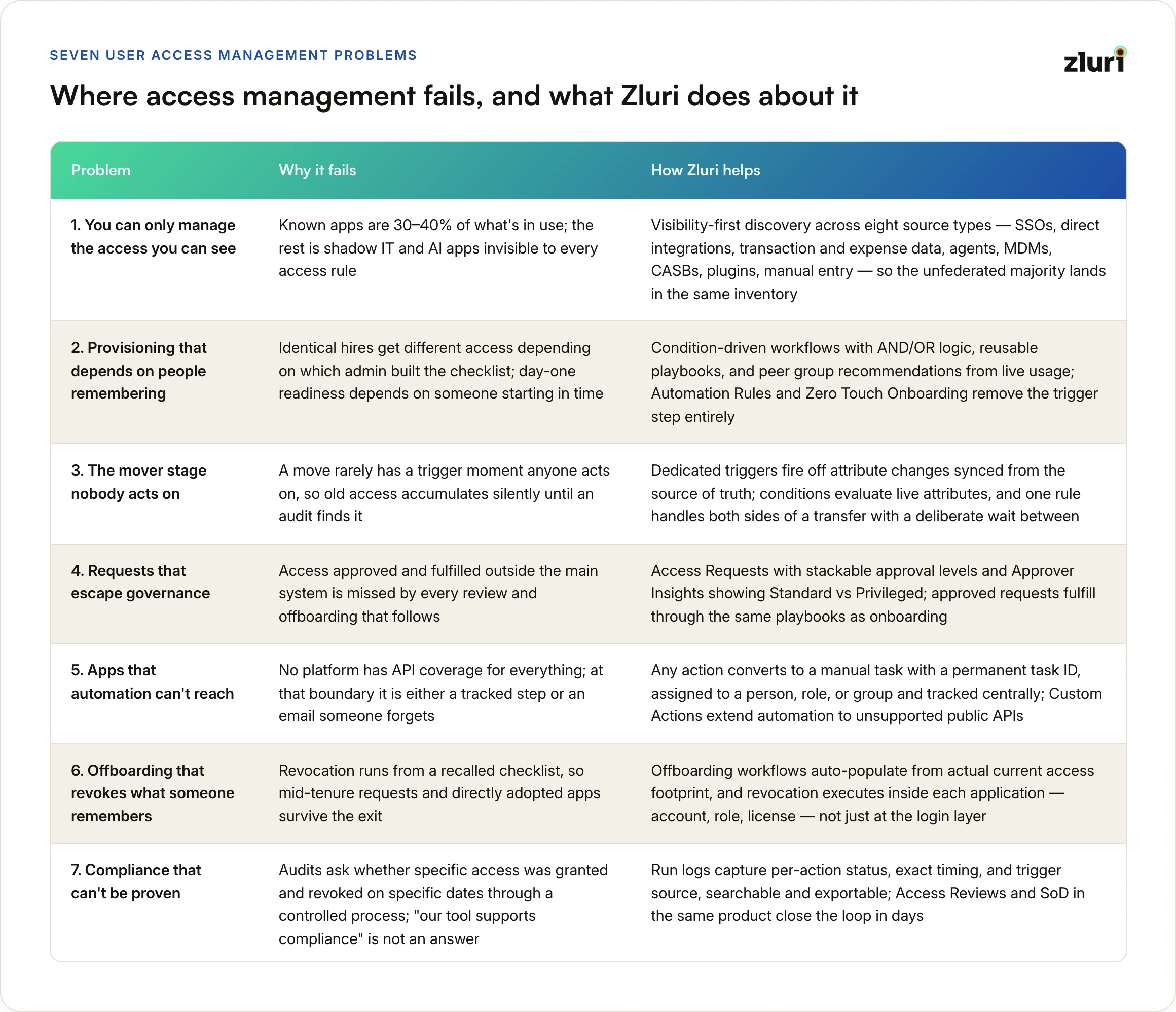
Every access management tool governs the apps it knows about. The catch: the apps an organization knows about are generally just 30 to 40% of the SaaS apps actively in use. The rest is shadow IT, SaaS and, increasingly, AI apps bought directly by teams, departments, and individuals without IT involvement, carrying company data from day one and invisible to every access rule built around the sanctioned stack.
How Zluri helps: a visibility-first approach, the only one in the category. Discovery pulls from eight independent source types, SSOs, direct integrations, transaction and expense data, agents, MDMs, CASBs, plugins, and manual entry, so the unfederated majority of the estate lands in the same inventory as the sanctioned fraction. The access you manage becomes the access that actually exists.
Problem 2: Provisioning That Depends on People Remembering
Manual provisioning is inconsistent by nature: identical hires end up with different access depending on which admin built the checklist, and day-one readiness depends on someone starting the process in time.
How Zluri helps: the full grant runs through condition-driven workflows, evaluated at two levels (whether an entire application applies to a person, and whether a specific action inside it does), with AND/OR logic across department, role, location, and status. Workflows convert into reusable playbooks so "Sales onboarding" means the same thing for the fiftieth hire as the first, and recommendations come from peer group intelligence, what people in the same role, department, and location actually use, drawn from live usage data rather than a static template.
The trigger itself is removable: Automation Rules fire playbooks off defined events, and Zero Touch Onboarding connects directly to the HR platform so the hire date already sitting there starts the sequence, no marking step, no ticket, no one remembering. The full mechanics are covered in the module overview.
Problem 3: The Mover Stage Nobody Acts On
Role changes and department transfers are where access drifts furthest, because unlike a join or an exit, a move rarely has a trigger moment anyone acts on. Old access accumulates silently until an audit finds it.
How Zluri helps: movers get dedicated mechanics rather than a workaround. Dedicated triggers fire automation directly off attribute changes synced from the source of truth, a department change, a designation change, a reporting manager change. Conditions evaluate against live attributes, so a rule behaves correctly for someone promoted eighteen months in, not just for a new hire. And a single automation rule can handle both sides of a transfer, deprovisioning what the old department justified and triggering the new department's playbook, with a deliberate wait between the two.
Problem 4: Requests That Escape Governance
Mid-tenure access needs are inevitable. The failure is what happens after approval: a request fulfilled manually or through a disconnected tool becomes access the main system doesn't know about, missed by every review and offboarding that follows.
How Zluri helps: self-service requests flow through the Access Requests module with defined approval logic, multiple stackable levels for sensitive grants, and Approver Insights putting real context in front of the approver, including whether the requested access level is Standard or Privileged, rather than leaving that judgment to their read of the request. Approved requests fulfill through the same playbook infrastructure as onboarding, so requested access carries the same record and gets caught by the same offboarding and reviews, regardless of how it was originally granted.
Problem 5: Apps That Automation Can't Reach
No platform has API coverage for everything, and the honest question is what happens at that boundary: a tracked step, or an email someone forgets.
How Zluri helps: any action converts to a manual task assigned to an individual, a Zluri role, or a group (where any member can pick it up), notified by email, Slack, or a Jira ticket, and tracked through a central dashboard with a permanent task ID that survives reassignment. The non-automatable path stays inside the same auditable system as the automated one. For apps with a public API that Zluri doesn't support natively, Custom Actions extend automation there too, reusable across every playbook once built.
Problem 6: Offboarding That Revokes What Someone Remembers
The classic offboarding failure is completeness: revocation runs from a checklist of what someone recalls granting, and everything granted outside that memory, the mid-tenure request, the directly adopted app, survives the exit.
How Zluri helps: offboarding workflows auto-populate from the person's actual current access footprint, which is the payoff of the lifecycle being accurately maintained through every stage before it, and of discovery covering the estate beyond SSO. Revocation executes inside each application, account, role, license, not just at the login layer, with the same conditions, approvals, and manual-task fallback as granting.
Problem 7: Compliance That Can't Be Proven
The question a SOX, HIPAA, or PCI DSS audit actually asks is whether specific access was granted and revoked on specific dates through a controlled process. "Our tool supports compliance" is not an answer; an artifact is.
How Zluri helps: every execution, automated or manual, lands in run logs with per-action status, exact timing, and the trigger source recorded, searchable and exportable. Manual tasks carry the same rigor through permanent task IDs and full status history. And because Access Reviews and Segregation of Duties sit in the same IGA product, the certification evidence and the provisioning evidence come from one system, with review findings feeding directly back into fixing the upstream workflows, the governance loop closed in days rather than across a quarterly export between tools.
What This Looks Like Put Together
A new Sales hire gets entered in the HRMS with a start date; Zero Touch Onboarding fires the Sales playbook, staged across the days before day one, and every grant lands in the run log. Eighteen months later a promotion changes their designation in the HR system; a mover trigger deprovisions what the old role justified and provisions what the new one requires. A mid-tenure request for a design tool routes through approval with privileged-versus-standard context shown to the approver, and fulfills through the same playbooks. At exit, offboarding populates from their real footprint, including the two apps discovery surfaced that never touched SSO, and the auditor six months later gets an exported log for every one of those events.
That's user access management as a running system rather than a set of intentions, and it deploys in weeks: standard integrations go live in 2 to 4 weeks, with custom enterprise connectors at 4 to 8.
Frequently Asked Questions
Which Zluri product does user access management live in?
The Access Management and Access Requests modules of Zluri's IGA product, alongside Access Reviews and Segregation of Duties. The granting side and the checking side ship together, which is what lets review findings fix provisioning workflows directly rather than crossing a tool boundary.
Does Zluri replace our identity provider or SSO?
No. Zluri consumes identity data from the existing identity provider as one source of truth and governs authorization and lifecycle on top of it, and it runs SSO-level actions (like Okta group assignments) inside the same workflows. SSO stays exactly where it is; Zluri is the access management layer above it.
How does Zluri handle access for apps IT never sanctioned?
Discovery surfaces them first, from eight source types including expense data and browser signals, so shadow SaaS and AI apps enter the same inventory as sanctioned ones. From there the same governance applies: authorization status, ownership, access visibility, and inclusion in offboarding and reviews.
How long does Zluri take to implement?
Standard integrations go live in 2 to 4 weeks. Custom enterprise connectors for bespoke or homegrown systems run 4 to 8 weeks. Implementation time matters directly, since every month spent deploying is a month the access gaps the tool was bought to close stay open.


.svg)