.png)


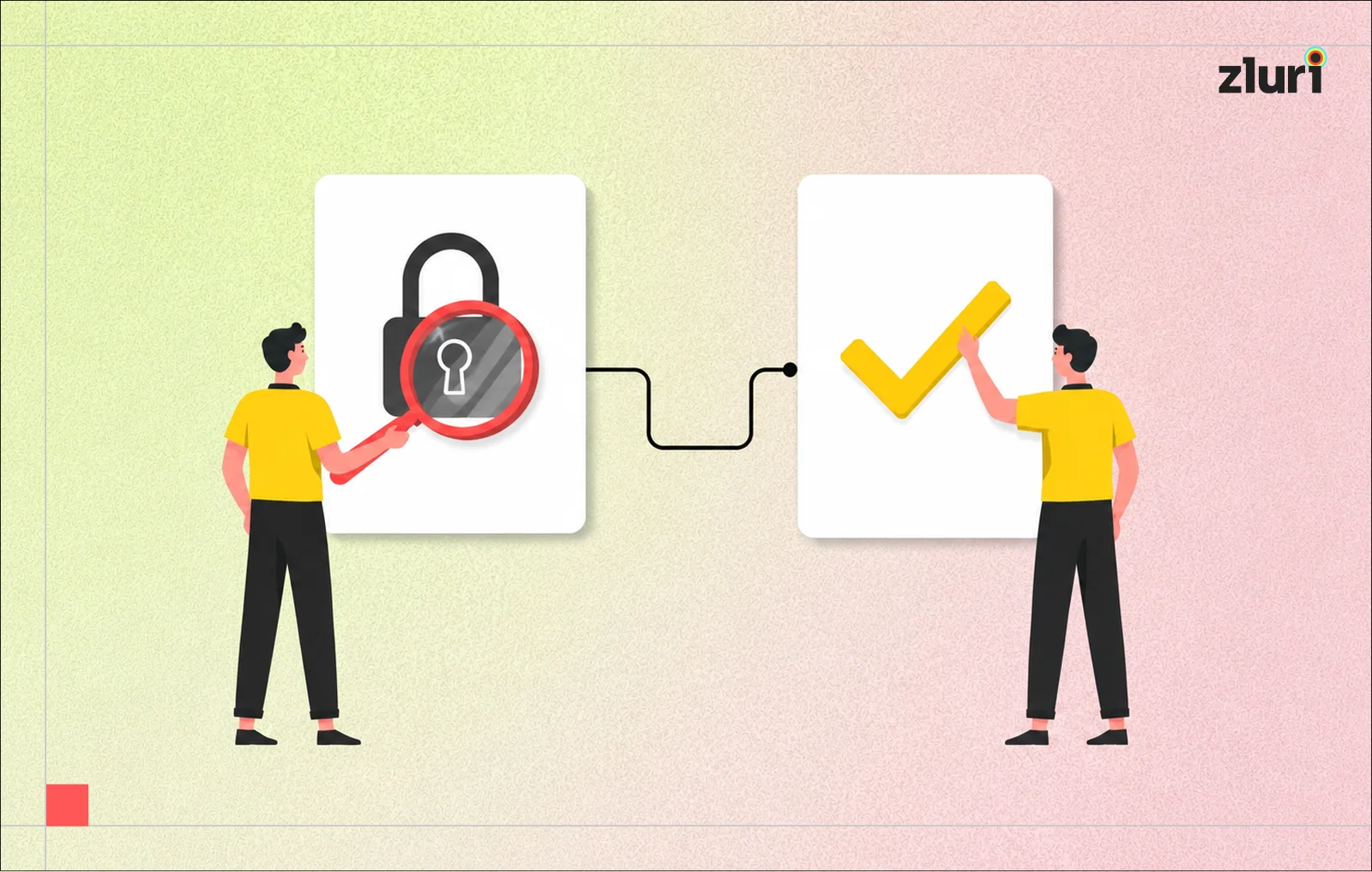

Most access reviews only need one qualified person to look at a record and make a call. Some access doesn't work that way, a single reviewer's judgment isn't enough evidence that a privileged grant is safe, and one person's oversight or bias can push something through that should have been caught. Multi-level access review is the structural answer to that gap: more than one reviewer, in sequence, each bringing independent judgment before access is confirmed.
What a Multi-Level Access Review Actually Is
A multi-level access review requires sequential sign-off from more than one reviewer before a certification is considered complete. It goes by a few names depending on the organization and the platform, multi-level review, tiered review, escalated review, staged certification, but the underlying structure is the same: a record isn't fully reviewed until every configured reviewer, in order, has independently signed off on it.
This is distinct from simply notifying multiple people about the same access decision. A multi-level review is a sequence, not a broadcast. Each reviewer in the chain sees the record, and typically the prior reviewer's decision, before making their own independent call.
The Principle Behind It: More Eyes, Different Judgment
Multi-level review borrows its logic from a much older idea in security and finance: the four-eyes principle, sometimes called the two-person rule or maker-checker in banking and audit contexts. The premise is simple, no single person should be able to unilaterally approve something significant enough that getting it wrong causes real damage. Requiring a second, independent reviewer reduces the odds that one person's mistake, bias, or oversight goes unchecked.
Applied to access governance, the same logic holds. A manager approving continued access to a system knows whether someone's role still justifies it. A security or compliance reviewer knows something different, whether that access represents acceptable risk regardless of the operational justification. Neither perspective alone is complete. Multi-level review exists to combine them deliberately, rather than relying on whichever single reviewer happened to be assigned the record.
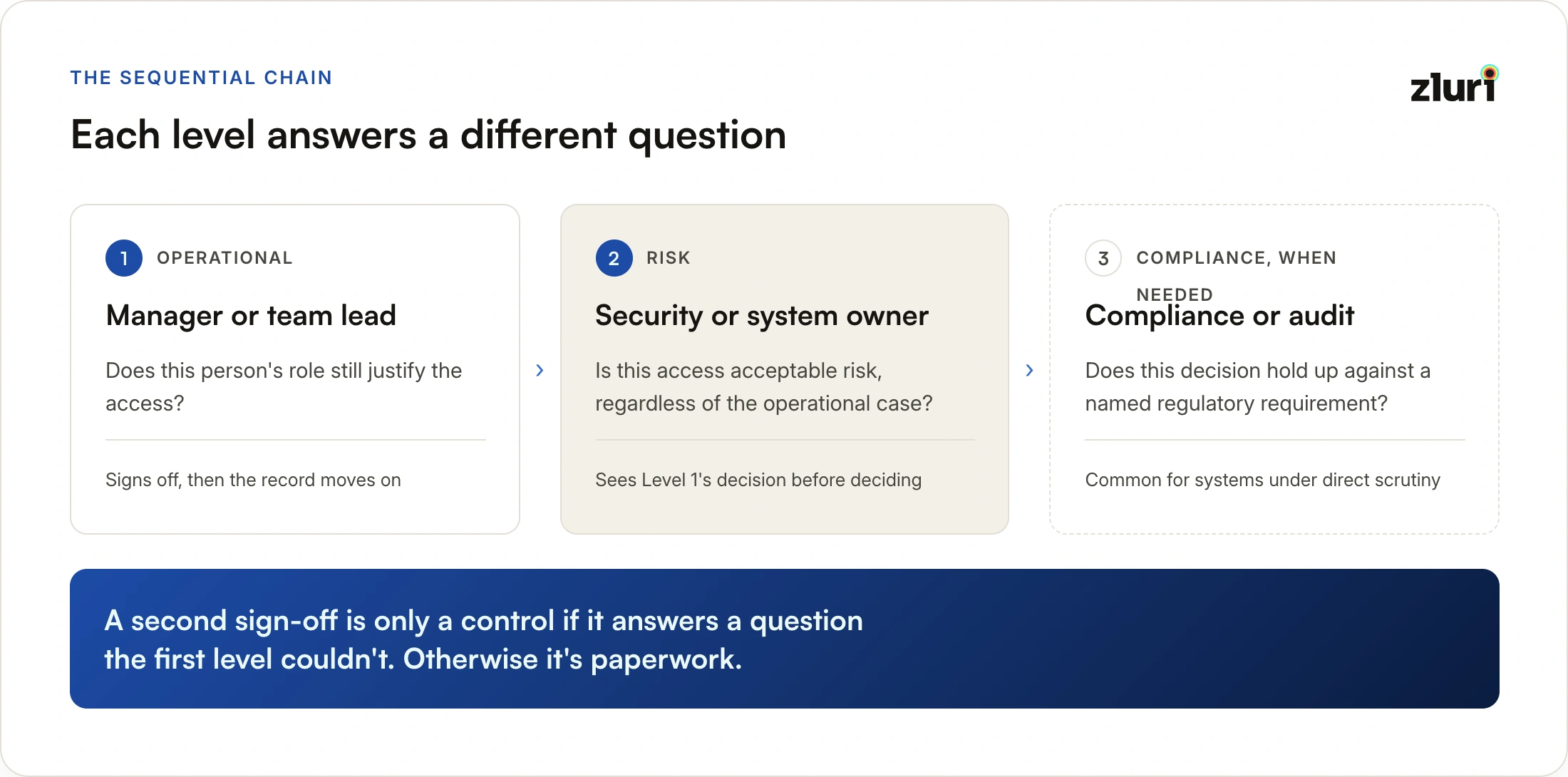
The critical word is independent. Adding a second reviewer only helps if that reviewer is actually evaluating the record with a different lens, not simply agreeing with whatever the first reviewer already decided. A second sign-off that rubber-stamps the first isn't a control, it's paperwork.
Sequential vs. Parallel Review
Organizations building out layered review processes generally land on one of two structures, and the difference matters more than it might first appear.
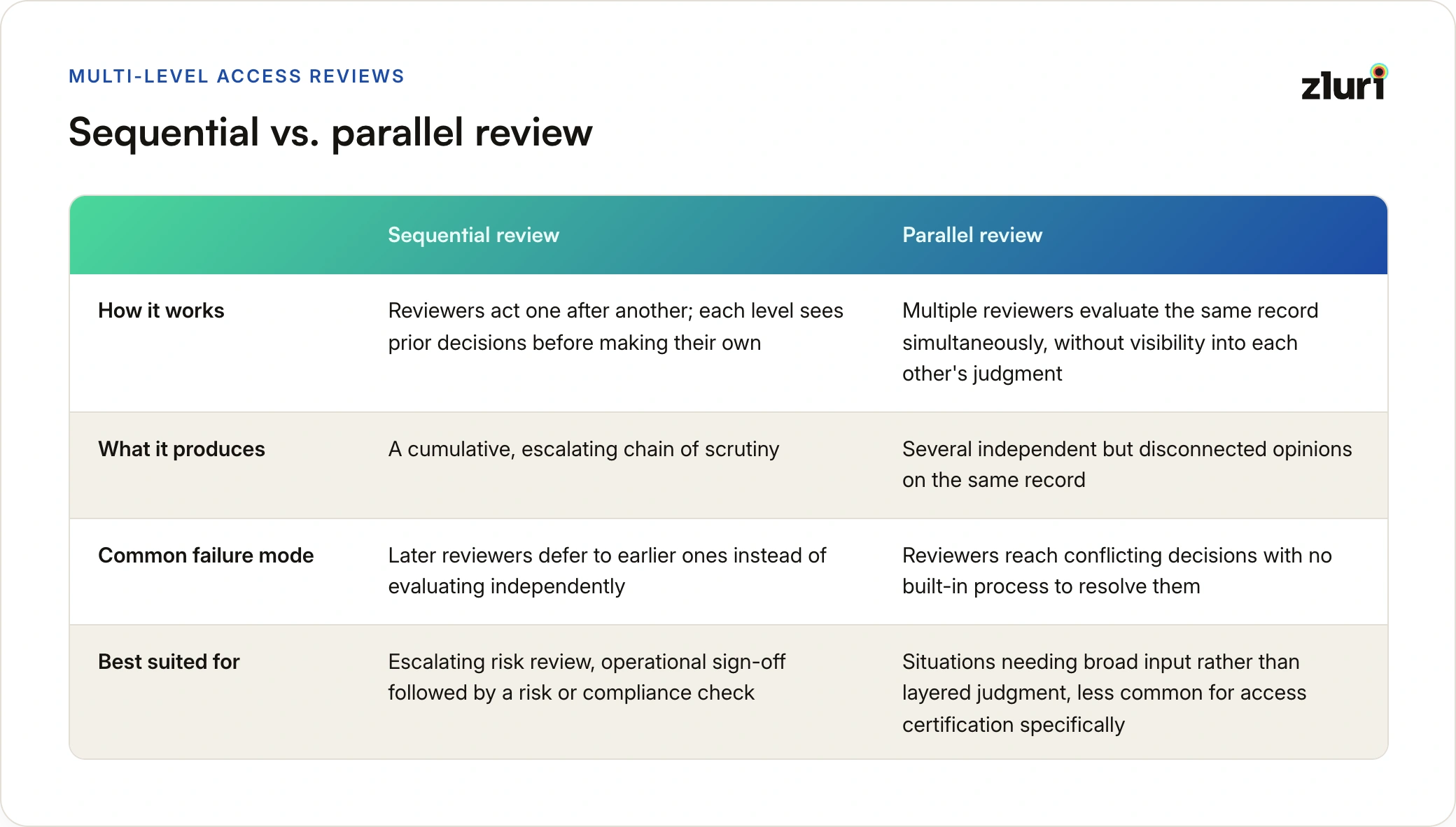
Most mature multi-level access review programs use the sequential model, specifically because it lets each subsequent reviewer build on the context already established, rather than starting from zero or working in a vacuum. A security reviewer who can see that a manager already confirmed operational need can focus entirely on the risk question, instead of re-litigating whether the person's role justifies the access in the first place.
When Multi-Level Review Is Actually Worth It
Multi-level review adds friction, more people, more time, more coordination, so it needs to earn its place. The clearest fits:
Privileged or admin-level access to business-critical systems. Anything where the access itself, if misused or simply left unnecessarily in place, could cause outsized damage.
Financial systems and revenue-affecting access. Controls frameworks like SOX are frequently built around the expectation that no single person can both grant and validate access to systems touching financial reporting.
Systems holding regulated data. Cardholder data under PCI DSS, health information under HIPAA, personal data under GDPR, these are the categories where auditors specifically look for evidence of layered, not single-reviewer, validation.
Access following a significant organizational change. After a reorg, a merger, or a major role change, a single reviewer's institutional knowledge is often stale. A second reviewer with a different vantage point catches what the first one might reasonably miss.
How Many Levels Is Actually Enough
There's a strong temptation, once multi-level review exists as an option, to apply it broadly "to be safe." In practice, most well-run programs converge on two or three levels, rarely more:
.webp)
Two levels is the most common configuration: an operational reviewer (a manager or app owner confirming the access still makes business sense) followed by a risk-focused reviewer (security, compliance, or a system owner confirming the access is acceptable regardless of operational justification).
Three levels typically adds a compliance or audit-specific sign-off, common for systems under direct regulatory scrutiny, where the third reviewer isn't re-checking operational or general risk judgment, but specifically validating the decision against a named compliance requirement.
Beyond three or four levels, the marginal value drops fast. Each additional level adds coordination overhead and the same rubber-stamp risk described above, reviewers further down a long chain tend to assume "someone already caught anything wrong," which defeats the purpose of requiring independent judgment at every stage.
Where Multi-Level Reviews Fall Short
They don't fix a bad underlying access model. Running a privileged, over-broad grant through three reviewers doesn't make the grant appropriately scoped, it just adds more people confirming something that arguably shouldn't exist in that form to begin with. Multi-level review is a validation control, not a substitute for good access design.
Independence gets hard to maintain in small or flat organizations. A team without enough distinct, qualified reviewers for a given system ends up forcing awkward workarounds, or quietly collapsing into a single decision-maker wearing two hats, which undermines exactly the guarantee the structure is meant to provide.
It slows down review cycles. More reviewers means more coordination and more time to close a certification. Applied indiscriminately, this turns access reviews from a periodic check into a persistent operational bottleneck, with no proportional gain in security for the low-risk access caught in the same net.
Reviewer fatigue compounds with each added level. The further down the chain, the easier it becomes to treat a sign-off as a formality rather than a genuine evaluation, particularly if earlier levels have a strong track record of catching real issues and later reviewers start assuming that pattern will continue.
Making Multi-Level Reviews Actually Work
Reserve it for a defined, risk-tiered population. Multi-level review should be the exception applied deliberately to the access that warrants it, not a default configuration turned on broadly.
Pair genuinely different perspectives at each level. Two reviewers with the same operational context add a second signature, not a second opinion. Combine operational reviewers with risk- or compliance-focused ones so each level actually contributes something the others can't.
Make the purpose of each level explicit. A reviewer who understands exactly what question they're supposed to be answering, "you're checking risk, not re-confirming operational need", is less likely to treat their sign-off as a rubber stamp.
Revisit the list of what requires multi-level review periodically. Risk profiles shift. A system that warranted three reviewers two years ago might not anymore, and something that started as single-reviewer might need to be escalated. Treat the scope of multi-level review itself as something to reassess, not a permanent setting.
Multi-Level Reviews and Compliance Frameworks
Most major compliance frameworks don't mandate the specific mechanics of multi-level review, but several create strong practical pressure toward it:
- SOX generally expects segregation between who grants access and who validates it, especially for systems touching financial reporting
- PCI DSS expects layered validation for access to cardholder data environments, beyond a single administrator's say-so
- SOC 2 auditors commonly look for evidence that privileged access decisions involve more than one accountable reviewer
- ISO 27001 frames access control review as an ongoing management responsibility, which in practice pushes organizations toward more rigorous, often multi-party, validation for higher-risk access
None of these frameworks require a specific number of levels. What they consistently expect is evidence that sensitive access wasn't validated by a single, unchecked decision-maker, which is precisely the gap multi-level review is built to close.
For a look at how one platform implements this mechanically, reviewer resolution, fallback logic, and sign-off sequencing, see how Zluri handles multi-level access reviews.
Frequently Asked Questions
What's the difference between multi-level access review and segregation of duties?
They're related but not identical. Segregation of duties (SoD) is about preventing any single person from holding a combination of standing access that lets them execute and approve the same transaction unilaterally, it's a property of what access someone holds. Multi-level review applies a similar principle to the review process itself, ensuring no single reviewer can unilaterally validate access on their own, regardless of what standing entitlements the person under review holds.
Is multi-level review the same as the four-eyes principle?
Conceptually, yes. The four-eyes principle (also called the two-person rule or maker-checker) is the general security concept, that no single individual should be able to unilaterally approve something significant. Multi-level access review is that principle applied specifically to access certification.
How many reviewer levels should a certification actually have?
Most effective programs use two or three. Two levels (operational plus risk-focused) covers the majority of cases that warrant escalation at all. A third, compliance-specific level is common for systems under direct regulatory scrutiny. Beyond that, additional levels tend to add coordination cost without a proportional increase in genuine scrutiny.
Does every access review need multiple levels?
No, and treating multi-level review as a default is a common mistake. Most access doesn't carry enough risk to justify the added coordination. It's best reserved for a deliberately narrow, risk-tiered population, privileged access, regulated systems, and access following major organizational change.
What's the difference between sequential and parallel multi-reviewer processes?
Sequential review has each reviewer act in order, seeing prior decisions before making their own, which produces a cumulative chain of scrutiny. Parallel review has reviewers evaluate the same record simultaneously without visibility into each other's judgment, which can produce disconnected or conflicting opinions with no built-in resolution process. Most access certification programs favor sequential review for exactly this reason.
Who should be the second (or third) reviewer in a multi-level chain?
It depends on what the earlier level already covers. If the first reviewer is confirming operational need (a manager or team lead), the second is typically someone evaluating risk independent of operational justification, a security team member, a system or application owner, or a compliance stakeholder for regulated systems. The goal is coverage of a different question, not a second person answering the same one.