
An employee transfers from Marketing to Sales in week two of the quarter. They get their Sales tools immediately, and keep every Marketing permission for the next ten weeks, until the quarterly review finally notices. Event-driven access reviews exist to close exactly that window: certifications triggered by the identity change itself, not by the calendar. Here's how they compare to periodic reviews, and why mature programs run both.
An employee transfers from Marketing to Sales in week two of the quarter. They get their Sales tools immediately. They also keep every Marketing permission they had, the analytics platform, the ad accounts, the campaign folders, for the next ten weeks, until the quarterly review finally notices.
Nothing about this is a process failure. The quarterly review ran exactly as designed. The problem is the design: a calendar-based control applied to risk that arrives on its own schedule.
Event-driven access reviews are the answer to that mismatch: certifications triggered automatically when a specific identity change occurs, a role change, a department transfer, a departure, rather than when a date arrives. They don't replace periodic reviews. They cover the window periodic reviews, by design, can't.
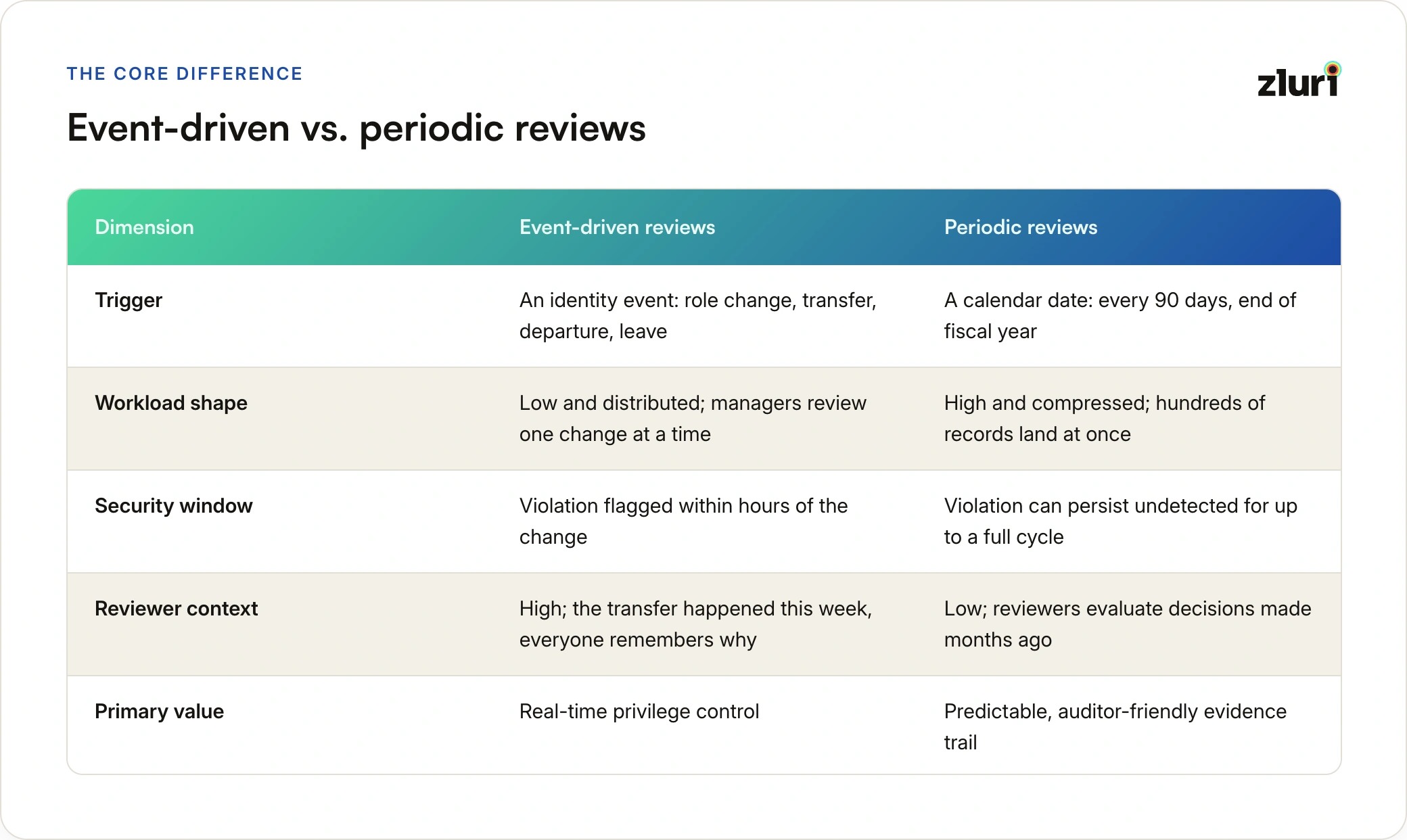
The Core Difference
The distinction is the trigger. A periodic review runs because a date arrived; an event-driven review runs because something changed. Everything else that separates them, workload shape, context quality, security exposure, follows from that one difference: periodic reviews compress a quarter's worth of decisions into one high-volume campaign reviewed months later, while event-driven reviews distribute decisions to the moment each change happens, when the reviewer still remembers why.
Where Periodic Reviews Are Strong, and Where They Break
Periodic reviews are the traditional backbone of access governance, and for good reason: they're what compliance frameworks were written around. SOC 2, SOX, ISO 27001, and PCI DSS all expect periodic review in some form, and auditors favor them because a sequence of completed, dated review cycles is clean, predictable evidence that access control is enforced.
They also provide something event-driven reviews can't: a comprehensive baseline. A full periodic sweep catches the anomalies no trigger was configured for, the manual override someone made in an admin console, the orphaned account from a system that isn't integrated, the access granted before the automation existed.
The breakdown is in two built-in weaknesses:
The exposure window. Anything that goes wrong the day after a review closes sits unexamined until the next cycle opens. On a quarterly cadence, that's up to 90 days of undetected drift; on an annual cadence for lower-tier apps, it's a year.
Reviewer fatigue. Compressing every decision into one campaign means managers receive hundreds of access lines at once, most of them unchanged from last cycle. Volume produces rubber-stamping: "Approve All" isn't reviewer laziness, it's the rational response to a list too large to genuinely evaluate. The result is a completed review that certified very little.
What Event-Driven Reviews Actually Trigger On
An event-driven review listens to your HRIS and identity provider for the changes that actually move risk, and launches a scoped certification the moment one fires. The triggers worth configuring:
- Role changes and promotions. New responsibilities usually mean new access, and old access that should go. A triggered review certifies both directions of the change.
- Department transfers. The classic mover problem: new-department access gets granted immediately, old-department access lingers indefinitely. A transfer-triggered review flags the old permissions for revocation while the transfer is still fresh in everyone's mind.
- Departures and contract endings. Offboarding automation handles the apps it knows about; a departure-triggered review catches what it missed, access granted manually, through an unmapped group, or in a system that isn't fully integrated.
- Extended leave. Parental leave or sabbatical shouldn't leave privileged access active and unmonitored for months. A leave event can trigger suspension or review of sensitive access until return.
- High-risk anomalies. Access to sensitive environments from an unusual location or unmanaged device can trigger an immediate scoped review of that account, turning the review program into a response mechanism, not just a hygiene practice.
The common thread: each trigger produces a small, high-context review. One person, one change, one decision, made by a reviewer who knows exactly what just happened. That's the inverse of the periodic model's volume problem, and it's why event-driven reviews largely escape the rubber-stamping that erodes calendar-based campaigns.
This is also the model that actually stops privilege creep. Creep is the accumulation of small, individually reasonable grants over an employee's tenure; a control that only looks quarterly sees the accumulation after it's happened. A control that fires on every role change interrupts the accumulation at each step.
Applying the Two Models Across Entity Types
The trigger-versus-calendar question runs across all three certification scopes. User-based reviews trigger on HR events (a transfer, a promotion, a risk flag) and run periodically for high-risk populations like contractors and admins. App-based reviews trigger on application configuration changes (external sharing enabled, a compliance status drop) and run periodically on a risk-tiered cadence, which is the classic SOC 2 and SOX audit pattern. Group-based reviews trigger on directory changes (a manual add to an admin group, a membership spike) and run periodically as identity-hygiene cleanup. The matrix:
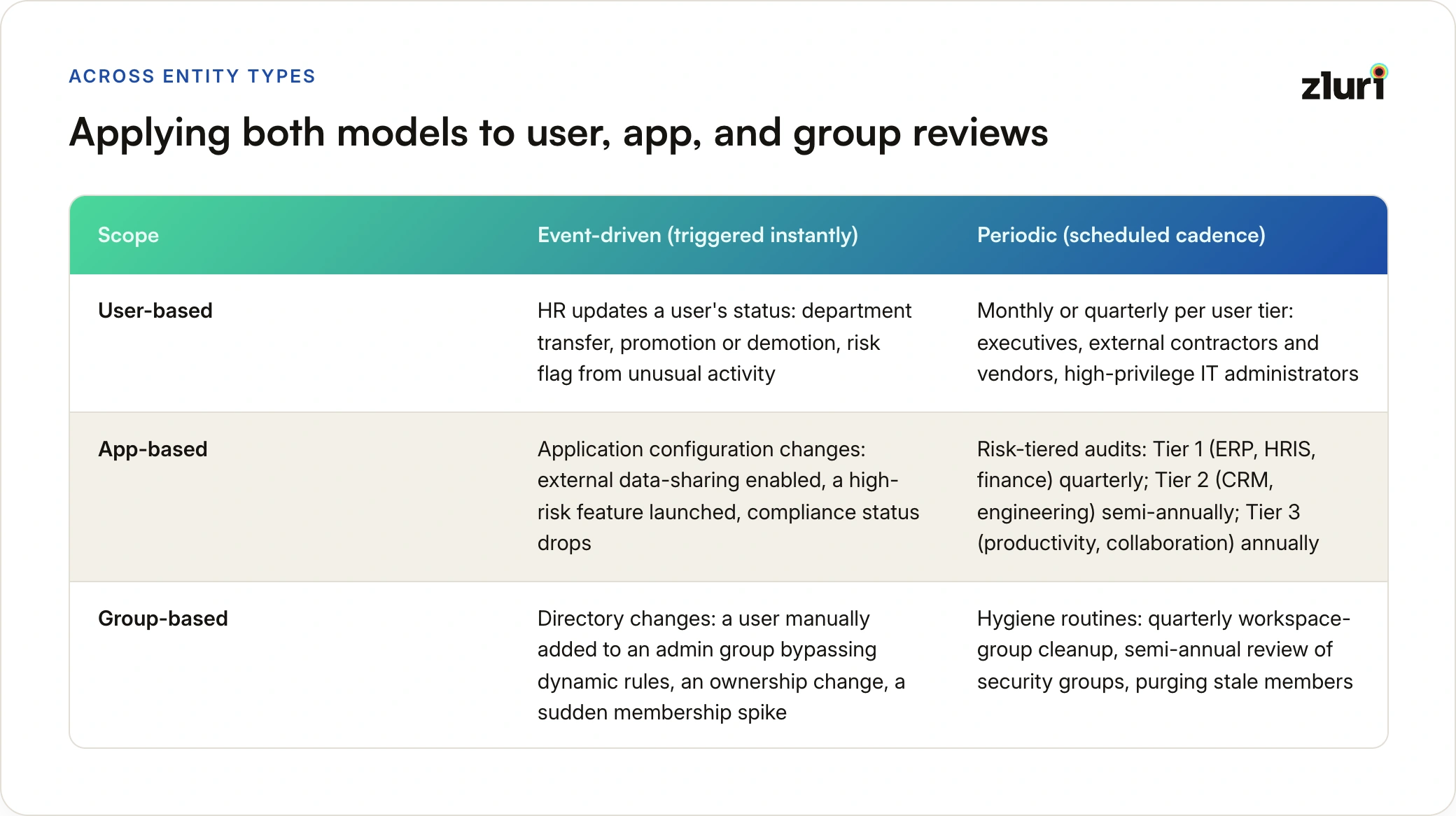
The scenario mapping follows naturally. User-based reviews with event triggers handle the daily joiner-mover-leaver shifts, one person, one change, one immediate decision. Application-based reviews on a periodic cadence satisfy external auditors, since a quarterly certification of the financial system is exactly the evidence SOC 2 and SOX expect. And group-based reviews split both ways: an event trigger catches the manual admin-group add the moment it bypasses your dynamic rules, while the periodic cleanup catches the membership bloat that accumulates gradually with no single triggering event.
Where Event-Driven Reviews Fall Short
The model is stronger in theory than a naive rollout is in practice. Each benefit carries a hidden risk on its other side: real-time revocation depends entirely on upstream HR data quality, distributed micro-reviews can decay into year-round alert fatigue, a continuous posture can confuse auditors trained on point-in-time reports, and high-volume event bursts can hit the API limits of the very apps being governed. The trade-off matrix:
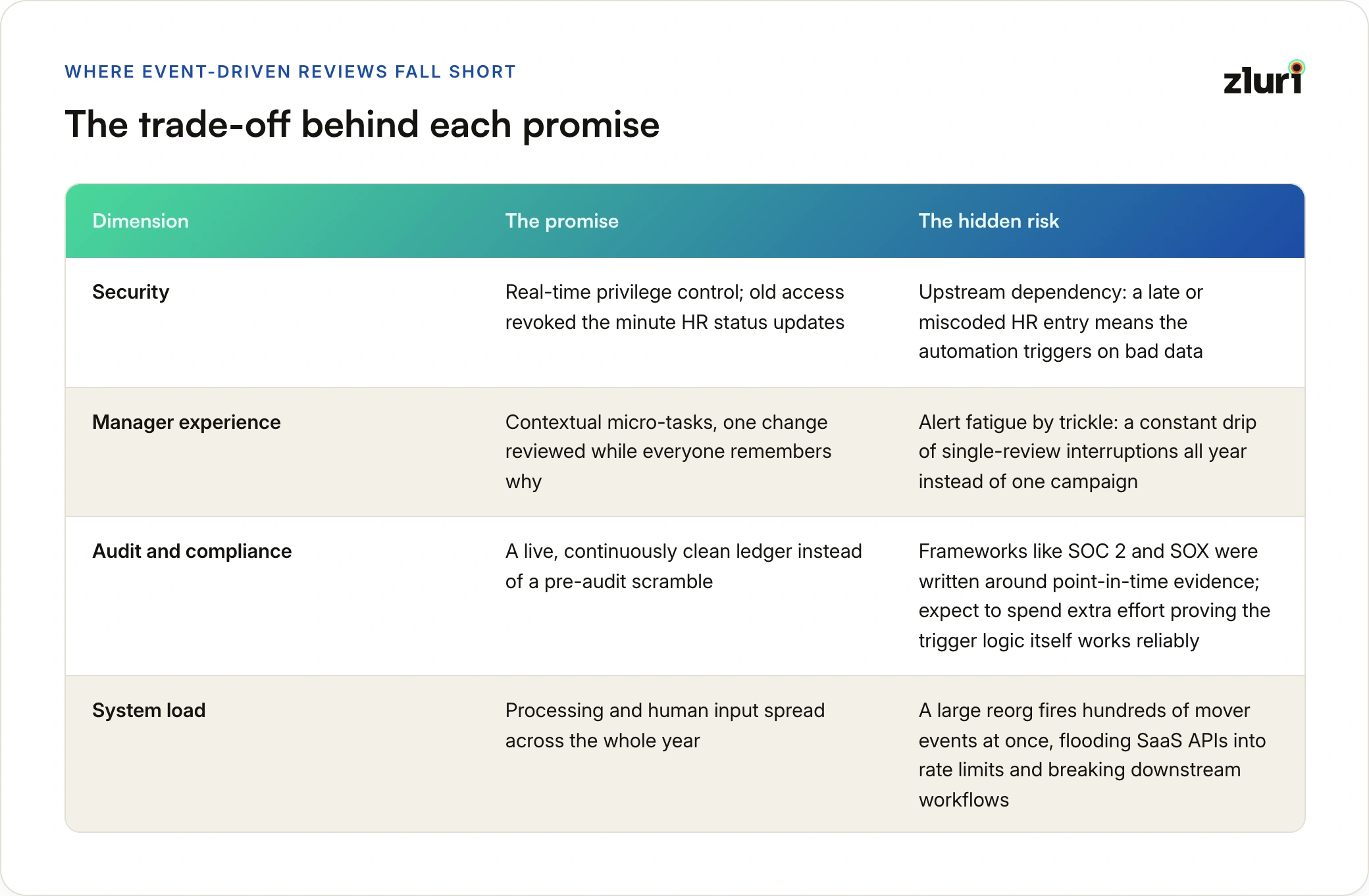
Teams that have made the shift consistently report the same two-sided experience: rubber-stamp approvals drop dramatically because reviewers actually remember the change they're certifying, while the ongoing cost moves upstream, into keeping HR job codes and department data clean enough to trigger on, and into walking auditors through event-bus logic instead of handing over a signed quarterly export.
The practical line most programs draw follows blast radius. Make it event-driven for the access that can't wait for a calendar: production databases, cloud root accounts, core financial systems, source code repositories. Keep it periodic for low-risk productivity tools, where the overhead of building and maintaining event hooks outweighs any security benefit a faster review would add.
The Hybrid Model: Triggers for Transitions, Calendar for Baseline
The mature answer isn't choosing one. High-performing programs run both, with each doing the job it's built for:
Event-driven triggers cover transitions. Every role change, transfer, departure, and leave event forces a scoped, immediate certification. The high-risk moments in an identity's lifecycle never wait for the calendar.
Event-driven triggers cover high-risk assets. Sensitive systems and privileged access get anomaly-based triggers layered on top, unusual access patterns launch a review of that account now, not next quarter.
Periodic reviews provide the baseline. A scheduled sweep, quarterly for critical systems, semi-annual or annual for the rest, catches everything the triggers weren't configured for: manual overrides, un-integrated systems, drift with no triggering event, and the comprehensive evidence trail auditors expect.
The two models also fix each other's weaknesses. Event-driven coverage shrinks what the periodic review has to catch, which shrinks the review lists, which reduces the fatigue that produces rubber-stamping. And the periodic baseline catches the gaps in trigger coverage, so an unconfigured event type doesn't become a permanent blind spot.
The workload math favors the hybrid too: in our survey of 215 security and IT leaders, a fully manual review cycle averages 149 person-days against 55 for fully automated teams, and the gap comes largely from exactly what event-driven automation removes, the data gathering and chasing that a compressed calendar campaign concentrates into a few brutal weeks.
What Event-Driven Reviews Require
Triggers only work if the plumbing exists. Three prerequisites:
An authoritative source of identity events, in real time. The HRIS (Workday, BambooHR, Rippling) has to be integrated as the system of record, and the integration has to support real-time event delivery, not just a nightly batch sync. A trigger that fires twelve hours after the transfer breaks the immediate-mitigation promise the model is built on. HR-driven triggers are the same foundation that powers lifecycle management automation; event-driven reviews are that foundation applied to certification.
Visibility beyond SSO. A trigger that fires correctly but can only see federated applications reviews a fraction of the person's real footprint. The transfer-triggered review needs to surface the transferred employee's access everywhere, including the tools their old department adopted outside IT.
Remediation connected to the review. A triggered review that ends in a ticket recreates the original problem at a smaller scale: the violation is found fast and fixed slowly. Closed-loop remediation is what makes the event-driven model complete, the revocation executes as part of the review outcome, not as a follow-up someone owes.
A complete, tamper-evident event trail. Every triggered review needs the "why" (the exact event), the "what" (the system action), and the "who" (the human sign-off) logged immutably, because this is the evidence that replaces the signed quarterly export auditors are used to. And the workflow needs fail-secure escalation: if the new manager doesn't act on a transfer-triggered review within a defined window, the system escalates or revokes automatically rather than letting the review, and the risk, sit open indefinitely.
This is how Zluri implements the model end to end: HRMS integration supplies the identity events, discovery provides the full application footprint including shadow IT, scoped certifications launch on the configured triggers, and remediation playbooks execute the decisions automatically, with the audit trail generated as a byproduct. The periodic baseline runs in the same system, so triggered reviews and scheduled reviews produce one consistent evidence record instead of two parallel processes.
Get Started
See event-driven and periodic reviews running in one system → Book a Demo
Frequently Asked Questions
What is an event-driven access review?
A certification that triggers automatically when a specific identity change occurs, a role change, department transfer, departure, or extended leave, rather than on a fixed schedule. The review is scoped to the person and the change, so the decision happens while the context is fresh instead of months later in a bulk campaign.
Do event-driven reviews replace periodic reviews?
No. Compliance frameworks expect periodic review as the documented baseline, and a scheduled sweep catches everything triggers weren't configured for: manual overrides, un-integrated systems, and drift with no triggering event. Event-driven reviews cover the transition windows periodic cycles inherently miss; mature programs run both.
Which events are worth configuring as review triggers?
Role changes and promotions, department transfers, departures and contract endings, extended leave, and high-risk anomalies like sensitive-system access from an unusual device. The test for any candidate trigger: does this event change what access the person should hold? If yes, it's worth a scoped review at the moment it happens.
Why do event-driven reviews reduce rubber-stamping?
Because they invert the volume problem. Periodic campaigns hand reviewers hundreds of mostly-unchanged records at once, and "Approve All" becomes the rational response. An event-driven review is one person and one change, evaluated by a reviewer who knows exactly why the change happened, small enough to genuinely evaluate rather than batch-approve.
What does an event-driven review program require to actually work?
Three things: an integrated HRIS as the authoritative source of identity events, discovery that covers the full application footprint rather than just SSO-federated apps, and remediation connected directly to review outcomes so a found violation becomes an executed revocation rather than a ticket in a backlog.



.svg)