.png)



An access review that ends at approve or deny hasn't ended. The "deny" is a decision; the revocation is the outcome, and in most organizations the two live in different systems with a ticket queue in between. In this piece, we cover what closed-loop remediation actually means, why review cycles die at exactly that handoff, and why the compliance tools most teams reach for can't close the loop even in principle.
Picture the end of a well-run quarterly review. Scope was right. Reviewers showed up. Every line got a decision: 1,840 approvals, 160 denials. The campaign dashboard shows 100% complete, on time. Everyone moves on.
Six weeks later, an auditor samples ten of those 160 denials. Four still have active access.
Nothing about the review failed. The scoping was correct, the decisions were sound, the documentation is immaculate. What failed is the part nobody owns: the distance between "this access should not exist" and "this access no longer exists." That distance is what closed-loop remediation eliminates, and it's worth understanding precisely, because it decides whether your user access reviews improve your security posture or just document it.
What closed-loop remediation actually means
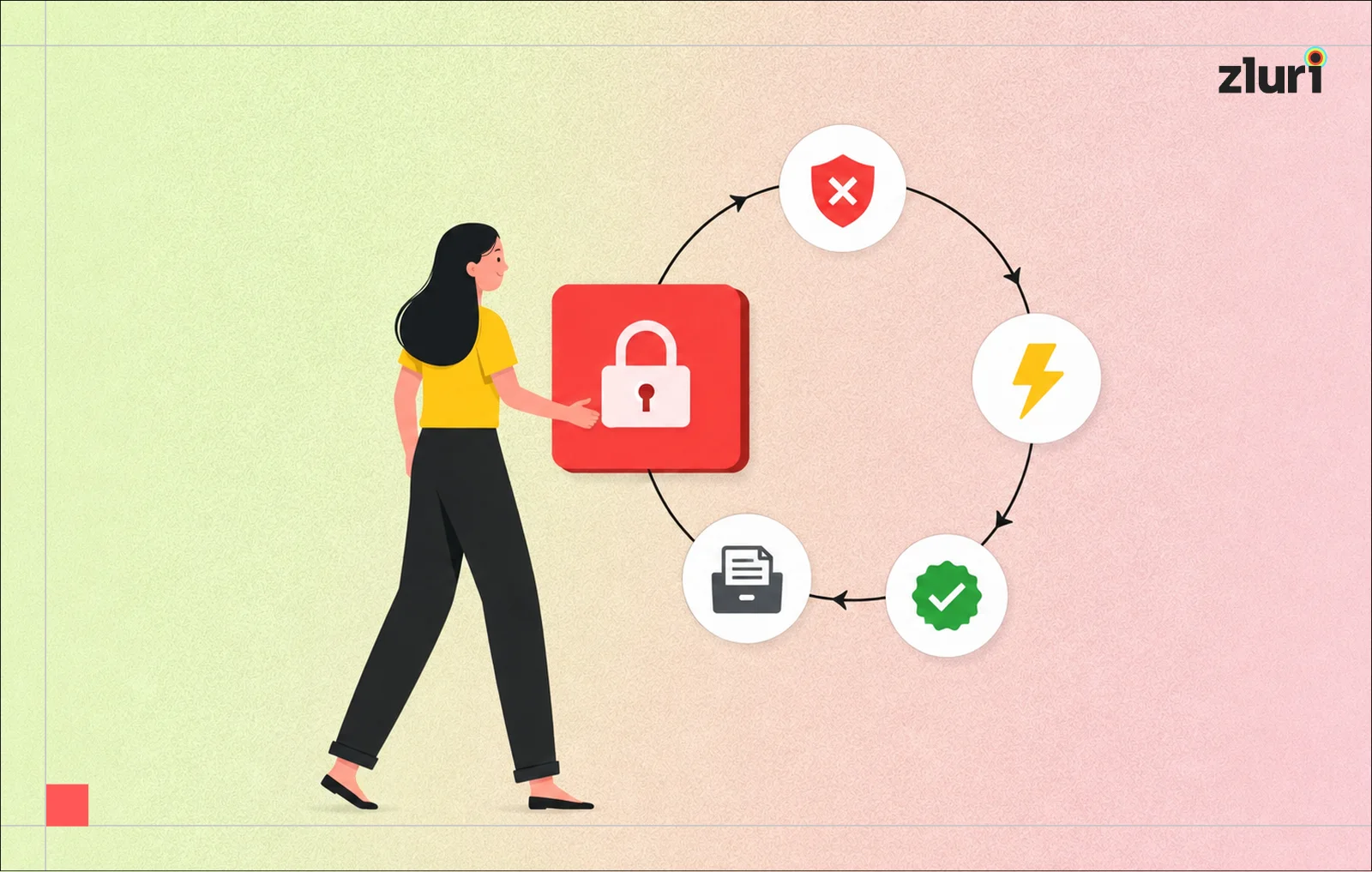
Closed-loop remediation means the system that captures the review decision also executes it, verifies it, and records the evidence, without the decision ever leaving that system.
The loop has four steps:
- Decide. A reviewer marks access as inappropriate.
- Execute. The revocation happens in the target application.
- Verify. The system confirms the access is actually gone, not just requested to be gone.
- Evidence. The full chain, decision, action, confirmation, timestamp, lands in one audit trail.
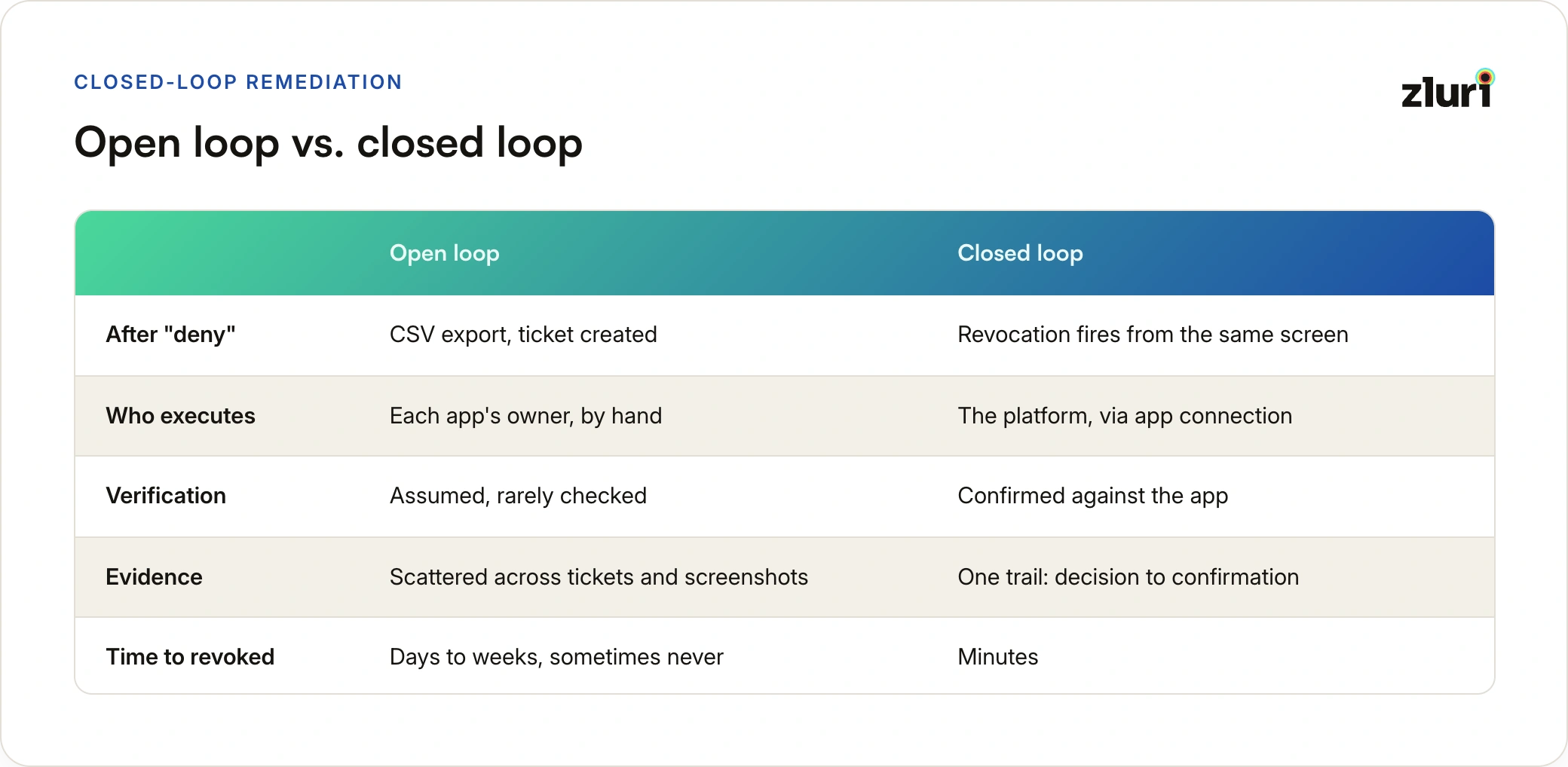
An open loop breaks after step one. The decision is exported as a CSV or a ticket, and steps two through four become someone else's job in someone else's system, on someone else's timeline.
The ticket handoff is where review cycles die
The handoff feels harmless. The review is "done," and revocation is just execution, routine follow-up work. But look at what the handoff actually creates.
Every denial becomes a task routed to whoever owns that application, and ownership is scattered across the organization. Centrally managed apps land with IT. But the Salesforce removal goes to the sales head, because sales owns Salesforce. The NetSuite change goes to the finance owner. The design tool goes to whoever in marketing holds the admin seat. Each owner has their own queue, their own priorities, and their own definition of urgent, and revoking someone else's access is never at the top of it. A revocation that IT could batch in an afternoon instead waits on five departments independently finding time for their share.
And nobody's job description says "confirm the 160 denials from last quarter actually landed across every owner's queue," so nobody checks.
This isn't an edge case. Our research across enterprise IT teams found that 41% of enterprises regularly miss access review deadlines, and remediation is the phase that blows them. The review completes; the removals don't. The next quarter's review then re-finds the access that last quarter already denied, which is exactly the recurring-findings pattern that makes access governance feel like firefighting: the same problems, certified twice.
A denied entitlement that stays active is worse than one that was never reviewed. You now have documented proof that your organization knew the access was inappropriate and left it in place. Auditors read that as a control failure; an incident responder reads it as negligence.
Why compliance automation and GRC tools can't close the loop
The tools most teams reach for at review time make the problem look solved without solving it. Understanding why requires looking at what they're built to do.
Compliance automation tools and GRC software are evidence systems. They orchestrate attestations, collect screenshots and exports, map controls to frameworks, and assemble audit packages. Those are real jobs, and they do them well. But an evidence system holds no connections into your applications. It can record that a reviewer denied Bob's Salesforce admin access; it cannot remove Bob's Salesforce admin access, because it has no write path into Salesforce. It was never designed to have one.
So every deny exits the platform as a task, and the loop opens at exactly the point where it needed to close. The tooling category difference matters more than any feature comparison:
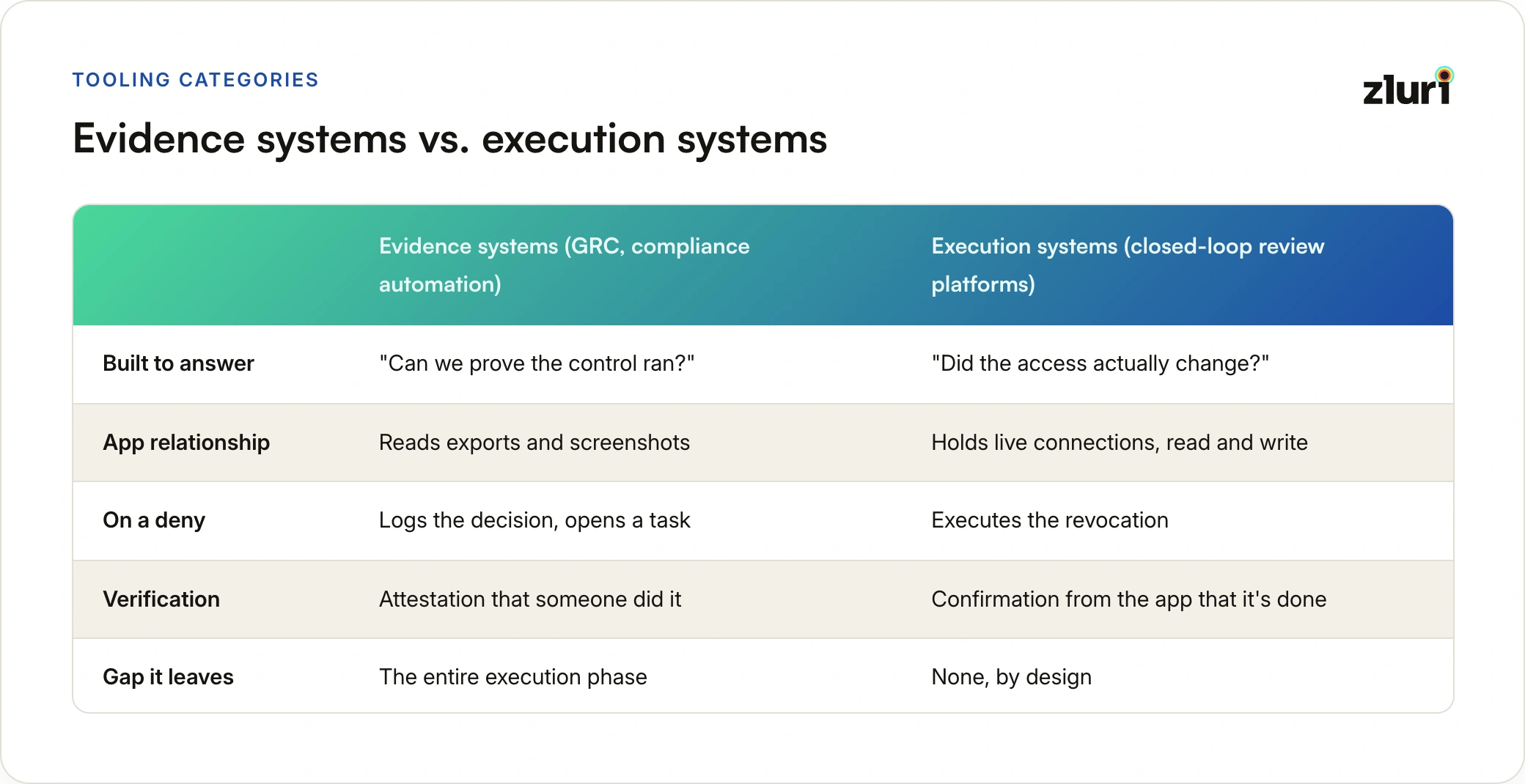
This is why "we automated our access reviews with our compliance platform" so often means "we automated the paperwork around our access reviews." The decisions flow faster; the access changes at the same manual speed as before. For SOX programs specifically, this is the trap we've written about in SOX automation: reviews are the control most worth automating first, but only if the automation reaches execution, not just attestation.
None of this means you should throw out your GRC platform. It means you should be precise about what it's for: framework mapping, policy management, audit assembly. The review-and-remediate loop belongs in a system with live application connections, feeding its completed evidence upward into GRC, not the other way around.
What auditors actually test
Auditors have caught up to the open loop. Evidence that reviews happened used to be enough; now the sampling goes one level deeper, and what auditors test in a user access review audit increasingly centers on one gap: flagged for removal versus actually removed.
The test is simple. Pull a sample of denied entitlements from the last campaign. Check current state in the live application. Every denial still active is an exception, and exceptions in this category are hard to argue down, because your own review already established the access was inappropriate. An open-loop process fails this test structurally on timing alone: even when every removal eventually lands, "eventually" produces a window of documented, known, unremediated access in every single cycle.
What closing the loop requires
Closed-loop remediation is an architecture, not a feature toggle. Four capabilities have to exist together:
- Live application connections. The review platform needs API integrations into the apps under review, with permission to revoke, not just read. This is the capability evidence systems lack by design.
- A path for apps without APIs. Not every application exposes a revocation endpoint. For those, the platform should run guided workflows that walk an admin through the manual removal and capture the confirmation in the same audit trail, so the loop closes even when execution is human.
- Verification as a step, not an assumption. After the revocation fires, the system re-checks the app and records the confirmed state. "We sent the request" and "the access is gone" are different claims; only the second one survives an audit sample.
- One evidence trail. Decision, execution, confirmation, and timestamps in a single record per entitlement. The moment evidence spans two systems, you've rebuilt the handoff you were removing.
If you're evaluating your options, this is the sharpest filter available: of the five ways to automate user access reviews, only approaches with live app connections can close the loop. Everything else automates the decision and leaves the outcome manual.
How this works in Zluri
Zluri's review campaigns are built around the closed loop. A reviewer denies an entitlement; for the 300+ apps with direct integrations, the revocation executes from that decision, and the platform confirms the resulting state against the application. For apps without APIs, guided workflows capture the manual removal in the same trail. Remediation playbooks extend the loop beyond campaigns: a departure triggers revocation everywhere, a role change adjusts entitlements, and a high-risk finding escalates immediately instead of waiting for the next cycle. The audit record for every entitlement reads end to end, decision through confirmation, in one place.
Want the setup detail? The full walkthrough of configuring review campaigns and remediation playbooks, including auto-revoke versus guided manual paths, is here: How Access Reviews Work in Zluri.
Frequently Asked Questions
What is closed-loop remediation in access reviews?
It means the system that records a review decision also executes it, verifies it, and stores the evidence, with no export or ticket handoff in between. A deny becomes a completed, confirmed revocation in the same platform where the reviewer clicked it.
Why can't GRC or compliance automation tools do closed-loop remediation?
They're evidence systems: built to collect attestations, map controls, and assemble audit packages. They hold no live write connections into your applications, so they can record that access should be removed but cannot remove it. Every deny leaves the platform as a task, which is the open loop by definition.
Does closed-loop remediation require every app to have an API?
No. Apps with APIs get automatic revocation; apps without them need guided manual workflows where the admin's removal steps and confirmation are captured in the same audit trail. The loop is closed by where the evidence lands, not by whether a machine or a human executed the removal.
How do auditors test for remediation gaps?
They sample denied entitlements from a completed campaign and check the current state in the live application. Any denial still active is an exception, and a damaging one, because the review itself documented that the access was inappropriate.
Is closed-loop remediation only relevant for access reviews?
The pattern extends anywhere a governance decision needs to become an application-level change: offboarding, role changes, and policy violations all benefit from the same decide-execute-verify-evidence chain. Reviews are simply where the open loop is most visible, because the volume of decisions per cycle is highest.