.png)




Privileged access management is really two problems wearing one name. One is securing the credential itself: vaulting it, rotating it, recording the session it's used in. The other is governing whether that privileged access should exist at all: who holds it, whether it's still needed, and whether it combines with something else into a risk nobody would approve of if they saw the full picture. Most tools on this list solve the first problem. At least one exists for the second, and a complete privileged access program needs both.
Privilege is where access risk concentrates. An over-provisioned standard account is a problem; an over-provisioned admin account is an incident waiting for a date. Privileged access management tools grew up around protecting the credentials behind that access, and the vault players below do that with real depth. But a vault secures a credential that governance has already decided should exist, and if nobody's making that decision deliberately, the vault is protecting access that shouldn't be there in the first place.
There's a second shift running underneath the category. Modern security has reorganized around identity as the primary attack surface, and through that lens the biggest security gain from any PAM tool isn't the vault door itself. It's reducing standing privileged access, the always-on admin rights that sit waiting to be stolen, and shrinking the blast radius when an identity is compromised. Every tool below is worth reading against that measure: how much standing privilege does it actually eliminate, convert, or contain, and how much does it merely store more securely?
This comparison covers eight PAM tools across both halves of the problem, and is direct about which half each one solves. A comparison table at the bottom lays out how each tool handles standing privilege reduction specifically.
What PAM Tools Do
Traditional PAM tools secure the most sensitive credentials in an environment: admin passwords, root accounts, service credentials. The core capabilities are credential vaulting, automatic rotation, just-in-time credential checkout, and session recording and monitoring, so that even when privileged access is used legitimately, there's a controlled, observable path for it.
Sitting logically upstream of all of that is privileged access governance: identifying what actually counts as privileged across the estate, scoring the real risk each privileged grant represents, gating how privilege gets requested and approved, reviewing it on a schedule with real scrutiny, and catching combinations of privileged access that create danger even when each grant looks reasonable alone. The two layers are complementary, not competing: governance decides the access should exist and keeps checking whether it still should; the vault secures the credential once it does.
On-Premises, SaaS, and Hybrid PAM: Where the Vault Lives
The core capabilities above apply across deployment models, but how they're implemented differs enough to shape your shortlist.
On-premises PAM centers on infrastructure inside your own data centers: domain controllers, network devices, internal servers. The vault runs on local servers, rotation is handled by internal connectors talking directly to Active Directory and server operating systems, and sessions are isolated through local jump servers or proxies. This is the classic CyberArk-style architecture, and it remains the right shape for organizations whose privileged risk lives primarily in owned infrastructure.
SaaS-delivered PAM flips the focus toward cloud environments, SaaS applications, and API and machine identities. The vault and management plane are vendor-hosted, rotation leans heavily toward API tokens, cloud IAM roles, and SaaS administrator credentials, and session isolation typically runs through web-based gateways so the user never touches the underlying credential at all.
Hybrid is where most modern platforms have landed. A cloud-hosted console with hybrid connectors can vault and rotate an on-premises Windows server password, an AWS root key, and a SaaS admin account from one place. If your estate spans all three (and for most mid-size and larger organizations, it does), a single-model tool forces either a coverage gap or a second product.
The evaluation question isn't "cloud or on-prem." It's whether the tool's connector model reaches every place your privileged access actually lives, including the SaaS admin consoles and API integrations that traditional infrastructure-centric PAM historically ignored.
What to Evaluate
Which half of the problem you're actually buying for. If admins share root passwords over Slack, you need a vault first. If privileged access sprawls with nobody able to say who holds what and why, you need governance first. Most mature programs need both, but sequencing matters.
How much standing privilege it removes, not just protects. A vaulted standing credential is safer than an unvaulted one, but it still exists around the clock as a target. The stronger posture is less standing privilege overall: just-in-time grants that expire on their own, ephemeral credentials that cease to exist between uses, and continuous elimination of grants that no longer have a justification. Ask every vendor what your standing privilege count looks like twelve months after deployment, not just how securely the current count is stored.
How "privileged" gets identified. Name-matching on roles called "Admin" misses privileged access hiding under innocuous names and over-flags harmless ones. Look for privilege tracked as explicit data on the permission or role itself.
Whether non-human privilege is covered. Service accounts and API integrations hold standing high-privilege access with no person behind them. Both the vault layer and the governance layer need to treat them as first-class.
Session-to-decision traceability. For vaults: can you get from a recorded session back to who approved that access existing? For governance: can you get from an approval to evidence it was reviewed since?
The 8 Best PAM Tools in 2026
1. CyberArk
CyberArk is the PAM category's reference incumbent, with the deepest vaulting, rotation, and session-management capability and the largest enterprise install base.
Key features:
- Enterprise credential vaulting with automatic password rotation
- Session isolation, recording, and live monitoring
- Just-in-time privilege elevation
- DevOps and application secrets management through Conjur
- Threat analytics on privileged account behavior
Best for: Enterprises with serious privileged credential risk and the security staffing to run a full PAM program.
Limitations: Implementation and administration are heavyweight, licensing is enterprise-priced, and the governance question upstream (should this privileged access exist, and is it still appropriate) sits outside its design center.
2. Zluri
Zluri is not a traditional PAM player, the kind that does password management, credential vaulting, rotation, or session recording, and it doesn't position as one. It covers the governance half of the problem, the layer upstream of every vault on this list: whether a given privileged grant should exist at all, and whether standing privilege is trending down or quietly piling up.
Key features:
- Privilege tracked as explicit data (a flag plus type: create, read, update, delete, admin) instead of guessed from role names
- Access Duration plus linked Deprovisioning Playbooks, so new grants expire on their own instead of becoming standing access
- Live inventory of orphaned, dormant, and undeprovisioned access, cleaned up through a consent-first removal flow
- Threat scoring per person, per grant, surfaced to approvers as Standard vs Privileged
- Segregation of duties detection across applications, catching combinations no single grant reveals
- Service Account Exposure applying the same discipline to non-human identities
Full mechanics: how Zluri governs privileged access without being a credential vault.
Best for: Organizations that need to govern privileged access sprawl across a SaaS and application estate and continuously drive standing privilege down, typically running alongside a vault rather than instead of one. Standard integrations live in 2 to 4 weeks.
Limitations: Everything a traditional PAM player does on the credential side, Zluri deliberately doesn't: no password management, vaulting, rotation, or session recording. Its JIT operates at the grant-duration level (days, weeks, months), not the session level. Organizations whose acute problem is credential security itself should start elsewhere on this list and add governance second.
3. BeyondTrust
BeyondTrust pairs privileged credential management with the category's strongest endpoint privilege management, removing standing local admin rights at scale.
Key features:
- Endpoint privilege management across Windows, Mac, and Linux
- Credential vaulting with automatic rotation
- Secure remote access for vendors and support teams
- Application control and least-privilege policy enforcement on endpoints
- Session monitoring and recording
Best for: Organizations attacking privilege from the endpoint side, eliminating local admin sprawl, alongside credential vaulting. Its endpoint work is genuine standing privilege removal: users stop being permanent local admins entirely.
Limitations: The portfolio spans several formerly separate products, so coherence varies by module, and administration carries enterprise-grade overhead.
4. Delinea
Delinea (the Thycotic-Centrify merger) delivers enterprise PAM with a reputation for faster deployment than the heaviest incumbents.
Key features:
- Secret Server credential vaulting with approachable administration
- Automatic password rotation and discovery of privileged accounts
- Session launching, monitoring, and recording
- Cloud-first delivery alongside on-premises options
- Privilege elevation and delegation for servers
Best for: Mid-market and enterprise teams wanting credible vaulting and session management without CyberArk-scale implementation weight.
Limitations: Depth at the highest end (large-scale session isolation, the broadest target coverage) trails the category leader, and the merged product lines still show seams.
5. HashiCorp Vault
HashiCorp Vault approaches privilege from the machine side: secrets management, dynamic credentials, and encryption as infrastructure primitives.
Key features:
- Dynamic, short-lived credentials generated on demand
- Centralized secrets management for applications and pipelines
- Encryption-as-a-service for data in transit and at rest
- Deep infrastructure-as-code and CI/CD integration
- Identity-based access across clouds and platforms
Best for: Engineering-led organizations securing machine-to-machine and pipeline privilege in cloud-native environments. Its dynamic credential model is the strictest form of zero standing privilege on this list: credentials that genuinely cease to exist between uses.
Limitations: Human privileged access workflows (checkout, session recording, approval UX) are not the design center, and operating it well requires real engineering investment.
6. StrongDM
StrongDM provides a unified access plane for infrastructure: databases, servers, Kubernetes, and cloud consoles, with every session logged and credentials never exposed to the end user.
Key features:
- Credential-less access where users never see the underlying secret
- Complete session audit trails across infrastructure targets
- Unified access across databases, servers, Kubernetes, and clouds
- Just-in-time access grants with approval workflows
- Fast agent-based deployment
Best for: Cloud-forward teams standardizing how engineers reach production infrastructure.
Limitations: Scope centers on infrastructure access rather than the full PAM surface (endpoint privilege, broad application estates), and it complements rather than replaces enterprise vaulting in complex environments.
7. Teleport
Teleport delivers identity-native infrastructure access built on short-lived certificates instead of standing credentials, eliminating much of what a vault would otherwise need to store.
Key features:
- Certificate-based, ephemeral access replacing standing credentials
- Coverage across servers, Kubernetes, databases, and internal apps
- Session recording and audit across all access
- Open-source core with enterprise extensions
- Passwordless, identity-native authentication
Best for: Engineering organizations willing to rethink infrastructure access around ephemeral certificates rather than managed passwords. Like HashiCorp Vault, this is standing privilege elimination at the credential level, not just protection.
Limitations: The model asks for real architectural adoption, and traditional PAM surfaces (Windows endpoint privilege, legacy system coverage, business-user workflows) sit outside its lane.
8. ManageEngine PAM360
ManageEngine PAM360 packages vaulting, session management, and privileged analytics at a mid-market price point within the ManageEngine ecosystem.
Key features:
- Credential vaulting with automatic rotation
- Session recording and monitoring
- SSH key and SSL certificate management
- Privileged user behavior analytics
- Integration with the broader ManageEngine suite
Best for: Mid-size IT teams wanting mainstream PAM coverage without enterprise-suite pricing.
Limitations: Depth per feature trails the specialists, the interface shows the suite's utilitarian heritage, and very large or complex estates outgrow it.
How to Choose
Sequence by your acute problem, then build toward both halves.
If credentials are the fire (shared root passwords, no rotation, no session visibility), start with the vault half: CyberArk or BeyondTrust at enterprise scale, Delinea or PAM360 below it, StrongDM or Teleport if the estate is cloud infrastructure, HashiCorp Vault if the privilege is mostly machine-to-machine.
If sprawl is the fire (nobody can say who holds privileged access, why, or whether it's been reviewed), start with the governance half, which is where Zluri sits, then add vaulting for the credentials governance confirms should exist.
The mistake worth avoiding is treating the two halves as substitutes. A vault protecting access nobody decided should exist is securing the wrong thing well. Governance with unprotected credentials is deciding the right thing and leaving it exposed. Mature privileged access programs run both, and the tools pair cleanly because they operate at different layers of the same problem.
Standing Privilege and Blast Radius: How the 8 Compare
Since the real security gain in modern PAM is reducing standing privileged access and shrinking blast radius, here is how each tool contributes on exactly that measure.
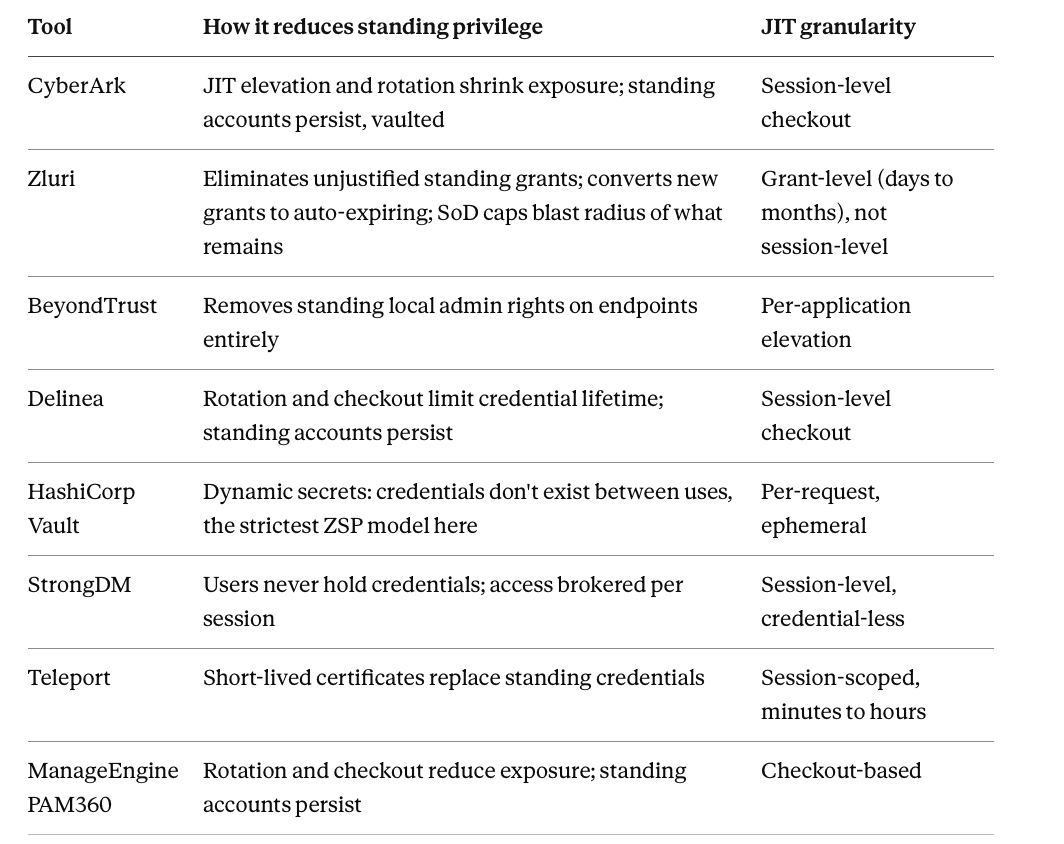
Read together, the pattern is clear: the vaults and infrastructure tools attack standing privilege at the credential and session level, while Zluri attacks it at the grant and entitlement level, deciding what should exist, expiring what's temporary, and eliminating what's no longer justified. A program running both ends up with less standing privilege overall and a smaller blast radius when something is compromised, which is the actual point.
Frequently Asked Questions
Is Zluri a PAM tool?
Not a traditional one, and it doesn't claim to be. It doesn't do password management, credential vaulting, rotation, or session recording. It governs the layer upstream of that: whether privileged access should exist, who approved it, whether it survives scheduled review, whether new grants expire automatically, and what dangerous combinations exist across the estate. Organizations typically run it alongside a vault, not instead of one.
Do we need both a vault and privileged access governance?
For a mature program, yes, because they answer different questions. The vault answers "is this credential secure and its use observable." Governance answers "should this privileged access exist at all, and is it still appropriate." Either one alone leaves the other question unanswered.
What's the difference between JIT access and zero standing privilege?
JIT access builds expiry into the grant: access exists for a bounded window and revokes itself. Zero standing privilege in its strictest form goes further: nothing persists between uses at all, with credentials created on demand and destroyed immediately after, which is what HashiCorp Vault's dynamic secrets and Teleport's short-lived certificates implement at the infrastructure level. Zluri's duration-based JIT and continuous elimination of unjustified grants drive an organization's overall posture toward that ideal at the application layer, without implementing the ephemeral credential model itself.
How should privileged access be identified, if not by role names?
As explicit data on the permission or role itself: a privileged flag tied to what the entitlement actually allows, not what it happens to be called. Name-matching both misses privilege hiding under innocuous labels and over-flags roles that sound scarier than they are.
Does privileged access management cover service accounts?
It has to, and this is worth testing explicitly on any tool. Service accounts and API integrations frequently hold standing high-privilege access with no person behind them and no one routinely reviewing them, which makes them exactly where privileged risk accumulates unnoticed on both the credential side and the governance side.