


Every sprawl problem an organization deals with, identity, access, group, data, gets treated as its own separate initiative with its own separate owner. Almost all of them started the same way: someone signed up for a SaaS tool that IT never saw coming.
Trace almost any instance of identity sprawl, access sprawl, group sprawl, or data sprawl back to its origin, and the trail leads to the same starting point: an application that entered the organization outside any governed process. A free trial someone signed up for with a work email. A team's favorite tool is expensed on a personal card. A vendor's platform adopted for one project that never got decommissioned.
That single event, one ungoverned SaaS signup, is rarely where the story ends. It's where every other sprawl problem actually begins:
- The application creates a new identity to use it.
- That identity accumulates access inside it.
- Someone builds a group to manage who's in it.
- Data starts living inside it that nobody's tracking.
Four different sprawl categories, all triggered by one signup that took thirty seconds and no approval.
This piece traces that chain reaction directly, and makes the case that treating SaaS chaos as the upstream cause, not just one sprawl category among several, changes where the actual fix belongs.
The Chain Reaction, Step by Step
At a glance, before the detail:
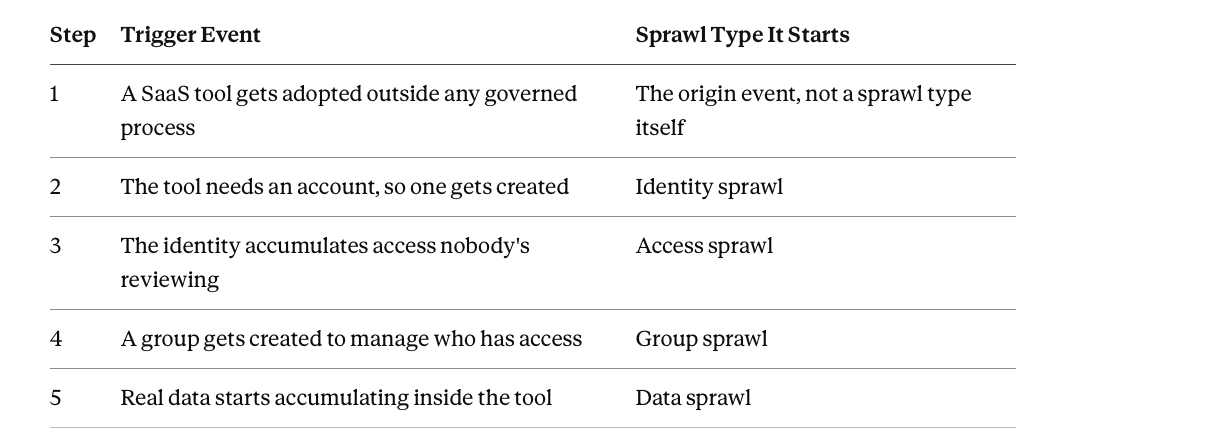
Step one: a SaaS tool gets adopted outside any governed process. This is the actual origin event. It doesn't look dangerous in the moment. Someone on a team needs a tool, finds one, signs up with a work email or a personal card, and starts using it within minutes. No IT ticket, no procurement review, no security assessment. By most measures, nothing has gone wrong yet.
Step two: that tool needs an identity, so one gets created. Using the new application requires an account, and that account is a new identity the organization now has, one that almost certainly isn't synced to the central directory, isn't covered by SSO, and isn't visible to whatever identity governance process already exists. This is where identity sprawlactually starts: not through a mistake in identity management, but through an application that was never brought into the identity conversation in the first place.
Step three: the identity accumulates access, and nobody's watching. Once the account exists, it starts picking up permissions the way every account does, more scope for a new project, admin rights because it was easier than figuring out the minimal role, access that made sense in the moment and was never revisited. Because this application sits outside the organization's governed inventory, none of the access happening inside it is subject to whatever review cadence covers everything else. This is access sprawl, growing in a blind spot by construction.
Step four: more than one person needs access, so a group gets created. The moment a second or third person needs the same tool, managing access one person at a time stops being practical, and a group gets created to bundle it. Nobody checks whether a similar group already exists elsewhere, because there's no visibility into what already exists, since the application itself was never part of any central inventory. This is exactly how group sprawl starts: not through carelessness, but through the same absence of visibility that let the original signup go unnoticed.
Step five: real data starts accumulating inside the tool. Files get uploaded. Customer information gets entered. Conversations happen. None of it is backed up, classified, or covered by whatever data governance policy exists elsewhere, because the application holding it was never on anyone's radar to begin with. This is data sprawl, and it's rarely caused by a failure of data policy. It's caused by data living inside an application that data policy never knew existed.
By the time any of this surfaces, usually during an audit, a security incident, or a spend review, what looks like four separate sprawl problems is actually one unmanaged SaaS signup that was never caught at the only point it would have been cheap to catch: before it happened.
Why AI Sprawl Is This Same Chain Reaction, Just Faster
AI tools are following the exact same chain, compressed into a much shorter timeline. An employee signs up for an AI tool with a work email, often through a generous free tier that requires no procurement involvement at all. That tool needs an account, so a new identity gets created. That account starts accumulating permissions and integrations. And the data going into it is frequently the most sensitive kind an organization has: proprietary code, unreleased product plans, customer records, pasted directly into a prompt with no governance anywhere in the loop.
The mechanism isn't new. What's different is the speed and the stakes. AI tool adoption moves faster than traditional SaaS adoption ever did, and the data risk per tool is meaningfully higher, since the entire interaction model revolves around feeding the tool sensitive information to get useful output back. AI sprawl isn't a new category of problem. It's SaaS chaos's fastest-moving, highest-stakes symptom. For the department-by-department breakdown of exactly how this shows up in practice, see AI sprawl by department.
Why Treating Each Sprawl Type Separately Misses the Actual Fix
Standard practice treats identity sprawl, access sprawl, group sprawl, and data sprawl as four separate initiatives: an identity cleanup project here, an access review there, a group consolidation effort somewhere else, a data classification exercise run by an entirely different team. Each one produces a clean result on the day it finishes, and each one starts drifting again almost immediately, because none of them addressed the actual origin point all four traced back to.
This is the core weakness in treating sprawl as four downstream problems rather than one upstream one:
- Cleaning up identities without catching new ungoverned SaaS signups means new fragmented identities keep appearing at the same rate they always did.
- Reviewing access without visibility into which applications exist means entire categories of access never enter the review at all.
- Consolidating groups without a complete application inventory means new redundant groups keep forming around whatever tool nobody's tracking this quarter.
- Classifying data without governing the applications data lives in means the classification project is permanently a few tools behind reality.
Fix the origin point instead, catch the ungoverned SaaS signup before or immediately after it happens, and every downstream sprawl category gets a meaningfully smaller problem to solve. Fewer ungoverned applications means fewer untracked identities, less unreviewed access, fewer redundant groups, and less ungoverned data, not because each of those problems got individually solved, but because the event that creates all four of them stopped happening as often.
What Catching SaaS Chaos at the Source Actually Requires
Discovery that doesn't depend on the application being reported. The applications driving real SaaS chaos are, by definition, the ones that never went through an official channel. A discovery approach relying on a single source, an approved app list, SSO federation records, misses exactly this population by definition, since these are precisely the tools that avoided that channel in the first place. Discovery has to pull from multiple independent signals, transaction records, network and browser activity, direct integrations, agents, specifically because the applications that matter most for this problem will never self-report through the expected path. For the full breakdown of this measurement gap and how it's closed, see the full breakdown of SaaS sprawl and how Zluri contains it.
Catching the signup at or near the moment it happens, not months later. The cost of addressing an ungoverned SaaS tool grows enormously the longer it sits undiscovered. Caught within days, it's an unreviewed signup. Caught after a year, it's an application with an entrenched team, live workflows, accumulated access, redundant groups, and real data inside it, at which point removing it means genuine disruption rather than simply not renewing a subscription nobody was using yet.
Treating every discovered application as an event that touches four systems at once, not one. A newly discovered SaaS tool isn't just an application inventory update. It's a potential new identity source, a potential new access surface, a potential new group-creation trigger, and a potential new place data can live, all simultaneously. Handling it as purely an app-inventory task, and routing the identity, access, group, and data implications to four separate teams or processes, is exactly what lets those four downstream sprawl categories keep accumulating independently even after the application itself has technically been discovered.
Frequently Asked Questions
Is SaaS sprawl really the cause of identity, access, group, and data sprawl, or just another type of sprawl alongside them?
Both, but the causal direction matters. An ungoverned SaaS signup is very often the originating event: it creates a new identity, that identity accumulates access, a group forms around managing it, and data starts living inside it. Treating SaaS chaos as the upstream trigger, rather than one peer among four unrelated categories, changes where the highest-leverage fix actually sits.
Why does fixing SaaS discovery help with sprawl types that seem unrelated, like data sprawl?
Because data sprawl is almost always downstream of application sprawl. Data lives inside whichever application created it, so an application nobody's tracking means data nobody's tracking by direct consequence. Closing the SaaS discovery gap closes a meaningful share of the data governance gap automatically, without a separate data-specific initiative doing that work on its own.
Is AI sprawl a genuinely different problem from SaaS sprawl, or the same one?
The same underlying mechanism, moving faster and carrying higher stakes. AI tools get adopted the same ungoverned way general SaaS tools do, often faster given how easy free tiers make signup, and the data being fed into them tends to be more sensitive than what a typical SaaS tool handles. It's SaaS chaos's fastest-moving symptom, not a separate category requiring an entirely different fix.
If SaaS chaos is the root cause, does that mean identity, access, and group governance don't matter on their own?
They still matter, since not every instance of identity or access sprawl originates from an ungoverned application, some come from legitimate tools with governance gaps of their own. But a meaningful share of what shows up as identity, access, group, and data sprawl traces back to the same unmanaged SaaS signup, which is why addressing that origin point reduces the volume all four downstream categories have to deal with, even though it doesn't eliminate the need for governance at each individual layer.
What's the fastest way to tell how much of an organization's sprawl actually originates from ungoverned SaaS adoption?
Run a proper multi-source discovery pass and compare the result against whatever official, approved application list currently exists. The gap between the two, applications nobody officially tracked, is a reasonably direct proxy for how much of the organization's identity, access, group, and data sprawl traces back to SaaS chaos specifically, since every one of those undiscovered applications is a potential trigger for all four.



.svg)