
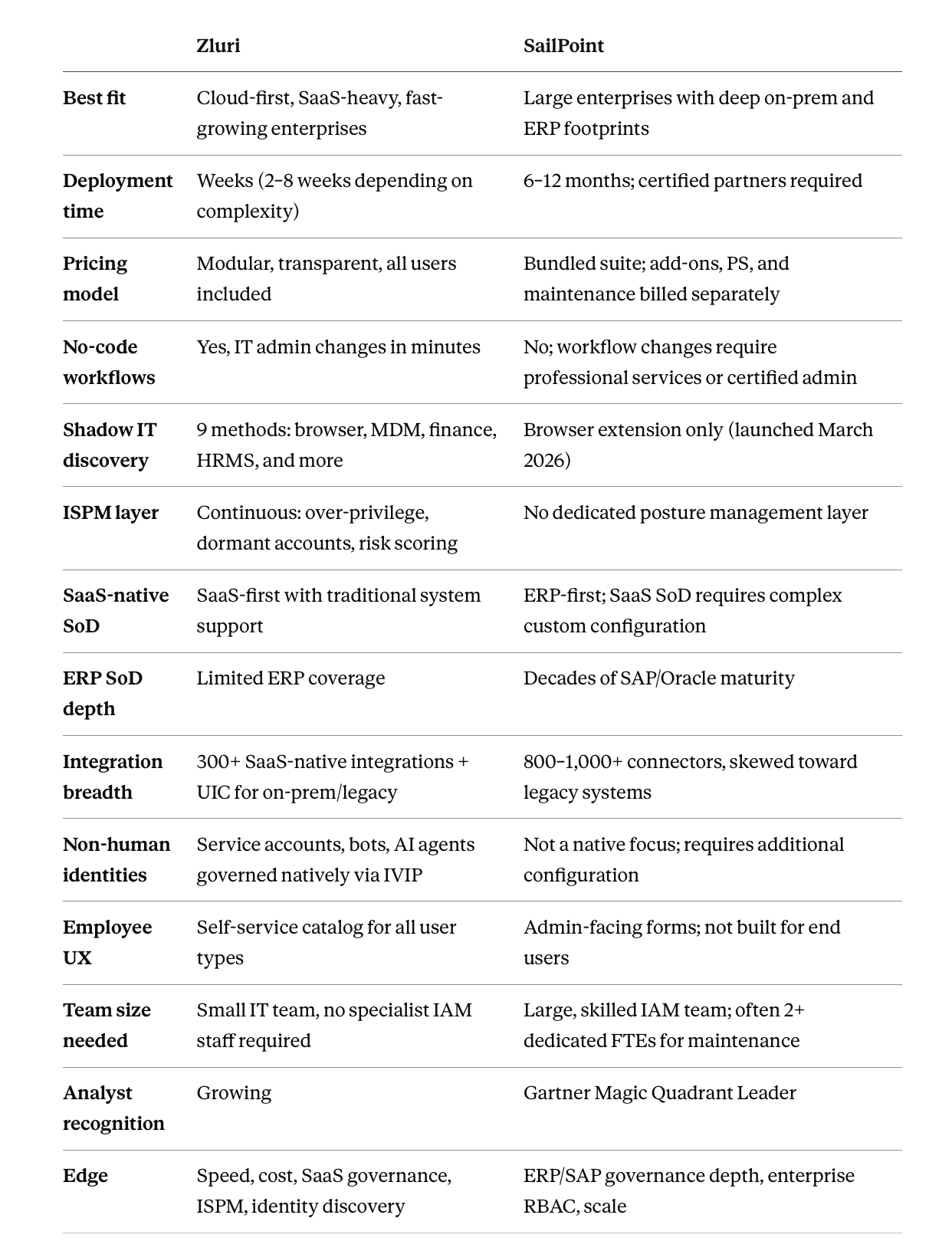
The short version: SailPoint fits large enterprises with heavy on-prem or ERP footprints, a dedicated IAM team, and SAP, Oracle, or mainframe SoD as the core requirement. Zluri fits modern, SaaS-and-cloud-heavy environments, mid-market and fast-growing enterprises that need governance live in weeks, not months or years, regardless of how big the company has gotten.
SailPoint is the name most security leaders default to when identity governance comes up. It is the established enterprise standard, built for organizations with tens of thousands of identities, deep on-premise estates, and IAM teams large enough to run a multi-year deployment. Decades in the market and a position as a Gartner Magic Quadrant leader have made it the reflexive answer to "what IGA platform should we buy."
That reputation is earned. SailPoint's depth in enterprise role mining, SAP and Oracle governance, and large-scale entitlement management is real, and for the right buyer, it remains the strongest option on the market.
But that scale comes at a cost, and not just a financial one. SailPoint's pricing, implementation timelines, and ongoing maintenance are built for enterprises that can absorb them: organizations with dedicated IAM teams, multi-year procurement cycles, and budget set aside for professional services on top of licensing. For everyone else, those same strengths become friction. A growing company evaluating SailPoint today is essentially being asked to adopt the operating model of a Fortune 500 IT department before it has one.
We built Zluri as an identity security platform for organizations that need real governance without that overhead. In this article, we break down where SailPoint's model creates friction, what we built differently, and where each platform genuinely makes more sense than the other.
The short version: SailPoint fits large enterprises with heavy on-prem or ERP footprints, a dedicated IAM team, and SAP, Oracle, or mainframe SoD as the core requirement. Zluri fits modern, SaaS-and-cloud-heavy environments, mid-market and fast-growing enterprises that need governance live in weeks, not months or years, regardless of how big the company has gotten.
Where SailPoint Creates Overhead
Pricing is high and bundled. SailPoint does not publish list pricing, which means every quote starts as a negotiation. Based on third-party procurement data, annual costs for smaller deployments typically start in the low six figures, and can climb well into six figures, sometimes approaching half a million dollars or more annually, for mid-market and larger enterprises, scaling with identity volume.
That implementation cost is the part buyers often underestimate. Professional services for setup, integration, and custom workflow development typically add 30% to 60% on top of first-year licensing, which for a mid-size deployment can mean a comparable amount again added to the license cost in Year 1 alone.

One enterprise buyer benchmark put a 36-month, 2,500-identity contract at roughly $825,000 total. Beyond the first year, ongoing maintenance and support typically run 18% to 22% of license value annually for on-premise deployments.
Modules like access reviews typically cannot be purchased on their own either. You license the suite, then pay again for setup, customization, and long-term upkeep, with optional add-ons like privileged access or password management priced separately on top.
Implementation takes months, often years. Most deployments require developers or outside consultants to configure roles, policies, and integrations correctly. You are integrating with dozens of source systems, building custom workflows, mapping roles, and configuring certification campaigns from scratch. Getting from contract signature to a working program is a multi-quarter project, not a multi-week one, and for larger or more complex environments, multi-year timelines are not unusual.
The platform demands constant specialist attention. Roles, policies, and integrations need frequent updates as the business changes, and that upkeep usually requires dedicated IAM expertise. A new acquisition, a department reorg, or a new SaaS rollout each typically means another round of role mapping and policy configuration. Day-to-day tasks like certification campaigns carry a real learning curve. One G2 reviewer put it plainly:
"There is a ton of training needed to fully understand and utilize the product to its full potential. All the training offered to use the product is free, but you need to pay for more training to gain a better understanding."
The result is a platform that performs well in the hands of specialists, but creates a dependency on those specialists for almost everything beyond initial setup.
Integrations need custom work. Even with pre-built connectors available, most integrations still require scripting, troubleshooting, or professional services to get right. Rate limits and API quirks on platforms like Okta add further friction, and resolving them often means relying on vendor documentation or third-party support. SailPoint's connector catalog is broad, often cited in the 800 to 1,000-plus range, but that breadth skews toward legacy enterprise systems. For a team whose stack is mostly modern SaaS, a large share of that catalog is simply not relevant.
Shadow IT discovery is still catching up. SailPoint's shadow AI remediation only launched in March 2026, and it runs through a browser extension alone. Apps purchased through finance or surfaced through HRMS records, two of the most common ways shadow IT enters a company, stay outside that coverage.
Segregation of duties was built for ERP, not SaaS. SailPoint's SoD engine carries decades of maturity for SAP and Oracle environments. That same maturity does not carry over cleanly to SaaS. Configuring SoD conflict rules for tools like Salesforce or Okta typically means complex custom configuration rather than something that works out of the box.
Periodic certifications carry rubber-stamping risk. SailPoint is the market leader on certification campaigns, but the model itself is periodic by design. Reviewers working through long lists on a deadline tend to approve in bulk rather than evaluate each line, and that habit is a known risk in any review-cycle-based approach.
The interface is built for admins, not end users. Routine employee-facing tasks, like requesting access, run through admin-style forms rather than something built for non-technical use.
None of this makes SailPoint a bad platform. It makes it a platform built for a specific kind of buyer: one with the headcount, budget, and timeline to support it.
What We Built Instead
We are not trying to be SailPoint at a smaller scale. We built Zluri as an identity security platform from a different starting point: discover everything fast, govern it without custom engineering, and keep security and IT teams ahead of risk instead of reviewing it after the fact.
The platform runs on four connected layers, with a fifth layer extending reach into systems that have traditionally been the hardest to govern.
IRIS is the intelligence foundation underneath everything else. It connects identity signals in real time across systems and turns raw access data into decisions security teams can act on, instead of spreadsheets they have to interpret. IRIS works across three connected layers: a visibility layer with more than 10 pre-built dashboards covering access requests, access management, certifications, and shadow IT and AI; an intelligence layer with more than 80 widgets that surface what needs attention and why; and an action layer that lets teams drill from an org-wide dashboard straight into the specific records causing a problem. Dashboards are also role-based, so a help desk admin, a security analyst, and a compliance lead each see the view relevant to their job.
IVIP (Identity Visibility & Intelligence) discovers every identity, human and non-human, across SaaS, cloud, and on-premise systems, then maps how access actually flows through a unified identity graph. This goes beyond SSO-only visibility, surfacing service accounts, bots, and AI agents that traditional tools, including SailPoint, were never built to track. This discovery runs on multiple methods working together, not a single data source, pulling identity data from SSO, HR systems, finance platforms, CASB tools, MDM, directories, endpoints, APIs, and on-premise systems to build a single unified inventory. The identity graph itself is the differentiator here. A permission list tells you who has access. A graph tells you how that access was granted, how it spreads across systems, and where risk concentrates, which is the difference between knowing an account exists and understanding whether it is dangerous.
IGA (Identity Governance & Administration) covers access management, access requests, access reviews, and segregation of duties. This is where lifecycle automation lives: joiner, mover, and leaver workflows that run without manual ticket-pushing. A single automation rule can carry a user through a role change, department move, or country relocation, adjusting their access automatically rather than requiring IT to manually track down every system that needs an update. Access requests run through a catalog model rather than a ticketing queue, and access reviews pull live usage data directly from connected apps instead of relying on a reviewer's memory of who needs what.
ISPM (Identity Security Posture Management) monitors identity risk continuously and remediates it in real time with 1,500+ automated actions, rather than waiting for the next scheduled review cycle to catch an overprivileged account. The logic here is straightforward: identity risk is continuous, not periodic. Permissions change constantly as people join, move between teams, and pick up new tools, while service accounts and API keys accumulate quietly in the background. A security model built around quarterly or annual certification cycles leaves long windows where risk simply accumulates unseen. ISPM closes that gap by surfacing over-privileged accounts, dormant access, and policy violations as they emerge, then resolving them automatically rather than adding them to a backlog.
A fifth layer, Universal Identity Connector (UIC), extends all of this into the systems that are usually hardest to govern: legacy infrastructure, custom-built internal applications, ERP platforms, and anything storing permissions directly in a database rather than exposing them through a clean API. Where SailPoint requires custom connector development for these systems, UIC offers five built-in pathways: directory integration for syncing through systems like Active Directory, enterprise connectors for widely used ERP and HR platforms, database orchestration for applications that store permissions directly in a database, an extensible connector framework for proprietary or custom-built applications, and interface automation for provisioning through an application's interface when no API or database access exists at all. Standard integrations go live in 2 to 4 weeks, enterprise connectors in 4 to 8 weeks, scaling with system complexity rather than defaulting to the longest possible timeline.
This matters because identity is no longer a SaaS-only problem. Service accounts, API tokens, and AI agents now outnumber human users in most organizations, and most identity programs have no systematic way to track or govern them. We built the platform around that shift rather than retrofitting it later, which is also why UIC was built as a core part of the platform rather than a bolt-on afterthought for the handful of customers who happen to still run legacy systems.
Where We Differ From SailPoint
Transparent, modular pricing. You choose the modules that match your compliance and security needs. If access reviews are your immediate priority for SOC 2, HIPAA, or ISO 27001, you can start there without committing to a full suite. Pricing covers all users, internal and external, with no separate per-contractor fees layered on top, and no surprise charges for the kinds of add-ons that turn a SailPoint quote into a much larger number once professional services and optional modules are factored in.
No-code deployment, run by your own team. Our workflows are built for IT teams to configure and manage directly, without certifications or ongoing training cycles. A workflow change that would mean opening a ticket with a certified admin or consultant in SailPoint is something your own IT team can make directly, in minutes, through a visual builder. Most organizations achieve real value in weeks, not the multi-year timelines common with legacy identity platforms, which also means the cost of governance starts paying for itself almost immediately rather than after a year of setup work.
300+ pre-built integrations, with an SDK for the rest. Connecting a new SaaS application takes a few clicks, not a custom script. For anything outside the pre-built catalog, our SDK lets your team build a connector directly, with support from our team rather than a third-party consultant. Unlike a connector catalog built primarily around legacy and on-premise systems, ours is weighted toward the modern SaaS stack most growing companies are actually running.
Authoritative source flexibility. You decide which system drives your governance decisions. If your HRMS has more accurate role and designation data than your identity provider, you can set it as the source of truth instead of defaulting to whatever syncs first. This matters more than it sounds: a designation change in HR that does not propagate correctly to access systems is one of the more common ways stale or excessive permissions creep into an organization.
Continuous risk detection, not periodic reviews. Identity risk does not wait for your next quarterly certification cycle, and we do not think your defenses should either. ISPM flags overprivileged accounts, orphaned access, and policy drift as they happen, with remediation built directly into the workflow.
SaaS-first segregation of duties. We built SoD for the environment most of our customers actually run: SaaS-heavy, with traditional system support alongside it. Conflict rules for tools like Salesforce or Okta are something your IT team can configure directly, not a custom engagement.
Audit-ready reviews instead of rubber-stamped ones. Our access reviews pull contextual insight directly from the apps themselves, so reviewers are evaluating real usage and risk signals rather than a flat list. Reports come out audit-ready, with customers reporting time savings of up to 90% on review cycles.
An access experience built for employees, not just admins. Requesting access runs through an employee-friendly catalog that any user type can navigate, not a form designed around IT's mental model.
Proof, Not Just Claims
Assured Allies, a provider of evidence-based aging-in-place technology, was running bi-monthly SOC 2 and contractual compliance audits across more than 70 SaaS applications with a single person responsible for the process. Manually cross-referencing spreadsheets and chasing department managers for access details consumed roughly 30 hours every quarter. After automating access reviews with Zluri, that process now takes 30 minutes instead of a full workday, a 90% reduction in audit prep time, configured without an implementation partner. Their Global IT Manager put it this way: "We have searched for various solutions in the field of Identity Governance and access management, but none were as robust as Zluri."
Roller Networks, a fast-growing technology company, had provisioning that was only reliable for core apps like Google Workspace and Slack. Everything else was frequently missed, leaving departing employees with active accounts and creating ongoing compliance risk. After integrating their HRIS, Entra ID, and SaaS apps into automated lifecycle workflows, provisioning and deprovisioning time dropped from 30 minutes per user to 1 minute per user, no consulting engagement required, and governance maturity shifted from reactive cleanup to proactive, policy-driven management.
These are not isolated results. Zluri is trusted by more than 250 organizations, including monday.com, Narvar, BambooHR, and Tipalti, and reviewers on G2 consistently point to ease of use, automation, and time savings as the most valued aspects of the platform, with self-configuration cited repeatedly as a reason teams chose Zluri over a consultant-dependent alternative.
Where SailPoint Still Makes Sense
If your environment is dominated by SAP, Oracle, or mainframe systems, and you have a certified IAM team with the budget and runway for a long implementation, SailPoint's depth in that territory is real. Decades of ERP-native role mining and fine-grained entitlement management are not something any newer platform replicates overnight, and for procurement processes that weigh analyst validation heavily, SailPoint's standing carries weight too.
Zluri tends to be the stronger fit when your stack is cloud-first or SaaS-heavy rather than ERP-dominant, when governance needs to be live this quarter rather than after a year of implementation, when your SoD requirements sit across SaaS apps rather than ERP transactions, and when continuous posture monitoring matters now rather than later.
We built Zluri for a different reality: organizations that need full identity security, including reach into legacy and on-premise systems through UIC, without the multi-year runway or specialist headcount SailPoint's model assumes. If you are evaluating SailPoint and finding the timeline or cost out of step with your team's size, that is usually a sign worth paying attention to.
See It Yourself
Reading about deployment speed and cost is one thing. Seeing how your own identity stack maps to the platform is another. The fastest way to know whether Zluri fits is to see it against your own environment, including the SaaS tools, on-prem systems, and service accounts you are already managing today.
Get a demo and we will walk through how IRIS, IVIP, IGA, and ISPM apply to your specific identity stack, on-prem systems included, and give you a realistic picture of what a Zluri implementation would actually look like for a team your size.
Frequently Asked Questions
Is Zluri a replacement for SailPoint, or a different category of tool? Zluri is a direct alternative for identity governance and administration, covering the same core ground as SailPoint: access management, access requests, access reviews, segregation of duties, and identity risk monitoring. The difference is in how that governance gets delivered, not what it covers, though SailPoint's ERP-native depth still has no close substitute at the extremes of scale and infrastructure complexity.
Can Zluri handle on-premise and legacy systems, or is it SaaS-only? Zluri was SaaS-first originally, but that is no longer the full picture. Universal Identity Connector extends governance into on-premise infrastructure, legacy systems, custom-built internal applications, and ERP platforms, through five distinct connection pathways depending on what the system exposes. It is not built to replace decades of SAP or Oracle-specific governance maturity, but it does close the gap that used to push hybrid organizations toward SailPoint by default.
How long does a typical Zluri implementation take? Most organizations see real value within weeks. Standard integrations through Universal Identity Connector go live in 2 to 4 weeks, enterprise connectors in 4 to 8 weeks. This is consistently the most cited difference between the two platforms: SailPoint deployments typically run 6 to 12 months and require certified implementation partners, while Zluri's no-code workflows are designed for an in-house IT team to configure directly.
Does Zluri support segregation of duties (SoD) for SaaS applications? Yes, and this is one of the more practical differences between the two platforms. SailPoint's SoD engine carries deep maturity for SAP and Oracle environments, but applying that same rigor to SaaS tools like Salesforce or Okta typically requires complex custom configuration. Zluri was built SaaS-first, with SoD conflict rules for SaaS applications configurable directly by your IT team, alongside support for traditional systems.
What does Zluri do about non-human identities like service accounts and AI agents? This is one of the fastest-growing blind spots in identity security, and most legacy governance tools, including SailPoint, were not originally built with it in mind. IVIP discovers and governs service accounts, API tokens, bots, and AI agents alongside human identities, applying the same ownership and lifecycle controls rather than treating non-human identities as a separate problem to solve later.
Is Zluri only for mid-market companies, or does it work for larger enterprises too? Zluri has grown well beyond a mid-market-only tool. It is built for organizations with cloud-first or SaaS-heavy environments, regardless of how those organizations would otherwise be categorized by headcount or revenue, including fast-growing and large enterprises that have not standardized on SAP, Oracle, or mainframe infrastructure as their primary systems.



.svg)