


No fighter goes the distance without getting hit. What separates the ones still standing at the final bell isn't that they avoided every punch. It's conditioning: the same shot that would floor an unprepared fighter barely moves one who trained for it. Security works exactly the same way, and most organizations have only trained for the punch that never lands.
Walk into most security budget conversations and the entire discussion is prevention: better detection, tighter perimeter controls, another tool promising to stop the attack before it lands. Almost none of that conversation is about a different, equally important question: when something does get through, how much damage does it actually do.
Not how fast you clean it up afterward. How much it hurts in the first place, at the moment of impact, because of how conditioned the organization already was before it happened.
Getting hit isn't the failure. Every organization gets hit eventually. The failure is being built in a way where the hit takes you down.
At a glance, before the detail:
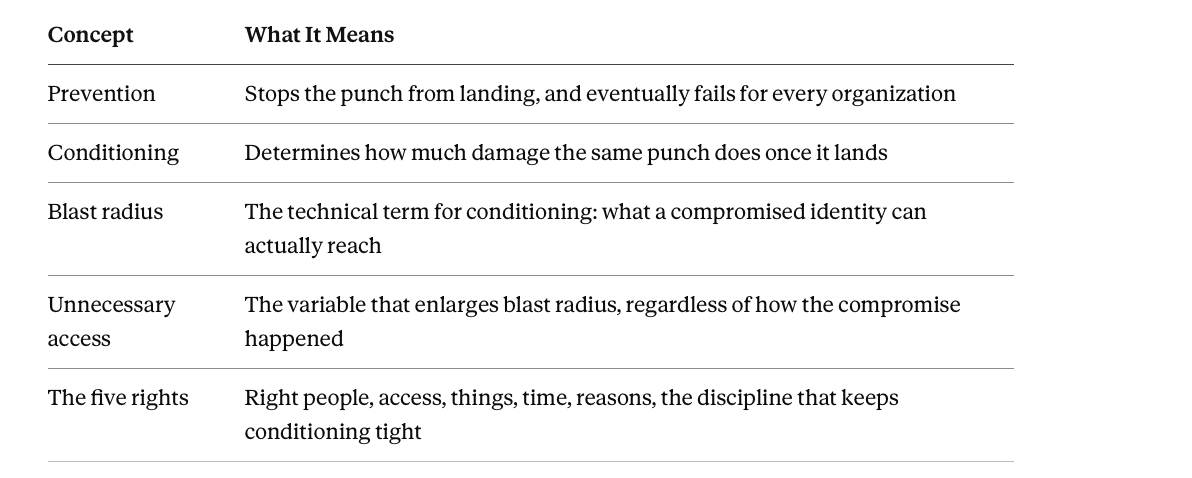
What Actually Separates Experienced Security Teams From the Rest
The security leaders who've genuinely been through a real incident, not read about one, tend to talk about this differently than the budget conversation usually reflects. They don't treat a breach as a 0.1% edge case worth acknowledging and then deprioritizing. They treat it as the eventual, near-certain event that every other control is really just delaying, and they prepare the organization's actual structure, not just its response plan, for the day it happens anyway.
That's not fatalism. It's the same logic an experienced fighter operates on: you don't train exclusively for the fight where you never get hit, because that fight doesn't exist past a certain level of competition. You condition your body for the fight where you do, because that's the fight you're actually going to have, and conditioning happens long before the bell rings.
Preparing seriously for the 0.1% scenario, treated as a certainty on a long enough timeline rather than a footnote, is what separates an organization built to absorb a hit from one that's never had to find out whether it could.
What Determines Whether a Hit Knocks You Down
In the ring, conditioning determines how much a given punch actually costs you. The exact same shot lands differently on a fighter who's spent months building core strength and a tight defensive stance than on one who hasn't. The punch is identical. The damage isn't.
In security, the equivalent isn't a fast cleanup after the fact. It's how much a compromised identity can actually reach at the moment it's compromised, which is entirely a function of how the organization was built beforehand, not how it responds afterward.
A phished credential that unlocks one narrowly scoped application barely registers. The same phished credential, attached to an identity that's accumulated broad access across a dozen systems over years of role changes nobody fully unwound, takes the whole organization down. The attacker did the same thing in both cases. The outcome was decided long before the phishing email was even sent.
This is conditioning, not response. It has to already be true at the moment of impact, because there's no version of "recovering well" that undoes damage that a poorly conditioned access model already made possible in the first place.
Blast Radius Is Conditioning, and Unnecessary Access Is What Enlarges It
Here's the mechanism stated directly, because it's specific and worth naming precisely rather than leaving as a metaphor: conditioning, in security terms, is blast radius, the total scope of what a single compromised identity or account can actually reach. Blast radius is driven by exactly one variable, how much access that identity is carrying that its current role doesn't actually require.
Least privilege is the discipline of keeping that variable as close to zero as possible: an identity holds only the access its current, active responsibilities genuinely justify, nothing left over from a past role, nothing granted broadly because narrowing it felt like unnecessary effort, nothing kept "just in case" it's needed again someday.
Every piece of unnecessary access an identity carries isn't a neutral, unused permission sitting there harmlessly. It's additional surface area available to whoever eventually compromises that identity, whether that's a phished credential, a stolen session token, or a leaked API key. Unnecessary access doesn't make an attack more likely. It makes the attack that eventually happens, and one eventually will, worse than it had to be.
This is why blast radius isn't primarily a detection problem or a monitoring problem. It's an access hygiene problem, decided well before any attacker is involved. An identity carrying exactly what its role requires, and nothing else, is conditioned. An identity carrying five years of accumulated, unreviewed access from every role and project it's ever touched is not, regardless of how good the organization's detection tooling is.
Why Most Organizations Aren't Actually Conditioned
Access accumulates quietly over an identity's tenure. Every role change adds new access reliably, since granting is obvious and immediate. It rarely removes the old access with the same reliability, since nothing about a role change inherently signals that prior access should go, and removal typically requires an explicit, separately configured step most workflows don't include by default. Years of this produces an identity whose real access footprint is the union of every role, project, and exception it's ever touched, none of it trimmed back down to what's currently needed.
An organization in this state isn't unconditioned by accident. It's unconditioned by default, because the ordinary mechanics of granting access reliably and revoking it inconsistently produce exactly this outcome unless something actively works against it on an ongoing basis. The identity that eventually gets phished was never going to be a small, contained problem. It was carrying years of undocumented, unreviewed access the whole time, waiting for the one moment it would matter.
Why Mid-Size Enterprises Feel This Gap Hardest
A mid-size organization carries essentially the same attack surface as a much larger enterprise, real SaaS sprawl, real vendor access, real employee and contractor turnover, without the budget to staff a security operations center running continuous monitoring around the clock. Attackers don't scale down their interest to match company size. The threat is the same. The conditioning usually isn't.
A large enterprise can partially compensate for accumulated access risk with sheer headcount, a bigger team manually reviewing more of the access graph more often. A mid-size organization generally can't out-staff its way to a small blast radius. It has to be built into how access actually works by default, continuously, so conditioning doesn't depend on a large team noticing the accumulation before an attacker finds it first.
What Actual Conditioning Requires
Building an organization that can take a hit without going down comes down to the same principle a fighter's conditioning does: the work happens continuously, well before the moment it's tested, not in reaction to it.
Right people. Access tied to a verified, current identity, not a shared login, not an account nobody remembers creating, not a former contractor's credential still technically active.
Right access. Scoped to what the role actually requires, not what was easiest to grant at the time, not leftover permissions from two roles ago that nobody revoked when the person moved on.
Right things. Specific systems and data, not broad, standing access to entire categories of resources because narrowing scope felt like more configuration work than it was worth.
Right time. Access that exists for as long as the need does and disappears when it doesn't, rather than persisting indefinitely because removal was never built into the process the way granting was.
Right reasons. Justification that's still valid today, not access that was correct when granted and has simply never been revisited since.
Get all five right, continuously, and any single compromised identity is carrying only what its current role genuinely requires, nothing accumulated, nothing forgotten. That's the difference between a hit that barely registers and one that takes the whole organization down.
This Is What Zluri's IGA Is Actually Built to Solve
This is the direct, practical connection worth naming rather than leaving implied: conditioning an organization to absorb a hit isn't a side effect of good identity governance. It's the point.
- Continuous discovery keeps an accurate, current record of every identity and every application, so no account is quietly carrying access nobody's tracking.
- Access reviews, backed by peer comparison and real usage data, catch the accumulated, unjustified access that individual grants looked reasonable enough to approve at the time, trimming every identity back down to what its current role actually needs before anything goes wrong.
- Mover-stage workflows pair every new grant with explicit removal of what the previous role no longer justifies, closing the addition-without-removal gap that produces bloated, poorly conditioned identities by default.
- Just-in-time access and time-bound grants keep temporary need from quietly becoming permanent exposure.
- Segregation-of-duties evaluation runs against an identity's full, current footprint, catching toxic combinations that accumulate piece by piece across years of role changes, long before any single credential becomes the one that gets phished.
None of this stops the punch from landing. That was never the fight this is built to win. What it does is make sure that whichever identity eventually gets hit, and on a long enough timeline, one will, it was never carrying more than its current role justified, so the hit lands, and the organization barely moves.
Frequently Asked Questions
Isn't this just a different way of describing incident response?
No, and the distinction matters. Incident response is what happens after a compromise is detected. This is about the access model already being lean and current before anything happens, so that whichever identity gets compromised was never carrying excess exposure in the first place. Good incident response can't undo damage that a poorly conditioned access model already made possible.
Why does unnecessary access specifically make a breach worse, rather than just being untidy?
Because blast radius is a direct function of what a compromised identity can reach, and unnecessary access is additional surface area available to whoever eventually compromises that identity. It doesn't make the compromise more likely. It makes the compromise that happens anyway reach further than it needed to.
Is this the same thing as least privilege?
Yes, essentially. Least privilege is the operational discipline. Blast radius is the outcome that discipline is minimizing. Conditioning, in the terms this piece uses, is what least privilege enforced continuously actually produces: an identity that can only ever expose as much as its current role genuinely requires.
Can a mid-size organization build this kind of resilience without a large, dedicated security team?
That's specifically the gap continuous, automated identity governance is built to close. Keeping every identity's access trimmed to current need doesn't require a large team manually reviewing constantly if the underlying platform is running that discipline continuously on its own, which is exactly what makes real conditioning achievable without enterprise-scale headcount.

.svg)