A practical buyer's guide to Segregation of Duties software: what to evaluate, common pitfalls, and how the leading vendors compare.
Buying SoD software usually starts after a specific moment of pain: an audit finding, a near-miss fraud case, or the slow realization that nobody can actually say with confidence who holds conflicting access across a 150-app SaaS stack.
In this guide, we'll cover what to evaluate when choosing SoD software, the mistakes worth avoiding, and how the leading platforms compare. If you're new to the underlying concept, our Segregation of Duties guide covers the fundamentals this article assumes.
Why manual SoD reviews stop working
Most organizations start SoD enforcement with a spreadsheet: a matrix of conflicting roles, checked periodically against a manually pulled access report. This works fine at small scale. It breaks down for a specific, predictable reason: access changes continuously, but a spreadsheet only reflects a single moment in time.
The breakdown gets worse as companies add applications. A conflict that spans two different SaaS tools, "create vendor" rights in the ERP and "approve payment" rights in a separate finance system, is invisible to either tool's own admin console, and invisible to a spreadsheet unless someone manually cross-references both systems on a recurring basis. Past a certain number of employees or applications, that manual cross-referencing simply doesn't happen reliably, which is usually the point at which organizations start evaluating dedicated software. For what's actually at stake when that cross-referencing doesn't happen, see our breakdown of Segregation of Duties risks.
For the underlying logic of what a conflict matrix should contain before you even start evaluating tools, see our Segregation of Duties matrix template.
What to evaluate when choosing SoD software
Cross-application detection. The single most important capability, and the one that separates genuine SoD tools from access review tools with SoD marketed as a feature. Ask specifically whether the tool can detect a conflict where each side of the toxic combination lives in a different application.
This matters especially for IT environments, where conflicts often span cloud consoles, identity providers, and CI/CD tools rather than sitting in one system; see our IT Segregation of Duties guide for how these conflicts actually form.
Identity-centric, not account-centric, violation detection. Some tools flag conflicts per account rather than per person. If an employee holds three accounts across different systems, an account-centric tool can miss that the same identity holds conflicting access spread across all three. Identity-centric detection consolidates this into a single violation tied to the person, with every offending account shown as supporting context.
Rule-building flexibility. Can you define conflicts using both specific, named entitlements (exact roles or permissions you select manually) and dynamic criteria (rules that automatically adapt as entitlements change in the source application)? Tools that only support one or the other force a tradeoff between precision and maintainability.
Enforcement options, not just detection. A tool that flags a violation and stops there still leaves the remediation work manual. Look for configurable automated remediation, ideally with more than one enforcement shape: a mode where a human reviews and decides which side of the conflict to revoke, and a mode where the system automatically revokes a pre-defined default side for high-confidence conflicts.
Simulation before enforcement. Turning on automated remediation without first understanding how many violations a new rule will generate is risky. Look for the ability to test a policy against your actual environment, ideally both a quick single-identity check and a full-scope dry run, before anything goes live.
Exemption handling. Legitimate business exceptions happen. The question is whether the tool forces accountability around them: a documented reason, a maximum duration, and automatic re-evaluation once the exemption expires, rather than a permanent bypass nobody revisits.
Audit trail depth. For compliance-driven buyers especially, check whether the tool preserves a full configuration snapshot at every policy version, not just a basic change log. Being able to show an auditor exactly what a policy looked like on a specific past date is a meaningfully stronger evidence trail than a generic "last modified" timestamp.
This is the kind of evidence that strengthens SoD's role as a testable control activity within a broader internal controls framework; see Separation of Duties and internal controls for how the two connect.
Where it lives relative to your broader identity stack. SoD detection that's isolated from your broader identity governance program, provisioning, access reviews, lifecycle management, creates yet another silo. Tools that sit inside a broader IGA platform can share the same entitlement data and remediation playbooks already built for other identity governance work, instead of duplicating that integration effort separately.
Pricing and total cost of ownership
SoD software pricing varies more than the feature comparison alone suggests, and the sticker price on a quote rarely reflects total cost of ownership.
Enterprise IGA suites often price on a per-identity basis with separate implementation fees that can rival or exceed the first year of licensing, particularly when professional services are required. Newer, SaaS-native platforms tend toward simpler per-identity or tiered pricing with implementation handled largely in-house, which shows up as a meaningfully different total cost even when the headline licensing number looks similar.
The cost that's easiest to underestimate is ongoing maintenance: how much internal effort it takes to keep rules current as roles and applications change. A tool with rigid, manually maintained rule sets requires more analyst time than one supporting criteria-based rules that adapt automatically.
When comparing quotes, ask vendors directly what a rule update actually requires. A support ticket, a professional services engagement, or a self-service edit each carries a very different cost over a multi-year period than the initial license fee alone would suggest.
Common mistakes when evaluating SoD software
Confusing access review tools with SoD tools. Many platforms marketed broadly as "access governance" support periodic access certification but lack real two-sided conflict detection. Ask directly and specifically whether the tool can define two rule sets and flag identities holding entitlements from both, not just whether it can generate an access report. Testing this against concrete conflicts, like the ones in our Segregation of Duties policy examples, is a faster way to tell the difference than reading a feature list.
Underestimating rule-building complexity. A tool that only supports simple, static rule lists will struggle with entitlements that change frequently in the source application. Criteria-based rules that auto-adapt matter more than they seem to during a demo, and matter a great deal six months into actual use.
Ignoring how false positives get handled. Every SoD tool generates some false positives, especially early on. Ask how the vendor's simulation and validation tooling helps you tune a policy before it starts generating noise that trains your team to ignore alerts.
Treating implementation timeline as an afterthought. Some platforms in this category require lengthy professional-services-led implementations measured in quarters. Others can have core SoD policies live in weeks. This difference matters enormously for how quickly you can close an actual audit finding, and for how well the tool fits into the documented procedure your team already follows for identifying and remediating violations; see Segregation of Duties policy and procedure for what that procedure typically looks like.
Vendor comparison
The table below compares platforms commonly evaluated for SoD, spanning dedicated IGA suites, newer identity security platforms, and specialized access-orchestration tools.
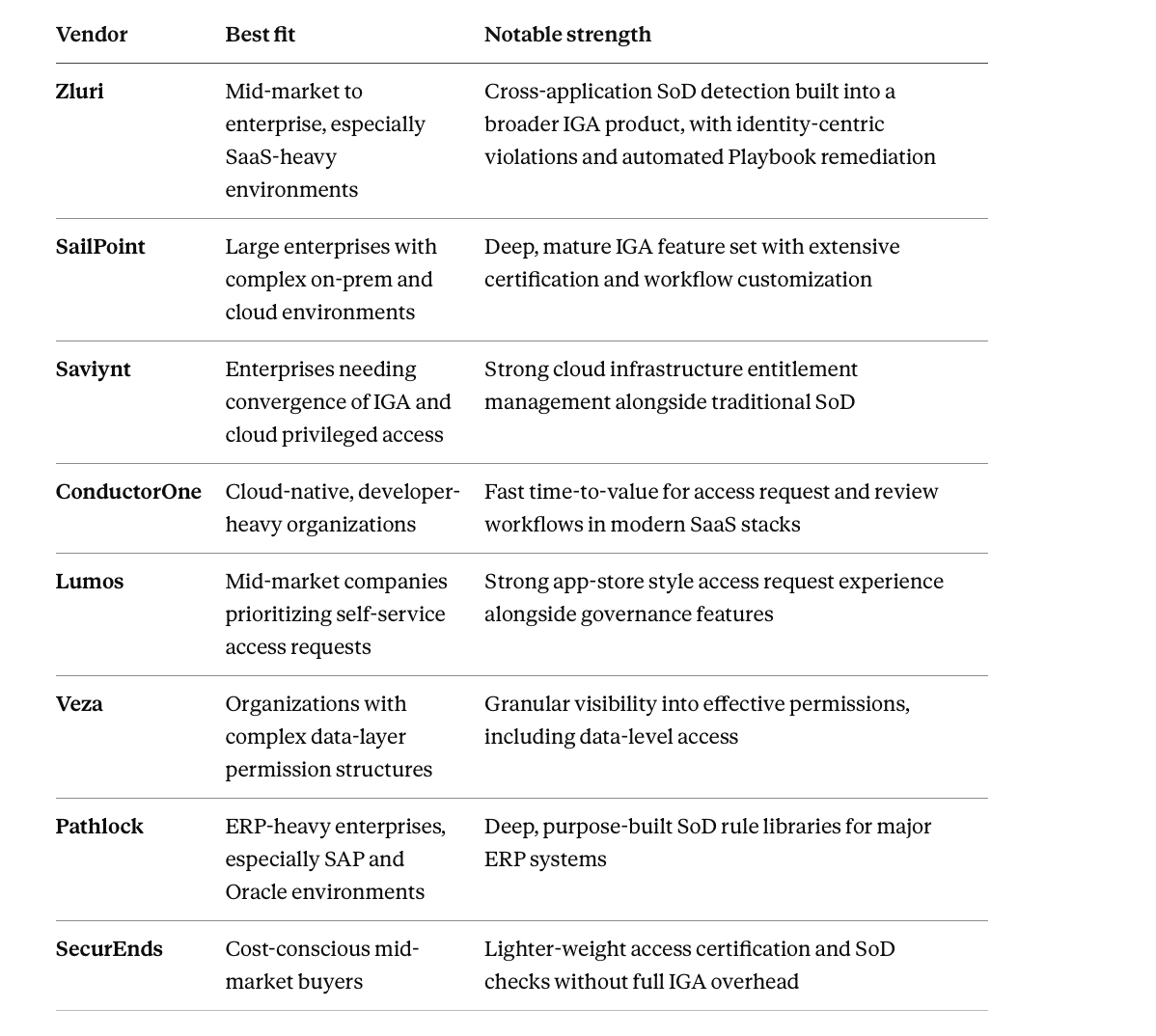
Evaluate any of these against the criteria above rather than the marketing summary alone, since capability depth within each category (rule-building flexibility, cross-application coverage, remediation automation) varies significantly even among vendors that all claim to "do SoD."
How Zluri approaches Segregation of Duties
Zluri, an identity security platform, includes Segregation of Duties as part of its IGA product, alongside Access Management, Access Reviews, and Access Requests. A few specifics worth knowing if you're evaluating it directly.
Two-list rule authoring with dual input modes. Every SoD policy in Zluri defines two entitlement sets, and each set can combine specific, individually selected entitlements with dynamic, criteria-based rules in the same rule set. This means a policy can include both "this exact permission in NetSuite" and "any privileged role in Workday" side by side, without forcing a choice between precision and maintainability.
Cross-application detection as a default, not an add-on. A single Zluri policy can span multiple applications, so a conflict where one side lives in your ERP and the other lives in a separate finance tool still gets caught as one consolidated violation.
Identity-centric violations. Zluri raises violations against the identity, not the account, so one person's conflicting access across multiple accounts produces a single violation with all offending accounts shown as supporting context, rather than fragmenting the same conflict into multiple disconnected findings.
Monitor and Enforce modes. New policies can run in Monitor mode, detecting and logging violations without taking action, the recommended way to validate a rule before turning on automated remediation. Promoting to Enforce mode automatically back-tests existing open violations against the new configuration.
Dual-mode simulation. Before publishing a policy, Quick Validation checks a single identity in seconds, while Full Simulate runs detection across the entire matched scope in the background with CSV export.
Time-bound, reason-mandatory exemptions. Exemptions require both a documented reason and a maximum duration, and Zluri automatically re-opens the violation once that duration expires, so exceptions don't quietly become permanent.
Full version-snapshot audit trail. Every published policy change creates a new version with a complete configuration snapshot, author, timestamp, and a mandatory publish note.
Because SoD sits inside Zluri's broader IGA product rather than as a standalone module, it shares entitlement data and remediation infrastructure with Access Management, Access Reviews, and Access Requests. A conflict identified through SoD can be remediated using the same Playbook infrastructure already built for provisioning and deprovisioning elsewhere in the platform.
Ready to see cross-application SoD detection running against your own SaaS stack? Book a demo with Zluri.
Frequently Asked Questions
What's the difference between SoD software and general access review software? Access review software typically supports periodic certification of who has access to what. Genuine SoD software specifically defines two-sided conflicting entitlement rules and flags identities holding both sides simultaneously, which is a distinct detection capability many access review tools don't fully support.
Can SoD software detect conflicts across different applications? The best SoD tools can, which is one of the most important evaluation criteria. A conflict where one side of the toxic combination lives in one application and the other lives in a separate tool is invisible to single-application admin consoles and to tools that only check access within one connected system at a time.
How long does SoD software typically take to implement? This varies significantly by vendor. Some enterprise IGA suites require lengthy, professional-services-led implementations measured in quarters. Others, particularly newer identity security platforms built for SaaS-first environments, can have core SoD policies live within weeks.
Should SoD software be a standalone tool or part of a broader IGA platform? Both approaches exist in the market. A platform where SoD sits inside a broader IGA product can share entitlement data and remediation workflows already built for provisioning, deprovisioning, and access reviews, which reduces duplicate integration work compared to a fully standalone SoD point solution.
What should I test before turning on automated SoD remediation? Simulate the policy against your actual environment first, ideally both a single-identity validation check and a full-scope dry run, so you understand how many violations a new rule will generate before it starts taking automated action.
How does Zluri handle SoD exemptions? Exemptions in Zluri require a documented reason and a maximum duration at the time they're granted, and the system automatically re-opens the violation once that duration expires, which prevents temporary exceptions from quietly becoming permanent.
Is it worth switching SoD software if we already have a spreadsheet-based process? It depends on scale. A spreadsheet can work reasonably well for a small number of employees and applications with a dedicated owner reviewing it consistently. Past roughly a few dozen employees, or more than a handful of connected applications, the manual cross-referencing required tends to fall behind reality quickly enough that automated detection becomes worth the switch.
Can one SoD tool cover both finance-system conflicts and IT-system conflicts? Yes, provided the tool supports connecting to both types of systems and building rules with entitlement types relevant to each. Some vendors specialize heavily in one domain (ERP-focused SoD rule libraries, for instance) and are weaker in general SaaS and cloud infrastructure coverage, so confirm breadth of application support matches your actual environment before assuming one tool covers everything.



.svg)