.png)




Is a user entitlement review just a more thorough access review? Conceptually, yes, if you're genuinely evaluating whether someone's access is appropriate, you're already asking what that access lets them do. Operationally, no, and the gap between those two answers is what most guides to entitlement review skip entirely.
Two engineers can both hold GitHub access and still be carrying completely different levels of risk:
- One has read access to a handful of repos
- The other has admin rights across the entire org
A review that only checks "does this person have GitHub" sees no difference between them at all. That's the gap entitlement review exists to close, and it's a real one.
What's less settled is whether closing it means adding a step to your existing access review, or running an entirely separate process. The honest answer is both, depending on which entitlement you're looking at.
What Is a User Entitlement Review?
An entitlement isn't the application itself, it's the specific role, permission set, or scope a person holds within it. A user entitlement review, sometimes bundled into a broader access certification cycle, evaluates whether that specific level is still appropriate, separately from whether the underlying access to the app should exist at all.
An access review asks: should this person have this application. An entitlement review asks: should this person hold this specific permission, at this specific level, inside it. The second question is more precise than the first, and it's also considerably more expensive to ask at scale, which is exactly where the practical complications start.
Is Entitlement Review Really Just a Deeper Access Review?
Conceptually, yes. If a manager is genuinely evaluating whether someone's Salesforce access is appropriate, and stops at "yes, they need Salesforce" without asking what their profile actually permits, that manager has only answered half the question. A thorough access review is, in principle, already doing entitlement-level work.
In practice, treating them as one undifferentiated process breaks down fast, for three concrete reasons.
Three Reasons They Diverge in Practice
- The reviewer knowledge gap: managers can confirm someone belongs on a team, not what a specific technical permission actually does
- The data visibility limit: not every system exposes fine-grained roles and permissions, some only confirm an account exists
- The scale math: reviewing every permission individually multiplies fast enough to guarantee rubber-stamping instead of real evaluation
The reviewer knowledge gap. Access reviews are typically performed by line managers, and a manager can reliably answer "does this person still work on the team that needs Salesforce." That same manager usually has no basis for evaluating something like an Apex profile permission that grants Modify All Data rights. Knowing whether someone belongs on a team is a different skill than knowing what a specific permission actually does inside an application's data model. A thorough entitlement decision needs the application or data owner, not the line manager, which means it structurally can't happen at the same review step unless something bridges that expertise gap.
The data visibility limit. An access review only needs to know that an account exists. An entitlement review needs to know what that account can specifically do, and not every system exposes that. Plenty of applications, especially older or less-integrated ones, surface account existence through a directory or SSO connection but never expose the fine-grained roles and permissions underneath. A review can only be as granular as the data feeding it, and for a meaningful share of any organization's application portfolio, that data simply isn't there.
The scale math. Consider a mid-market IT team where a manager used to sign off on twenty application accounts during a standard access review. Push that same manager into a true entitlement-level review, and twenty accounts can easily become four hundred individual permission line items, once you multiply by the specific roles, permission sets, and scopes attached to each app. Nobody reads four hundred line items carefully. The reviewer stops evaluating and starts rubber-stamping, and a review that rubber-stamps everything is worse than no review at all, because it produces a signed-off audit trail that isn't actually true.
None of these three constraints means entitlement review is a bad idea. They mean that running it as a literal line-by-line extension of every access review collapses under its own weight before it produces any real security value.
What Counts as an Entitlement
Before reviewing any of this, it helps to know what "entitlement" actually covers, since it's more than a single permission checkbox.
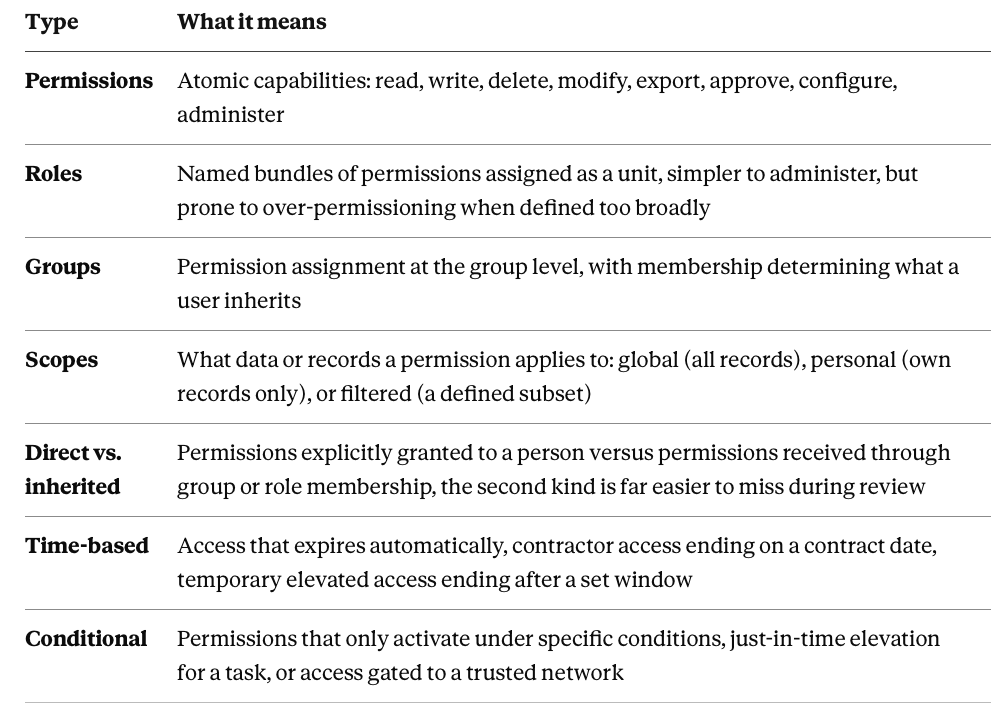
Inherited entitlements deserve particular attention here. A person can show standard permissions on their direct profile while holding admin-level access through a group they were added to months ago for an unrelated reason. A review that only checks direct assignments will certify that account as appropriate while missing the actual effective permission entirely.
Making Bundled Review Actually Hold Up: Attribute-Based Access
The reviewer knowledge gap and the scale math both point toward the same resolution: stop asking a line manager to evaluate individual technical entitlements, and have someone with real application expertise define what a role should grant instead. But a role only works as a shortcut if it stays both precise, so approving it genuinely means approving the right permissions, and small in number, so someone can actually keep every role current. Those two requirements pull against each other, and that tension is exactly what attribute-based access control resolves.
A static, named role like "Sales Rep, North America, Standard" tries to capture every dimension of variation, region, seniority, data sensitivity, employment type, inside the role name itself. Every new dimension needs its own role to stay accurate, which is how a handful of roles turns into dozens, then hundreds, a well-documented failure mode usually called role explosion. A role bundle nobody can keep current is exactly as dangerous as the individual entitlement it replaced, except now it's silently wrong for every person assigned to it at once.
Attribute-based access control avoids that multiplication by computing the differentiation instead of naming it. A role like "Sales Rep" stays a single, coarse, stable definition, and an attribute layer, region, employment type, data sensitivity tier, determines what that role actually grants for each specific person. The role name is what a reviewer approves. The attributes are what do the precision work behind it, without requiring a new named role for every combination those attributes could produce.
Reviewing a bundled role only means something if attributes are doing the differentiation behind it. A role name with no attribute layer underneath it is just a bigger, harder-to-audit version of the individual entitlement problem it was meant to solve.
How Each Type of Review Performs for Entitlements
Application-based, group-based, and user-based reviews all exist as ways to scope an access review, and they don't perform equally once the question shifts from "does this person have the app" to "what can they actually do inside it."
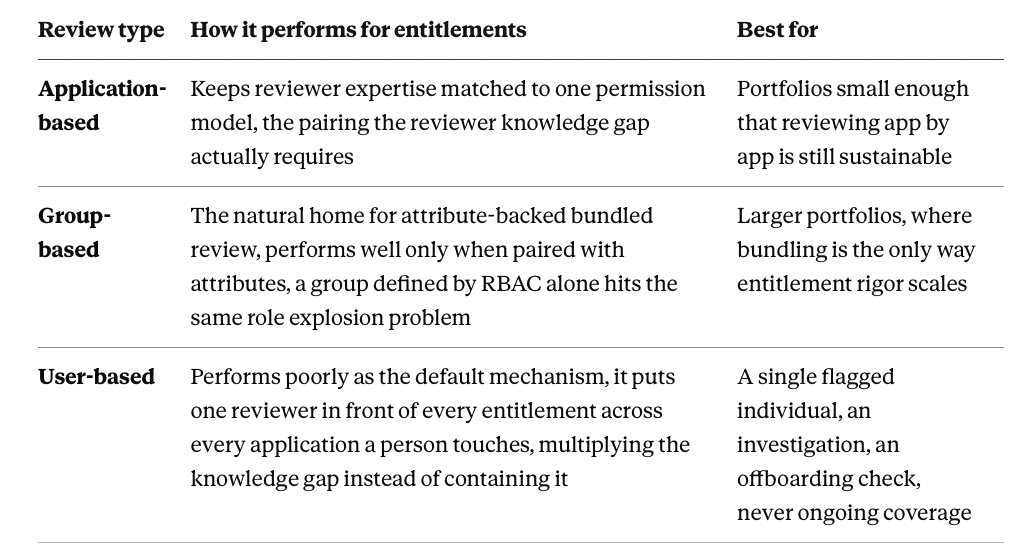
Application-based review is where reviewer expertise and entitlement depth line up most naturally. An app owner who actually understands Salesforce's permission model is the right person to evaluate Salesforce entitlements, and that pairing holds regardless of scale. What stops scaling is the number of applications one reviewer population can cover this way, not the quality of the review itself.
Group-based review is where the attribute-backed bundling above actually lives. Reviewing a group's definition, and confirming someone's membership in it is correct, validates every entitlement the group grants, provided attributes are doing the differentiation inside that group rather than a sprawling set of near-duplicate groups trying to do it through naming alone. Group-based review without an attribute layer underneath it just relocates role explosion into group sprawlinstead of solving it.
User-based review is the one most often reached for by instinct, since "look at everything this person has" sounds like the most thorough option, and it's the one that performs worst for routine entitlement coverage. It reverses the pairing that makes entitlement review work at all: instead of one reviewer per application who knows that application, it puts a single reviewer in front of unfamiliar entitlements across every application the person touches. It's the right tool for a specific, bounded question about a specific person, not the default for ongoing entitlement governance across a population.
What This Looks Like in Practice
The honest picture has three columns, not two, because the actual answer most organizations land on is a compromise between the standard and the deep version.
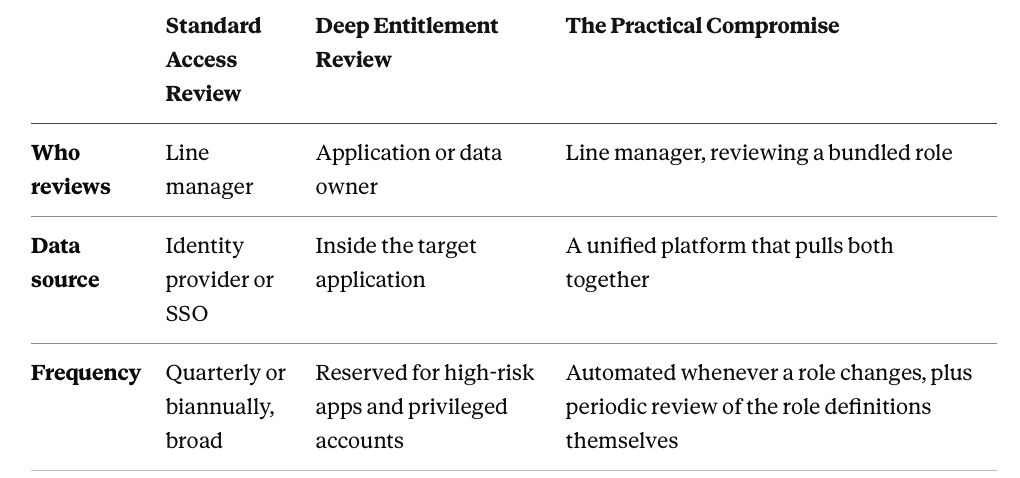
The middle column doesn't disappear in this arrangement, it moves upstream. Someone with real application expertise still has to build and maintain the role bundles correctly, or the "single click validates everything underneath it" promise falls apart. What changes is that expertise gets spent once per role definition instead of once per person per review cycle, which is the entire reason this scales.
Why "Keep or Remove" Is Still the Wrong Frame for What's Left
Role bundling absorbs the bulk of routine entitlement questions, but it deliberately doesn't cover everything. Privileged access, exceptions to a defined baseline, and anything that doesn't cleanly fit an existing role still need individual review, and for that remaining slice, the same binary trap that limits access review shows up again.
A binary keep-or-remove decision forces a reviewer into a bad choice whenever the honest answer sits in between. Either they approve an excessive entitlement because pulling it entirely would break someone's legitimate work, or they revoke access the person genuinely needs because the level, not the access itself, was the actual problem. For the individually reviewed exceptions, the decision set needs a real middle option: keep the access, change the level. That's what turns an entitlement review into something that reflects how access problems actually show up, rather than a formality that only ever produces two possible outcomes.
When Individual Entitlement Review Still Earns Its Overhead
Not every entitlement needs this level of individual scrutiny, and knowing where to spend it matters as much as knowing how.
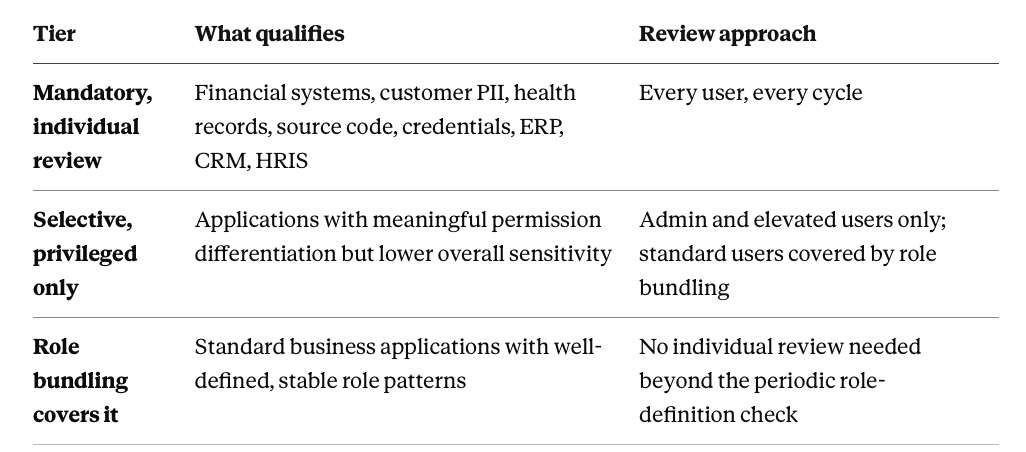
A useful rule of thumb: individual, line-by-line entitlement review typically belongs on a small minority of an application portfolio, the systems with the highest concentration of sensitive data and the broadest permission models, plus any privileged or admin-level access regardless of which application it sits in. Everywhere else, a well-maintained role bundle is doing the same job at a fraction of the reviewer cost.
Running It: Baselines and Exceptions
For the tier that does need individual review, reviewing every permission from scratch every cycle still doesn't scale. The practical method is reviewing deviations from a defined baseline instead.
Document what a role's permissions, profile, and scope should look like under normal circumstances, then flag anyone whose actual entitlements exceed it. Someone holding exactly their baseline doesn't need re-evaluation. Someone holding a permission beyond it does, and that's where reviewer attention should concentrate:
- Why does this person need it
- Is the need temporary or ongoing
- Could the same work happen at the baseline level instead
- If the exception is approved, what compensating control offsets the added risk
Every approved exception needs a documented reason and an expiration to revisit. An exception without one is indistinguishable from an oversight the next time someone audits it.
Frequently Asked Questions
Is a user entitlement review just a more thorough version of a user access review?
Conceptually yes, operationally no. Genuinely evaluating whether access is appropriate means asking what that access permits, which is entitlement-level work. But reviewer expertise, data visibility, and reviewer scale all break down if you try to run every access review at full entitlement depth. Mature programs handle this by bundling entitlements into reviewable roles rather than merging the two processes outright.
Why can't the same line manager who does access reviews also review entitlements?
Because knowing someone belongs on a team and knowing what a specific technical permission does inside an application are different kinds of knowledge. A manager can reliably confirm someone still needs Salesforce. That same manager usually can't evaluate whether a specific permission set grants excessive database export rights. That evaluation belongs with the application or data owner, which is exactly the expertise that gets captured once, upfront, when a role bundle is defined.
How does bundling entitlements into a role actually solve the scale problem?
By moving the expensive, expert-level evaluation to when a role is defined rather than to every individual review. A manager approving that role during a routine access review is implicitly validating everything configured inside it. That only holds up if the role stays precise and the number of roles stays maintainable, which is why the role needs an attribute layer behind it rather than standing on its own.
Doesn't bundling entitlements into roles just cause role explosion?
It does, if a static, named role is the only mechanism doing the work. Every real dimension of variation, region, seniority, data sensitivity, employment type, needs its own named role to stay accurate, and that multiplies fast enough to become unmaintainable. Attribute-based access control avoids this by computing that differentiation instead of naming it: a role stays coarse and stable, and an attribute layer adjusts what it actually grants per person, without spawning a new role for every combination.
Which type of review, application-based, group-based, or user-based, performs best for entitlements?
It depends on portfolio size, not preference. Application-based review keeps reviewer expertise matched to one permission model, which works well until the portfolio gets too large for that to scale. Group-based review, paired with an attribute layer, is the natural way entitlement rigor scales past that point, a group defined by naming alone runs into the same role explosion problem. User-based review, starting from one person and reviewing everything they touch, is genuinely useful but only for a specific, event-driven case, an investigation or an offboarding check, not as the default mechanism for ongoing coverage, since it puts a single reviewer in front of every application's entitlements at once.
Does every application need entitlement-level review?
No. A small minority of the application portfolio, systems holding sensitive financial, health, or credential data, plus any privileged or admin-level access, genuinely warrants individual entitlement review. Everywhere else, a well-maintained role bundle covers the same ground without the reviewer overhead.
What's the right frequency for entitlement review?
It depends on what's being reviewed. Role-bundled, standard access can be validated automatically whenever a role changes, with periodic review of the role definitions themselves. The smaller set of individually reviewed exceptions and privileged entitlements warrants a fixed cadence, monthly or quarterly for the highest-risk items, tied to how much damage a wrong answer could actually cause.
What happens to entitlements that don't fit an existing role bundle?
They become individually reviewed exceptions. The review should ask why the person needs something beyond the standard baseline, whether the need is temporary or ongoing, and what compensating control applies if the exception is approved. Documenting the reason and an expiration date is what keeps an exception from quietly becoming a permanent, unexamined grant.